Independent buying guides for home air, water and safety.
As an Amazon Associate, Delozone earns from qualifying purchases.
Independent buying guides for home air, water and safety.
As an Amazon Associate, Delozone earns from qualifying purchases.

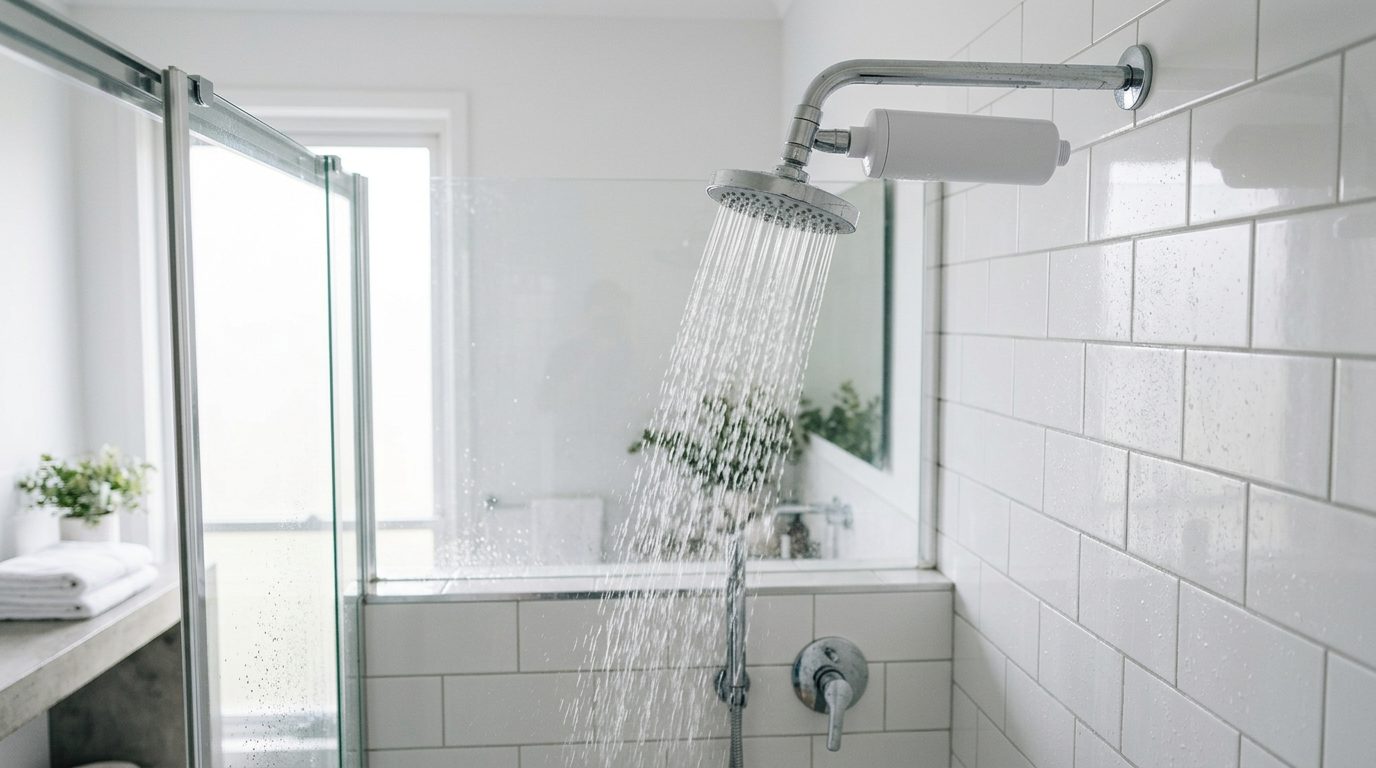
The best shower filters of 2026: NSF/ANSI 177 certified picks for chlorine, honest advice on chloramine and hard water, cartridge life and installation tips.

The best shower filter is one that is certified to NSF/ANSI 177 for free chlorine reduction, matches the disinfectant your water utility actually uses, and has a cartridge you will replace on schedule, and for most homes our top pick is the Sprite HO2, a high output inline filter certified to NSF/ANSI 177 with a cartridge rated for 12 months or 25,000 gallons. If you want a two-stage inline filter with a clear housing, the Weddell Duo lists NSF certified chlorine reduction and a 2.8 gallon per minute flow rate, and if you would rather replace your showerhead in one step, the Aquasana AQ-4100 pairs carbon and copper-zinc media with a three-setting head.
Before you buy, check one thing: whether your city uses chlorine or chloramine. NSF/ANSI 177 covers free chlorine only, and most shower filters do little against chloramine. A shower filter also does not soften hard water. If scale and soap scum are your real problem, a water softener is the tool for the job, and we explain how to tell the difference below.
Top picks at a glance
Affiliate links: As an Amazon Associate, Delozone earns from qualifying purchases, at no extra cost to you. Full disclosure
Key takeaways
Quick comparison: best shower filters for 2026
| Model | Type | Certification (maker) | Rated life | Best for | Buy |
|---|---|---|---|---|---|
| Sprite HO2 | Inline filter with massage head | NSF/ANSI 177 | 12 months or 25,000 gal | Longest cartridge life | Check price |
| Weddell Duo | Two-cartridge inline filter | NSF certified chlorine reduction | Up to 8,000 gal | Clear housing, high flow | Check price |
| Aquasana AQ-4100 | Filtered showerhead | Tested to NSF-177 standards | 6 months or 10,000 gal | One-piece head and filter | Check price |
| AquaBliss SF100 | Inline multi-stage filter | UL external testing (cartridge listing) | 3 to 6 months | Value, any showerhead | Check price |
| Jolie Filtered Showerhead | Filtered showerhead | Maker cites third-party lab tests | See maker schedule | Design and spray feel | Check price |
| Sprite Slim-Line 2 | Low-profile inline filter | NSF/ANSI 177 | 6 months or 10,000 gal | Short shower arms | Check price |
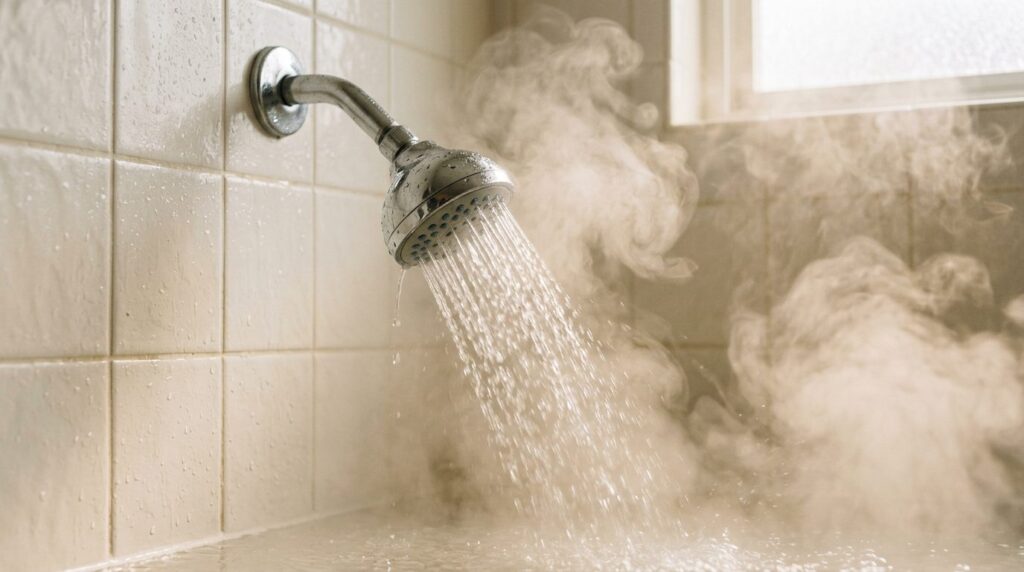
Your water utility adds a disinfectant on purpose. The CDC’s page on water disinfection explains that utilities add chlorine or chloramine so that low levels keep killing germs as water travels through miles of pipe to your tap. US utilities first used chlorine in 1908 and chloramine in 1929.
The CDC states that chlorine or chloramine levels up to 4 milligrams per liter, or 4 parts per million, are considered safe in drinking water. That matters for how you think about a shower filter. It is not a safety device that makes dangerous water safe. It is a comfort device that reduces the smell and the drying feel that many people notice from chlorinated water.
The CDC also notes that chlorinated water can taste and smell different from untreated water, and that taste and smell problems grow when chlorine levels are higher. Hot water releases more of that smell in an enclosed bathroom, which is one reason people who never notice chlorine in a glass of water do notice it in the shower.
Chloramines form when a utility adds ammonia to chlorine. According to the EPA’s chloramines page, they provide longer-lasting disinfection as water moves through pipes, and more than one in five Americans uses drinking water treated with chloramines. Some utilities switched to chloramine to meet disinfection byproduct rules.
The CDC adds that chlorine gets used up quickly in water, while chloramine keeps working longer in the pipes and forms fewer disinfection byproducts. Some utilities switch back and forth between the two during the year, often moving to chlorine for a few weeks to clear biofilm from the pipes. Your water can change disinfectant without you noticing anything except a different smell.
This difference is the single most important fact when you shop. Chloramine is more stable than free chlorine, and the CDC points out that you can remove chlorine from water by letting it sit for a few days but you cannot remove chloramine that way. Most shower filter media are designed and certified around free chlorine. If your city uses chloramine, expect a much smaller effect from almost any shower filter.
NSF/ANSI 177, Shower Filtration Systems, Aesthetic Effects, is the national standard written for shower filters. A Plumbing and Mechanical overview of NSF/ANSI 177 lists what it covers: material safety, structural integrity, minimum flow rate, free available chlorine reduction and product literature.
For the chlorine claim, the test water holds 2.0 mg/L of free available chlorine plus or minus 0.2, at about 104 degrees F, with total chloramines below 0.1 mg/L. A filter must reduce that challenge by at least 50%. The flow rate must be at least 1 gallon per minute at an initial dynamic pressure of 80 psi, and the test stops if flow drops below that point. Systems run 15 minutes on and 15 minutes off for 16 hours, then rest for 8 hours, with samples taken across the claimed capacity.
“Shower filters are not considered drinking water treatment units.”
Plumbing and Mechanical, NSF/ANSI Standard 177 overview
Two practical points follow. First, 50% is a floor, not a typical result, so makers often publish higher figures from their own data. Second, the test deliberately keeps chloramine out of the challenge water. A filter certified to NSF/ANSI 177 has shown that it reduces free chlorine in warm water; it has not shown anything about chloramine, hardness, lead or other contaminants.
A shower filter will not soften hard water. The USGS Water Science School defines hardness as dissolved calcium and magnesium, and classes water from 0 to 60 mg/L as calcium carbonate as soft, 61 to 120 mg/L as moderately hard, 121 to 180 mg/L as hard and more than 180 mg/L as very hard. Removing those minerals takes ion exchange, which a small cartridge cannot do for long at shower flow rates.
Some listings say a filter “helps control scale” or works for hard water. Treat that as a claim about the media’s effect on how deposits form, not as softening. If you see white crust on glass doors, spots on fixtures and soap that will not lather, our guide to the best water filter for hard water explains the options that actually change hardness.
A shower filter is also not a fix for a health contaminant in your water. If your report shows lead, PFAS, nitrate or bacteria above a limit, the right response is drinking water treatment at the tap or whole-house treatment, plus a conversation with your utility. Our guides to the best under sink water filter and whole house water filter systems cover those choices.
An inline filter screws onto the shower arm, and your existing showerhead screws onto the filter. It is the most flexible design because you keep the head you already like, whether that is a rain head, a fixed head or a handheld on a hose. Three of our six picks work this way.
The trade-off is length. An inline housing pushes the showerhead out and down by a few inches. The Sprite Slim-Line 2 adds about 1.5 inches, the AquaBliss SF100 about 3 to 4 inches and the Sprite HO2 about 4 inches, according to their listings. In a shower with a low arm, that can matter for tall users.
Inline filters also put the cartridge in plain sight, which makes swaps simple. Most open by hand without tools. Check whether the cartridge is sold separately and in stock before you buy the housing, because you will buy cartridges for years and the housing only once.
A filtered showerhead puts the cartridge inside or behind the head itself. You remove your old head and install one unit. The Aquasana AQ-4100 and the Jolie Filtered Showerhead are examples. The result looks cleaner, with no extra cylinder on the arm.
The downside is that you are also choosing a showerhead. If you dislike the spray pattern, you have to replace the whole unit or live with it. Filtered heads also tie you to one brand’s cartridges, and some makers void the head warranty if you use non-genuine cartridges, so read the terms first.
Flow rate is part of this choice. The Jolie lists 1.8 gallons per minute and the Aquasana lists a maximum of 2.5 gallons per minute. A lower flow rate saves water and hot water energy, but it can feel weaker in homes with low pressure. We cover pressure in more detail further down.
Handheld filtered wands put the cartridge in the handle. They suit people who rinse children, pets or the tub, and they can be a good fit for renters who already have a handheld on a hose. The filter capacity in a slim handle is usually smaller than in a large inline housing, so expect more frequent changes.
Bath filters are a separate category. They fit the tub spout and filter water as the tub fills, which is useful for families who bathe young children rather than shower them. They face the same chloramine limit as shower filters, so the utility check still comes first.
If you only want one device, an inline filter on the shower arm combined with a handheld head gives you both uses. That is the setup we would choose for a family bathroom with a tub and shower combination.
A whole-house carbon system treats every tap, including every shower, the washing machine and the kitchen. It uses much larger media beds than any shower filter, so it can work on chlorine and, with the right catalytic carbon, on chloramine. It is a plumbing project and costs far more than a shower filter.
It makes sense for homes with several bathrooms, for people who want chloramine reduction that a small cartridge cannot deliver, or for owners already planning plumbing work. Pairing it with a softener on very hard water is common.
For one bathroom, a shower filter is the faster and cheaper option. For three bathrooms and a chloramine utility, a whole-house system usually ends up making more sense than buying and maintaining three shower filters that each do less.
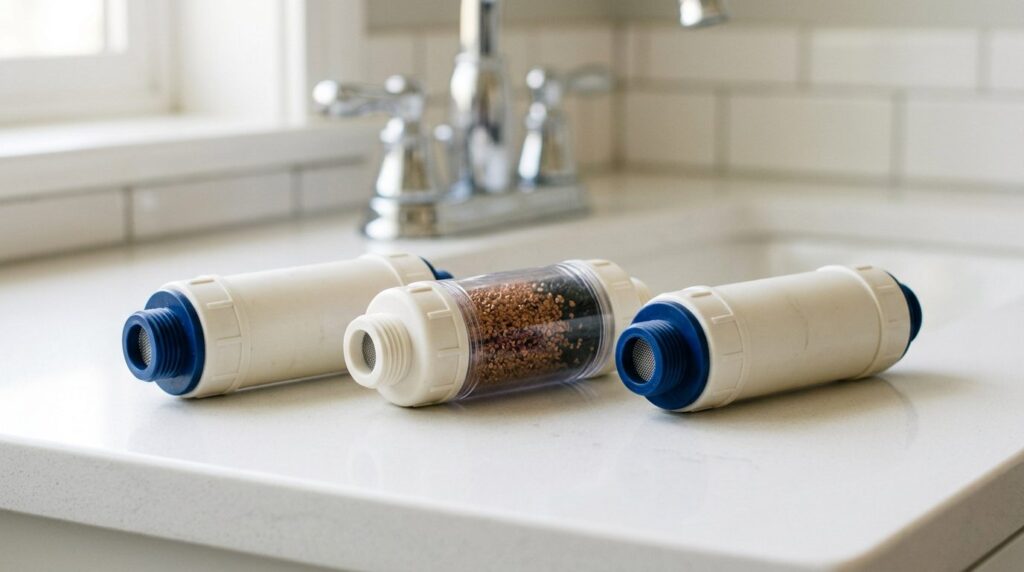
KDF-55 is a granular blend of copper and zinc. Makers describe it as working through a redox reaction that converts free chlorine into chloride. Several of our picks use it, including the Aquasana AQ-4100, which describes “patented copper-zinc media” alongside coconut shell carbon, and the Jolie, which lists a blend of KDF-55 and calcium sulfite.
KDF media is popular in showers because it handles warm water better than plain carbon and does not break down quickly. Makers also say it limits bacterial growth inside the cartridge. We did not find a primary source that quantifies its hot shower performance on its own, so we judge KDF products by their full-system claims rather than the media name.
On its own, KDF does little for chloramine. That is a common gap in marketing copy, where “removes chlorine” turns into “removes chlorine and chloramine” without data. Look for the exact claim on the product’s certification or data sheet.
Activated carbon is the standard media in drinking water filters and handles chlorine taste and odor well in cold water with enough contact time. In a shower, the water is hot and moves fast, often more than 2 gallons per minute, so a small carbon bed has very little time to work.
That is why most shower filters use carbon as one stage among several rather than the only stage. The Aquasana AQ-4100 lists coconut shell carbon plus copper-zinc media, and the AquaBliss SF100 cartridge lists activated carbon with calcium sulfite and redox media.
Carbon can also release fine black particles on first use. Aquasana’s listing tells owners to run water after installing to clear carbon fines. If you see grey specks in the first minute, that is normal; if they continue after the flush, check the cartridge seating.
Calcium sulfite reacts quickly with free chlorine, including in hot water, which makes it a common shower filter media. Sprite uses its own non-carbon media called Chlorgon. On its shower filter page, Sprite says Chlorgon removes free chlorine, combined chlorine in the form of sodium hypochlorite, hydrogen sulfide, iron oxide, dirt, sediment and odors, and that it is pH balanced.
Sprite also says most of its products are certified to NSF/ANSI Standard 177 through IAPMO, and warns that a vague “certified filtration media” claim can mean only one ingredient in a multi-stage filter was tested. That is a fair warning for the whole category, and it is the reason we give more weight to whole-system certification.
The rotten egg smell of hydrogen sulfide is more common on well water. If that is your main complaint, a Sprite filter may help in the shower, but a well that smells of sulfur usually needs treatment at the point of entry so the smell is gone from every tap.
Vitamin C, or ascorbic acid, reacts with both chlorine and chloramine. It is used in cartridges and in dissolving tablets, and it is the one media type most often marketed for chloramine. The AquaBliss SF100 cartridge listing says its vitamin C media “helps to reduce chloramine at lower levels for a short period”, which is a more careful claim than many competitors make.
The catch is capacity. Vitamin C is consumed as it reacts, so a small amount in a cartridge cannot keep up for months at shower flow rates. Expect shorter real-world life if your water carries chloramine, and replace cartridges at the early end of the maker’s range.
Vitamin C is not part of NSF/ANSI 177, which tests free chlorine only. If chloramine reduction is your goal, ask the maker for test data at a flow rate and temperature close to your own shower, and treat any claim without numbers as marketing.
Many low-cost filters advertise 15, 20 or even 36 stages. A “stage” in these listings is usually a layer of a different material in one small cartridge, such as ceramic balls, mineral stones or vitamin beads. More layers do not mean more filtration if each layer is thin and the water passes through in a fraction of a second.
Sprite’s point about tested media versus tested systems applies here. A filter can list a certified ingredient while the complete unit has never been tested to a standard. We prefer filters where the whole system holds an NSF/ANSI 177 certification or where the maker publishes full-system data.
When you compare listings, ignore the stage count and look for three facts: the standard the full system is certified to, the rated gallons, and the flow rate the rating applies to. A filter that will not state those three facts is hard to judge.
If you get water from a public system, your utility publishes an annual Consumer Confidence Report. The EPA’s Consumer Confidence Report page explains how to find yours. The CDC recommends checking it to see whether there is a disinfectant in your water, which kind your utility uses, and the levels of disinfectant and disinfection byproducts.
Look for the words “chloramine”, “monochloramine” or “total chlorine” in the disinfectant section. If the report says chlorine or free chlorine, an NSF/ANSI 177 filter is a good match. If it says chloramine, adjust your expectations and read the chloramine section below.
The same report usually lists hardness, sometimes in grains per gallon and sometimes in mg/L. If your number is listed in mg/L and is above 120 mg/L, hard water is likely part of what you feel in the shower, and a filter alone will not solve it. For a deeper look at testing, see our guide on how to test your home water quality.
This is where shower filters work best. Free chlorine reacts readily with KDF, calcium sulfite and Chlorgon, and certified filters have shown at least a 50% reduction under warm-water test conditions. Most owners notice the change as less smell in the bathroom.
Pick by cartridge life and fit. If you want to change cartridges once a year, the Sprite HO2 is rated for 12 months or 25,000 gallons. If your shower arm is short, the Sprite Slim-Line 2 adds only about 1.5 inches. If you want a new head anyway, the Aquasana AQ-4100 combines both.
Remember that some utilities switch to chlorine for a few weeks each year to clean the pipes. If you notice a strong chlorine smell for a short period, check your utility’s announcements before assuming your filter has failed.
Chloramine is the hard case. Standard shower filter media are slow to react with it, and NSF/ANSI 177 does not test it. The EPA states that water containing chloramines that meets its standards is safe for drinking, cooking and bathing, so this is a comfort question, not a safety one.
If you still want a shower filter, a vitamin C based option such as the AquaBliss SF100, with its stated reduction of chloramine at lower levels for a short period, is the honest choice, with frequent cartridge changes. A dissolving vitamin C filter or a whole-house catalytic carbon system will do more.
The CDC notes that chloramine can change water chemistry in ways that affect lead and copper pipes. If you live in an older home in a chloramine area, a lead test at the kitchen tap matters more than any shower filter.
Hard water causes the white crust on fixtures, soap that does not lather and a film on skin after washing. The USGS notes that soap reacts with calcium in hard water to form soap scum and that more soap is needed to get hands, hair and laundry clean. A shower filter does not change that chemistry in any lasting way.
If your water is hard and chlorinated, a shower filter can still help with the chlorine smell while a softener deals with the minerals. On a well, our guide to the best water softener for well water covers iron-tolerant systems.
Hard water also clogs showerheads, including filtered ones. Plan to soak the head in white vinegar every few months. The USGS mentions vinegar for the same reason with coffee makers: its acidity helps dissolve mineral deposits.
Many private wells have no disinfectant at all, so a chlorine filter has nothing to remove. The CDC notes that some utilities using groundwater do not add a disinfectant when testing shows it is not needed, and the same is often true of household wells unless the owner has installed a chlorinator.
The common shower complaints on wells are sulfur smell, iron staining and hardness. A Chlorgon filter lists hydrogen sulfide and iron oxide reduction, which may help at low levels in the shower. Higher levels call for treatment where the water enters the house.
Test your well before buying anything. A basic panel for hardness, iron, manganese, sulfur and bacteria will tell you whether a shower filter, a softener or an iron filter is the right first step.
Inline filters and filtered heads are renter friendly. They thread onto the standard half-inch shower arm, need no tools beyond thread seal tape, and come off when you move. Keep the original showerhead in a drawer so you can reinstall it on move-out day.
If your landlord does not allow any changes, a handheld wand on an existing hose is the least visible option. Our guide to the best water filters for apartments and renters covers drinking water options that also need no plumbing.
In a small bathroom with poor ventilation, warm water releases chlorine smell into a closed space, so renters in older buildings often notice the biggest difference after installing a filter.
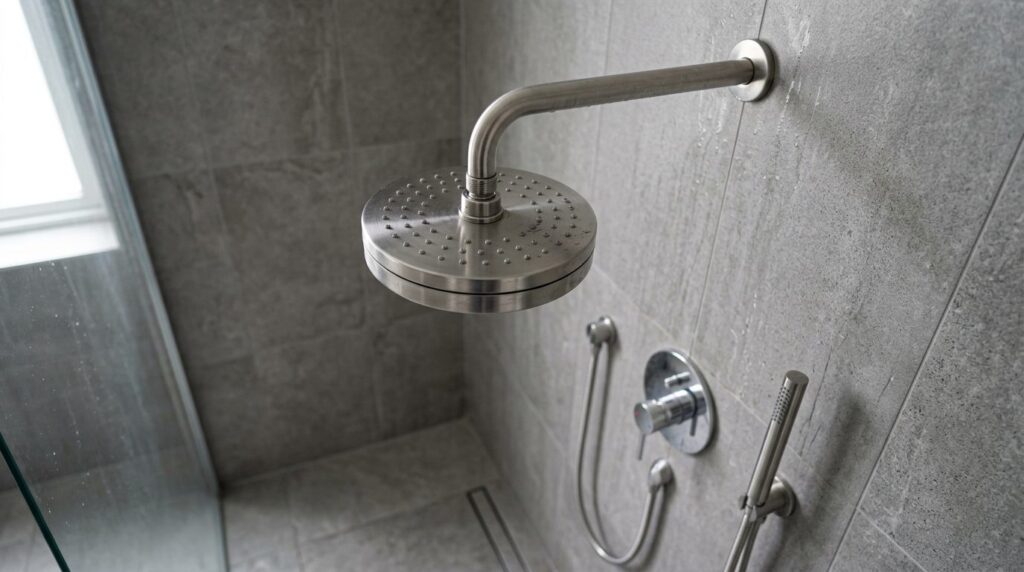
All 6 picks were in stock on Amazon with a working buy box when we checked in October 2026, and each comes from an established filter brand with replacement cartridges available. We ranked them on certification scope, media, rated life, fit and the pattern of verified owner feedback. Four list a certification or test claim tied to NSF/ANSI 177.
We left out many high-stage-count filters with no full-system certification, and we did not include products that only claim certified media. Where a maker’s claim goes beyond its certification, we say so in the pick.
The Sprite HO2 is a high output inline filter with Sprite’s Chlorgon media, and its listing states that it is certified to NSF/ANSI Standard 177. It comes with a replaceable HOC cartridge rated for 12 months or 25,000 gallons, whichever comes first, which is the longest rated life among our picks.
It fits most half-inch NPT shower arms and includes a 3-setting massage head, so you can use it as a complete unit or attach your own showerhead. The housing extends the head by about 4 inches, which is the main thing to check in a low shower. Sprite backs it with a one-year warranty with proof of purchase.
Chlorgon is a non-carbon media, and Sprite says it reduces free chlorine as well as hydrogen sulfide, iron oxide, sediment and odors. Like every NSF/ANSI 177 product, its certified claim is free chlorine reduction, not chloramine. For homes on chlorinated city water, it is the simplest long-life option.
Check Sprite HO2 price on Amazon
The Weddell Duo uses two cartridges in a clear case that sits between the shower arm and your showerhead. Its listing states NSF certified chlorine reduction and a lead-free build, and lists up to 99% chlorine reduction for 8,000 gallons. The clear housing lets you see the condition of the cartridges, and they swap with a twist.
The listing gives a flow rate of 2.8 gallons per minute and a temperature range of 34 to 120 degrees F. Weddell says it works with fixed, rain and handheld heads and installs without tools, with thread seal tape included. The model number is WD-100BL and the case is made of ABS plastic.
Weddell also says an accredited third-party lab verified reduction of PFAS and particulates, and notes that this is not part of its NSF certification. We treat that as a maker claim and recommend the Duo for chlorine. Shower filters are not drinking water treatment, so PFAS in your water is a job for a certified drinking water filter.
Check Weddell Duo price on Amazon
The Aquasana AQ-4100 is a showerhead and filter in one unit. Aquasana says it is tested to NSF-177 standards and uses coconut shell carbon plus patented copper-zinc media to reduce more than 90% of chlorine. The filter is rated for 6 months or 10,000 gallons.
The listing gives a maximum flow rate of 2.5 gallons per minute, an operating pressure range of 30 to 80 psi and a temperature range of 40 to 115 degrees F. The head has 3 settings and fits standard half-inch shower arms. Aquasana says installation takes 4 steps and recommends running water after setup to clear carbon fines.
The AQ-4100 is a good choice if your current showerhead is old or clogged and you want one tidy unit. The one-year limited warranty is shorter than some competitors, and you will need Aquasana cartridges, so check that the replacements are in stock when you buy.
Check Aquasana AQ-4100 price on Amazon
The AquaBliss SF100 Daily Revitalize is one of the most reviewed shower filters on Amazon, with close to 70,000 ratings on its listing when we checked. It is an inline filter that works with fixed, rain, handheld and combination heads, and AquaBliss says it installs in under two minutes with no tools.
Its SFC100 cartridge combines calcium sulfite, redox media and activated carbon, and the cartridge listing names UL as its external testing certification. AquaBliss rates the cartridge for 3 to 6 months depending on water quality and says it reduces chlorine, sediment and organic impurities. The housing adds about 3 to 4 inches to the shower arm.
Its claim about chloramine is unusually careful: the vitamin C media “helps to reduce chloramine at lower levels for a short period”. That makes it a sensible low-cost option for chloramine areas, as long as you change the cartridge at the 3-month end of the range. AquaBliss also suggests replacing it sooner if lather feels flatter or the chlorine smell returns.
Check AquaBliss SF100 price on Amazon
The Jolie Filtered Showerhead is a large round head with the filter built in. Jolie lists a blend of KDF-55 and calcium sulfite, a flow rate of 1.8 gallons per minute and 5 spray settings, and says the filter changes in under 20 seconds. It is designed for standard US half-inch NPT shower arms and may not fit custom plumbing.
Jolie says its filter was tested in multiple third-party labs and “far exceeds NSF-177 certifications”. That wording describes performance compared with the standard. It is not the same as a listed NSF/ANSI 177 certification, so we rank the Jolie below the certified picks for filtration evidence.
Jolie also cites its own clinical study on hair shedding. We report that as a maker claim; it is not part of any NSF standard. Choose the Jolie if you want a single designer head with a soft, wide spray and lower water use, and you are happy with maker-tested chlorine reduction.
Check Jolie Filtered Showerhead price on Amazon
The Sprite Slim-Line 2 is the compact version of Sprite’s inline filter. Its listing states that it is certified to NSF/ANSI Standard 177 and uses the same Chlorgon media. The housing extends the showerhead by only about 1.5 inches, the shortest among our inline picks.
It includes an SLC cartridge rated for 6 months or 10,000 gallons, whichever comes first, and a Dial-A-Date indicator you set when you change the cartridge. That small feature solves the most common shower filter problem, which is forgetting when the cartridge went in.
The Slim-Line 2 has no head of its own, so you keep your existing showerhead. It carries a one-year warranty with proof of purchase. Pick it for a low shower arm or a tight space where the HO2 would push the head too far down.
Check Sprite Slim-Line 2 price on Amazon
We started with NSF/ANSI 177, because it is the only national standard written for shower filters and it covers the whole system, including materials and structure. Filters whose listings state that certification, or a certification by IAPMO against it, ranked highest.
Next we read each claim against the standard. When a listing said a filter removes chloramine, PFAS or heavy metals, we checked whether that claim was part of the certification or a separate maker claim. Where it was separate, we say so in the pick rather than repeating it as fact.
We also discounted listings built around stage counts, mineral balls and scents without full-system data. Those products may work for some people, but we could not verify what they do.
We compared the media in each filter against what it needs to do. KDF, calcium sulfite and Chlorgon react with free chlorine in warm water. Vitamin C is the realistic choice for chloramine. Carbon alone struggles at shower flow rates.
Rated life matters as much as media. We list each maker’s rating in gallons and months so you can estimate your own cartridge cost. A cartridge rated for 10,000 gallons in a home that uses 40 gallons of shower water a day lasts about 250 days; the same cartridge in a home using 80 gallons a day lasts about 125 days.
Flow rate rounds out the picture. We noted the published flow rate of each filtered head and inline filter because a filter that restricts flow below what your showerhead needs will feel weak, especially on low-pressure systems.
We read verified owner feedback for each pick, looking for patterns rather than single reviews: leaks at the threads, cartridges that clogged early, hard-to-find replacements and changes in smell. Repeated complaints about leaks or short life ruled out several popular filters.
We also checked that each pick had a working Amazon buy box and that replacement cartridges were sold. A filter you cannot get cartridges for is a short-term purchase.
We did not test these filters ourselves. Our ranking is based on certification records, maker specifications, the primary sources linked in this guide and owner experience. We will update it when products, certifications or availability change.
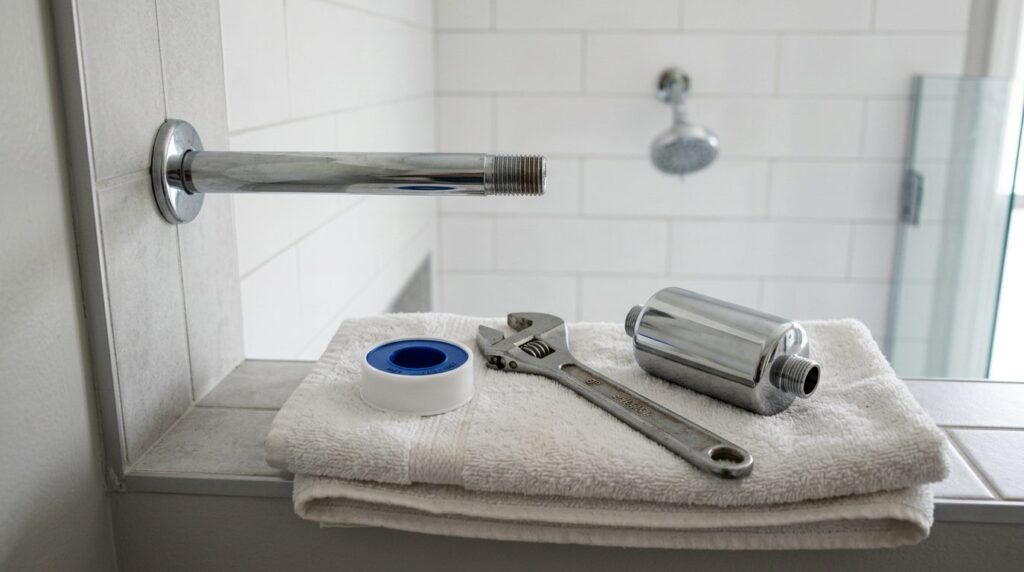
Almost every US shower arm uses a half-inch NPT thread, and every pick on our list is designed for it. Unscrew your current showerhead by hand or with a wrench wrapped in a cloth so you do not scratch the finish. If it is stuck with mineral scale, a short vinegar soak around the joint often frees it.
Look at the exposed thread on the arm. Remove old tape and scale with a dry cloth or an old toothbrush. Clean threads seal better and reduce the chance of a slow drip behind the filter.
Measure the space below the arm before you install an inline filter. Adding 4 inches to the length can drop the head enough to bother tall users, which is the main reason to choose a low-profile model like the Sprite Slim-Line 2.
Wrap thread seal tape clockwise around the arm thread a few times, so the tape tightens as you screw the filter on. Most picks include tape in the box. Do not use pipe compound on plastic housings unless the maker says it is safe.
Check that the rubber washer or O-ring is seated in the filter inlet. A missing or twisted washer is the most common cause of leaks at the arm. Hand-tighten the filter, then add no more than a quarter turn with a wrench if needed. Overtightening can crack plastic threads.
Repeat the process where your showerhead attaches to the filter outlet. Many inline filters have arrows showing flow direction; make sure the arrow points from the arm toward the head.
Run cold water for a few minutes before the first shower. This clears loose media and carbon fines. Aquasana’s instructions specifically say to run water after installation for this reason.
Look for drips at both joints with the water running and again a few minutes after turning it off. A small drip usually means the tape needs another wrap or the washer is not seated. Fix it now; a slow leak behind the filter can run down the wall unnoticed.
Write the install date on the cartridge with a marker, set the reminder dial if your filter has one, and set a phone reminder for the replacement date. Those thirty seconds are what keep the filter working.
Chlorine reduction can drop well before flow slows down, so do not wait for the shower to feel different. Use the maker’s rating, whichever comes first of months or gallons. A standard showerhead uses 2.5 gallons per minute according to the EPA, so a 10-minute shower uses about 25 gallons and two such showers a day use about 50 gallons.
At 50 gallons a day, a 10,000 gallon cartridge lasts about 200 days and a 25,000 gallon cartridge would last longer than its 12-month limit. A 3-month cartridge in a busy family bathroom is a real 3-month cartridge, not a 6-month one.
If your water uses chloramine or carries a lot of sediment, plan on the short end of every range. AquaBliss’s own guidance, to replace sooner if the chlorine smell returns or lather feels flatter, is a good general rule.
Mineral scale builds up on the face of any showerhead, filtered or not, and blocks nozzles. Every few months, soak the head in white vinegar for an hour, then rinse and run water through it. Rubber nozzles can usually be rubbed clean with a finger.
For inline filters, wipe the outside of the housing and check the threads at each cartridge change. Clear housings like the Weddell Duo can show discoloration on the cartridge, which is a useful visual cue but not a replacement for the gallon count.
Do not run hot water above the maker’s limit through the filter. The Weddell Duo lists a range up to 120 degrees F and the Aquasana up to 115 degrees F.
Third-party cartridges that claim to fit Sprite, Culligan, Aquasana or Jolie housings are common. They may fit, but they are not covered by the original certification, and some makers void the housing warranty if you use them.
When a brand’s certification is the reason you chose its filter, the genuine cartridge is the only way to keep that certification in place. Buy two at once if you want to avoid a gap between orders.
Check the cartridge model before ordering. The Sprite HO2 uses the HOC cartridge, the Slim-Line 2 uses the SLC, and the AquaBliss SF100 uses the SFC100. Ordering by model number avoids most returns.
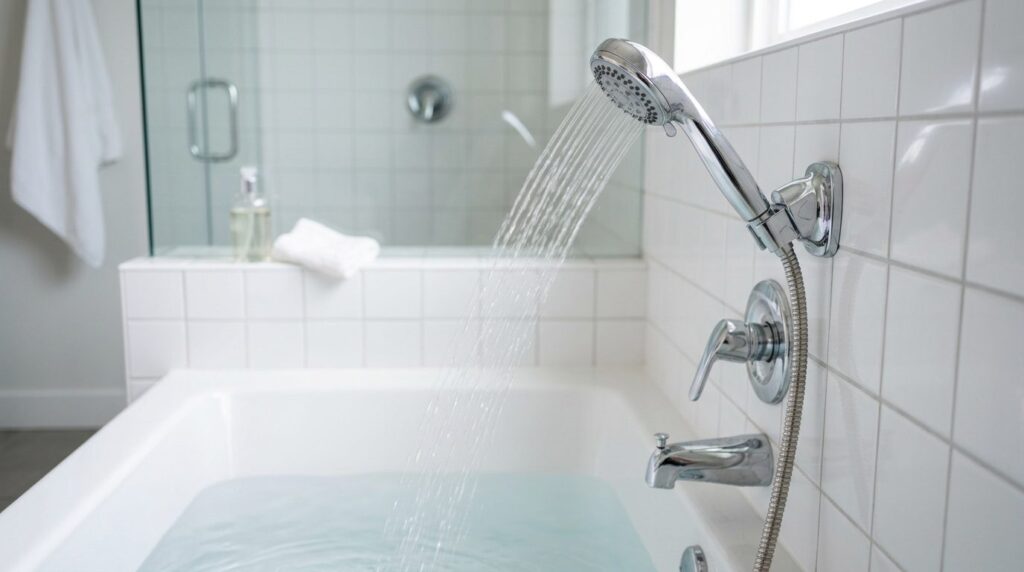
Any filter adds some resistance, but NSF/ANSI 177 requires certified systems to keep at least 1 gallon per minute at 80 psi through the test, and most well-designed filters keep flow close to what your head allows. The bigger effect usually comes from the showerhead’s own flow restrictor.
The Aquasana AQ-4100 lists an operating pressure range of 30 to 80 psi. If your home pressure is near the low end, a filter that adds resistance will be more noticeable. A pressure gauge on an outdoor hose bib gives you the number in a minute.
If flow drops over time, the cartridge is likely clogged with sediment or scale. Replace it first; if flow is still poor, clean the showerhead nozzles before blaming the filter.
According to the EPA WaterSense showerhead page, standard showerheads use 2.5 gallons per minute, and showerheads that earn the WaterSense label must use no more than 2.0 gallons per minute while still giving a satisfying shower.
Among our picks, the Jolie lists 1.8 gallons per minute, below the WaterSense limit, while the Aquasana lists a 2.5 gallon per minute maximum. An inline filter’s flow depends on the head you attach, so pairing a WaterSense head with an inline filter is a simple way to save water and stretch cartridge life.
Lower flow also stretches the gallon rating. At 1.8 gallons per minute instead of 2.5, the same 10,000 gallon cartridge covers about 39% more shower minutes.
Shower water is mostly heated water, so flow rate and shower length drive your water heater’s energy use. A filter does not change that directly, but choosing a lower-flow head with your filter cuts both water and energy.
Filters work under heat. The NSF/ANSI 177 test uses water at about 104 degrees F, and the structural tests use water up to 120 degrees F. That is close to a normal hot shower, which is why a certified filter’s chlorine claim is more meaningful in real use than a cold-water drinking filter claim.
If your bathroom is also dry in winter, a shower filter will not fix dry air. A humidifier addresses that separately; our guide to the best humidifier for bedroom use covers quiet options.
For most homes on chlorinated city water, we recommend the Sprite HO2. Its listing states NSF/ANSI 177 certification and its cartridge is rated for 12 months or 25,000 gallons. The Weddell Duo and Aquasana AQ-4100 are strong alternatives if you want a clear two-stage housing or a filtered showerhead.
For free chlorine, yes, when the filter is certified and the cartridge is within its rated life. NSF/ANSI 177 requires at least a 50% reduction of a 2.0 mg/L chlorine challenge in warm water. For chloramine, hardness, lead or PFAS, most shower filters do little, and those claims are not part of the standard.
Most do not remove much. NSF/ANSI 177 tests free chlorine with chloramine kept below 0.1 mg/L. Vitamin C media reacts with chloramine, and the AquaBliss SF100 states that it helps reduce chloramine at lower levels for a short period. For strong chloramine reduction, consider whole-house catalytic carbon.
No. Hardness is dissolved calcium and magnesium, and removing it takes a softener. Some filters claim to reduce scale, but they do not change hardness. If your water is above 120 mg/L as calcium carbonate, a softener will make the bigger difference.
Some makers cite dermatologists in their marketing, but we found no EPA or CDC guidance recommending shower filters for skin conditions. The CDC advises talking to a healthcare provider if you are concerned your tap water affects your health. If you have eczema or another skin condition, ask your dermatologist before relying on a filter.
Follow the maker’s rating, whichever comes first of months or gallons. Among our picks that ranges from 3 to 6 months for the AquaBliss SF100 to 12 months or 25,000 gallons for the Sprite HO2. Replace sooner if the chlorine smell returns.
A well-designed filter has a small effect. Certified filters must hold at least 1 gallon per minute at 80 psi in the NSF/ANSI 177 test. A clogged cartridge or scaled showerhead is the usual cause of a noticeable drop.
Neither is better in general. A filtered showerhead is one tidy unit; an inline filter lets you keep any head you like and is easy to move. Choose inline if you love your current head, and a filtered head if you were planning to replace it.
Do not rely on one for lead. Lead reduction is not part of NSF/ANSI 177, and lead is a drinking water concern first. Use a filter certified for lead at the kitchen tap and test your water if your home has older plumbing.
Often not, because many wells have no added chlorine. If your well water smells of sulfur or stains fixtures, a filter with media like Chlorgon may help a little in the shower, but treatment at the point of entry usually works better.
Yes. Inline filters such as the Sprite Slim-Line 2, Weddell Duo and AquaBliss SF100 fit between the shower arm and the hose connection of most handheld heads.
It can be. Inline filters and filtered heads install without tools on a standard half-inch arm and come off when you move. Keep the original showerhead so you can put it back.
Stage counts are not a measure of filtration. Look for a full-system certification to NSF/ANSI 177 or published full-system test data, the rated gallons and the flow rate. Without those, there is no way to compare filters fairly.
For drinking water, see our guides to the best countertop water filters and the best under sink water filter.
Written by the Delozone Editorial Team. We research products using manufacturer specifications and performance data, NSF/ANSI 177 and IAPMO certification claims, EPA, CDC and USGS guidance and verified owner feedback, and we update guides when products or standards change. How we work.
The Delozone Editorial Team researches water treatment, pool and spa, and indoor air products for independent buying guides. We compare products using manufacturer specifications, certification listings such as NSF/ANSI, UL, AHAM and Energy Star, published third-party test data and verified owner feedback. We do not sell products, and affiliate commissions never decide what we recommend.