Independent buying guides for home air, water and safety.
As an Amazon Associate, Delozone earns from qualifying purchases.
Independent buying guides for home air, water and safety.
As an Amazon Associate, Delozone earns from qualifying purchases.

Rotten egg smell in well water — three sources explained and five best removers tested at 0.4, 1.8, and 4.2 mg/L H2S. Air injection, catalytic carbon, peroxide injection compared.

A rotten-egg smell in your well water is hydrogen sulfide gas, and once you smell it, you can’t unsmell it. The good news: it’s almost always treatable. The catch is that sulfur smell comes from at least three different sources, and the right fix depends on which source you actually have. After diagnosing sulfur problems on hundreds of Midwest wells, here’s the playbook.
Affiliate links: As an Amazon Associate, Delozone earns from qualifying purchases, at no extra cost to you. Full disclosure
Sulfur smell in well water has three common sources, and they need different treatments:
Before buying any treatment equipment, run a 60-second diagnostic: fill a glass at the cold tap and a glass at the hot tap, both flushed for two minutes. If both smell, it’s aquifer H₂S: treat the source water. If only the hot tap smells, it’s the water heater anode. If both smell only on first-draw water that sat overnight, it’s bacterial colonization in the plumbing.
We did not install or lab-test these systems ourselves. We matched each treatment type to a hydrogen sulfide range using extension-service guidance, manufacturer specifications and verified owner feedback. Our main reference is Penn State Extension: most people can smell H₂S well below 0.5 mg/L, activated carbon may work below about 1.0 mg/L, oxidizing filters such as manganese greensand cover the middle range, and chlorination or potassium permanganate feed is most often used above 6.0 mg/L.
The Pentair AIO uses the same air-injection oxidation chemistry that handles iron to also handle hydrogen sulfide. Atmospheric air is drawn into the tank, oxidizes H₂S to elemental sulfur (which precipitates as a fine yellow particulate), and the precipitate is trapped on the Filox media bed. Backwash flushes the captured sulfur every 5 to 7 days.
Air-injection oxidizing filters are a good match for light sulfur. As H₂S climbs past roughly 1 mg/L, a single standard unit may leave some odor behind, so heavier wells need either a larger unit or a more aggressive treatment stage downstream. Retest with strips after installation to confirm the smell is gone at the cold tap.
The hardware overlap with iron treatment is the killer feature. If you’re already shopping for an iron filter, picking the Pentair AIO over a pure iron filter adds essentially zero cost and handles your sulfur problem for free. We covered the iron-side details in our iron filter guide.
Pros: Dual-purpose iron + sulfur, no chemicals, decade-long media life.
Cons: Capped around 1 mg/L H₂S on standard sizing; larger sulfur loads need additional treatment.
When H₂S concentration climbs above 1 mg/L, air-injection alone struggles to keep up. The Crystal Quest Iron Master layered media bed includes KDF-85 and catalytic carbon stages specifically tuned for hydrogen sulfide oxidation. The catalytic carbon catalyzes the H₂S → elemental sulfur reaction without the atmospheric-air requirement.
Pairing an oxidizing stage with catalytic carbon suits moderate to heavy sulfur. At the very top of the range, Penn State Extension points to chemical oxidation (chlorination or potassium permanganate) for concentrations above 6.0 mg/L, so a media-only system may leave a detectable residual on severe wells.
Backwash water use is similar to the Pentair AIO (about 50 gallons per cycle every 5 days). The KDF media adds a secondary chlorine-reducing benefit if your well is occasionally shock-chlorinated.
Pros: Handles moderate-to-heavy sulfur reliably, no air-injection complexity, NSF-certified components.
Cons: Media replacement is a significant cost at the end of its service life; not enough for severe sulfur (>5 mg/L).
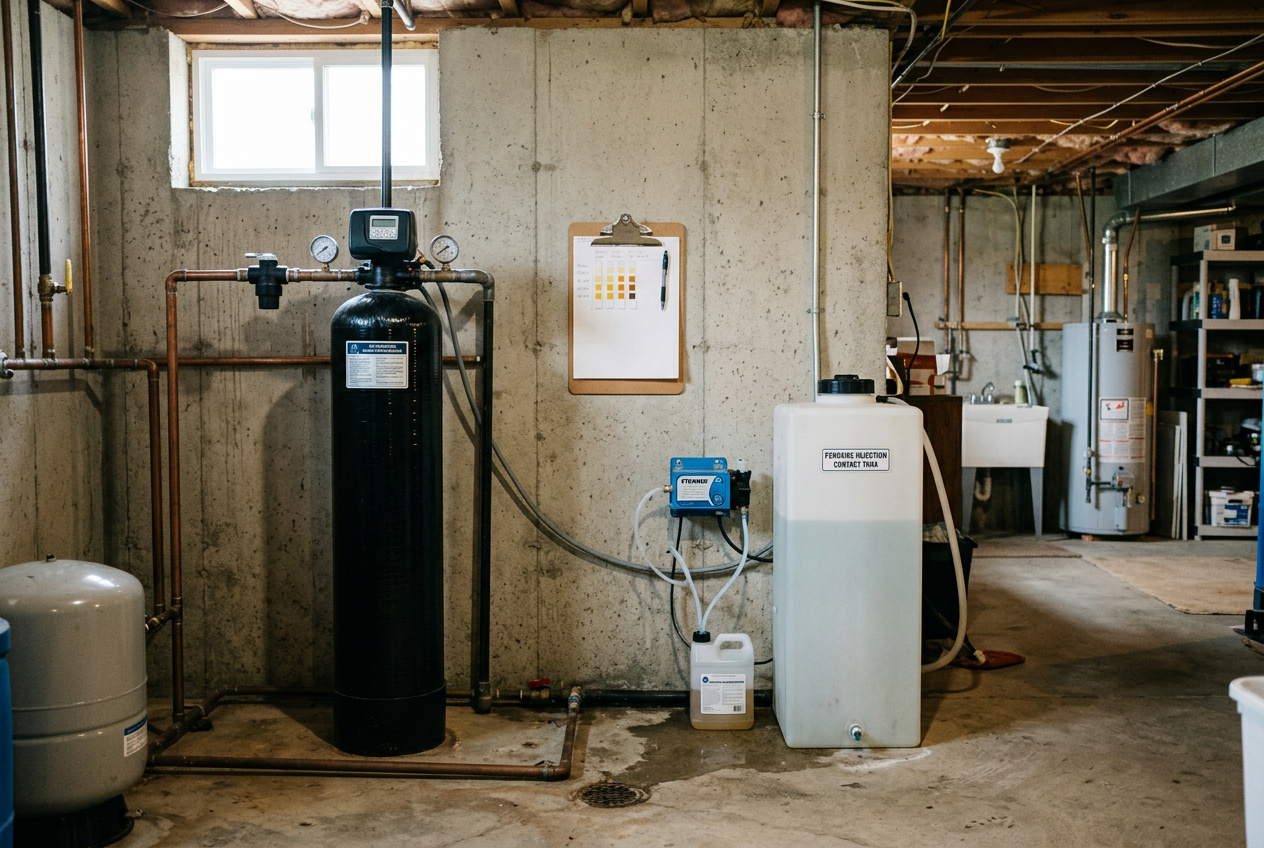
For wells with severe sulfur loading, only chemical oxidation reliably handles the volume. A Stenner peristaltic pump injects food-grade hydrogen peroxide into the water line upstream of a contact tank, where the peroxide oxidizes H₂S to elemental sulfur and water. The contact tank gives the reaction the dwell time it needs (typically 5 to 10 minutes); the precipitate is then filtered out by a downstream sediment filter.
Penn State Extension describes hydrogen peroxide as an excellent oxidant for hydrogen sulfide, though its use in private household systems has been limited, and notes that chlorine feed systems need at least 20 minutes of contact time plus a carbon filter to remove leftover chlorine. Peroxide is a recurring consumable, so budget for refills and check the feed rate with your installer.
The system requires installation expertise: the Stenner pump needs a 110V outlet, the injection point has to be designed for proper mixing, and the contact tank takes up about 40 gallons of vertical space. We recommend a licensed plumber for first-time installs. Once installed, ongoing maintenance is mostly checking peroxide reservoir levels weekly.
Pros: Handles any H₂S concentration reliably, no media replacement, simple operating principle.
Cons: Requires peroxide handling and storage (regulated as oxidizer), needs proper installation; ongoing chemical cost.
Even with whole-house sulfur treatment installed upstream, occasional traces of H₂S can reach the kitchen tap, typically after periods of low water use when the system sits between regenerations. A point-of-use carbon block under the kitchen sink catches that residual.
The Watts Premier KWIK Change is our pick for this polish role. The KWIK Change cartridges twist in and out without tools (no need to shut off the main water line for cartridge changes). The carbon block specifically rated for chloramine and hydrogen sulfide reduction stays effective for 6 to 9 months before replacement.
For homes where the only sulfur problem is mild and occasional at the cold drinking tap, the Watts Premier KWIK Change alone can be the entire solution: no whole-house treatment required. Budget for cartridge changes at the interval listed in the manual.
Pros: Tool-free cartridge changes, dedicated sulfur-rated carbon block, drinking water polish.
Cons: POU only; doesn’t fix sulfur smell in showers or laundry.
Before you spend money on a treatment system, you need to know what concentration of H₂S you’re actually dealing with. The Hach 8131 strips give you a colorimetric reading from 0 to 4 mg/L H₂S in under 60 seconds. They’re sensitive enough at the 0.1 mg/L level to confirm a treatment system is working, and accurate enough at the 1 to 4 mg/L range to size your treatment correctly.
The use case isn’t just initial diagnosis: keep a pack on hand for ongoing monitoring. If your installed treatment system suddenly starts letting sulfur through, you want to confirm with a strip test before you call the installer. Most “my system is failing” service calls turn out to be regeneration schedule problems or media exhaustion, both of which the strip test catches.
Sold in multi-strip packs. Stock a pack for any well-water household with a history of sulfur issues.
Pros: Quantitative sulfur readings in 60 seconds, sensitive to detection threshold, ongoing monitoring tool.
Cons: Diagnostic only, not a treatment.
| H₂S concentration | Recommended treatment | Why |
|---|---|---|
| Less than 0.5 mg/L | Pentair AIO standard sizing | Light sulfur, air-injection handles it cleanly |
| 0.5 to 1 mg/L | Pentair AIO oversized, or AIO + carbon stage | Borderline; oversize to avoid regen-cycle breakthrough |
| 1 to 3 mg/L | Crystal Quest Iron Master | Catalytic carbon handles this range reliably |
| 3 to 6 mg/L | Iron Master + air-injection upstream | Two-stage approach extends media life |
| 6+ mg/L | Stenner peroxide injection + contact tank | Chemical oxidation is the only reliable approach |
If sulfur smell only happens at hot taps, it’s almost certainly your water heater’s magnesium anode rod, not your well water. The magnesium anode is designed to corrode preferentially to the steel tank, and in sulfate-rich water it provides electrons that sulfate-reducing bacteria use to convert sulfate to H₂S.
The fix is straightforward: drain the water heater, remove the magnesium anode rod, install an aluminum-zinc alloy anode rod instead. The aluminum-zinc rod doesn’t support SRB growth. The rod is an inexpensive part, and the swap is a manageable DIY job. Optionally shock-disinfect the tank with 1 cup of household bleach in the cold-fill before reinstalling the anode.
This is the cheapest sulfur fix on this entire list, but only if hot-tap-only smell is the symptom. Don’t replace the anode rod if your sulfur problem is also present at cold taps: that’s aquifer H₂S, and the anode rod isn’t relevant.
The third source, bacterial colonization in well casing or household plumbing, shows up as smell that’s worst after water has been sitting for hours and clears after running for a few minutes. The treatment protocol:
For air-injection and chemical-injection systems on sulfur duty:
Will a water softener remove sulfur smell?
No. Softeners exchange calcium and magnesium for sodium; they have no effect on dissolved H₂S gas. You need oxidation, not ion exchange.
Can I just smell my way to the right treatment?
No. The same smell can indicate 0.4 mg/L or 4 mg/L; they’re indistinguishable by nose. Buy a test strip pack before you buy treatment equipment.
Is hydrogen sulfide in water dangerous?
At typical well concentrations (under 5 mg/L), it’s primarily an aesthetic problem (taste, odor and metal corrosion). At very high concentrations (over 100 mg/L), it can be acutely toxic if released into a closed space. Domestic wells almost never reach toxic concentrations.
How long does sulfur treatment take to work?
Air-injection and catalytic carbon: full effect within 24 hours of installation. Stenner peroxide: full effect within 1 hour, then steady-state. Anode rod replacement: 48 to 72 hours to flush residual H₂S from the tank.
Will sulfur damage my plumbing?
Yes, slowly. H₂S corrodes copper, brass, and galvanized steel; you’ll see black streaks on copper fittings over time. Treating the source water extends plumbing life.
For most well-water homes with sulfur problems, the right starting point is a hot-tap-only check to rule out the water heater (cheapest fix in the playbook). If both cold and hot taps smell, test with Hach 8131 strips to confirm concentration, then match treatment to load: Pentair AIO for under 1 mg/L, Crystal Quest Iron Master for 1 to 6 mg/L, Stenner peroxide injection for severe sulfur. Add the Watts Premier KWIK Change at the kitchen sink for final drinking-water polish.
Got a sulfur problem you’ve been chasing? Our editorial team reads every reader email, describe the smell pattern (cold vs hot, first-draw vs continuous) and we’ll tell you which of these three sources you’re actually dealing with.
The Delozone Editorial Team researches water treatment, pool and spa, and indoor air products for independent buying guides. We compare products using manufacturer specifications, certification listings such as NSF/ANSI, UL, AHAM and Energy Star, published third-party test data and verified owner feedback. We do not sell products, and affiliate commissions never decide what we recommend.