Independent buying guides for home air, water and safety.
As an Amazon Associate, Delozone earns from qualifying purchases.
Independent buying guides for home air, water and safety.
As an Amazon Associate, Delozone earns from qualifying purchases.

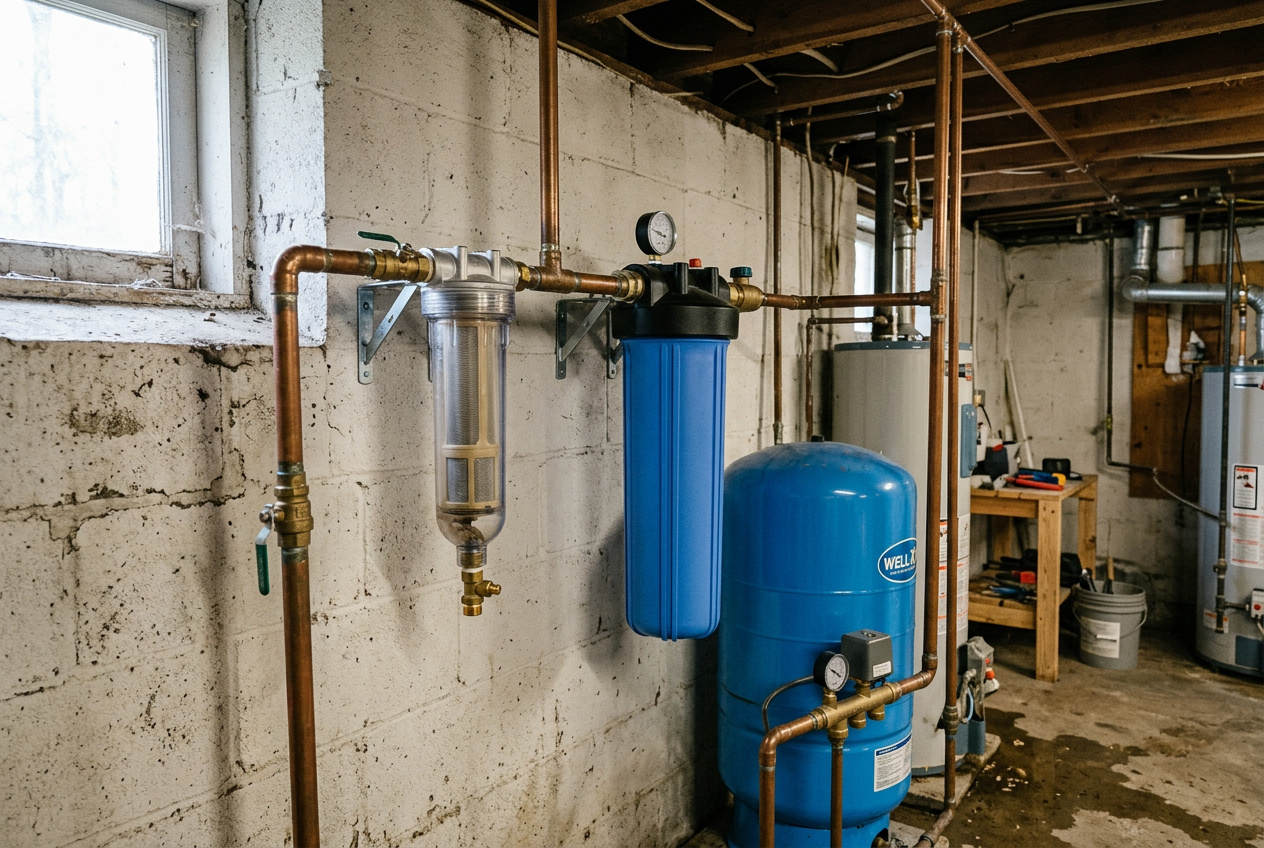
Best sediment filters for well water tested on sandy, silty, and iron-floc wells. Spin-down and 5-micron cartridge picks compared by senior reviewer Daniel Reeves.

A sediment filter is the first line of defense on every well: it traps sand, silt, rust particles, and pipe scale before that grit reaches your softener, iron filter, UV chamber, or appliances. Skip it and downstream equipment wears out early. Here are the five sediment filters we shortlisted for 2026, ranked by where they fit in a real plumbing layout, with specs taken from manufacturer spec sheets and listings.
Affiliate links: As an Amazon Associate, Delozone earns from qualifying purchases, at no extra cost to you. Full disclosure
Every piece of downstream water-treatment equipment is rated against a sediment load. A softener’s resin bed can clog: Penn State Extension notes that turbid water “may clog the resin with mud and clay.” A UV chamber’s quartz sleeve will scratch from grit and lose germicidal output. An iron filter’s media bed will pack with silt and short-cycle on backwash. The sediment filter exists to protect those systems, not your drinking water directly (most “sediment” is mechanical, not biological).
Two filter geometries dominate the residential market:
The usual sequence on a well with real grit is both: spin-down first (catches the big stuff, never clogs), cartridge second (catches the fine stuff before treatment).
| Particle | Size | Filter needed |
|---|---|---|
| Sand (well grit) | 50 to 500 µm | Spin-down (50 µm) |
| Silt | 5 to 50 µm | Cartridge (5 to 25 µm) |
| Fine rust particles | 1 to 10 µm | Cartridge (5 µm) |
| Bacteria | 0.2 to 2 µm | UV (not filtered) |
| Cryptosporidium | 4 to 6 µm | Certified 1 µm absolute |
| Viruses | 0.02 to 0.3 µm | RO or UV (not filtered) |
For most well-water homes, a 5-micron cartridge as the final pre-filter stage is the sweet spot: fine enough to protect downstream equipment, coarse enough that a cartridge lasts a reasonable time between changes on most wells.
We did not lab-test, install or measure these filters ourselves. Instead, we shortlisted sediment filters that are easy to buy in the US and checked each one against public evidence:
A sediment filter only handles particles. Before you buy, get a lab test that covers turbidity or total suspended solids (TSS), iron, manganese, hardness and pH, plus bacteria and nitrate on any private well. Iron that oxidizes in the plumbing shows up as fine orange particles that load a cartridge quickly, and that is a job for an iron filter, not a smaller micron rating. A simple check at home: fill a clear glass jar from the tap, let it sit for an hour, and look at what settles. Sand that drops fast points to a spin-down; a haze that never settles points to fine silt or oxidized iron.
The Pentair Big Blue 20-inch housing is the workhorse of residential pre-filtration. According to the Pentair spec sheet, the cap comes with 3/4-inch, 1-inch or 1-1/2-inch NPT ports, accepts 4-1/2-inch diameter cartridges, and the 1-inch 20-inch housing (150233) is rated at 1 psi initial pressure drop at 15 gpm with an empty housing. Maximum pressure for the 20-inch size is 90 psi and the temperature rating is 40 to 100°F, so it is cold-water only. Several part numbers are certified by NSF International to NSF/ANSI 42 for material and structural integrity.
Pair it with a 5-micron cartridge sized for Big Blue (4.5 x 20 inches). Pleated polyester cartridges can usually be rinsed and reused a time or two; meltblown polypropylene cartridges trap particles through their depth and are replaced when loaded. Cartridge life depends almost entirely on your sediment and iron load, which is why a pressure gauge on each side of the housing is worth adding.
Cartridge changes are simple with the matching wrench (Pentair lists the SW-4 for 20-inch Big Blue): close the valves or flip the bypass, press the pressure relief button, unscrew the sump, swap the cartridge, lubricate the o-ring and reassemble. Pentair warns to protect the housing against freezing to prevent cracking and leaks.
Pros: industry-standard housing, low published pressure drop, multiple port sizes, NSF/ANSI 42 structural certification.
Cons: 20-inch length needs clearance below for sump removal; cartridge cost stacks up on iron-heavy wells.
The Rusco 1-inch spin-down filter is a common first stage on wells with visible sand. The Rusco product page lists 1-inch slip ports, a 1 to 25 gpm flow range, a 150 psi maximum pressure, and a long list of screen options: polyester screens from 24 to 1000 mesh and stainless steel screens from 30 to 200 mesh, plus pleated, meltblown and carbon elements for the same housing.
Water spins around the screen and grit drops into the clear sump, so you can see how fast it loads and flush it through the valve at the bottom before it restricts flow. Pick the screen to match your grit: a coarse screen for well sand, then let a cartridge downstream handle fine silt.
The clear housing is genuinely useful, but treat it like any plastic sump: install indoors and protect it from freezing.
Pros: reusable screen, many mesh options, visual grit indicator, high rated flow range.
Cons: not a fine-silt filter on its own; needs regular flushing on sandy wells.
The iSpring WSP-50 is a smaller-format spin-down filter with a 50-micron reusable screen. Retailer listings describe it with a 1-inch male NPT inlet and a 3/4-inch female NPT outlet, a clear housing and a brass top, so check the adapters you need before you order.
For 1 to 3 bath homes without a serious sand problem, it does the same basic job as the Rusco for less money. The trade-off is fewer screen choices and a smaller sump, so on very sandy wells you will flush it more often.
iSpring sells several variants under the WSP name (for example versions with a scraper or an auto-flush head), so confirm the exact model and included parts on the listing.
Pros: inexpensive, reusable 50-micron screen, easy install.
Cons: fewer screen options than the Rusco; mixed port sizes need adapters on some installs.
The Pentek PD-5-934 is a 5-micron (nominal) Polydepth cartridge made of thermally bonded polypropylene microfibers around a rigid polypropylene core. The Pentek spec sheet lists it at 2.32 x 9.88 inches, which means it fits standard slim 10-inch housings, not Big Blue, with an initial pressure drop under 2 psi at 2 gpm. It is certified by NSF International to NSF/ANSI 42 for material requirements, and its 40 to 175°F rating is wider than the Big Blue housing’s.
Pentek says the polypropylene construction “provides superior chemical resistance and is not prone to bacterial attack,” which is why polypropylene depth cartridges are a sensible choice on wells that get periodic shock chlorination. The same Polydepth line is also sold in a 20-inch slim length (PD-5-20, rated under 2 psi at 5 gpm). For a Big Blue housing, choose a 4.5-inch-diameter polypropylene cartridge instead.
Use it as a final polishing stage under a sink, ahead of a UV unit or RO system with a 10-inch slim housing, or as the main filter on a low-flow cabin well.
Pros: chemically resistant polypropylene, NSF/ANSI 42 material certification, standard size.
Cons: slim size has limited dirt-holding capacity for whole-house flow; not washable.
If you don’t want to plumb two stages and your sediment load is moderate, the Culligan WH-HD200-C is a heavy-duty whole-house housing from a brand that is easy to find in US hardware stores. Owners choose it for convenience features on the head, so check the listing for the port size, whether a bypass valve and pressure gauge are included, and which Culligan cartridges it takes.
The compromise is that one stage has to do everything: on a sandy well, a single cartridge loads quickly. For grit-heavy wells, a spin-down ahead of it, or the Big Blue setup above, is the better long-term answer.
Pros: single-housing simplicity, widely available cartridges.
Cons: single stage isn’t enough on grit-heavy wells; confirm included accessories on the listing.
Sediment filter sizing is governed by peak flow rate. Undersize the housing and pressure drop becomes a problem during peak demand (morning showers, dishwasher running, laundry cycling). Oversize and you spend more on cartridges than you need. For reference, Pentair rates its 1-inch Big Blue housings at 1 psi initial drop at 15 gpm with no cartridge installed; the cartridge adds its own drop on top.
| Peak flow demand | Recommended housing | Typical use case |
|---|---|---|
| Up to 8 gpm | 10-inch Big Blue | 1 to 2 bath cabin or apartment |
| 8 to 15 gpm | 20-inch Big Blue | 2 to 4 bath family home |
| 15+ gpm | Twin 20-inch in parallel, or 1-1/2-inch ports | 5+ bath home or working farm |
For wells with both coarse and fine sediment, run a spin-down first (catches sand), then a 5-micron cartridge (catches silt). The spin-down takes the heavy load off the cartridge so it lasts much longer.
| Cartridge type | How it filters | Reusable? | Best for |
|---|---|---|---|
| Pleated polyester | Surface filtration on a large pleated area | Can be rinsed a time or two | Clean wells, low pressure drop |
| Meltblown / thermally bonded polypropylene | Depth filtration through graded fibers | No | Silt, chlorinated or shocked wells |
| String-wound polypropylene | Depth filtration through wound yarn | No | Heavy coarse sediment on a budget |
| Spin-down screen | Centrifugal separation plus mesh screen | Yes, flush and reuse | Sand and grit first stage |
Most residential cartridges carry a nominal micron rating, meaning they catch most particles of that size, not all. An absolute rating is a much stricter claim and is what matters if filtration is meant to stop cysts such as Cryptosporidium; check the certification listing rather than the box.
Plan on a half-day install for a first-time DIYer with PEX or soldering experience. A 20-inch Big Blue gets heavy when full of water, so use the wall-mount bracket.
The cleanest trigger is a rise in pressure drop across the filter compared with a fresh cartridge, so note the reading on day one. Without a gauge, watch for:
Change intervals vary widely with sediment load, from every few weeks on sandy or iron-carryover wells to several months on clean ones. Wells with iron carryover from an air-injection or greensand filter upstream load cartridges much faster. If that’s you, place the cartridge after the iron filter to catch fines, and fix the iron filter’s backwash before blaming the cartridge.
Spin-down filters need a manual flush whenever grit builds up in the sump, which can be weekly on sandy wells and monthly on cleaner ones. The usual procedure: open the flush valve at the bottom of the housing for a few seconds with water running so the grit blows out, then close it. If grit packs above the flush valve, shut off the supply, remove the sump, pull the screen, rinse it and reassemble.
A typical full treatment sequence on a well with sediment, iron and hardness looks like this:
This sequence protects every downstream stage from sediment loading. Skip stage 4 and fines reach your softener resin and UV sleeve. Skip stage 2 and sand packs into the iron filter media.
Does well water need a sediment filter?
Most wells benefit from one, because pumps pull sand and silt, especially in older wells or after heavy pumping. Even if the water looks clear, a sediment stage protects softeners, UV units and fixture valves. Penn State notes that turbid water can clog softener resin with mud and clay.
What is the best in-line sediment filter for well water?
For most homes, a 20-inch Big Blue housing with a 5-micron cartridge, with a spin-down ahead of it if the well makes visible sand. Smaller homes or point-of-use systems can use a standard 10-inch housing with a cartridge like the Pentek PD-5-934.
How do I get rid of sediment coming from the well itself?
Filtration treats the symptom. If sediment suddenly increases, have a well contractor check the pump depth, screen and casing; a pump set too low or a damaged screen can pull sand that no filter should have to handle.
Do I need both a spin-down and a cartridge filter?
If your well has visible grit, yes. If your water test shows very low suspended solids, a single 5-micron cartridge is often enough. Most rural wells benefit from both.
How often does the spin-down need flushing?
Whenever grit is visible in the sump. That can be weekly if your well draws sand during heavy pumping and monthly otherwise. Set a calendar reminder; flushing takes seconds.
Can I clean and reuse a cartridge filter?
Pleated polyester cartridges can usually be rinsed in a backwards-flow direction a time or two before disposal. Meltblown and string-wound cartridges cannot: replace when loaded.
What micron size should I pick?
5-micron is the sweet spot for protecting downstream equipment. Coarser (10 to 25 micron) lasts longer but lets more silt through. Finer (1 micron absolute) is needed only when you’re skipping UV and using a certified filter alone for cyst protection.
Does a sediment filter remove iron, chlorine, or hardness?
No. A sediment filter is mechanical only. For iron, install a dedicated iron filter. For chlorine, add a carbon stage. For hardness, install a softener.
For most well-water homes, the right setup is a Rusco 1-inch spin-down as the first stage (catches sand and grit) feeding into a Pentair Big Blue 20-inch with a 5-micron cartridge (catches silt and iron-floc carryover). Step down to the iSpring WSP-50 if budget is tight. Use a Pentek PD-5-934 in standard 10-inch housings for point-of-use or polishing stages. And reach for the Culligan WH-HD200-C if you want a single-housing solution and your sediment load is moderate.
Have a well-water test result you’d like a second opinion on? Our editorial team reads every reader email. Paste your TSS, iron, hardness, and household flow demand and we’ll tell you which sediment setup on this list (or off it) fits your well.
The Delozone Editorial Team researches water treatment, pool and spa, and indoor air products for independent buying guides. We compare products using manufacturer specifications, certification listings such as NSF/ANSI, UL, AHAM and Energy Star, published third-party test data and verified owner feedback. We do not sell products, and affiliate commissions never decide what we recommend.