Independent buying guides for home air, water and safety.
As an Amazon Associate, Delozone earns from qualifying purchases.
Independent buying guides for home air, water and safety.
As an Amazon Associate, Delozone earns from qualifying purchases.

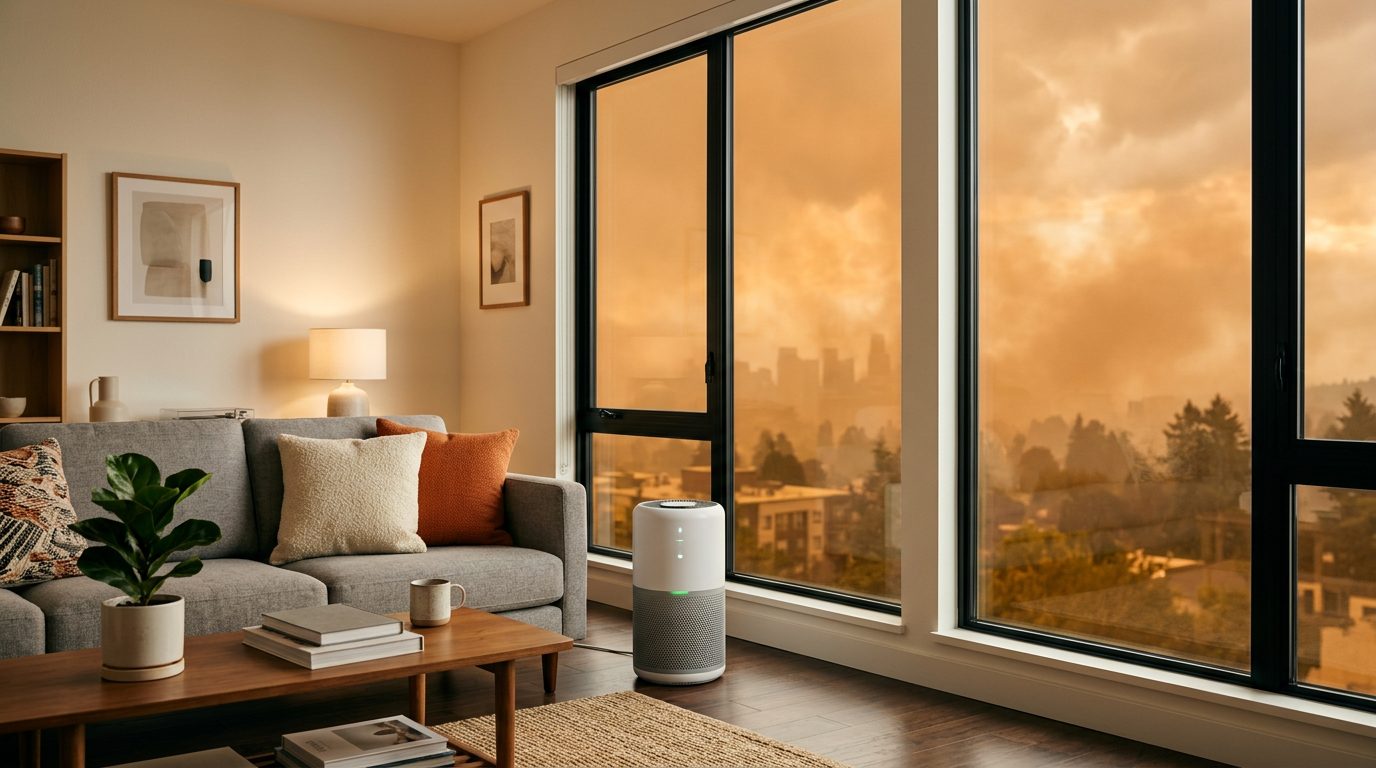

The best air purifier for smoke pairs a True HEPA filter with a real activated carbon stage and has a smoke CADR high enough for your room, and our top pick for most homes is the Coway Airmega 400, which lists a smoke CADR of 328 and an Energy Star room size of 583 sq ft. Wildfire smoke is mostly a fine-particle problem that HEPA handles well, while cigarette and cooking smoke add gases and odors that only carbon can reduce, so the right choice depends on which kind of smoke you are dealing with and how big the room is.
Top picks at a glance
Affiliate links: As an Amazon Associate, Delozone earns from qualifying purchases, at no extra cost to you. Full disclosure
Key takeaways
Quick comparison: air purifiers for smoke
| Model | Filtration | Published CADR or rating | Room size | Best for | Buy |
|---|---|---|---|---|---|
| Coway Airmega 400 | Pre-filter + activated carbon + HEPA | 328 smoke CADR | 583 sq ft (Energy Star) | Most homes | Check price |
| Levoit Core 600S | 3-stage with HEPA-grade filter | 391 CFM CADR | About 600 sq ft at 4.8 ACH | Open plans, high ceilings | Check price |
| Winix 9800 | Pre-filter + carbon + True HEPA | AHAM Verifide 500 sq ft | 500 sq ft (AHAM) | Living rooms | Check price |
| Honeywell HPA5300B | HEPA + carbon pre-filters | 4.8 ACH in 500 sq ft (AHAM Verifide) | 500 sq ft (AHAM) | Wildfire particles | Check price |
| Medify MA-112 | Dual H13 HEPA | 1,009 m³/h (about 594 cfm) | 2,228 sq ft per 30 min (maker) | Whole floors | Check price |
| Alen BreatheSmart 75i | HEPA with Fresh carbon filter | Up to 2,800 sq ft per hour (maker) | About 700 sq ft at 4 ACH | Large open rooms | Check price |
| Winix 5510 | True HEPA + AOC carbon | 253 smoke / 252 dust / 247 pollen | 392 sq ft (AHAM) | Bedrooms, small rooms | Check price |
According to the EPA’s guidance on wildfires and indoor air quality, smoke is a complex mixture of gases and fine particles produced when wood and other organic materials burn, and the biggest health threat comes from the fine particles. Those particles are small enough to reach deep into the lungs, which is why PM2.5 is the number that air quality alerts focus on.
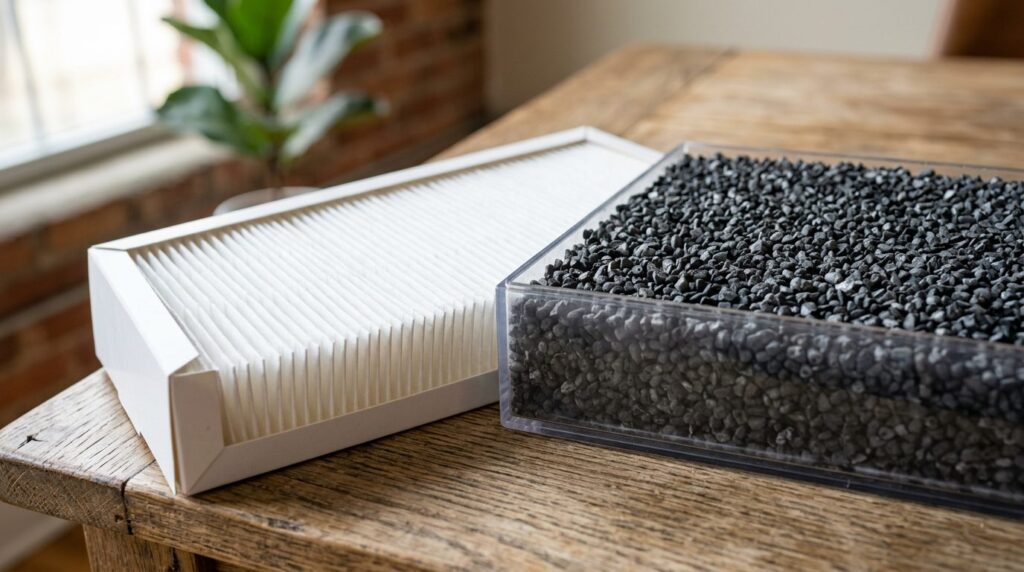
A True HEPA filter is the right tool for this part of the problem. Under the U.S. Department of Energy standard it captures at least 99.97% of particles at 0.3 micrometers, and AHAM’s smoke CADR test measures how quickly a purifier removes particles in roughly the 0.09 to 1 micrometer range, which is where most smoke particles sit.
That is also why smoke CADR is the most useful single number when you shop for smoke. A purifier with a high dust or pollen CADR but a weak smoke CADR will struggle with wildfire haze, because larger particles are easier to catch than the fine ones that smoke produces.
Smoke also contains gases, including volatile organic compounds, formaldehyde and the compounds responsible for the stale smell of tobacco and burnt wood. HEPA media does not capture gases, so a HEPA-only purifier can clear visible haze while leaving much of the smell behind.
Activated carbon adsorbs those molecules onto its surface. The amount matters: a thin carbon-dusted pre-filter handles light cooking odors, while granular carbon beds, like the AOC layer in the Winix 5510, keep working longer before they saturate. For cigarette or cigar smoke, carbon capacity is at least as important as CADR.
The EPA’s Guide to Air Cleaners in the Home makes the same distinction. For gases and VOCs it recommends a portable air cleaner with an activated carbon or other sorbent filter, and notes that these can be effective when there is a large amount of material in the filter, the thicker the better. Once carbon is saturated it stops reducing odors, which is why smoke odor often returns a few months after a filter change.
The CDC’s page on secondhand smoke is clear: there is no safe level of exposure to secondhand smoke, and even brief exposure can cause immediate harm. The CDC also reports that secondhand smoke causes nearly 34,000 premature deaths from heart disease each year among U.S. adults who do not smoke.
“There is no safe level of exposure to secondhand smoke.”
Centers for Disease Control and Prevention, Health Problems Caused by Secondhand Smoke
An air purifier reduces particle levels and odor, but it cannot remove every harmful gas in tobacco smoke or make indoor smoking safe for other people in the home. If someone smokes indoors, the purifier is a way to reduce exposure, not a substitute for smoking outside.
Smoke leaves residue on walls, fabrics and carpets, and that residue keeps releasing odor long after the air itself is clean. This is why a room can still smell of smoke even when a particle monitor shows low PM2.5 readings.
A carbon filter helps with the odor released into the air, but cleaning soft furnishings, washing walls and replacing HVAC filters does more for lingering smell than running a purifier alone. After a wildfire event, the same applies to curtains and upholstery that absorbed smoke while windows were open.
If you are moving into a home previously occupied by a smoker, plan on surface cleaning first and a purifier with heavy carbon second. The purifier then keeps the air fresh while the remaining residue slowly fades.
All seven picks combine HEPA-class filtration with activated carbon or a dedicated odor filter, publish their CADR or AHAM-verified room size, and were in stock on Amazon when we checked in September 2026. We ranked them on smoke CADR, carbon capacity, ozone safety, noise and running costs.
The ranking reflects typical use. Wildfire smoke rewards raw airflow, while tobacco and cooking smoke reward carbon capacity, so we note which kind of smoke each model handles best and the room size its published figures support.
The Coway Airmega 400 lists a smoke CADR of 328, and its Energy Star listing gives a room size of 583 sq ft. Coway also rates it to clean up to 3,120 sq ft once per hour, which makes it one of the most capable mainstream purifiers for living rooms and open-plan spaces during wildfire season.
It uses Coway’s HyperCaptive system: a washable pre-filter, an activated carbon filter and a HEPA filter that Coway rates at 99.97% for 0.3 micron particles. The separate carbon filter reduces volatile organic compounds and odor, which is why it handles cooking and light tobacco smoke better than models with only a carbon-coated pre-filter.
Smart Mode adjusts fan speed to the room’s air quality, Eco Mode switches the fan off after 30 minutes of clean air and restarts it when pollution is detected, and Sleep Mode lowers noise once the room is dark and clean for 3 minutes.
Check Coway Airmega 400 price on Amazon
Levoit lists a CADR of 391 CFM for the Core 600S and says it can purify a 2,933 sq ft space once per hour. At the 4.8 air changes per hour that AHAM uses for its room-size ratings, that works out to roughly 600 sq ft, which is why Levoit positions it for extra-large rooms, open floor plans and high ceilings.
The three-stage filter is rated at 99.97% efficiency for 0.1 to 0.3 micrometer particles, and the unit carries the AHAM Verifide seal. Levoit also sells alternative filters for the Core 600S, so you can choose one with more carbon if smoke odor rather than haze is your main concern.
Auto mode adjusts fan speed to the air quality reading, and Levoit notes that with its original filter the Core 600S remains HEPA-grade in Sleep Mode according to independent lab testing. The VeSync app shows air quality history, which is useful for seeing how quickly the room recovers after a smoke event.
Check Levoit Core 600S price on Amazon
The Winix 9800 is AHAM Verifide at 500 sq ft, and Winix rates it to clean rooms up to 2,420 sq ft once per hour, 1,210 sq ft every 30 minutes and 605 sq ft every 15 minutes. That puts it between the Winix 5510 and the larger Coway and Levoit models.
Its four stages are a washable fine-mesh pre-filter, an activated carbon filter that Winix says reduces VOCs and odors from cooking, pets and smoke, a True HEPA filter, and PlasmaWave. As with other Winix models, the filters do the core work against smoke, and you can run the purifier with PlasmaWave switched off if you prefer.
Dual sensors drive the auto mode, an LED indicator shows real-time air quality, and the Winix Smart App adds remote control over WiFi. Winix lists 26.2 dB on the slowest speed, and a light sensor switches the unit to Sleep Mode when the room goes dark.
Check Winix 9800 price on Amazon
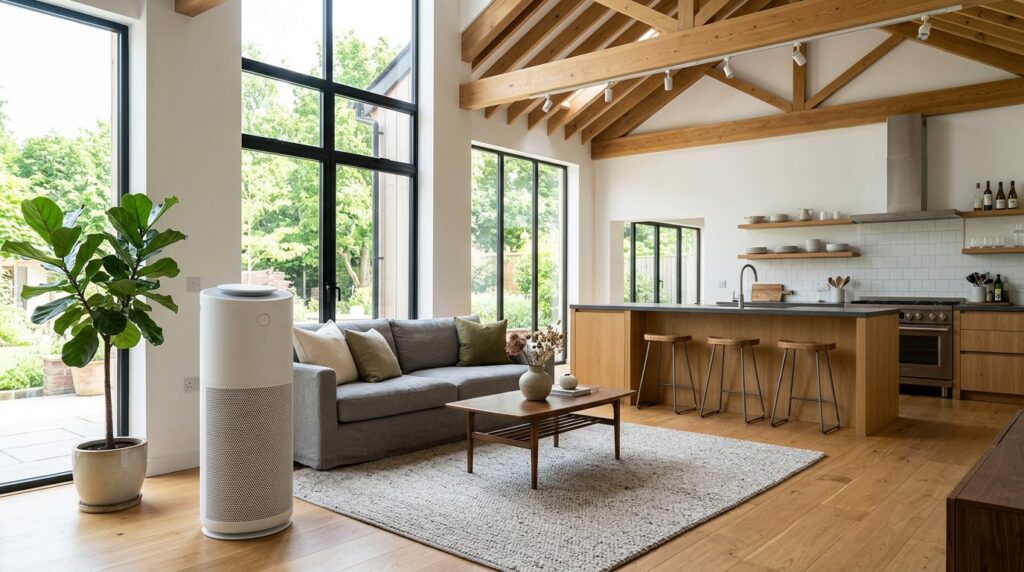
Honeywell’s HPA5300B is AHAM Verifide to filter and recirculate air 4.8 times an hour, or every 12.5 minutes, in rooms up to 500 sq ft, and Honeywell says it refreshes the air at least once an hour in rooms up to 2,400 sq ft. Honeywell specifically mentions smoke from wildfires that are miles away as one of the pollutants it targets.
The filtration pairs HEPA filters, which Honeywell rates at over 99.99% for airborne dust, pollen, pet dander and smoke, with odor-reducing carbon pre-filters. The carbon layer is a pre-filter rather than a deep bed, so the HPA5300B is stronger against wildfire particles than against heavy tobacco odor.
An air quality indicator and auto mode adjust the fan automatically, and the at-a-glance controls make it easy to switch to a higher setting when outdoor air quality drops. For households where smoke events are occasional but intense, that simplicity is a real advantage.
Check Honeywell HPA5300B price on Amazon
The Medify MA-112 is the largest purifier on our list. Medify lists a CADR of 1,009 cubic meters per hour, which is about 594 cubic feet per minute, and rates it to clean 2,228 sq ft in 30 minutes or 4,455 sq ft in one hour. That makes it a realistic single-unit option for an open main floor during a wildfire smoke event.
It uses dual H13 HEPA filters, which Medify says remove 99.9% of particles down to 0.1 microns, including smoke, odors and VOCs. H13 is a medical-grade classification under the European EN 1822 standard, and the dual-filter design keeps airflow high even as the filters load.
The touch panel includes auto mode, a PM2.5 indicator, a dust sensor, a timer, sleep mode, a child lock and an optional ionizer that you can leave off. Medify lists CARB and ETL certification, a maximum noise level of 70 dB on the top setting and a filter life of about 3,000 hours, or roughly 6 months.
Check Medify MA-112 price on Amazon
Alen rates the BreatheSmart 75i for large spaces up to 2,800 sq ft per hour, which is roughly 700 sq ft at four air changes per hour. The version we link uses Alen’s Fresh filter, which combines HEPA media with activated carbon to reduce household odors, cooking smells and urban pollution.
Alen offers several filter types for the 75i, so you can match the filter to the problem: carbon-heavy options for smoke and odor, or standard HEPA filters where particles are the main concern. That flexibility is useful in homes where the smoke source changes with the seasons, from wildfire haze in summer to wood stoves in winter.
A SmartSensor adjusts fan speed and shows air quality through colored rings on the unit. The listing we checked was relatively new with fewer owner reviews than the other picks, so read recent reviews before buying.
Check Alen BreatheSmart 75i price on Amazon
The Winix 5510 is AHAM-verified for 392 sq ft with CADR figures of 253 for smoke, 252 for dust and 247 for pollen. It is the smallest purifier on this list, but it is a strong choice for bedrooms, home offices and apartments where the room size keeps its CADR comfortably above the two-thirds rule.
Its main advantage for smoke is the AOC granular carbon filter, which holds more carbon than the thin pre-filters found on many purifiers in this size class. That makes it better than most compact units at reducing cigarette and cooking odors.
The 5510 is the 2024 successor to the Winix 5500-2, adds app support, and is CARB certified. PlasmaWave can be switched off from the control panel, and the filters handle smoke particles and odor on their own.
Check Winix 5510 price on Amazon
The Clean Air Delivery Rate is measured under the AHAM test standard separately for smoke, dust and pollen, and the smoke figure is the one that matters here. Where a manufacturer publishes a smoke CADR, like the 328 for the Coway Airmega 400 or the 253 for the Winix 5510, we used it directly.
AHAM’s rule of thumb is that the smoke CADR should be at least two-thirds of the room area in square feet for a room with 8-foot ceilings. A 450 sq ft living room therefore needs a smoke CADR of at least 300, and during wildfire events we would aim higher.
Where a maker publishes only coverage figures, we converted them to air changes per hour. AHAM’s own room-size ratings assume 4.8 air changes per hour, so a purifier rated for 2,400 sq ft once per hour covers about 500 sq ft at that level.
For tobacco, cigar and cooking smoke, we weighted the amount and type of carbon. Separate carbon filters and granular beds, as in the Coway Airmega 400 and Winix 5510, outlast thin carbon-coated pre-filters, which suit occasional odors rather than daily smoke.
We also favored models that offer optional carbon-heavy filters, such as the Levoit Core 600S and Alen BreatheSmart 75i. Being able to switch filters lets you respond to seasonal changes without buying a new purifier.
No carbon filter lasts indefinitely in a smoker’s home. Plan on replacing carbon more often than the manufacturer’s standard schedule if smoke is present every day.
The EPA’s wildfire guidance tells buyers to make sure a portable air cleaner does not produce ozone and points to the California Air Resources Board’s list of certified air cleaning devices, which limits ozone emissions to 0.050 ppm.
The EPA’s Guide to Air Cleaners in the Home adds that electrostatic precipitators, ionizers, UV lights without adequate lamp coatings and plasma air cleaners may have the potential to emit ozone. Where our picks include an ionizer or PlasmaWave, we note that it can be switched off.
Devices sold as ozone generators were excluded entirely. We explain why in the section on technologies to avoid.
A purifier only helps if it stays on. We compared published noise levels at low settings, such as the 26.2 dB Winix lists for the 9800, and favored models with auto and sleep modes that keep noise down when the air is already clean.
We also compared filter life and the number of filters each model uses. The Medify MA-112, for example, lists about 3,000 hours per filter set, roughly 6 months of continuous use, while models with separate carbon and HEPA stages may need the carbon replaced sooner in smoky homes.
Energy Star certification, like the Coway Airmega 400’s, was a plus. Purifiers often run for months at a time during wildfire season, so efficiency adds up.
For wildfire smoke in a bedroom or clean room of up to about 250 sq ft, the Winix 5510 with a smoke CADR of 253 gives a wide margin over the two-thirds rule. For a living room of 400 to 600 sq ft, the Coway Airmega 400 (smoke CADR 328), Winix 9800 (AHAM Verifide 500 sq ft) or Honeywell HPA5300B (4.8 air changes per hour in 500 sq ft) are the natural choices.
For open floor plans and high ceilings, the Levoit Core 600S with its 391 CFM CADR or the Medify MA-112 at about 594 cfm move enough air to keep up with heavy outdoor smoke. The Medify is the only pick on our list that can realistically cover a large main floor on its own.
For tobacco, cigar or cooking smoke, weight carbon over airflow. The Coway Airmega 400 and Winix 5510 have the strongest dedicated carbon stages among our picks, and the Alen BreatheSmart 75i and Levoit Core 600S let you switch to carbon-heavy filters when odor is the main issue.
Every model was in stock on Amazon in September 2026, and we checked that each listing matched the exact model described. We excluded several well-known purifiers whose Amazon listings were unavailable or pointed to a different variant.
We read long-term owner feedback for recurring issues such as sensor drift, fan noise and hard-to-find filters. Models with persistent reliability complaints did not make the list.
Several popular smoke purifiers were left out for that reason. The Blueair Blue Pure 211i Max and IQAir HealthPro Compact had no Amazon buy box when we checked, and some listings for well-known models pointed to a different variant or a replacement filter rather than the purifier itself. We would rather recommend a slightly less famous model you can actually buy than send you to an empty listing.
Availability changes quickly during wildfire season, when purifiers and filters often sell out, so we recheck every listing when we update this guide. We will replace any pick that becomes unavailable rather than leave a dead link in place.
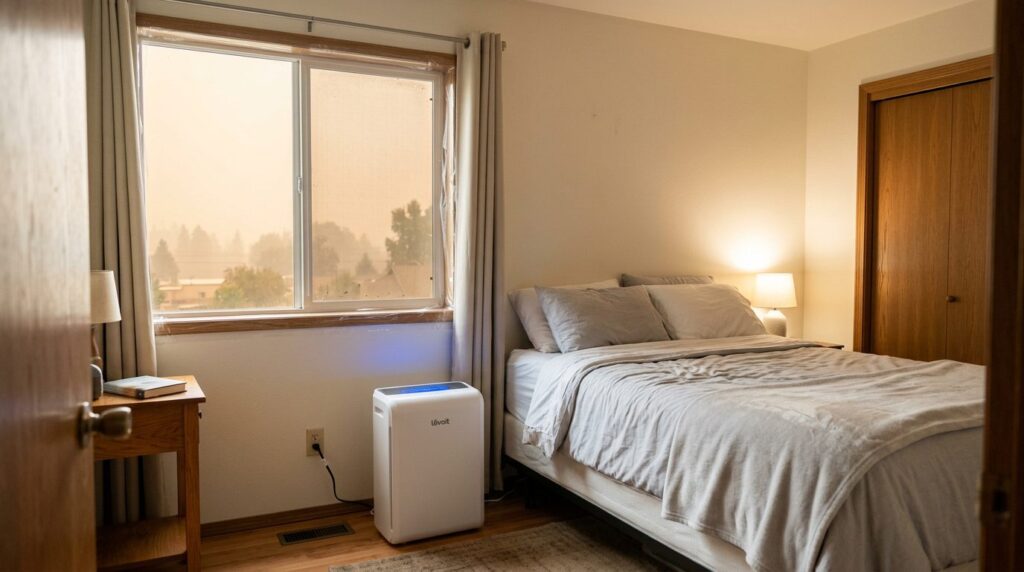
The EPA recommends creating a clean room at home during smoke events: a room with as few windows and doors as possible, kept closed, with a portable air cleaner running inside it. A bedroom is often the best choice, because it is where people spend the most continuous time.
Size the purifier for that room rather than the whole home. A 150 sq ft bedroom needs a smoke CADR of about 100, so even the smallest purifier on our list, the Winix 5510 with a smoke CADR of 253, provides a large margin.
The EPA also advises avoiding activities that add particles indoors during smoke events, such as smoking, burning candles or incense, frying or broiling food, and vacuuming unless the vacuum has a HEPA filter.
If you have central air or forced-air heating, the EPA suggests setting the system to recirculate during smoke events and upgrading to a MERV 13 or higher filter if the system can accommodate it. The filter should fit snugly and be replaced on the manufacturer’s schedule.
HVAC filtration and portable purifiers work together: the HVAC filter cleans air throughout the areas the system serves, while the portable unit adds extra cleaning in the room where you spend the most time. Our HVAC filter and MERV rating guide explains how to check whether your system can take a higher-rated filter.
Evaporative coolers are a special case. The EPA suggests covering the outside air intakes with 4-inch-thick MERV 13 furnace filters if you can safely access them.
An indoor PM2.5 reading tells you whether your purifier is keeping up. If the reading climbs while outdoor smoke is heavy, raise the fan speed, close gaps around doors and windows or add a second purifier.
Our guide to the best air quality monitors for home covers monitors with laser particle sensors that update in real time. Several purifiers on our list, including the Honeywell HPA5300B and Medify MA-112, also show PM2.5 or air quality indicators on the unit itself.
Track readings over a few days. Many people find that indoor PM2.5 drops quickly after the purifier is switched to a higher setting, which is a useful sign that the room is sealed well enough.
The EPA describes do-it-yourself air cleaners made by attaching one or more furnace filters to a box fan, and notes that commercial air cleaners with a known CADR are typically preferred. A DIY unit can be a reasonable backup when purifiers sell out during a fire season.
If you build one, follow the EPA’s DIY air cleaner guidance, including its recommendations on filter rating and fan safety, and never leave it running where it could overheat or be knocked over.
Treat a DIY unit as a temporary measure. A certified purifier with a published CADR is easier to size correctly and safer to run for long periods.
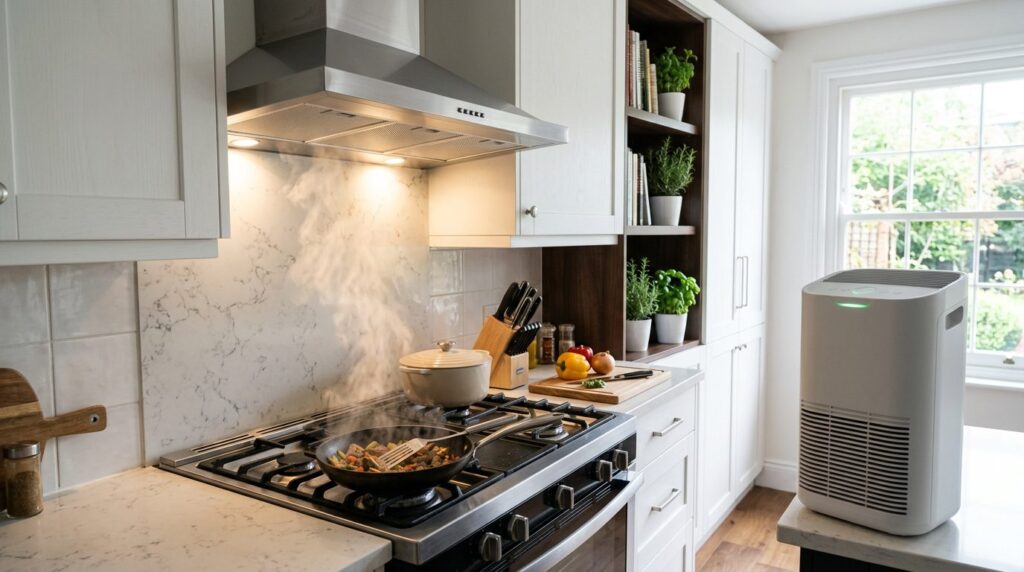
For tobacco and cigar smoke, carbon capacity matters more than it does for wildfire haze. The Coway Airmega 400 and Winix 5510, with separate or granular carbon stages, are better suited to daily smoke odor than models that rely on a carbon-coated pre-filter.
Replace carbon filters on the manufacturer’s schedule or sooner. In a room where someone smokes daily, carbon can saturate within a few months, and a saturated filter no longer reduces odor.
If odor persists even with fresh filters, the smell is probably coming from residue on surfaces rather than from the air. Cleaning fabrics and walls will make a bigger difference at that point.
Place the purifier between the smoke source and the rest of the room, with space on all sides for air to circulate. In a smoking area, that means near where people smoke; in a kitchen, near but not directly beside the stove.
Keep the purifier away from walls and curtains, which restrict airflow, and away from open windows during wildfire events, where it would be trying to filter outdoor air.
For larger homes, two medium purifiers in different rooms often work better than one large unit, because smoke does not spread evenly and a purifier cleans the air closest to it most effectively.
For cooking smoke, a range hood vented outdoors is the first line of defense. A purifier helps with the smoke and odor that escape the hood, but it cannot replace ventilation at the source.
Frying and broiling are among the activities the EPA lists as sources of indoor particles during smoke events. On heavy cooking days, running the purifier on a higher setting for an hour after cooking clears the remaining haze faster.
Wood stoves and fireplaces are another source of indoor smoke. A purifier can reduce particles that leak into the room, but the stove itself should be properly installed, sealed and maintained.
The CDC states there is no safe level of exposure to secondhand smoke, and its health effects in nonsmoking adults include coronary heart disease, stroke and lung cancer. Adults who do not smoke and are exposed to secondhand smoke raise their risk of coronary heart disease by 25 to 30 percent, according to the CDC.
Purifiers reduce particle concentrations and odor, but they cannot remove all the gases in tobacco smoke. The only way to eliminate exposure indoors is to keep smoking outside the home.
If you share a home with a smoker, a purifier with heavy carbon in the rooms you use most, combined with a smoke-free rule for those rooms, is the practical middle ground.
Ozone generators are sometimes sold as smoke-odor removers. The EPA advises choosing portable air cleaners that do not produce ozone and warns against devices that intentionally produce it, because ozone is a lung irritant.
Ozone can react with smoke-related chemicals and other indoor pollutants, and ozone at levels that do not exceed public health standards is generally ineffective against indoor air pollution, according to the EPA. Our article on ozone generator safety covers the risks in more detail.
Professional smoke remediation sometimes uses high-concentration ozone in unoccupied buildings. That is a different process from running a device in a room where people live.
The EPA notes that electrostatic precipitators, ionizers, UV lights without adequate lamp coatings and plasma air cleaners may have the potential to emit ozone. Modern CARB-certified models stay below the 0.050 ppm limit, but these functions are not needed to remove smoke.
Several of our picks include an optional ionizer or PlasmaWave. We suggest running them off by default, especially for anyone with asthma, because HEPA and carbon handle smoke on their own.
If a purifier’s main selling point is ionization rather than filtration, it is not the right choice for smoke.
“HEPA-type” and “HEPA-like” are marketing terms with no standard behind them. They may capture far fewer fine particles than a True HEPA or H13 filter, which is a problem for smoke, where most particles are fine.
Look for True HEPA (99.97% at 0.3 micrometers under the DOE standard) or H13 (99.95% at the most penetrating particle size under EN 1822), and for a published smoke CADR.
A purifier without a published CADR is hard to size correctly for smoke, so we did not include any in our picks.
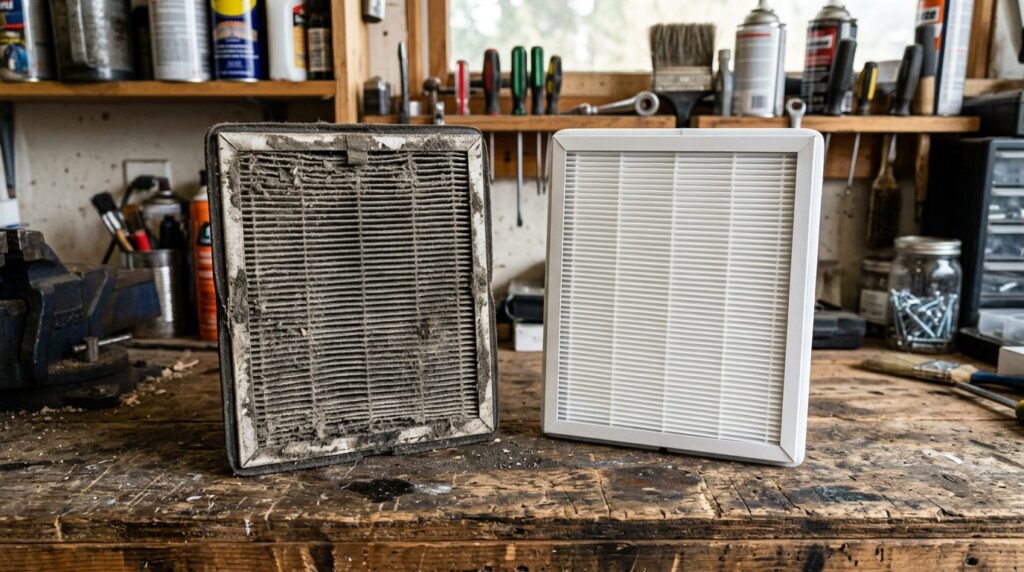
A wildfire smoke event can load a HEPA filter much faster than normal use. After several days of heavy smoke, check the filter and replace it if it looks gray or the airflow has dropped, even if the filter indicator has not triggered.
Most filter indicators track running hours rather than actual filter condition, so treat them as a reminder. The Medify MA-112’s roughly 6-month filter life, for example, assumes typical use rather than wildfire season.
Keep a spare set of filters before fire season starts. Filters for popular models often sell out when smoke arrives.
In homes with tobacco smoke, carbon usually needs replacing before HEPA. When smoke odor returns despite the purifier running, the carbon is likely full.
Models with separate carbon and HEPA stages let you replace just the carbon, which lowers running costs. Combined filters are simpler but mean replacing both at once.
Washable pre-filters should be cleaned monthly and dried completely before reinstalling, so they keep capturing larger particles and protect the more expensive filters.
To compare purifiers fairly, add the purchase price to two or three years of filter replacements and electricity. Larger units cost more to buy and maintain but may replace two smaller purifiers.
The EPA’s Guide to Air Cleaners in the Home stresses that filters need regular replacement, because a dirty, overloaded filter will not work well, so budget for filters from the start. Energy Star models like the Coway Airmega 400 keep the electricity side of that calculation lower.
Because prices change often, we do not list them here. Check current prices on each product page, and consider buying spare filters at the same time.
A True HEPA purifier removes smoke particles from the air, and an activated carbon stage reduces smoke odor and some gases. It cannot remove smoke residue from surfaces or all the harmful gases in tobacco smoke, so it reduces smoke rather than eliminating it.
Choose a model with a substantial carbon stage, such as the Coway Airmega 400 with its separate activated carbon filter or the Winix 5510 with granular carbon. Replace the carbon regularly, because saturated carbon stops reducing odor.
For wildfire smoke, smoke CADR matters most. The Medify MA-112 (about 594 cfm), Levoit Core 600S (391 CFM) and Coway Airmega 400 (328 smoke CADR) offer the most airflow on our list, and the EPA recommends running a purifier in a closed clean room during smoke events.
Use AHAM’s rule of thumb: a smoke CADR of at least two-thirds of the room’s area in square feet for 8-foot ceilings. For wildfire events, more headroom helps, so size up if you can.
Yes, if the purifier has activated carbon and the room is reasonably sealed. Keep windows and doors closed during smoke events and set any central HVAC system to recirculate.
Avoid ozone generators entirely. For purifiers with an ionizer or PlasmaWave, choose a CARB-certified model and consider running with that function off, since HEPA and carbon do the essential work.
Yes. Run it continuously on auto or a higher setting while smoke is present, keep the room closed and check filters after heavy smoke days.
If you are also dealing with damp rooms, see our guide to the best air purifiers for mold, and for allergy-focused picks, our best HEPA air purifiers for allergies.
Written by the Delozone Editorial Team. We research products using manufacturer specifications, certification listings and published test data, and we update guides when products or standards change. How we work.
The Delozone Editorial Team researches water treatment, pool and spa, and indoor air products for independent buying guides. We compare products using manufacturer specifications, certification listings such as NSF/ANSI, UL, AHAM and Energy Star, published third-party test data and verified owner feedback. We do not sell products, and affiliate commissions never decide what we recommend.