Independent buying guides for home air, water and safety.
As an Amazon Associate, Delozone earns from qualifying purchases.
Independent buying guides for home air, water and safety.
As an Amazon Associate, Delozone earns from qualifying purchases.

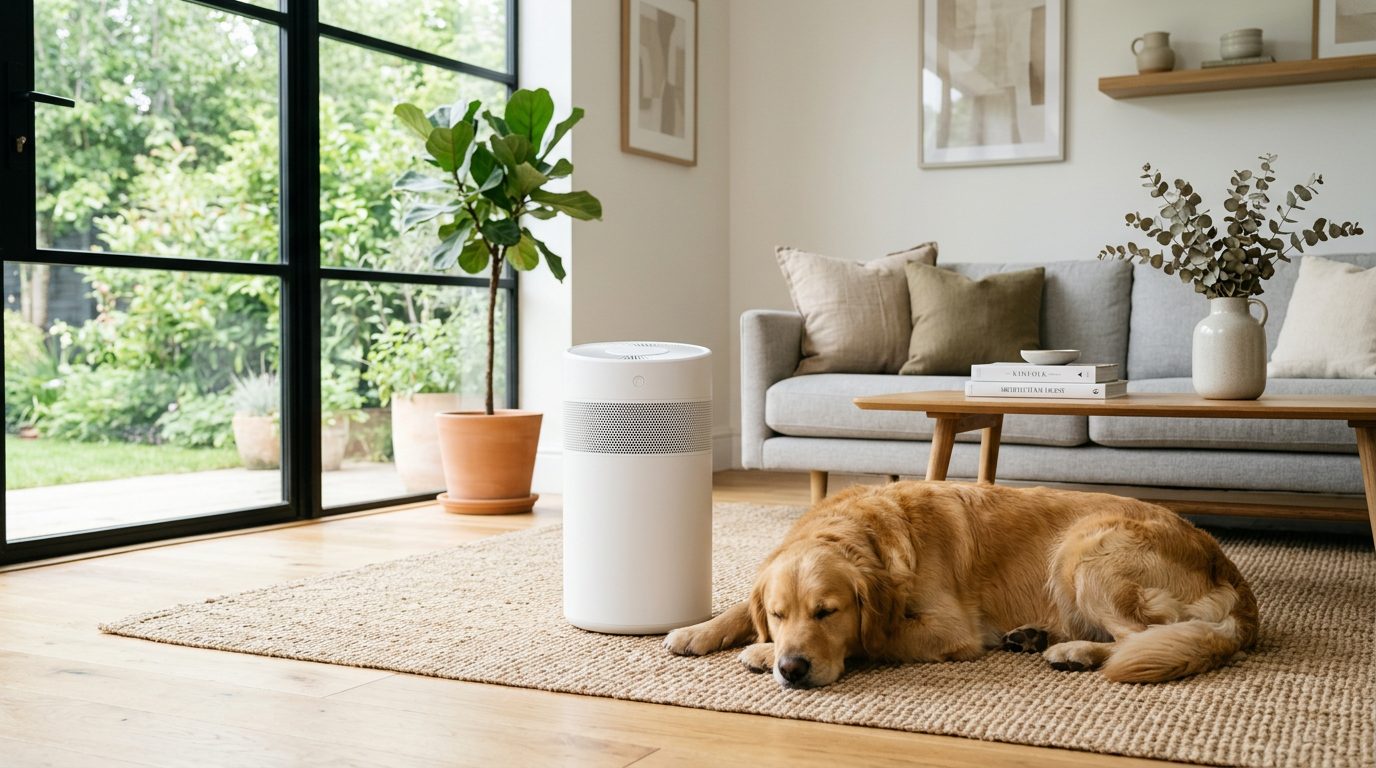
The best air purifiers for pets in 2026, compared by verified CADR, carbon for litter box and dog odors, and pre-filters for fur, plus EPA sizing tips.

The best air purifier for pets combines a HEPA-grade filter for dander, a real activated carbon stage for odors and a washable pre-filter for loose fur, sized with enough clean air delivery rate (CADR) for the room your pets use most, and our top pick for most homes is the Levoit Vital 200S-P, which is AHAM Verifide with a dust CADR of 254 cfm and an extra U-shaped air inlet designed to catch floating pet hair. Pet allergies come from proteins in dander, saliva and urine rather than from the hair itself, so the filter that matters most is the one that captures tiny airborne particles, while carbon handles the litter box and wet dog smells that HEPA cannot touch.
Top picks at a glance
Affiliate links: As an Amazon Associate, Delozone earns from qualifying purchases, at no extra cost to you. Full disclosure
Key takeaways
Quick comparison: best air purifiers for pets in 2026
| Model | Published rating | Coverage (maker) | Odor filtration | Best for | Buy |
|---|---|---|---|---|---|
| Levoit Vital 200S-P | AHAM Verifide; smoke 250, dust 254 cfm | 1,875 sq ft once per hour | Activated carbon stage | Most pet homes | Check price |
| Winix 5510 | AHAM Verifide 392 sq ft | 1,882 sq ft once per hour | Odor control carbon filter | Value, bedrooms | Check price |
| Levoit Core 400S-P | AHAM Verifide; smoke 231, dust 240, pollen 259 cfm | 1,733 sq ft once per hour | 3-in-1 filter with carbon | Apartments, bedrooms | Check price |
| Levoit EverestAir-P | CADR 354 cfm; AHAM Verifide | 2,655 sq ft once per hour | More carbon (maker) | Strong pet odors, large rooms | Check price |
| Coway Airmega 400 | Smoke CADR 328; Energy Star 583 sq ft | Up to 3,120 sq ft once per hour | Separate activated carbon filter | Open plans, several pets | Check price |
| Shark NeverChange Air Purifier Max (HP301) | CARB certified; 99.98% particle capture claim | 1,300 sq ft in one hour | Odor neutralizer cartridge | Lowest filter upkeep | Check price |
The single most useful fact for a pet owner shopping for a purifier is that the allergy does not come from the fur. The Asthma and Allergy Foundation of America’s pet allergy guide explains that people react to proteins found in a pet’s dander, which is dead skin, and in its saliva and urine. Hair, fur and feathers collect those proteins and spread them around, along with dust mites, mold and pollen they pick up along the way.
That changes what you should look for. Dander particles are small enough to float, and AAFA notes that once pet allergens are airborne, the particles can stay in the air for long periods, and that many are small enough to reach the lungs. A HEPA or HEPA-grade filter, which captures at least 99.97% of particles at 0.3 microns under the U.S. Department of Energy definition, is the right tool for that fine, floating fraction.
AAFA also reports that about 6 in 10 U.S. households have a pet and that allergies to cats and dogs affect 10 to 20% of people worldwide. The American College of Allergy, Asthma and Immunology says cat allergies are about twice as common as dog allergies, and AAFA describes cat allergens as especially sticky. No breed is truly allergy free: AAFA states plainly that a truly non-allergic dog or cat does not exist, so a purifier is useful even with a so-called hypoallergenic breed.
“When you have a pet allergy, you are not allergic to the pet’s hair, fur, or feathers. You are allergic to the protein that is found in the pet’s dander (dead skin cells) saliva, and urine.”
Asthma and Allergy Foundation of America, Pet Allergy
Pet odors are gases, not particles. Litter boxes, wet dogs, accidents and pet beds release ammonia and other volatile compounds that pass straight through a HEPA filter. The EPA’s Guide to Air Cleaners in the Home says that to filter gases you need an activated carbon filter or another filter designed to remove gases, and that activated carbon filters can be effective provided there is a large amount of material in the filter.
That last condition is the one most listings skip. A thin carbon-dusted mesh helps with light cooking smells but saturates quickly in a home with a litter box. Purifiers with thicker, dedicated carbon stages, like the Levoit EverestAir-P, the Winix 5510’s odor control filter and the Coway Airmega 400’s separate carbon filter, keep working longer before odor returns.
The EPA also notes that there is no widely used performance rating system for how well air cleaners remove gases, because CADR measures particles only. That means you have to judge odor performance by the type and amount of carbon a manufacturer describes, and by long-term owner feedback on smell, rather than by a single number.
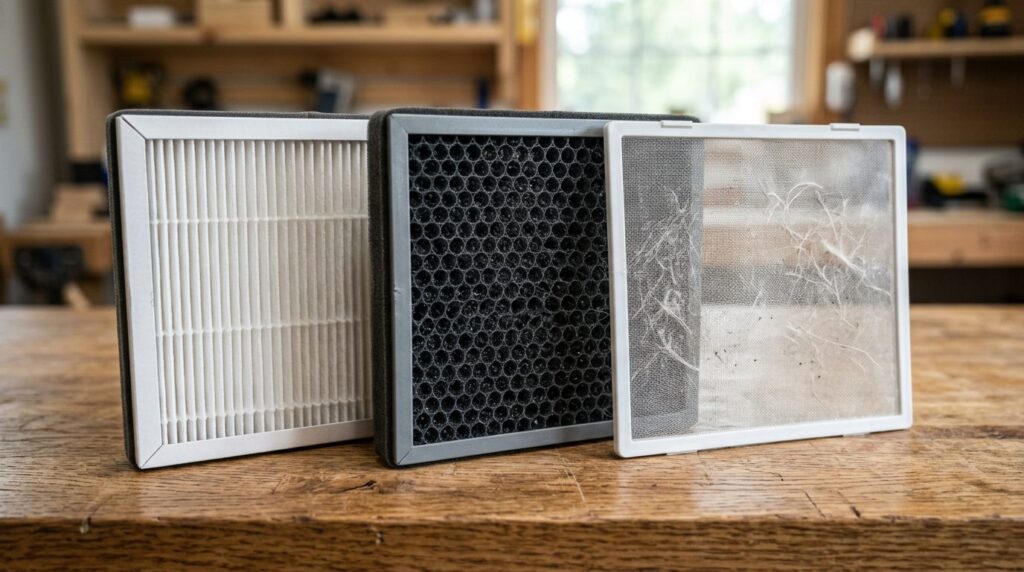
Loose fur is mostly a floor, furniture and clothing problem. A purifier’s washable pre-filter catches the hair and large particles that do get pulled in, which protects the more expensive HEPA filter behind it. In a shedding household, that pre-filter can clog in days rather than weeks, so easy access and washability matter more for pet owners than for anyone else.
Some pet-focused models add features aimed at fur. The Levoit Vital 200S-P and Vital 100S-P use an additional U-shaped inlet that Levoit says traps airborne pet hair without clogging, and the Shark NeverChange Air Purifier Max uses removable debris screens that you vacuum or rinse.
Still, no purifier replaces a vacuum. AAFA recommends vacuuming carpets and fabric furniture weekly with a HEPA-filter vacuum and wiping hard surfaces with a damp cloth, because settled allergens are stirred back into the air by everyday activity. The purifier catches what gets airborne; cleaning removes the reservoir.
CADR, the clean air delivery rate, is the number the EPA tells you to use when choosing a purifier for particles. It measures how many cubic feet of filtered air a purifier delivers per minute at its highest speed, for smoke, dust and pollen separately. Because smoke particles are the smallest, the EPA suggests choosing by smoke CADR if fine particles are your main concern.
The EPA’s sizing chart, based on 8-foot ceilings, calls for a minimum CADR of 65 cfm for 100 sq ft, 130 cfm for 200 sq ft, 195 cfm for 300 sq ft, 260 cfm for 400 sq ft, 325 cfm for 500 sq ft and 390 cfm for 600 sq ft. In other words, roughly two-thirds of the floor area in square feet. For higher ceilings, or a home with several pets, choose a higher CADR than the chart suggests.
Be careful with the large “sq ft” numbers on product boxes. Figures like “up to 1,875 sq ft” describe how big an area the purifier can clean once per hour, which is far fewer air changes than an allergy sufferer needs. The AHAM Verifide room size, or the EPA chart, gives a more realistic room size for everyday use.
A pet purifier runs for hours every day, so noise and electricity matter. Look for a published low-speed noise level, a sleep mode and an auto mode driven by a particle sensor, which raises the fan when a dog shakes or a cat jumps off the sofa and lowers it when the air clears.
Three independent listings help separate real performance from marketing. AHAM Verifide confirms a model’s CADR and room size claims. Energy Star confirms efficiency. The California Air Resources Board (CARB) lists air cleaners that meet its ozone emission limit, and the EPA points to the CARB and AHAM lists as the easiest way to find cleaners that emit little or no ozone.
All 6 of our picks carry at least one of these listings: AHAM Verifide, Energy Star or CARB. Filter replacement is the largest long-term cost, so compare the price and life of replacement filters before you buy, especially the carbon stage, which a litter box can exhaust first.
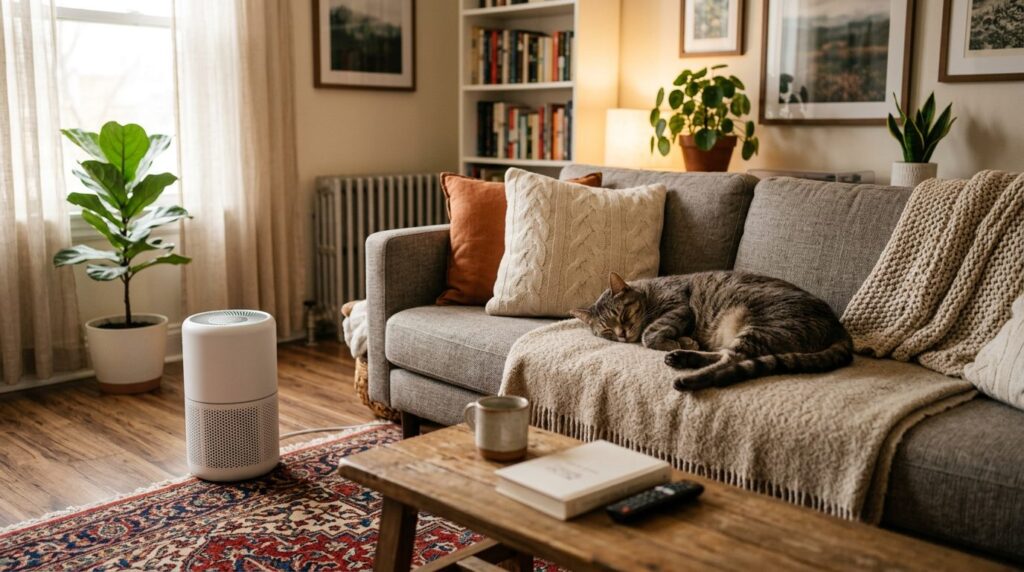
All 6 picks use a HEPA or HEPA-grade particle filter, include a pre-filter for fur and some form of odor filtration, carry an AHAM, Energy Star or CARB listing, and were in stock on Amazon with a working buy box when we checked in September 2026. We ranked them on verified CADR, carbon capacity, pre-filter design, noise, running costs and the pattern of verified owner feedback from pet households.
Each pick is labeled with the home it suits best. A single cat in a one-bedroom apartment, two large shedding dogs in an open-plan house and a multi-cat home with litter boxes in the laundry room need different machines, and a purifier that is right for one can be the wrong choice for another.
The Levoit Vital 200S-P is AHAM Verifide, with published CADRs of 250 cfm for smoke and 254 cfm for dust. Using the EPA’s two-thirds rule, that suits a room of roughly 375 sq ft, which covers most living rooms and large bedrooms. Levoit also rates it to clean up to 1,875 sq ft once per hour for lighter-duty use.
What makes it a pet pick is the air path. Alongside the main inlet, Levoit adds a U-shaped air inlet that it says traps airborne pet hair and odors without clogging, and the washable pre-filter sits in front of a 3-stage filter with an activated carbon layer. Levoit states 99.97% filtration efficiency for 0.1 to 0.3 micron particles, including dander, based on independent lab testing, and lists 27 dB for quiet bedroom use.
The VeSync app adds schedules, filter life tracking and an air quality display, and the built-in sensor drives auto mode. Its carbon is thinner than the EverestAir-P’s, so homes with strong litter box odors may prefer that model. For dander and fur in a typical pet home, the Vital 200S-P is the most balanced choice we found.
Check Levoit Vital 200S-P price on Amazon
The Winix 5510 is the new generation of the long-running Winix 5500-2, and it is AHAM Verifide at 392 sq ft. Winix also rates it to clean 1,882 sq ft in 1 hour, 941 sq ft in 30 minutes and 470 sq ft in 15 minutes, which gives a useful sense of how quickly it clears a bedroom after a pet has been in it.
Its odor control carbon filter is the reason it lands on a pet list. Winix says the carbon reduces VOCs and household odors from cooking, pets and smoke and helps prolong the life of the True HEPA filter, which Winix rates at 99.99% for particles as small as 0.01 microns. A washable fine mesh pre-filter catches fur first.
Winix lists 23.5 dB on the slowest speed, an air quality indicator, auto mode and app control. It also includes PlasmaWave, an ionization feature you can switch off; the HEPA and carbon filters do the essential work. For a bedroom or a mid-sized living room on a budget, the 5510 is the best value we found.
Check Winix 5510 price on Amazon
The Levoit Core 400S-P is AHAM Verifide with published CADRs of 231 cfm for smoke, 240 cfm for dust and 259 cfm for pollen. Applying the two-thirds rule to the smoke figure points to a room of about 345 sq ft, and Levoit rates it to clean up to 1,733 sq ft once per hour.
Its cylindrical 3-in-1 filter combines a pre-filter, a HEPA-grade layer and activated carbon, and Levoit states 99.97% efficiency for 0.1 to 0.3 micron particles including animal dander, based on independent lab testing. A laser dust sensor drives auto mode and shows air quality on the display, and it works with Alexa and the VeSync app.
The round, 360-degree intake suits apartments where the purifier has to sit in the middle of the room rather than against a wall. Levoit lists 24 dB in sleep mode, which makes it a comfortable choice for a bedroom where a pet sleeps. Replacement filters are easy to find, including third-party pet-oriented versions, but we recommend Levoit’s original filter to keep the published performance.
Check Levoit Core 400S-P price on Amazon
The Levoit EverestAir-P is the most powerful Levoit on our list for odors. Levoit lists a CADR of 354 cfm and rates it to filter up to 2,655 sq ft in one hour, and it carries the AHAM Verifide seal. By the two-thirds rule, 354 cfm suits a room of roughly 530 sq ft.
Levoit says the EverestAir-P has 60% more carbon than its comparison model, which is exactly what the EPA’s guidance points to for gases: more carbon material means longer odor control. A 3-channel laser sensor tracks PM10, PM2.5 and PM1.0 separately, so you can see when a grooming session or a shaking dog sends particles into the air, and app scenes can switch it on automatically when air quality drops.
It is larger and more expensive to run than the Vital or Core models, with a 70 W rating, and its filters cost more. For a multi-cat home with litter boxes near living space, or a large dog that spends time in a damp yard, the extra carbon is worth it.
Check Levoit EverestAir-P price on Amazon
The Coway Airmega 400 is Energy Star certified with a smoke CADR of 328 cfm and an Energy Star room size of 583 sq ft, according to the Energy Star listing for the Airmega 400 (AP-2015F). Coway rates it to clean up to 3,120 sq ft once per hour, which makes it one of the most capable mainstream purifiers for open-plan living areas.
Its HyperCaptive system uses a washable pre-filter, a separate activated carbon filter and a HEPA filter that Coway rates at 99.97% for 0.3 micron particles. Because the carbon is its own filter, you can replace it when odor returns without replacing the HEPA, which lowers running costs in a pet home where carbon saturates first.
Smart Mode adjusts the fan to air quality, Eco Mode turns the fan off after 30 minutes of clean air, and Sleep Mode quiets it in a dark room. It is a large unit, so it fits best in the main living space where pets spend the day. For homes with two or more dogs or cats sharing an open plan, it is our pick.
Check Coway Airmega 400 price on Amazon
The Shark NeverChange Air Purifier Max is built around a long-life filter that Shark says lasts up to 5 years, which appeals to pet owners who are tired of buying replacement filters. Shark rates it to purify up to 1,300 sq ft in one hour and says its Anti-Allergen NanoSeal filter captures 99.98% of particles, based on the IEST-RP-CC007 test at 0.1 to 0.2 microns. The listing notes that it is CARB certified.
Removable Debris Defense screens pull in hair, dust and dander before they reach the main filter; you vacuum, wipe or rinse them. A CleanSense IQ display shows particle levels in real time, and the lights dim for sleep.
Two trade-offs matter for pet homes. Shark does not publish an AHAM CADR in the listing, so sizing is less precise than with our other picks, and its Odor Neutralizer cartridge releases a scent, which some people and pets find unwelcome. For owners who want the least filter maintenance and do not mind a fragrance, it is a practical choice.
Check Shark NeverChange Air Purifier Max price on Amazon
We started with purifiers most often recommended for pet homes by specialist reviewers and the models that dominate pet-owner discussions, then removed any without an independent performance or safety listing. AHAM Verifide CADRs and Energy Star room sizes carried the most weight, because they are measured to a common standard rather than stated by the maker alone.
We also required a clean ozone record: none of our picks relies on ozone generation, and the Shark lists CARB certification. If you are unsure about a model, check it against the CARB list of certified air cleaning devices. Models built around ionizers or plasma that cannot be switched off were excluded, following the EPA’s advice to avoid air cleaners that intentionally produce ozone.
Where a well-known model was unavailable, we said so. When we checked in September 2026, the Coway Airmega AP-1512HH Mighty, the Levoit Vital 100S-P and the Blueair Blue Pure 211i Max had no working Amazon buy box, so they are not on the list.
For each model we looked at how much odor filtration it has and whether the carbon is a separate, replaceable stage. We also looked at the pre-filter: is it washable, easy to reach, and does it sit where it will actually catch fur?
Running cost was the third factor: the price and life of replacement filters, and the power draw at the speeds a pet home really uses. A cheap purifier with expensive, short-lived filters can cost more over 3 years than a pricier unit with long-life filters.
We did not assign scores or star ratings. Our ranking reflects fit for typical pet situations rather than a single number, which is why each pick is labeled with the home it suits.
We read verified owner reviews from pet households for patterns rather than star averages: how quickly pre-filters clog with fur, whether litter box odor returns early, fan noise at night, app reliability and filter availability.
Every product was checked in a browser on Amazon in September 2026 for a working buy box. Prices change often, so we link to current prices instead of printing numbers that go stale.
We did not run our own lab or chamber tests. Our choices rely on manufacturer specifications, AHAM, Energy Star and CARB listings, EPA and AAFA guidance and verified owner feedback, and we update the guide when products change.
A single cat in a one-bedroom apartment is the most common pet setup, and it is also where cat allergens are hardest to escape, because the whole home is effectively one room. ACAAI says cat allergies are about twice as common as dog allergies, and AAFA notes that cat allergens are especially sticky, clinging to walls, fabric and clothing. That means both airborne capture and regular cleaning matter.
For this setup, one mid-sized purifier in the main room is usually enough, sized for the combined living and kitchen area. The Levoit Core 400S-P, with a smoke CADR of 231 cfm, suits a room of about 345 sq ft, and its round intake lets it sit in the middle of an open space. If the bedroom is separate and closed at night, move the purifier there in the evening, or add a second small unit.
Put the litter box in a spot with airflow, such as a bathroom with the exhaust fan on a timer, and scoop daily. In a small space, odor control depends more on the litter box routine than on the purifier, and carbon lasts much longer when the source is kept clean.
With two or more cats, odor becomes the main complaint, and carbon capacity decides how long a purifier keeps up. The EPA notes that carbon filters are effective only when there is a large amount of material, so a thin carbon layer that works well with one cat may saturate within weeks with three.
This is where the Levoit EverestAir-P, with what Levoit describes as 60% more carbon, and the Coway Airmega 400, with a separate carbon filter you can replace on its own, make the most sense. Place the purifier in the room nearest the litter boxes, not inside a closet with them, so it cleans the air people and cats actually breathe.
A common rule among cat owners is one litter box per cat plus one. Whatever number you use, spreading boxes around the home spreads the odor sources too, so match purifier placement to the box locations, and replace carbon as soon as odor returns rather than waiting for the filter indicator.
Big double-coated dogs produce more loose fur than any purifier can capture, so the priorities shift. The pre-filter needs to be easy to reach and clean, and the purifier needs enough CADR for the large living areas where dogs lie around during the day.
The Coway Airmega 400, with an Energy Star room size of 583 sq ft, and the Levoit EverestAir-P, with a CADR of 354 cfm, suit open living rooms. For bedrooms, a second smaller purifier keeps the sleeping area cleaner, especially if the dog is kept out at night, as AAFA recommends for allergic households.
Wet dog odor comes from moisture and microbes in the coat, so drying a dog thoroughly after walks and baths reduces odor more than any filter. A towel by the door and a quick wipe-down, which AAFA also suggests for removing outdoor pollen, keep both fur and smells out of the air.
AAFA notes that rabbits, guinea pigs, hamsters, ferrets and horses can also cause allergy symptoms, and that people can be allergic to birds. Small-animal cages add bedding dust and hay particles to the mix, which a HEPA filter handles well.
Place the purifier near, but not directly facing, the cage, so the animal is not sitting in a constant draft. Fan noise matters for small animals too, so choose a model with a quiet low speed and run it on auto.
Bird owners should be especially careful about what else goes into the air. Avoid ozone generators, scented cartridges and fragrance sprays near birds, and ask your avian veterinarian before adding any air cleaner with an ionizer or plasma feature. A plain HEPA and carbon purifier, with any ionizer switched off, is the conservative choice.
If someone in the home has a pet allergy or allergic asthma, plan the purifier around that person rather than around the pet. AAFA recommends keeping pets out of the bedroom and keeping the bedroom door closed, and a purifier in that bedroom does its best work when the room stays pet free.
AAFA also notes that an asthma episode can begin within 15 to 30 minutes of inhaling allergens, and that allergies can develop at any time, even to a pet you have lived with for years. A purifier is one layer of protection, alongside cleaning, grooming routines and medical care.
For allergy-focused picks beyond pet homes, including pollen and dust mites, see our guide to the best HEPA air purifiers for allergies.
If you rent or cannot spend much, focus on one good purifier for the bedroom and a strong cleaning routine. The Winix 5510, AHAM Verifide at 392 sq ft, covers a typical bedroom with room to spare, and its carbon handles light pet odors.
Many rentals have carpet you cannot remove. AAFA suggests low-pile carpet steam cleaned often, washable throw rugs and slipcovers on fabric furniture, all of which work in a rental and reduce the allergen reservoir the purifier has to fight.
Check replacement filter prices before buying the cheapest purifier. Over a few years, filters can cost more than the unit, and a slightly pricier model with longer-lasting filters may be the better deal.
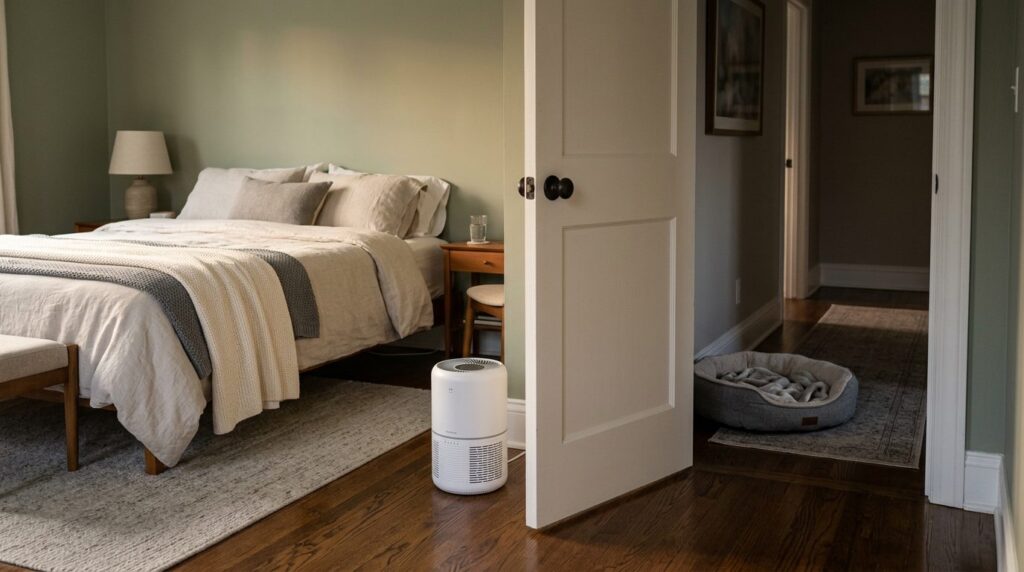
Put the purifier where your pets spend most of their time and where you breathe most: usually the living room during the day and the bedroom at night. Keep it a foot or more from walls and furniture so the intake is not blocked, and away from the spot where a dog likes to lie, since a purifier used as a headrest filters very little.
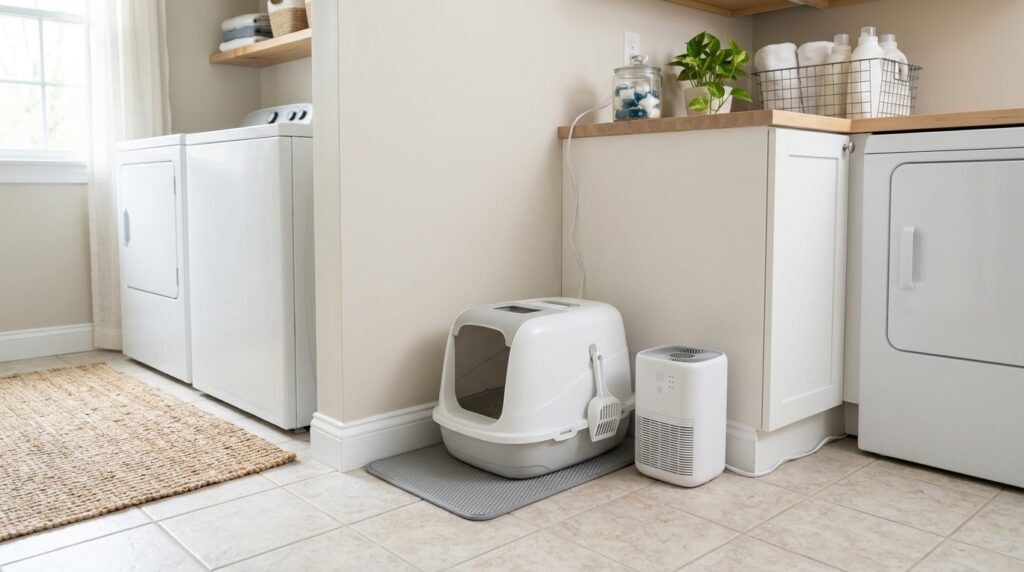
For pets that shed heavily, a location near their favorite resting area catches dander close to the source. Avoid placing it directly next to a litter box in a tiny closet, where it will saturate its carbon quickly without cleaning the rest of the home.
The EPA notes that longer run times and higher fan speeds filter more air. In a pet home, auto mode running continuously is usually the best setting, with a higher speed for an hour after grooming, bathing or vacuuming, when the most allergens are stirred up.
If anyone in the home is allergic, the single most effective change costs nothing. AAFA recommends keeping pets, their cages and their bedding out of bedrooms, because people spend about one-third to one-half of their time there, and keeping the bedroom door closed.
Pair that with a purifier in the bedroom. A smaller unit such as the Levoit Core 400S-P or Winix 5510 can keep a closed bedroom’s air low in dander overnight, even when pets are in the rest of the house.
AAFA also suggests washing bedding weekly in hot water and using slipcovers or washable blankets on fabric furniture. A purifier works much better in a room where the dander reservoir is kept small.
Litter boxes are the main odor source in most cat homes. Scoop daily, keep the box in a ventilated area and, if possible, put the purifier in the same room or next to it, with enough space for air to circulate. A model with more carbon, such as the EverestAir-P or the Coway Airmega 400, lasts longer before odor returns.
For dogs, crates and beds collect hair, dander and outdoor debris. Wash bedding often and keep the purifier within the same room, but not directly beside the crate, where the fan noise may bother a sensitive animal.
AAFA recommends that, if possible, someone without a pet allergy brush the pet outside and clean litter boxes and cages. If you do it yourself, it suggests wearing a mask and gloves, then running the purifier on high for an hour afterward.
One purifier cleans one room or open area. A two-level home with pets usually needs at least two: one in the main living space and one in the bedroom of the allergic person. Each should be sized by CADR for its own room.
The EPA chart is a good starting point: roughly two-thirds of the room’s square footage as the minimum CADR, more for high ceilings. With several pets, aim above the minimum, because allergen levels rise with every shedding animal.
For the rest of the house, the central HVAC system can help. The EPA recommends a furnace or HVAC filter rated at least MERV 13, or as high as your system can accommodate; our HVAC filter and MERV rating guide explains how to choose one.
AAFA says settled pet allergens can remain at high levels for months, cling to walls, fabric furniture and clothing, and cause symptoms up to 6 months after an animal is gone, especially cat allergens. A purifier cannot reach allergens stuck in a carpet, so regular cleaning is the other half of the job.
Vacuum carpets and fabric furniture weekly with a HEPA-filter vacuum, as AAFA recommends, and remove dust from hard surfaces with a damp or microfiber cloth so dander does not go back into the air. Run the purifier on high during and after cleaning.
If you are replacing flooring, AAFA suggests hard surfaces over carpet, or low-pile carpet that is steam cleaned often, and throw rugs that can be washed weekly in hot water.
Regular brushing removes loose fur before it ends up on furniture, and brushing outdoors keeps it out of the house entirely. AAFA suggests wiping pets with pet-friendly wipes or towels after they have been outside, to remove pollen and other allergens they carry in.
Wash your hands, face and clothes after close contact with a pet if you are allergic, and change clothes after grooming. These small habits reduce how much dander reaches your eyes and nose.
For cat owners, AAFA mentions a cat food designed to neutralize Fel d 1, the major cat allergen found in saliva. It may reduce reactions to that allergen, though AAFA notes you may still react to other cat allergens.
Ozone generators are sometimes sold for pet odors, but the EPA advises avoiding air cleaners that intentionally produce ozone, which it calls a lung irritant. Pets cannot leave a room when the air bothers them, which is one more reason to keep ozone machines out of occupied rooms. Our ozone generator safety guide explains the risks in detail.
The EPA also notes that some electrostatic precipitators, ionizers, UV lights without adequate lamp coatings and plasma cleaners may emit ozone. If a purifier includes one of these features, choose a CARB-certified model and consider running it with the feature off.
Scented sprays and plug-in fragrances mask odors rather than removing them, and some pets are sensitive to strong scents. Carbon filtration and regular cleaning remove odor at the source.
A purifier reduces exposure; it does not treat an allergy. AAFA recommends seeing a board-certified allergist for moderate to severe symptoms, since allergy testing can confirm which animal you react to and medicines or allergy shots can help.
AAFA also notes that pet allergy can trigger asthma attacks in people with allergic asthma, and that an episode can begin within 15 to 30 minutes of inhaling allergens. If anyone in the home has asthma, involve their doctor in your plan.
The EPA puts purifiers in context: several studies using portable HEPA air cleaners have found improvements in one or more allergy or asthma symptoms, but the improvements are not always major and not in every symptom. Combined with source control, they are one useful layer among several.
True HEPA, under the U.S. Department of Energy definition, means a filter that captures at least 99.97% of particles at 0.3 microns, the size that is hardest to catch. Many purifiers state this directly, while others describe their filters as HEPA-grade and quote an efficiency for a size range, such as Levoit’s 99.97% for 0.1 to 0.3 micron particles based on independent lab testing.
Be wary of “HEPA-type” or “HEPA-like” labels without a stated efficiency. Those terms have no standard behind them, and such filters can capture far less of the fine particles that carry dander.
The filter is only half the picture. A HEPA filter in a purifier with a weak fan cleans very little air, which is why CADR, not the filter label alone, is the number to compare.
The EPA explains that many air cleaners list 3 CADRs, for tobacco smoke, dust and pollen, which represent small, medium and large particles. Pet dander spans a range of sizes, so the dust and smoke CADRs are the most relevant for pet owners, and the smoke figure is the most demanding.
Our top pick, the Levoit Vital 200S-P, lists 250 cfm for smoke and 254 cfm for dust, and the Levoit Core 400S-P lists 231 cfm for smoke, 240 cfm for dust and 259 cfm for pollen. The closer the smoke CADR is to the dust and pollen figures, the more consistently the purifier handles fine particles.
The EPA also notes that CADR is typically measured at the highest fan speed. Most purifiers run quieter and slower most of the day, so a model sized with some headroom will still clean the room adequately on a lower, quieter setting.
Air changes per hour, or ACH, tells you how many times a purifier can filter the full volume of a room each hour. AHAM’s room-size ratings assume about 4.8 air changes per hour, which is why the AHAM Verifide room size, such as 392 sq ft for the Winix 5510, is much smaller than the “once per hour” coverage figures on the box.
You can estimate ACH yourself: multiply CADR by 60 to get cubic feet per hour, then divide by the room’s volume. A 254 cfm purifier in a 300 sq ft room with 8-foot ceilings, 2,400 cubic feet, delivers about 6.4 air changes per hour at top speed.
For a pet allergy, aim for at least the AHAM level of 4.8 air changes per hour in the room where the allergic person spends the most time, and more in the bedroom. Higher ceilings mean more volume, so choose a larger purifier for vaulted rooms.
| Room area (8 ft ceiling) | Minimum CADR (EPA) | Example pick that fits |
|---|---|---|
| 200 sq ft | 130 cfm | Winix 5510, Levoit Core 400S-P |
| 300 sq ft | 195 cfm | Levoit Core 400S-P, Levoit Vital 200S-P |
| 400 sq ft | 260 cfm | Coway Airmega 400, Levoit EverestAir-P |
| 500 sq ft | 325 cfm | Coway Airmega 400, Levoit EverestAir-P |
| 600 sq ft | 390 cfm | Two purifiers, or one larger unit per zone |
Noise is usually quoted at the lowest fan speed, such as 23.5 dB for the Winix 5510 or 24 dB for the Levoit Core 400S-P in sleep mode. At the high speeds needed for full CADR, every purifier is much louder, so a quiet low-speed figure mainly tells you how pleasant it will be at night.
Energy Star certification, like the Coway Airmega 400’s, confirms efficiency measured as clean air delivered per watt. Because a pet purifier often runs around the clock, a few watts of difference add up over a year.
Wattage figures in listings are usually at the highest speed. The Levoit EverestAir-P is listed at 70 W and the Winix 5510 at 65 W, but on auto in a clean room, both spend most of their time at lower speeds and draw much less.
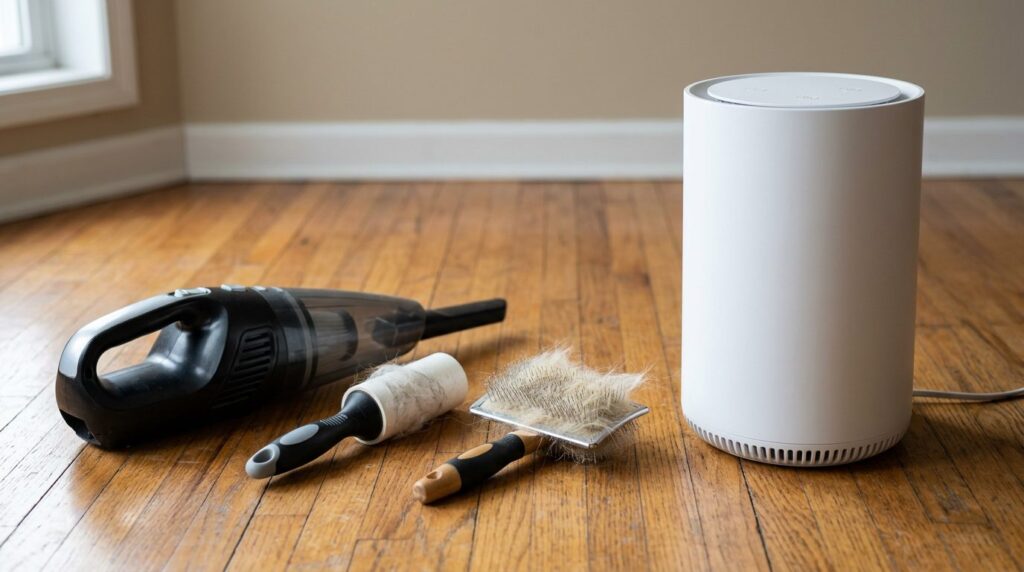
In a shedding household, check the pre-filter weekly. A mat of fur on the intake cuts airflow and makes the purifier louder and less effective. Vacuum it or rinse it according to the manual, and let it dry completely before reinstalling.
Clean pre-filters also protect the HEPA and carbon filters behind them, which are the expensive parts.
The EPA’s advice applies to every filter: all filters need regular replacement, because a dirty, overloaded filter will not work well.
Plan for seasonal peaks. Many double-coated dogs and long-haired cats shed much more heavily for a few weeks as the seasons change, and during those weeks the pre-filter may need cleaning every few days. Keeping a spare pre-filter, where the manufacturer sells one, lets you swap in a dry one while the other is washed, so the purifier never runs unprotected.
In homes with litter boxes, carbon usually saturates before the HEPA filter clogs. When pet odor comes back despite the purifier running, the carbon is likely full. Models with a separate carbon filter, like the Coway Airmega 400, let you replace just that stage.
Filter life indicators on most purifiers count running hours rather than measuring filter condition, so treat them as reminders. A home with two dogs will exhaust filters faster than the manufacturer’s typical-use estimate.
Buy spare filters from the original manufacturer when possible, so you keep the published CADR and filtration performance.
To compare purifiers fairly, add the purchase price to 2 or 3 years of filter replacements and electricity. Energy Star models, like the Coway Airmega 400, keep the electricity side lower, and long-life filters, like Shark’s NeverChange, reduce the filter side.
Because prices change often, we do not list them here. Check current prices, including replacement filters, on each product page before you buy.
If mold or damp is part of your home’s air problem, our guide to the best air purifier for mold covers that, and for general allergy picks see our best HEPA air purifiers for allergies.
The most common mistake is choosing a purifier by the largest number on the box. A claim like “up to 1,875 sq ft” usually means one air change per hour, while AHAM’s room-size ratings assume about 4.8 air changes per hour. For a pet allergy, the smaller AHAM figure is the realistic one.
Use the EPA’s chart instead: roughly two-thirds of the room’s square footage as the minimum CADR for 8-foot ceilings. For a 400 sq ft living room, that means at least 260 cfm, which rules out many compact purifiers marketed for “large rooms”.
If a purifier runs on high all the time to keep up, it is probably undersized. A correctly sized unit can clean the room on a quieter middle speed, which also means you are more likely to leave it on.
A purifier tucked behind a sofa or in a corner filters the air in that corner. The intake needs open space around it, usually a foot or more from walls and furniture, and the outlet should blow into the room rather than into a curtain.
Pets also treat purifiers as furniture. A dog lying against the intake or a cat napping on the warm top can block airflow and fill the pre-filter with fur in a day, so choose a spot pets do not use as a bed.
Moving one purifier between rooms works if you give it time. Run it on high for 30 to 60 minutes in the new room before you settle in, and close the door so it is cleaning a defined space.
In pet homes, filters fail in a predictable order: the pre-filter clogs with fur first, then the carbon saturates with odor, and the HEPA filter lasts longest. Many owners only notice when the purifier gets louder or the litter box smell returns.
Clean the pre-filter weekly during shedding season and replace the carbon when odor returns, even if the indicator says there is life left. The EPA’s warning that a dirty, overloaded filter will not work well applies with extra force when two dogs are shedding into it.
Write the filter change date on the filter or in your phone. It turns a guessing game into a routine and makes it easier to compare the real running cost of different models.
Fragrance cartridges, plug-in scents and sprays make a room smell different, not cleaner. The odor compounds are still there, and some pets and people find strong scents irritating.
Ozone generators are marketed for tough pet odors, but the EPA advises avoiding air cleaners that intentionally produce ozone, which it calls a lung irritant. Ozone does not remove dander, and it is not something to run in a room where pets and people live.
The reliable path is source control plus carbon: scoop and clean litter boxes daily, wash pet bedding, dry wet dogs, and give the purifier enough activated carbon for the number of pets you have.
The EPA notes that higher fan speeds and longer run times filter more air, and that an air cleaner set at a lower speed filters less. A purifier switched on only when symptoms flare is always playing catch-up with allergens that settled hours ago.
Leave it running on auto all day, and use a higher speed during and after grooming, bathing, vacuuming or play sessions, when the most dander is airborne. Sleep mode at night keeps the bedroom purifier quiet while it keeps working.
If noise stops you from running a purifier on a useful speed, it is the wrong purifier for that room. A larger unit on a middle speed is usually quieter than a small unit on high, for the same amount of clean air.
Yes, for airborne dander and odors, within limits. The EPA reports that several studies with portable HEPA air cleaners found improvements in one or more allergy or asthma symptoms, but the improvements are not always large. A purifier works best alongside cleaning, grooming and keeping pets out of bedrooms.
Mostly marketing, with a few useful differences. Pet versions usually add more activated carbon for odors, a pre-filter or inlet designed for fur, and sometimes a pet mode. The core filtration, HEPA plus carbon, is the same as in any good purifier.
A purifier’s pre-filter catches loose hair that gets pulled in, and models like the Levoit Vital 200S-P add an inlet designed for it. Most fur settles on floors and furniture, though, so a HEPA-filter vacuum and regular brushing do most of the hair removal.
Choose one with a substantial activated carbon stage, such as the Levoit EverestAir-P, the Coway Airmega 400 with its separate carbon filter or the Winix 5510. The EPA notes that carbon filters are effective when they contain a large amount of material.
Use the EPA’s chart: a CADR of at least about two-thirds of the room’s square footage for 8-foot ceilings, for example 260 cfm for a 400 sq ft room. With several pets or high ceilings, choose more.
HEPA and carbon purifiers are safe for pets. Avoid ozone generators and any air cleaner that intentionally produces ozone, which the EPA calls a lung irritant, and choose CARB-certified models if a purifier includes an ionizer or plasma feature.
Yes. The EPA notes that longer run times filter more air, and pets shed continuously. Auto mode running all day, with a higher speed after grooming or vacuuming, works well in most homes.
No. AAFA states that a truly non-allergic dog or cat does not exist, because people react to proteins in dander, saliva and urine. Some people tolerate certain breeds better, but a purifier and cleaning routine still help.
They help if the purifier has a substantial activated carbon stage and the litter box is kept clean. Carbon adsorbs odor compounds that HEPA filters cannot catch, but it saturates faster in multi-cat homes, so replace the carbon when the smell returns and scoop daily. Models with more carbon, like the Levoit EverestAir-P or the Coway Airmega 400, last longer between changes.
No. A purifier captures fur and dander that become airborne, but most fur settles on floors, furniture and clothing. AAFA recommends vacuuming carpets and fabric furniture weekly with a HEPA-filter vacuum and wiping hard surfaces with a damp cloth, then letting the purifier catch what cleaning stirs up.
More often than the manufacturer’s typical-use estimate. Clean washable pre-filters weekly during shedding season, replace carbon when odor returns and replace the HEPA filter when airflow drops or the indicator calls for it. Two or more shedding pets can shorten filter life noticeably.
Put it in the room where pets and people spend the most time, at least a foot from walls and furniture, and away from spots pets use as a bed. If someone is allergic, a second purifier in their pet-free bedroom, with the door closed, gives the biggest improvement at night.
For more on the air your pets and family share, see our guides to the best air quality monitors for home and the best air purifier for smoke.
Written by the Delozone Editorial Team. We research products using manufacturer specifications, AHAM, Energy Star and CARB listings, EPA and AAFA guidance and verified owner feedback, and we update guides when products or guidance change. How we work.
The Delozone Editorial Team researches water treatment, pool and spa, and indoor air products for independent buying guides. We compare products using manufacturer specifications, certification listings such as NSF/ANSI, UL, AHAM and Energy Star, published third-party test data and verified owner feedback. We do not sell products, and affiliate commissions never decide what we recommend.