Independent buying guides for home air, water and safety.
As an Amazon Associate, Delozone earns from qualifying purchases.
Independent buying guides for home air, water and safety.
As an Amazon Associate, Delozone earns from qualifying purchases.

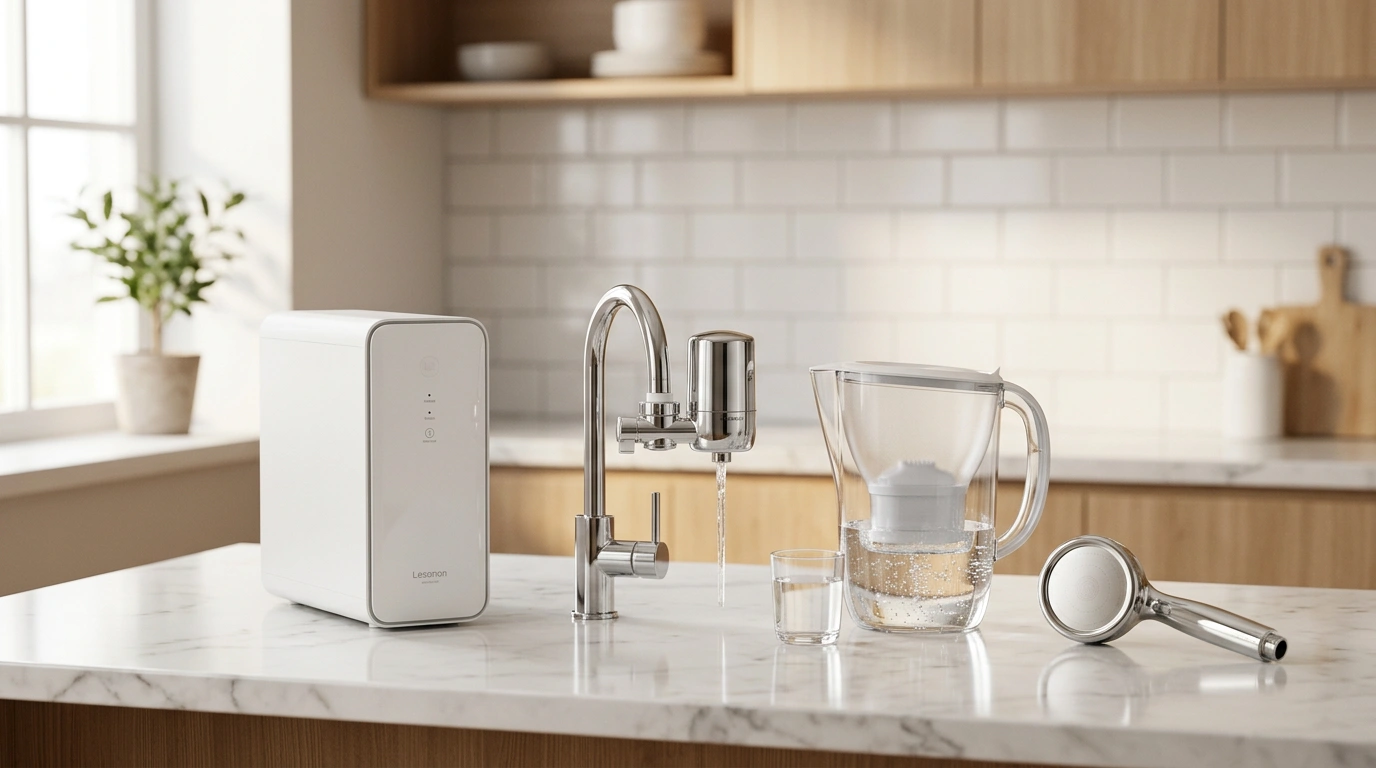

Choosing the best water filter for apartment living comes down to three things: which contaminants are certified, what the replacement filters cost, and what your lease lets you install. We compared 9 systems across countertop, faucet-mount, pitcher and shower categories on exactly those points. Here are the picks that make the most sense for renters.
Top picks at a glance
Affiliate links: As an Amazon Associate, Delozone earns from qualifying purchases, at no extra cost to you. Full disclosure
Key Takeaways
| Product | Category | Type | Key Feature | Buy on Amazon |
|---|---|---|---|---|
| AquaTru Classic | Best Overall | Countertop RO | Removes 84 contaminants | Check price |
| PUR Plus PFM400H | Best Budget | Faucet-Mount | NSF 53 certified, under budget | Check price |
| Clearly Filtered Pitcher | Best Filtration Pitcher | Pitcher | NSF 42 + 372 certified, 100-gal filter | Check price |
| Brita Elite 10-Cup | Best Budget Pitcher | Pitcher | 99% lead removal, 6-mo filter | Check price |
| ZeroWater 10-Cup | Best TDS Removal | Pitcher | Includes TDS meter, 0 TDS | Check price |
| Waterdrop WD-FC-06 | Best Faucet Runner-Up | Faucet-Mount | Stainless steel, 360° swivel | Check price |
| AquaBliss SF100 | Best Shower Filter | Shower | Multi-stage, universal fit | Check price |
| Sprite HO2-WH-M | Shower Runner-Up | Shower | Inline, keeps your shower head | Check price |
We did not run our own lab tests. Every pick on this page had to pass the same research checks, and we say where each claim comes from:
Apartment buildings add layers of plumbing between the municipal water main and your faucet that single-family homes simply do not have. Water travels through shared risers, aging branch lines, and sometimes decades-old solder joints before reaching your tap. According to the EPA, buildings constructed before 1986 may contain lead solder in their plumbing, and the building owner is not required to replace it.
Older apartment complexes are especially prone to elevated lead, copper, and sediment levels because of shared water heaters and long pipe runs. Water sitting in these pipes overnight absorbs whatever the pipe walls contain. That first-draw morning water from your kitchen faucet often carries the highest contaminant concentration of the day.
Municipal treatment plants deliver water that meets federal standards at the treatment facility. What happens between the main and your faucet is a different story. The EWG Tap Water Database shows that most U.S. water systems contain legal but potentially harmful levels of contaminants, legal limits and health-based guidelines are not the same thing.
The contaminants most likely to affect apartment dwellers fall into a few specific categories. Lead tops the list: according to the EPA, up to 9 million homes and businesses are still connected to water mains through legacy lead pipes, and the 2024 Lead and Copper Rule Improvements lower the lead action level from 15 to 10 micrograms per liter. Chlorine and chloramines come next, added intentionally during treatment but carrying taste, odor, and potential byproduct concerns by the time they reach your glass.
PFAS (per- and polyfluoroalkyl substances) became a regulatory priority when the EPA finalized limits for six PFAS in April 2024. In May 2026 the agency proposed keeping the PFOA and PFOS limits, with an option for water systems to request until 2031 to comply, and rescinding the limits for the other four. Because utilities have years to comply, a certified point-of-use filter is the fastest way for a renter to reduce PFOA and PFOS at the tap. Microplastics are a newer concern, and a few pitcher filters now carry certified microplastics reduction claims.
Other contaminants worth knowing about include arsenic, mercury, volatile organic compounds (VOCs), pesticide residues, pharmaceuticals, and cysts like Giardia and Cryptosporidium. The specific mix depends on your local water source and the age of your building’s plumbing. That variability is exactly why testing matters more than guessing.
A TDS meter is inexpensive and gives you a baseline reading of total dissolved solids in seconds. TDS under 150 ppm generally means a basic pitcher or faucet-mount filter will handle the job. Readings above 300 ppm point toward a countertop reverse osmosis system like the AquaTru for meaningful improvement.
For a more detailed picture, request your water utility’s annual Consumer Confidence Report (CCR), they are required by law to publish one. The CCR lists detected contaminants, their levels, and whether they exceed federal maximums. If you want to test specifically for lead, PFAS, or other chemicals the CCR may not cover, mail-in kits from certified labs are the next step, and the price depends on how many contaminants the panel covers.
TDS readings in older apartment buildings can vary from one unit to the next, so test your own tap rather than relying on the building average or a neighbor’s result. A reading near the 150 ppm or 300 ppm marks above is enough to change the type of filter that makes sense. Starting with data rather than assumptions saves you money and ensures the filter you buy actually addresses your water’s issues.
The first question for any apartment dweller is whether the filter requires plumbing modifications. Most lease agreements prohibit changes to the plumbing, and even “minor” modifications can cost your security deposit. The renter-friendly categories break down into four types: countertop (no installation), faucet-mount (hand-tightened adapter, fully removable), pitcher (zero contact with plumbing), and shower head (replaces existing shower head with no permanent changes).
Countertop reverse osmosis systems like the AquaTru sit on your counter and require only a power outlet. Faucet-mount filters like the PUR Plus screw onto your existing faucet aerator, no tools, no drilling, and they come off in seconds when you move. Pitcher filters go in the fridge and need nothing at all. Most shower filters thread onto the standard half-inch shower arm found in most U.S. bathrooms.
Under-sink filters technically exist as an option, but we do not recommend them for most renters. Even “tool-free” under-sink systems require access to your cold water supply line, and any leak becomes your financial responsibility. Countertop and pitcher options deliver comparable filtration performance without the risk. If you need help choosing between a broader set of systems, our home water filtration guide covers every type in detail.
Three core filtration technologies dominate the apartment-friendly market. Activated carbon (granular or carbon block) handles chlorine, taste, odor, and some organic compounds. Carbon block filters are denser and more effective than granular carbon, they force water through compressed carbon rather than around loose granules. Most faucet-mount and pitcher filters use some form of activated carbon.
Reverse osmosis (RO) pushes water through a semipermeable membrane with pores small enough to block dissolved solids, heavy metals, PFAS, fluoride, and most bacteria. Traditional RO systems required under-sink installation and a dedicated faucet. Countertop RO systems changed that equation entirely, they sit on your counter and produce RO-quality water without touching your plumbing.
Ion exchange resins target specific contaminants like lead, mercury, and dissolved minerals. The ZeroWater pitcher combines ion exchange with activated carbon in its 5-stage system. KDF (Kinetic Degradation Fluxion) media appears primarily in shower filters, where it reduces chlorine and heavy metals at higher water temperatures where carbon becomes less effective. Understanding which technology targets which contaminants prevents the common mistake of buying a chlorine-only filter when you actually need lead removal.
NSF/ANSI certifications are the only reliable way to verify a manufacturer’s contaminant removal claims. The NSF tests products independently in accredited laboratories, manufacturers cannot self-certify. Four standards matter most for apartment water filters:
| Standard | What It Covers | Key Contaminants |
|---|---|---|
| NSF/ANSI 42 | Aesthetic effects | Chlorine taste/odor, particulates |
| NSF/ANSI 53 | Health effects | Lead, cysts (Giardia, Cryptosporidium), VOCs, mercury |
| NSF/ANSI 58 | Reverse osmosis | TDS, arsenic, barium, fluoride, nitrates, radium |
| NSF/ANSI 401 | Emerging contaminants | Pharmaceuticals, pesticides, herbicides |
A filter certified to NSF 42 alone only removes aesthetic issues, it will not protect you from lead or PFAS. For meaningful health protection, look for NSF 53 at minimum. IAPMO R&T and WQA are also accredited certifiers that test against the same NSF/ANSI standards, so a listing from any of the three counts. Two more standards are worth knowing: NSF/ANSI 372 only confirms lead-free materials (it is not a contaminant reduction claim), and NSF/ANSI 177 covers free chlorine reduction in shower filters.
Watch out for vague language like “tested to NSF standards” or “meets NSF requirements.” These phrases mean nothing without an actual certification number from NSF, IAPMO, or WQA. If a manufacturer cannot provide a specific certification listing, treat their contaminant removal claims with skepticism.
AquaTru Classic Countertop RO System
| Spec | Detail |
|---|---|
| Setup time | 5 minutes |
| Counter space needed | 14″ x 12″ rectangle |
| Plumbing changes | None |
| Removes | Lead, PFAS, fluoride, arsenic, chlorine, 84 contaminants |
| Filter life | Three replaceable stages, app or indicator shows when each is due |
| Certification | IAPMO certified to NSF/ANSI 42, 53, 58, 401 and P473 (per owner’s manual) |
| Cost | premium upfront, mid-range/year ongoing |
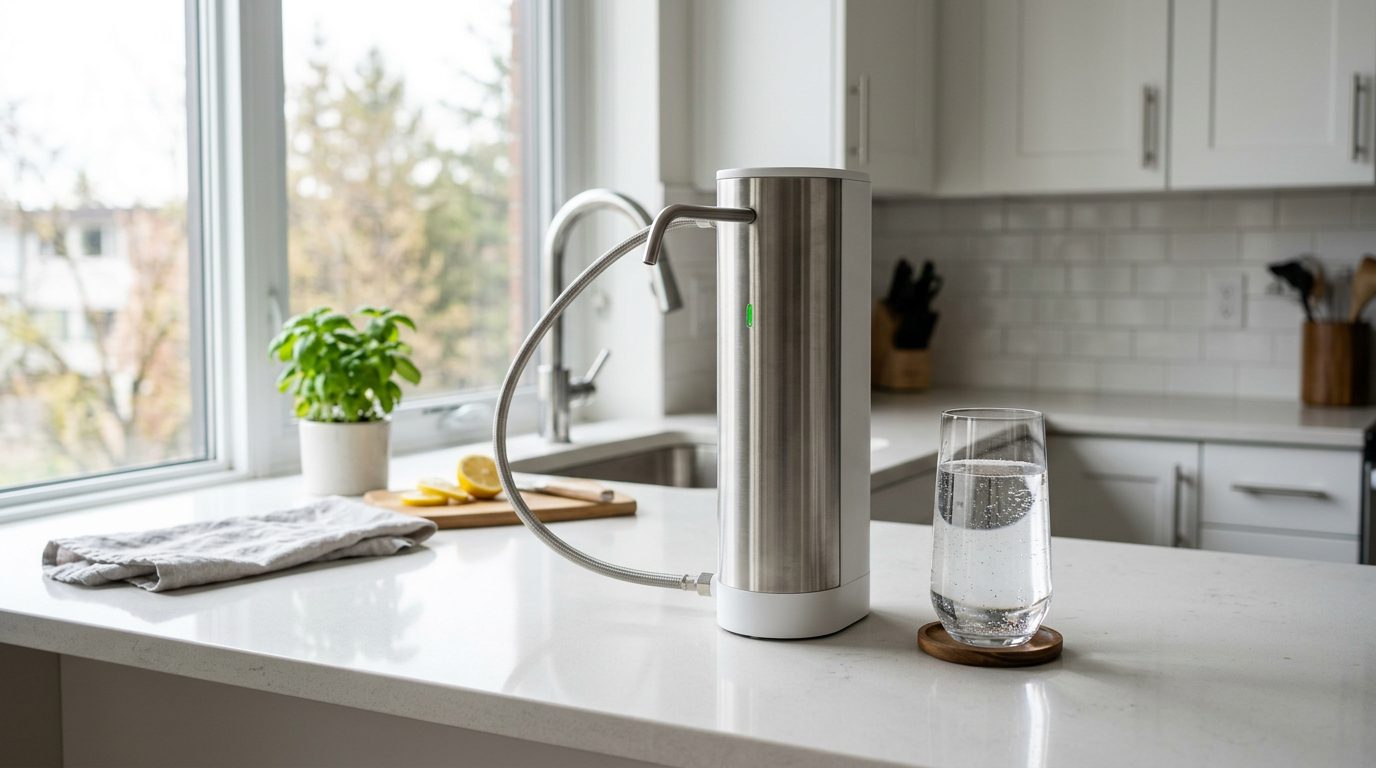
The AquaTru brings reverse osmosis purification to a countertop format that requires absolutely no plumbing. Fill the tank, press the button, and the 4-stage system produces RO-pure water. The pre-filter catches sediment, the carbon block handles chlorine and organics, the RO membrane removes most dissolved solids, and the final carbon stage polishes taste.
As a reverse osmosis system, the AquaTru typically removes 90 to 97% of dissolved solids, so a TDS meter reading should drop sharply after filtering. It works in batches: you fill the tap water tank, the unit purifies it into a separate clean water tank, and you pour from that, so it suits planned drinking and cooking rather than filling a large pot on demand. The Smart model connects to a mobile app that tracks filter life for each of the three replaceable stages.
If you are concerned about lead or PFAS, the AquaTru is the most effective portable option on this list. No other countertop system matched its breadth of certified contaminant removal. Our full countertop filter comparison covers additional models if you want to see how they stack up.
According to the AquaTru Classic owner’s manual, the system is certified by IAPMO against NSF/ANSI 42, 53, 58, 401 and P473 for the reduction claims on its performance data sheet, which covers chlorine, lead, PFOA/PFOS and a range of emerging contaminants. Its Amazon listing puts the total at 84 contaminants. These are certification results under standardized lab conditions, so the practical check at home is a TDS meter: a reverse osmosis system should show a large drop between tap and purified water, and a reading that creeps up over time is a sign a stage is due.
Noise during operation is minimal. The pump produces a low hum comparable to a refrigerator running. In an apartment with shared walls, owners generally describe it as quiet enough, quiet enough to run overnight without disturbing neighbors. The unit fits comfortably on a standard 24-inch kitchen counter with room to spare for a cutting board beside it.
One practical note: reverse osmosis produces waste water. Countertop RO units like the AquaTru send the rejected water back to the tap water tank or a waste reservoir that you empty by hand, so nothing drains into your plumbing. If you pay your own water bill, expect a small increase in use, and check the current reject ratio on the manufacturer’s spec sheet before you buy.
The AquaTru has the highest upfront cost of the picks on this page. Ongoing cost comes from three replaceable stages that wear out at different rates: the pre-filter stages need changing most often, while the RO membrane and the final carbon stage last longer. Check the current rated life for each stage on the manufacturer’s page before you compare it with a pitcher, because the cost per gallon is what matters.
Compared with buying bottled water every week, a countertop RO unit replaces a recurring purchase with a few filter changes a year, which is where it earns back its higher upfront cost. Against a Brita pitcher using standard filters, the AquaTru costs more per year but removes an order of magnitude more contaminants, including PFAS, fluoride, and dissolved solids that pitcher filters cannot touch.
For apartment renters who move frequently, the AquaTru’s portability is a genuine advantage. Drain the tanks, pack it in its original box, and set it up at your next apartment in 5 minutes. No plumbing to disconnect, no holes to patch, no deductions from your deposit.
Check Price on Amazon
PUR Plus Faucet Filtration System (PFM400H)
| Spec | Detail |
|---|---|
| Setup time | 2 minutes (screws onto faucet) |
| Counter space needed | None |
| Plumbing changes | None (hand-tightened adapter) |
| Removes | Chlorine, lead, mercury, some pesticides (70+ contaminants) |
| Filter life | 100 gallons (2 to 3 months) |
| Certification | NSF and WQA certified to reduce 70 contaminants (per PUR) |
| Cost | budget upfront, budget/year ongoing |
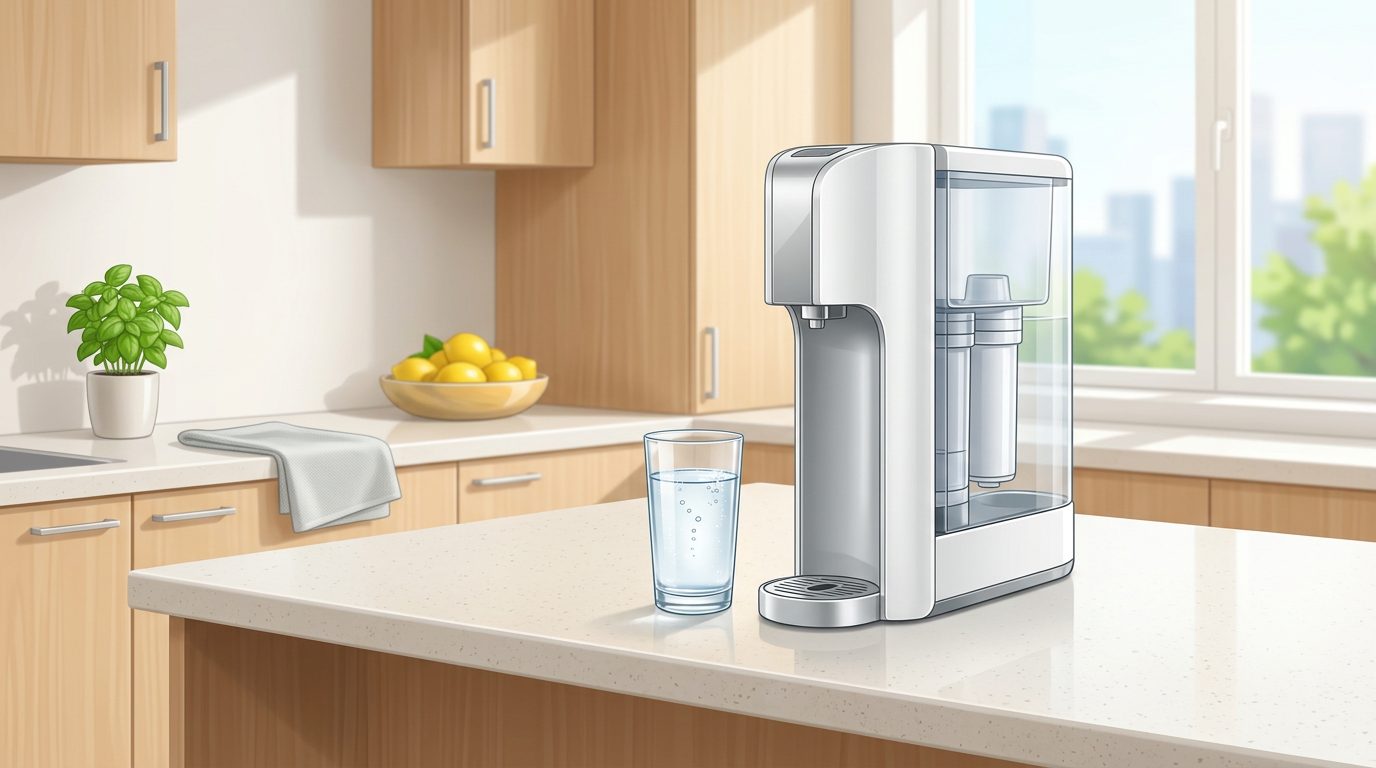
The PUR Plus faucet-mount filter attaches directly to your kitchen faucet with a hand-tightened adapter, no tools, no plumber, no landlord permission needed. A lever on the unit switches between filtered and unfiltered water, so you are not wasting filter life on dishes. PUR says its faucet systems are NSF and WQA certified to reduce 70 contaminants, including lead and mercury, so its lead claim is independently verified.
On cost per certified contaminant, the PUR Plus is the best value here: the system is one of the cheapest on this list, and each filter is rated for up to 100 gallons or 3 months. It is certified for 70 contaminants including lead and mercury, a meaningful upgrade over unfiltered tap water. One limit to know: PUR states that its filters do not filter microbes.
The trade-off is flow rate. Filtered water comes out at approximately 0.5 gallons per minute versus the typical unfiltered rate of 2.2 GPM. Filling a pot takes noticeably longer in filtered mode. The filter also needs replacement every 100 gallons or 3 months, which is more often than the Brita Elite’s 120-gallon pitcher filter. For our full faucet-mount comparison, see our faucet-mount filter review.
Check Price on Amazon
Waterdrop WD-FC-06 Faucet Water Filter
The Waterdrop WD-FC-06 is the upgrade pick if you want a faucet filter that looks like it belongs in a modern kitchen. The 304 stainless steel body replaces the plastic housings found on most competitors, and the 360-degree swivel nozzle positions filtered water wherever you need it. The coconut shell carbon block filter targets chlorine taste and odor, sediment and rust, according to Waterdrop’s listing.
Check how many replacement filters the listing you choose includes, because extra cartridges in the box change the first-year cost more than the sticker price does. The stainless steel body is also less prone to the cracking and discoloration owners report on older plastic faucet filters.
Where the Waterdrop falls short compared to the PUR Plus is certification breadth. It does not carry NSF 53 certification for lead reduction, which means its health-effect claims lack the same level of third-party verification. If lead is your primary concern, the PUR Plus is the safer choice. If chlorine taste and durability matter more, the Waterdrop wins.
Check Price on Amazon
| Feature | PUR Plus PFM400H | Waterdrop WD-FC-06 |
|---|---|---|
| Material | Plastic | 304 Stainless Steel |
| NSF 53 (Lead) | Yes | No |
| Contaminants | 70+ | Chlorine, sediment, rust |
| Replacement filters included | 1 | 4 |
| Filter life | 100 gallons / 2 to 3 mo | See current listing |
| Swivel | No | 360° |
| First-year cost | Mid-range | Low running cost |
| Best for | Lead/contaminant removal | Chlorine taste, durability |
Both filters install in under 2 minutes and remove completely when you move out. Neither leaves marks or modifications on your faucet. The deciding factor comes down to your water test results: if your lead test shows any detectable lead, go with the certified PUR Plus. If your water tests clean for heavy metals and you just want better-tasting water, the Waterdrop is the more durable and attractive option.
Clearly Filtered No.1 Water Pitcher
| Spec | Detail |
|---|---|
| Setup time | 1 minute |
| Counter space needed | Fits in refrigerator door |
| Plumbing changes | None |
| Removes | Chlorine (certified); lead, PFAS, fluoride per the brand’s own lab data |
| Filter life | 100 gallons (2 to 4 months) |
| Certification | NSF/ANSI 42 and 372 (per Clearly Filtered) |
| Cost | mid-range upfront, mid-range/year ongoing |
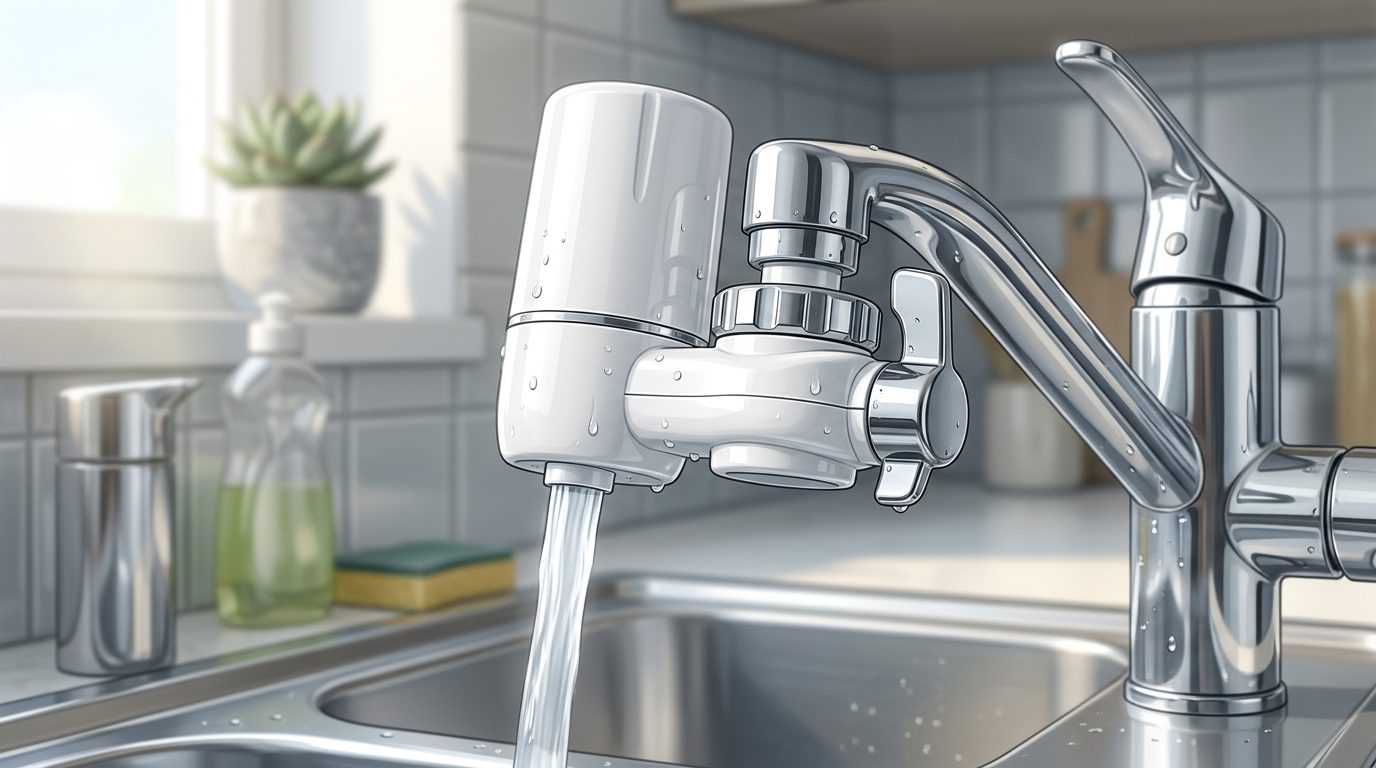
The Clearly Filtered pitcher sits in a category of its own among pitcher filters. The brand markets it as targeting 365+ contaminants including PFAS, fluoride, lead and microplastics, based on its own third-party lab reports. Be clear about what is certified, though: Clearly Filtered states the pitcher is certified by NSF International to NSF/ANSI 42 (chlorine taste and odor) and NSF/ANSI 372 (lead-free materials), and its filter is rated for 100 gallons or 6 months. NSF/ANSI 53 and 401 are not on that list.
Compared with the Brita Elite and ZeroWater, the Clearly Filtered publishes the longest list of tested contaminants, but the other two hold more health-effect certifications: the Brita Elite for lead and PFOA/PFOS, the ZeroWater for lead, chromium, mercury and PFOA/PFOS. TDS alone does not tell the whole story either, because a filter can lower TDS without being certified for the contaminant you worry about.
The trade-off is cost: it is the most expensive pitcher here to run. It makes sense if fluoride is your main concern and you are comfortable relying on the brand’s published lab data. If you want a certified lead or PFOA/PFOS claim, the Brita Elite or ZeroWater gives you that for less.
Check Price on Amazon
Brita Everyday Elite Water Filter Pitcher
| Spec | Detail |
|---|---|
| Setup time | 1 minute |
| Counter space needed | Fits in refrigerator door |
| Plumbing changes | None |
| Removes | Lead, PFOA/PFOS, chlorine, mercury, cadmium, benzene, microplastics |
| Filter life | 120 gallons (6 months) |
| Certification | NSF/ANSI 42, 53, 401 (WQA/NSF), PFOA/PFOS by IAPMO R&T |
| Cost | budget upfront, budget/year ongoing |
The Brita Elite is the most popular water filter pitcher in the U.S. for straightforward reasons: it works, it is cheap, and the filter lasts 6 months, three times longer than Brita’s standard filters. Brita’s performance data sheet lists reductions under NSF/ANSI 42, 53 and 401, including lead, mercury, cadmium, benzene and microplastics, and states that the Elite filter (OB06) is certified by IAPMO R&T against NSF/ANSI 53 for PFOA/PFOS reduction. It is rated for 120 gallons, about 6 months for an average family.
With a low pitcher price and only two filters a year, the Brita Elite has the lowest running cost of the drinking water picks on this page. For apartments with decent municipal water, meaning your CCR shows no major contaminant exceedances, the Brita Elite handles the basics without overthinking it.
The limitation is what the Brita Elite does not remove. It does not reduce fluoride, arsenic, nitrates or dissolved minerals, and its PFAS certification covers PFOA and PFOS rather than every PFAS compound. If your CCR or water test flags those, step up to the AquaTru. For apartments where chlorine taste, lead and PFOA/PFOS are the main concerns, the Brita Elite is the practical, no-nonsense choice.
Check Price on Amazon
ZeroWater 10-Cup Ready-Pour Pitcher
| Spec | Detail |
|---|---|
| Setup time | 1 minute |
| Counter space needed | Fits in refrigerator door |
| Plumbing changes | None |
| Removes | Lead, chromium, PFOA/PFOS, achieves 0 TDS reading |
| Filter life | Varies with your TDS; ZeroWater’s own test used a 15-gallon rated capacity |
| Certification | IAPMO certified for PFOA/PFOS, lead, chlorine, chromium, mercury |
| Cost | budget upfront, mid-range/year ongoing |
The ZeroWater pitcher takes a fundamentally different approach from other pitcher filters. Its 5-stage filtration system combines activated carbon with ion exchange resins to achieve a 0 TDS reading, something no other pitcher on the market replicates. The included TDS meter lets you verify the results yourself, testing your tap water before and after filtering to see the exact improvement.
ZeroWater ships with a TDS meter and aims for a 000 reading, which means dissolved solids are essentially gone. That visual proof makes the ZeroWater especially satisfying for apartment dwellers who have never tested their water before. ZeroWater states its 5-stage ion exchange filter is IAPMO certified to reduce PFOA/PFOS, lead, chlorine, chromium and mercury, which gives third-party backing to its most serious contaminant claims.
The catch is filter life. ZeroWater filters exhaust much faster than competitors because the ion exchange resin becomes saturated as it absorbs dissolved solids. ZeroWater recommends changing the filter when the meter reads 006, and the higher your starting TDS, the sooner that happens; its own published comparison used a 15-gallon rated capacity. That makes it clearly more expensive to run than the Brita Elite. Apartment dwellers with hard water (TDS above 300 ppm) will burn through filters even faster.
Check Price on Amazon
| Spec | Detail |
|---|---|
| Setup time | 5 minutes |
| Counter space needed | 8.5″ diameter circle |
| Plumbing changes | None |
| Removes | Chlorine, lead, PFAS, bacteria, viruses, VOCs |
| Filter life | Long rated life per Berkey, see manufacturer |
| Cost | premium upfront, mid-range/year ongoing |
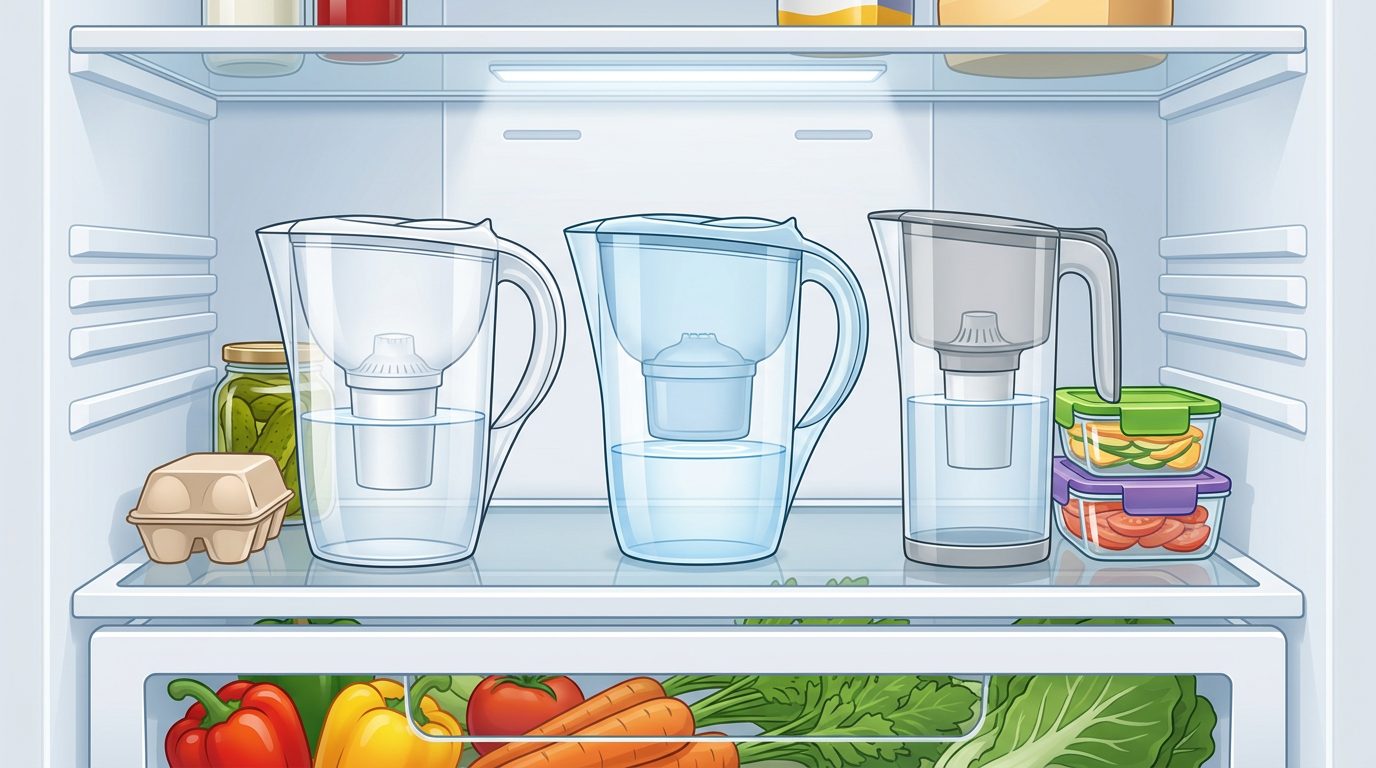
Gravity filters represent the simplest water filtration technology available: pour water into the top chamber, gravity pulls it through the filter elements, and clean water collects in the bottom. No electricity, no plumbing, no waste water, no moving parts. The Big Berkey’s 2.25-gallon capacity handles daily drinking water for 1 to 3 people without refilling constantly.
The Black Berkey filter elements claim removal of over 200 contaminants including bacteria, viruses, chlorine, lead, and PFAS. Berkey rates the elements for a long service life, so the filters are changed far less often than pitcher cartridges, which is the main appeal of a gravity system.
The asterisk on the Big Berkey is availability and certification. Berkey’s removal claims rest on lab reports it publishes rather than on an NSF/ANSI listing from NSF, IAPMO or WQA, and we could not confirm a current certification listing for the Black Berkey elements, so we do not link it as a pick. We include it here because the gravity filtration concept is genuinely excellent for apartments, but we recommend verifying current certification status directly with the manufacturer before purchasing. If you want a filter you can order today with verified NSF credentials, the hard water filter guide covers alternatives.
AquaBliss SF100 High Output Revitalizing Shower Filter
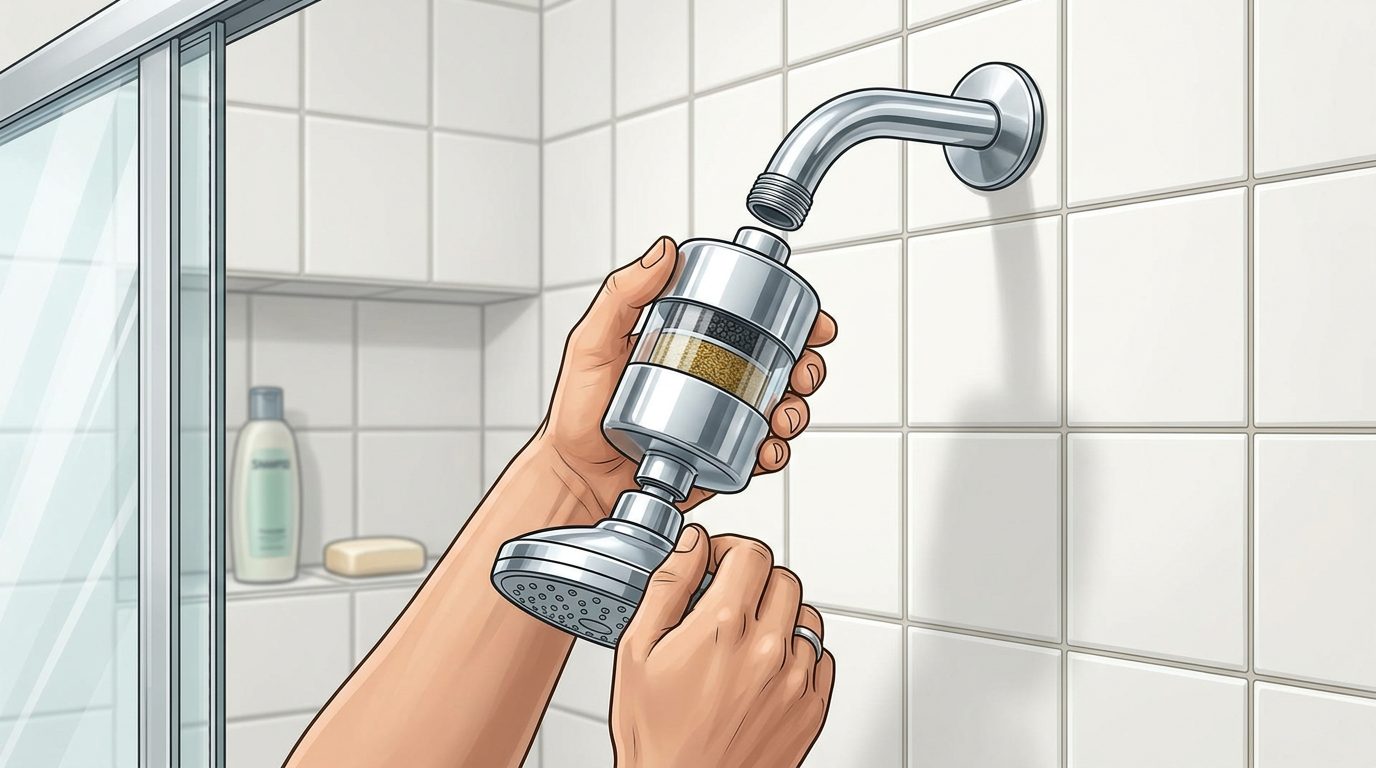
Drinking water gets all the attention, but shower water matters too. Chlorine and chloramines in hot shower water are the most common complaint, mainly as a pool-like smell and dry skin or hair. The AquaBliss SF100 addresses this with a multi-stage filtration system that threads onto any standard half-inch shower arm in under 2 minutes.
The SF100 combines sediment filtration, KDF-55 media, calcium sulfite, activated carbon, and ceramic balls in a single cartridge. KDF media is specifically effective at reducing chlorine in hot water, where standard activated carbon loses much of its capacity. The most common owner report is less chlorine smell in the bathroom; claims about skin and hair are anecdotal, and we could not find an NSF/ANSI 177 listing (the shower filter standard for free chlorine reduction) for the SF100.
It is inexpensive, replacement cartridges are easy to find, and it fits the standard half-inch shower arm. The only limitation is that shower filters cannot match the contaminant removal breadth of drinking water filters, they focus primarily on chlorine, sediment, and heavy metals rather than PFAS or lead at ppb levels.
Sprite HO2-WH-M Universal Shower Filter
The Sprite HO2 is the pick for apartment dwellers who want certification behind a shower filter. Sprite states that most of its products are certified to NSF/ANSI 177 for shower filtration; check that the exact cartridge you buy is on that list.
The inline design connects between your shower arm and shower head, meaning you keep your existing shower head rather than replacing it. For renters who have a preferred shower head or an apartment with a non-standard fixture, this flexibility matters. Installation still takes under 2 minutes with just hand tightening.
Compare the rated cartridge life of both filters before you buy, because the cost per month matters more than the price of the housing. If you want a brand that certifies to the shower filter standard and an inline design that keeps your existing shower head, the Sprite is the better long-term choice.
If you are working with a tight budget, a single Brita Elite pitcher covers your drinking water needs at the lowest running cost, with two filter changes a year. Add an inexpensive TDS meter to get a baseline for your tap water.
This setup handles chlorine taste and odor, reduces 99% of lead, and fits entirely inside your refrigerator. The limitation is that it covers drinking water only, cooking, shower, and sink water remain unfiltered. For most renters with decent municipal water, that trade-off is perfectly acceptable.
The Brita Elite is not the most powerful filter on this list, but it is the one most likely to actually get used daily. Expensive systems that sit unused on the counter because they are inconvenient provide zero filtration. A pitcher that lives in your fridge and gets refilled twice a day provides real, consistent protection.
Pairing a PUR Plus faucet filter with an AquaBliss SF100 shower filter covers both your kitchen and bathroom at a modest upfront cost. The faucet filter handles drinking and cooking water with NSF 53 certification for lead, while the shower filter reduces chlorine exposure during bathing. You will replace the faucet cartridge every 100 gallons or 3 months and the shower cartridge on its own schedule.
This combination addresses the two most common apartment water complaints: bad taste from the kitchen tap and dry skin or hair from chlorinated shower water. Both filters install without tools or plumbing modifications, and both remove completely when you move. It does not match the premium setup on PFAS, fluoride or dissolved solids, but it covers lead and chlorine, the two issues most renters actually notice, at a fraction of the upfront cost.
For the mid-range budget with a preference for pitcher convenience over faucet-mount, swap the PUR Plus for a Clearly Filtered pitcher and a Sprite HO2 shower filter. The combined cost stays in the mid-range, with broader contaminant coverage from the pitcher’s PFAS and fluoride certifications.
The premium configuration pairs the AquaTru countertop RO with an AquaBliss SF100 for total apartment coverage. The AquaTru handles drinking and cooking water with reverse osmosis, while the shower filter handles chlorine in the bathroom. It has the highest upfront cost of the three setups.
This setup makes sense for apartment renters in buildings where water testing reveals elevated TDS, detectable lead, detectable PFAS, or fluoride you want to remove. The RO system addresses contaminants that no pitcher or faucet filter can fully remove. If you have already tried a pitcher and are not satisfied with the taste improvement, the AquaTru is the logical next step before considering permanent under-sink installations that your lease may prohibit.
We also recommend the premium setup for households with infants or immunocompromised residents where even trace-level contaminants warrant extra caution. Its certifications cover the widest range of health-related contaminants on this page. For an infant formula or a medical question, follow your pediatrician’s or doctor’s advice on water as well.
Lead contamination in apartment buildings stems from three primary sources: lead service lines connecting the building to the water main, lead solder used in internal plumbing joints before 1986, and brass fixtures containing up to 8% lead (the pre-2014 standard). The EPA’s lead action level has been 15 parts per billion, and its 2024 Lead and Copper Rule Improvements lower it to 10 micrograms per liter; the agency also says no level of lead exposure is known to be safe, particularly for children and pregnant women.
The EPA says up to 9 million homes and businesses are still connected to water mains through legacy lead pipes, and the LCRI requires water systems to identify and replace them within 10 years. Even if your building’s internal plumbing is copper, the service line connecting it to the street may still be lead. The only way to know your actual exposure is to test your specific tap, building-wide averages mean nothing if your unit sits at the end of a long branch line with old solder joints.
For lead specifically, NSF/ANSI 53 certification is the standard to look for. Both the PUR Plus faucet filter and the Brita Elite pitcher carry this certification. For the most thorough lead removal, the AquaTru’s reverse osmosis membrane removes lead at rates exceeding 99%, well beyond what carbon-based filters achieve. Our lead-specific filter guide covers additional options and testing recommendations.
Most U.S. city water is disinfected with chlorine or chloramines. Chlorine is effective at killing pathogens but is also the most familiar cause of taste and odor complaints. Chloramines (a combination of chlorine and ammonia) last longer in the distribution system, which means they are more likely to arrive at your apartment tap at detectable levels.
The distinction between chlorine and chloramines matters for filter selection. Standard activated carbon filters handle free chlorine effectively, the Brita Elite, PUR Plus, and most pitcher filters excel here. Chloramines, however, require catalytic carbon or longer contact time with standard carbon to break down. If your utility uses chloramines (check your CCR or call the utility directly), verify that your chosen filter specifically certifies for chloramine reduction under NSF/ANSI 42.
Beyond taste, chlorine in shower water creates trihalomethanes (THMs) when it reacts with organic matter, and hot water accelerates this reaction. This is why shower filters matter even if you do not drink shower water. The KDF media in the AquaBliss SF100 and the Sprite HO2 specifically targets chlorine at elevated temperatures where standard carbon loses effectiveness. If you notice your bathroom smelling like a pool after a hot shower, an inexpensive shower filter usually reduces the problem. For broader strategies, our chemical-free water improvement guide covers additional approaches.
Hard water, characterized by elevated calcium and magnesium levels, is common across much of the U.S., and your utility’s CCR or a simple test strip tells you where your building falls. In apartments, hard water manifests as white scale buildup on faucets, spotty dishes, dry skin after showering, and reduced effectiveness of soap and detergent. Hard water is not a health hazard, but it creates quality-of-life issues that many renters mistake for normal apartment living.
Most apartment-friendly water filters do not soften water because true softening requires ion exchange at scale, typically a whole-house system that renters cannot install. The ZeroWater pitcher comes closest by removing dissolved minerals through its ion exchange resin, achieving a 0 TDS reading. However, this approach burns through filters rapidly in hard water areas, making it expensive as a daily driver.
For apartment renters dealing with hard water, the practical approach is targeted rather than whole-home. Use a pitcher or faucet filter for drinking water (addressing taste and health contaminants) and a shower filter for bathing water (reducing chlorine and some minerals). Accept that dishwasher spots and faucet scale are cosmetic issues you may need to manage with vinegar rather than filtration until you control your own plumbing. Our hard water filter guide covers the best options for managing mineral-heavy water in rental situations.
Apartment renters with specific concerns: If your unit has lead-era plumbing, the best water filter for lead removal guide covers no-install pitcher options. For cities with PFAS contamination, see the best water filter for PFAS removal. Hard-water apartments should review the best hard water filter for shower-filter and countertop solutions that don’t require plumbing changes.
If you can install a filter under the sink, our guide to the best under sink water filter compares certified reverse osmosis and carbon systems for lead, PFAS and chlorine.
Renters can filter the shower too. Inline shower filters and filtered showerheads thread onto a standard half-inch shower arm without tools and come off when you move. See our guide to the best shower filter for certified picks and how to tell whether your city uses chlorine or chloramine.
The AquaTru Classic countertop RO system is the best overall apartment water filter on our list. It removes 84 contaminants including lead, PFAS, fluoride, and arsenic without any plumbing modifications. For budget-conscious renters, the Brita Elite pitcher delivers NSF-certified lead reduction at a budget price.
Yes, pitcher filters, faucet-mount filters, countertop systems, and shower filters all require zero permanent modifications. Faucet-mount filters use hand-tightened adapters that remove in seconds. Countertop RO systems need only a power outlet. None of these options violate standard lease agreements or risk your security deposit. Under-sink systems may require landlord approval depending on your lease terms.
Absolutely. No lease can prevent you from using a freestanding pitcher filter or a removable faucet-mount filter, these are personal appliances, not plumbing modifications. Countertop and gravity filters sit on your counter like a coffee maker. Shower filters replace your shower head and restore the original when you move out. The only filter types that might need landlord permission are permanent under-sink or whole-house installations.
Filters certified to NSF/ANSI 53 for cyst reduction effectively remove Giardia and Cryptosporidium. Check the product’s performance data sheet for a cyst reduction claim; PUR, for example, states that its filters do not filter microbes. Reverse osmosis membranes physically block cyst-sized particles, but on public water the utility’s disinfection is the main barrier, so a filter is a backup rather than a substitute for a boil-water notice. Standard carbon-only filters without NSF 53 cyst certification should not be relied upon for Giardia removal.
Generally no. The Safe Drinking Water Act regulates public water systems, not landlords, and there is no federal rule that requires a landlord to supply a filter. State and local housing codes set the landlord’s duties for habitable plumbing, and they vary. Under the EPA’s 2024 lead rule, water systems with repeated lead exceedances must make lead-certified filters available to consumers. If your own test finds lead, tell your landlord in writing and contact your water utility and local health department.
The Brita Elite pitcher is the most affordable option with certified health claims. Its filter is certified for lead and for PFOA/PFOS and is rated for 120 gallons, about 6 months, so you buy only two filters a year and create far less plastic waste than bottled water.
Start with a TDS meter for a quick baseline reading. Then request your water utility’s annual Consumer Confidence Report (CCR), which lists all detected contaminants and their levels. For specific concerns like lead or PFAS, send a water sample to a state-certified laboratory; the price depends on the test panel. The EPA’s Safe Drinking Water page provides guidance on what to test for based on your building’s age and location.
Countertop reverse osmosis units are the renter-friendly option: they sit on the counter, plug into a power outlet and need no drilling or connection to the supply line. The AquaTru Classic is our pick because its owner’s manual lists IAPMO certification to NSF/ANSI 42, 53, 58, 401 and P473. Under-sink RO systems need a tap into the cold water line and usually a drain connection, so get written landlord approval first.
Faucet-mount filters reduce flow rate in filtered mode, typically from about 2.2 gallons per minute to approximately 0.5 GPM. Switch to unfiltered mode for full pressure when washing dishes. Countertop and pitcher filters do not connect to your plumbing at all, so they have zero impact on water pressure. Shower filters cause minimal pressure reduction, both the AquaBliss and Sprite models are designed for standard shower flow, and owners rarely report a large pressure drop.
Written by the Delozone Editorial Team. We research products using manufacturer specifications, certification listings and published test data, and we update guides when products or standards change. How we work.
The Delozone Editorial Team researches water treatment, pool and spa, and indoor air products for independent buying guides. We compare products using manufacturer specifications, certification listings such as NSF/ANSI, UL, AHAM and Energy Star, published third-party test data and verified owner feedback. We do not sell products, and affiliate commissions never decide what we recommend.