Independent buying guides for home air, water and safety.
As an Amazon Associate, Delozone earns from qualifying purchases.
Independent buying guides for home air, water and safety.
As an Amazon Associate, Delozone earns from qualifying purchases.

Best pressure tanks for well water tested on 5–15 gpm pumps. Drawdown sizing, pre-charge setup, and Amtrol, Flexcon, WaterWorker, AO Smith, Goulds compared.

The pressure tank is the unglamorous piece of your well system that decides whether your shower pressure stays steady or your pump cycles itself to death. Get it right and you’ll forget it exists for years. Get it wrong and the pump starts far more often than it should, which is the fastest way to shorten its life. Below are five real, widely sold tanks, chosen from manufacturer spec sheets, with the drawdown numbers you need to size one correctly.
Affiliate links: As an Amazon Associate, Delozone earns from qualifying purchases, at no extra cost to you. Full disclosure
We did not install or bench-run these tanks. We compared them on published numbers: total volume, drawdown at common pressure-switch settings (20/40, 30/50, 40/60), factory pre-charge, maximum working pressure, connection size, dimensions and warranty, taken from the Amtrol Well-X-Trol spec sheet, the WaterWorker tank guide and retailer spec listings for the Goulds V100 and WaterWorker HT-32B. We then matched drawdown to common pump sizes using the one-minute minimum run-time rule explained below, and read owner feedback for recurring failures such as lost pre-charge or leaking connections. Every drawdown figure on this page is the maker’s number, not our measurement.
An earlier version of this guide listed two models (a “Flexcon WW-220” and an “A.O. Smith ST-12”) that we could not match to any current manufacturer listing, and overstated the drawdown of the Amtrol WX-202. We replaced those picks with tanks whose specs we could confirm, and corrected the numbers.
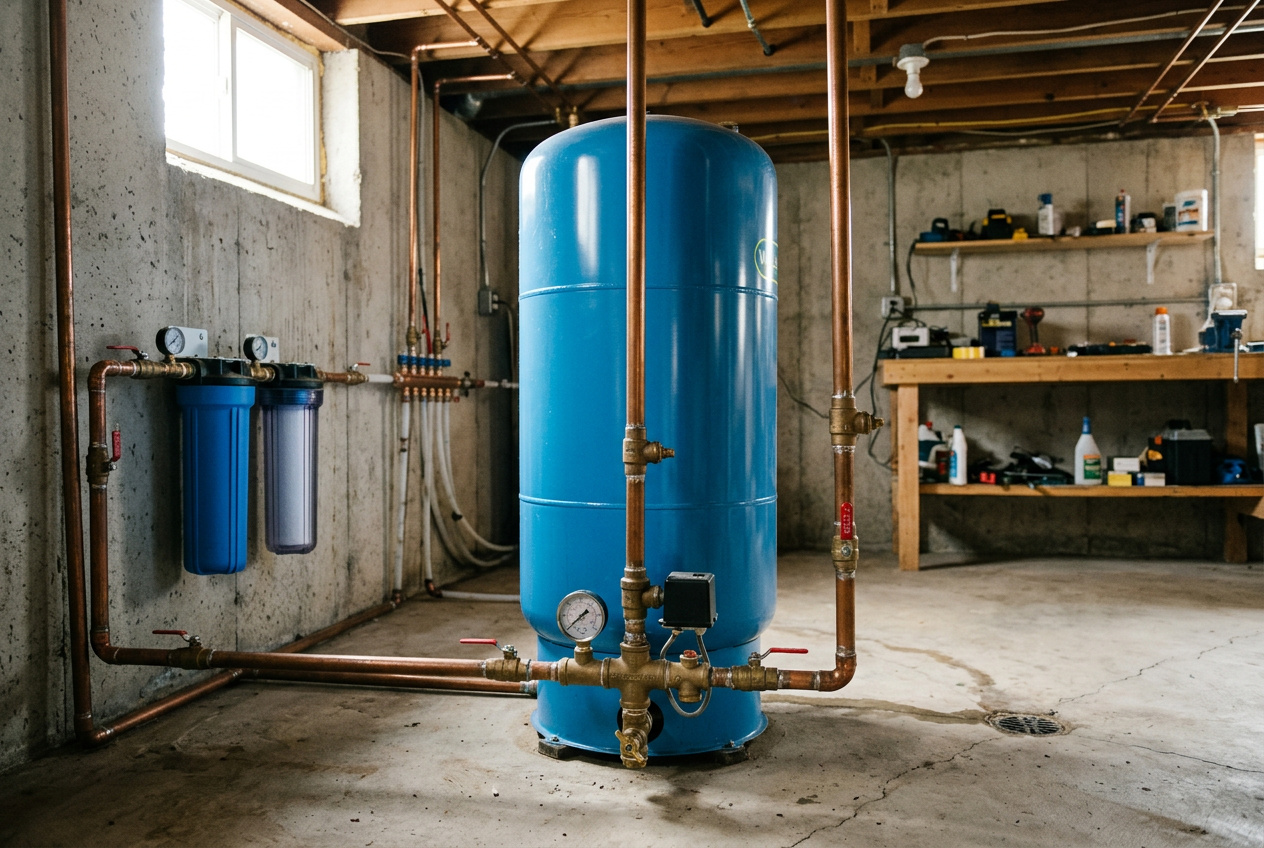
A pressure tank is a steel or composite vessel divided by a flexible diaphragm. One side holds pressurized air (pre-charged at the factory); the other side fills with water from the well pump. As water is drawn from the household side, the air pressure pushes water out, maintaining household pressure without the pump starting every time you flush a toilet.
The pump only switches on when pressure drops to the cut-in pressure (typically 20, 30 or 40 psi). It runs until the cut-out pressure (typically 40, 50 or 60 psi) is reached, then stops. The water volume between cut-in and cut-out is the drawdown, and that’s the number that actually matters when shopping for pressure tanks. Tank size on the label is total volume; drawdown is usually only about a third of it, and it gets smaller at higher pressure settings.
Example: the Goulds V100 is a 31.8-gallon tank, but its listed drawdown is 11.8 gallons at 20/40 psi, 9.9 gallons at 30/50 and 8.6 gallons at 40/60. That 9.9 gallons is how much water you can use at 30/50 before the pump starts again. A toilet flush is about 1.6 gallons under federal fixture standards, so a few flushes and a short shower will start the pump on almost any residential tank. What the tank really controls is how long the pump runs once it starts.
Every well pump needs a minimum run time per start. Short runs mean frequent starts, and starting is the hardest moment for the motor and the pressure switch. The rule of thumb used by pump installers:
That gives a simple sizing rule: drawdown in gallons should be at least equal to your pump’s flow in gallons per minute. A 10 gpm pump needs about 10 gallons of drawdown at your pressure setting. Undersize and the pump short-cycles. Oversize and you only spend basement space and money: a bigger tank does no harm to the pump.
The Goulds V100 is part of the Goulds HydroPro line of diaphragm tanks. Retailer spec listings give a 31.8-gallon total volume, a 38 psi factory pre-charge, a 125 psi maximum working pressure, a 1-inch NPTF connection and a footprint of about 15-3/8 inches across by 47-1/4 inches tall. Listed drawdown is 11.8 gallons at 20/40, 9.9 at 30/50 and 8.6 at 40/60, with a heavy-duty butyl diaphragm and a polypropylene liner so water does not touch the steel shell.
That drawdown matches the most common residential pumps (roughly 7 to 10 gpm) under the one-minute rule, which is why we put it first. Goulds is also a major well-pump brand, so supply houses that sell Goulds pumps usually stock the V-series tanks, which helps when you need a replacement fast.
Pros: Drawdown sized for common 7 to 10 gpm pumps, 125 psi rating, butyl diaphragm with liner, widely stocked.
Cons: Tall at about 47 inches; check basement clearance and confirm the warranty term with the seller.
For larger households, high-flow pumps, irrigation or farm use, the Amtrol Well-X-Trol WX-302 is the big tank in Amtrol’s Well-X-Trol line. Amtrol’s spec sheet lists an 86-gallon total volume, 47 inches tall by 26 inches across, a 1-1/4-inch connection, a 38 psi factory pre-charge and a 7-year warranty. Listed drawdown is 26.6 gallons at 30/50 psi and 23 gallons at 40/60.
Under the one-minute rule, that comfortably covers pumps up to about 20 gpm at 40/60, which is where most 4-bath homes and small farms sit. The trade-off is size and weight: at 26 inches across it needs a real footprint, and moving it into a basement is a two-person job.
Pros: Large drawdown for high-flow pumps, 7-year warranty, steel shell with butyl diaphragm and liner.
Cons: Wide and heavy; overkill for small households with small pumps.
The WaterWorker HT-32B is the hardware-store workhorse: a 32-gallon vertical pre-charged tank. Retail spec listings give 15 inches across by 46 inches tall, a 38 psi factory pre-charge, a 100 psi maximum working pressure, a 1-inch connection, and drawdown of 11.2 gallons at 20/40 and 9.9 gallons at 30/50. It uses a butyl diaphragm with a polypropylene liner.
On paper its drawdown at 30/50 matches the Goulds V100, so it suits the same 7 to 10 gpm pumps. The lower 100 psi pressure rating is fine for normal household settings but leaves less margin than the Goulds or Amtrol tanks. An earlier version of this guide called it a horizontal tank; it is a vertical tank. WaterWorker sells a separate horizontal line (see the FAQ).
Pros: Same 30/50 drawdown class as the Goulds V100, easy to find at hardware stores, butyl diaphragm.
Cons: 100 psi maximum working pressure; shorter warranty than the premium lines.
For cabins, small homes or pumps under about 6 gpm, the WaterWorker HT-20B is a compact 20-gallon tank. WaterWorker lists drawdown of 7.31 gallons at 20/40, 6.18 gallons at 30/50 and 5.35 gallons at 40/60, a 38 psi factory pre-charge, a 100 psi maximum and a 1-inch connection, in a 32-inch-tall body.
The size is the point and the limit: about 6 gallons of drawdown means it suits small pumps only. On a typical 10 gpm pump it would short-cycle, so check your pump’s flow before choosing it to save money.
Pros: Low cost, short 32-inch body, fine for small pumps and seasonal properties.
Cons: Only about 6 gallons of drawdown at 30/50; undersized for most full-time family homes.
The Amtrol Well-X-Trol WX-202 is the same size class as the HT-20B but from Amtrol’s premium line. Amtrol’s spec sheet lists a 20-gallon total volume, 32 inches tall by 15 inches across, a 1-inch stainless steel connection, a 38 psi factory pre-charge, a 150 psi maximum working pressure and a 7-year warranty. Retail listings give 6.2 gallons of drawdown at 30/50.
Choose it over the budget 20-gallon tank when you want the higher pressure rating and longer warranty in a small footprint. Amtrol also makes the WX-202XL (26 gallons, 39 inches tall) if you need a little more drawdown in nearly the same footprint.
Pros: 7-year warranty, 150 psi rating, stainless steel connection, compact.
Cons: Same small drawdown as other 20-gallon tanks; price premium over the budget option.
Use the one-minute rule: drawdown at your pressure setting should be at least your pump’s flow in gpm. Using the manufacturers’ drawdown figures above:
| Pump flow rate | Minimum drawdown | Tanks that meet it at 30/50 (maker figures) |
|---|---|---|
| Up to 6 gpm | 6 gallons | WaterWorker HT-20B (6.18), Amtrol WX-202 (6.2) |
| 7 to 9 gpm | 7 to 9 gallons | Goulds V100 (9.9), WaterWorker HT-32B (9.9) |
| 10 to 12 gpm | 10 to 12 gallons | Two 32-gallon tanks in parallel, or a larger tank such as the Amtrol WX-302 |
| 13 to 25 gpm | 13 to 25 gallons | Amtrol WX-302 (26.6 at 30/50, 23 at 40/60) |
| Over 25 gpm | 25+ gallons | Multiple large tanks plumbed in parallel; ask a pump installer |
Remember that drawdown shrinks at higher settings. If you run 40/60, use the 40/60 drawdown figure (for example 8.6 gallons on the Goulds V100, not 9.9). If you don’t know your pump’s flow, it is on the pump label or the installer’s paperwork, or you can time how long the pump takes to refill the tank from cut-in to cut-out.
The air pre-charge should be set about 2 psi below the pump’s cut-in pressure, with the tank empty of water:
All five tanks here ship at 38 psi, which suits a 40/60 switch. If your switch is 30/50, you need to let air out to 28 psi before connecting it. Wrong pre-charge is one of the most common causes of problems: too high and you lose drawdown, too low and the tank waterlogs and the pump short-cycles.
To check pre-charge: switch off power to the pump, open a tap until no water flows and the system pressure gauge reads zero, then measure at the Schrader (tire-style) valve on top of the tank with a tire gauge. Adjust with a small compressor or by letting air out.
Treatment equipment changes the picture too. If you add a whole-house filter or softener after the tank, the pressure drop across it shows up at the taps, not at the tank, so size both together. Our well water filter systems guide covers the treatment side, and how to test well water at home covers the water test that comes first. The EPA private wells program recommends testing private wells every year.
Replacing an existing tank of the same size is a realistic job for a homeowner who is comfortable with plumbing and with isolating power to the pump. New installs, upsizing to a larger connection, or anything involving the pressure switch wiring are worth a licensed installer.
How long does a pressure tank last?
It depends heavily on water quality, sizing and pre-charge. Manufacturers back their tanks with limited warranties (Amtrol lists 7 years for the Well-X-Trol line), and correctly sized, correctly pre-charged tanks often last well beyond that. Rising pump starts, a waterlogged tank or water at the air valve are the signs that the end is near.
What if my pump short-cycles even with a new tank?
Check the pre-charge first, with the pump off and the tank drained. If it is correct, check whether the tank is simply too small for the pump’s flow (use the sizing table), whether the pressure switch is worn, and whether a leak or running toilet is dropping pressure between uses.
Can I install a pressure tank horizontally?
Only if the manufacturer rates it for that. Most vertical tanks are not. Makers sell dedicated horizontal models for that job, such as the WaterWorker HT-20HB 20-gallon horizontal tank and Amtrol’s WX-202H. Check the drawdown of the horizontal model, since it can differ from the vertical one.
Do I need a pressure tank with a variable-frequency drive pump?
Yes, but a small one. Constant-pressure systems change pump speed instead of cycling on and off, so the tank mainly smooths small draws and prevents the pump from starting for a single glass of water. Use the size the drive’s maker specifies.
How do I know my pressure tank is failing?
Typical signs: the pump starts every few seconds or with every small draw; pressure swings quickly between cut-in and cut-out; water comes out of the air valve; or the tank sounds solid when you tap the top (waterlogged). Check pre-charge first, since a low charge causes the same symptoms as a failed diaphragm.
What size pressure tank do I need for a 10 gpm pump?
About 10 gallons of drawdown at your pressure setting. A single 32-gallon tank gives roughly 9.9 gallons at 30/50, which is just under, so many installers choose two 32-gallon tanks in parallel or one larger tank.
For most homes with a 7 to 10 gpm pump, the Goulds V100 or the WaterWorker HT-32B gives the right drawdown at 30/50. Step up to the Amtrol WX-302 for high-flow pumps and big households. For small pumps and cabins, the WaterWorker HT-20B keeps cost down, and the Amtrol WX-202 does the same job with a longer warranty and higher pressure rating. Whatever you buy, size it from the pump’s flow and the maker’s drawdown figure, then set the pre-charge 2 psi under cut-in.
Have a well system you’re sizing from scratch, or troubleshooting a short-cycling pump? Write to our editorial team with your pump flow rate, pressure switch setting and current tank size, and we will point you to the right sizing math.
The Delozone Editorial Team researches water treatment, pool and spa, and indoor air products for independent buying guides. We compare products using manufacturer specifications, certification listings such as NSF/ANSI, UL, AHAM and Energy Star, published third-party test data and verified owner feedback. We do not sell products, and affiliate commissions never decide what we recommend.