Independent buying guides for home air, water and safety.
As an Amazon Associate, Delozone earns from qualifying purchases.
Independent buying guides for home air, water and safety.
As an Amazon Associate, Delozone earns from qualifying purchases.

Best water softeners for well water tested on 14 gpg and 22 gpg hardness with iron up to 3 ppm. Fleck, AFW Iron Pro 2, Whirlpool, Rheem, AquaSure compared.

The best water softener for well water is the one that handles your particular combination of hardness, iron, and water demand without wasting salt or fouling its own resin in the first season. Below are five softeners we shortlisted for 2026, ranked by water profile rather than by raw price, with every performance number taken from the manufacturer’s own listing or spec sheet.
Affiliate links: As an Amazon Associate, Delozone earns from qualifying purchases, at no extra cost to you. Full disclosure
We did not lab-test, install or measure these softeners ourselves. Instead, we shortlisted ion-exchange softeners that are easy to buy in the US and checked each one against public evidence:
Wells we do not cover with a softener alone: anything above 6 ppm iron (those need a pre-filter, see our iron filter guide) and anything with pH below 6.5 (acidic water should be neutralized first).
Penn State Extension recommends sending a water sample to an independent lab rather than relying on a dealer’s free hardness test, because a third-party result “will protect you from being oversold.” For softener sizing you need four numbers: hardness, iron, manganese and pH. A coliform and nitrate test is worth adding on any private well, since a softener does nothing for either.
Hardness is reported either in milligrams per liter (mg/L, the same as ppm) as calcium carbonate or in grains per gallon (gpg). One grain per gallon is about 17 mg/L. The USGS classifies water as:
| Classification | mg/L as calcium carbonate | Approx. gpg |
|---|---|---|
| Soft | 0 to 60 | 0 to 3.5 |
| Moderately hard | 61 to 120 | 3.5 to 7 |
| Hard | 121 to 180 | 7 to 10.5 |
| Very hard | more than 180 | more than 10.5 |
Penn State notes that levels below 7 gpg will probably not cause major scaling or soap film, so softening below that line is a comfort choice, not a necessity.
Iron is what fouls well-water softeners. According to Penn State Extension, colorless reduced (ferrous) iron is removed by a softener, but red, oxidized iron that has been exposed to air or chlorine clogs the resin, so it should be filtered out before the softener. Once resin is badly fouled, cleaners may not fully restore it and it may need replacing.
The resin options you’ll see on softener spec sheets:
Some all-in-one units publish their own clear-water iron ratings: Whirlpool lists 10 ppm for the WHES40 and Rheem lists 8 ppm for the Preferred RHS32. Treat those as upper limits for ferrous iron only, not for red water or iron bacteria. If your test shows meaningful iron, fine-mesh resin or a dedicated iron filter ahead of the softener is the safer call.
Grain capacity is the total hardness a softener can remove between regenerations. Iron and manganese use up capacity too: AFW Filters advises adding 4 grains of “compensated hardness” for each ppm of iron and manganese. So a well with 14 gpg hardness and 1 ppm iron should be sized as 18 gpg.
Penn State Extension sizes softeners from daily use: multiply gallons per day by hardness in gpg to get grains removed per day, then divide the softener’s capacity by that number to get days between regenerations. Their example: 4 people at 75 gallons each on 10 gpg water use 3,000 grains a day, so a 20,000-grain unit regenerates about every 6 to 7 days. As a quick rule of thumb:
| People in home | Compensated hardness (gpg) | Minimum grain capacity |
|---|---|---|
| 1 to 2 | 5 to 15 | 24,000 |
| 1 to 2 | 16 to 25 | 32,000 |
| 3 to 4 | 5 to 15 | 32,000 |
| 3 to 4 | 16 to 25 | 48,000 |
| 5 to 6 | 5 to 15 | 48,000 |
| 5 to 6 | 16 to 25 | 64,000 |
Undersize and the unit regenerates every two days, burning salt and wasting water. Oversize far beyond your need and low flow through a deep resin bed can lead to channeling, where water tunnels through preferred paths without being fully softened.
The Fleck 5600 SXT is a digital metered control valve: it measures the water you use and regenerates only when the resin needs it, which is the efficient mode Penn State Extension describes as demand control. It is the valve many online softener kits are built around, including the AFW Iron Pro 2 below, which is why replacement seals, pistons and meters are easy to source.
A 48,000-grain kit fits most 3-to-4-person homes on hard to very hard well water once you add the compensated-hardness allowance for iron. Many bundled kits ship with standard 8% cross-link resin; if your test shows iron, choose a fine-mesh or 10% cross-link option from the seller instead. Because kits vary by seller, check the listing for resin type, tank size and whether a bypass valve is included.
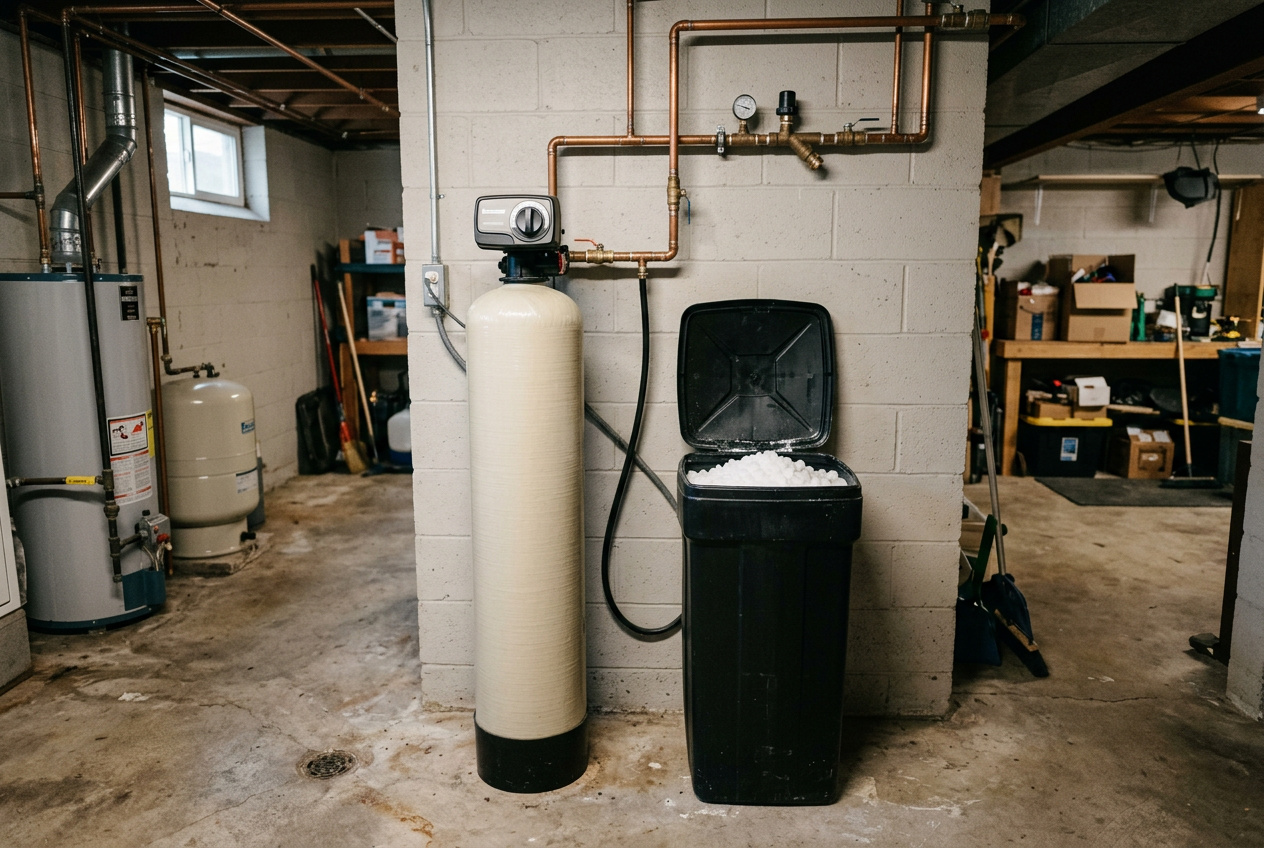
Installation note: the brine tank and resin tank usually ship as separate pieces, and you will need a drain and an outlet near the valve. Plan on a half-day install if you are comfortable with PEX or soldering; otherwise budget for a plumber.
Pros: metered demand regeneration, widely available parts, easy to service, accepts any resin grade.
Cons: kits differ by seller; default kits often ship with 8% resin unless you upgrade.
If your well test came back with iron alongside the usual hardness, the AFW Filters Iron Pro 2 is built for that scenario. AFW’s listing pairs a Fleck 5600SXT digital metered valve with fine-mesh resin that it rates for ferrous iron up to 6 ppm, and the kit is sold in several capacities, including 48,000, 64,000 and 80,000 grains.
The trade-off is salt. Fine-mesh resin is chosen for iron tolerance, not salt economy, so expect to set a somewhat higher salt dose than a standard kit on the same water. If your iron is under about 1 ppm, a standard 5600 SXT kit is the more economical choice; above that, the longer resin life on iron water is what you are paying for.
Size it with the compensated-hardness rule: hardness in gpg plus 4 for every ppm of iron and manganese.
Pros: fine-mesh resin rated for ferrous iron up to 6 ppm, metered regeneration, several capacities.
Cons: higher salt use than standard resin; not the most economical when iron is low.
The Whirlpool WHES40E is the softener we suggest to first-time owners who want an all-in-one unit from a brand they recognize, without comparing valve manufacturers. On Whirlpool’s product page, the 40,000-grain WHES40 is listed with demand-based regeneration, hardness removal up to 125 gpg, clear-water iron reduction up to 10 ppm, a tank-mounted light that shows salt level, and plumbing connections up to 1¼ inch. The page references NSF/ANSI 44 for softener performance.
Whirlpool recommends evaporated salt pellets or solar salt crystals with less than 1% impurities and advises against block salt. Owners mainly choose this unit for the single-cabinet design, which is simpler to place and connect than a two-tank kit.
The downside is the proprietary head: parts come from Whirlpool, while a Fleck valve can be rebuilt with widely sold third-party seal kits. For a first softener that’s an acceptable trade. For a 20-year set-and-forget install on iron water, a Fleck-based kit is easier to keep running.
Pros: NSF/ANSI 44 referenced, salt-level light, 10 ppm clear-water iron rating, simple all-in-one install.
Cons: proprietary parts, no fine-mesh resin option.
The Rheem Preferred RHS32 is a 32,000-grain demand softener that Rheem designs for households of up to 4 people. Rheem rates it at 7.9 gpm service flow and clear-water (ferrous) iron removal up to 8 ppm, and says its learning technology adjusts salt use to your water pattern, using up to 40% less salt than traditional softeners. Its published efficiency is 4,940 grains per pound of salt at the minimum 2.6-pound dose.
A blue status light flashes when it is time to add salt. Rheem lists a 10-year tank warranty and a 1-year parts and labor warranty that can be extended with maintenance. Rheem’s brochure also lists a larger 42,000-grain RHS42 for bigger households or harder water.
What the RHS32 doesn’t do is handle red, oxidized iron or very high iron. If your iron is meaningful or your water stains red after sitting, install a dedicated iron filter ahead of it.
Pros: published salt efficiency figure, learning demand regeneration, 8 ppm clear-water iron rating, made in the USA.
Cons: 32,000 grains is small for large families on very hard water; proprietary head.
The AquaSure Harmony Series 48,000-grain softener (AS-HS48D) uses a digital control head and standard cross-link resin, and AquaSure positions it for 4 to 5 people in homes with 1 to 3 bathrooms. For well water the more interesting version is the AS-HS48FM, which swaps in fine-mesh resin for better iron tolerance.
AquaSure does not publish an iron rating in ppm on that page, so use the compensated-hardness rule and keep iron low with a pre-filter if your test shows more than about 1 ppm.
The reason it isn’t our top pick: replacement parts for the AquaSure head are not as widely stocked as Fleck parts, so long-term serviceability is weaker.
Pros: good value for a 48,000-grain unit, fine-mesh resin option, digital head.
Cons: thinner parts inventory; no published iron rating.
| Model | Grain capacity | Iron rating (ferrous) | Regeneration | Source |
|---|---|---|---|---|
| Fleck 5600 SXT 48k | 48,000 | Depends on resin in kit | Metered demand | Seller listings |
| AFW Iron Pro 2 | 48,000 to 80,000 | Up to 6 ppm (fine mesh) | Metered demand | AFW |
| Whirlpool WHES40E | 40,000 | Up to 10 ppm | Demand | Whirlpool |
| Rheem Preferred RHS32 | 32,000 | Up to 8 ppm | Learning demand | Rheem |
| AquaSure Harmony 48k | 48,000 | Not published | Digital head | AquaSure |
Salt use depends far more on your hardness, iron and household size than on the brand. Demand (metered) regeneration is the biggest lever: Penn State Extension notes that timer models waste salt and water because they regenerate whether the resin needs it or not.
Only an ion-exchange (salt-based) softener actually removes calcium and magnesium. Salt-free conditioners are marketed to reduce scale, but as Pure Water NorthWest puts it, they won’t fully soften very hard water. They also do nothing for iron, which is the main reason well owners shop for a softener in the first place. On a well with iron and hard water, a salt-based softener with the right resin, plus an iron filter when needed, is the setup that addresses both.
For a first-time softener install on a well, follow the manual’s startup steps: fill salt, run an initial regeneration to flush the new resin bed, and run a few taps for several minutes before using the water for drinking.
| Year | Task |
|---|---|
| 1 | Check salt monthly; clean brine tank once |
| 2 | Inspect injector for resin fines; clean brine line flow control |
| 3 | Sanitize resin bed (follow the manufacturer’s instructions before adding any chemical) |
| 5 | Replace valve seal kit if leakage or hardness bleed appears |
| 7 | Pull and inspect resin; replace meter turbine if metered |
| 10 | Replace resin if iron-fouled; otherwise extend |
The sequence is always: well → pressure tank → sediment filter → iron filter → softener → distribution. Never put a softener ahead of an iron filter, because the softener will trap oxidized iron and you’ll lose resin life. If you’re undecided between buying a softener now or an iron filter now, and your iron is between 1 and 3 ppm, buy the iron filter first.
Do I need a special water softener for well water?
The softening process is the same, but well water often carries iron, manganese and sediment that city water does not. Choose a unit with a published clear-water iron rating or fine-mesh resin, size it with compensated hardness (add 4 gpg per ppm of iron and manganese), and put a sediment or iron filter ahead of it when your test calls for one.
What is the best water softener resin for well water?
For low-iron water, standard or 10% cross-link resin works. For noticeable ferrous iron, fine-mesh resin is the usual choice; AFW Filters rates its fine-mesh Iron Pro 2 for up to 6 ppm. Red, oxidized iron should be filtered out before any resin.
Is it bad to buy too big of a water softener?
Moderately oversizing is fine and stretches the time between regenerations. Going far beyond your need can lead to channeling and stale water sitting in the resin bed. Use the Penn State daily-grains method above and aim for a regeneration roughly every 4 to 8 days.
Do I need a softener if my well water tests soft?
Under 7 grains per gallon (about 120 mg/L as calcium carbonate), Penn State says you probably won’t see major scaling or soap film. Above that, scale builds in water heaters and shortens appliance life.
How much salt should I expect to use?
It depends on hardness, iron, household size and salt dose setting. A demand-regenerating unit on moderate settings uses far less than a timer unit. Rheem, for example, publishes 4,940 grains removed per pound of salt at its lowest dose on the RHS32.
Can I run my softener in bypass while on vacation?
Yes. Flip the bypass and your softener won’t regenerate. Just remember to flush the bed for a few minutes when you flip back to service.
Does softened water taste different?
Some people notice a slight sodium taste. Most don’t. If it bothers you, install a reverse-osmosis system at the kitchen sink for drinking water and let the softener handle everything else.
How long does softener resin last?
Penn State notes resin should not need replacing if it is regularly regenerated and maintained, but iron, sediment and bacteria fouling shorten its life. On iron water, fine-mesh resin and pre-filtration are the best ways to protect it.
For most well-water homes, a Fleck 5600 SXT 48k kit is the default we recommend: metered regeneration, the easiest parts supply, and a resin grade you can match to your water. Step up to the AFW Iron Pro 2 if ferrous iron is above about 1.5 ppm. Reach for the Whirlpool WHES40E for a simple all-in-one install or the Rheem Preferred RHS32 when published salt efficiency matters most. The AquaSure Harmony Series saves money, especially in its fine-mesh version.
Have a well test result you want a second opinion on? Our editorial team reads every reader email. Paste your hardness, iron, pH, and household size and we’ll tell you which softener on this list (or off it) fits your water.
The Delozone Editorial Team researches water treatment, pool and spa, and indoor air products for independent buying guides. We compare products using manufacturer specifications, certification listings such as NSF/ANSI, UL, AHAM and Energy Star, published third-party test data and verified owner feedback. We do not sell products, and affiliate commissions never decide what we recommend.