Independent buying guides for home air, water and safety.
As an Amazon Associate, Delozone earns from qualifying purchases.
Independent buying guides for home air, water and safety.
As an Amazon Associate, Delozone earns from qualifying purchases.

Septic-safe water softeners tested on 14 gpg well water. Salt-free TAC systems, chelation conditioners, and drywell workarounds for drain-field protection.

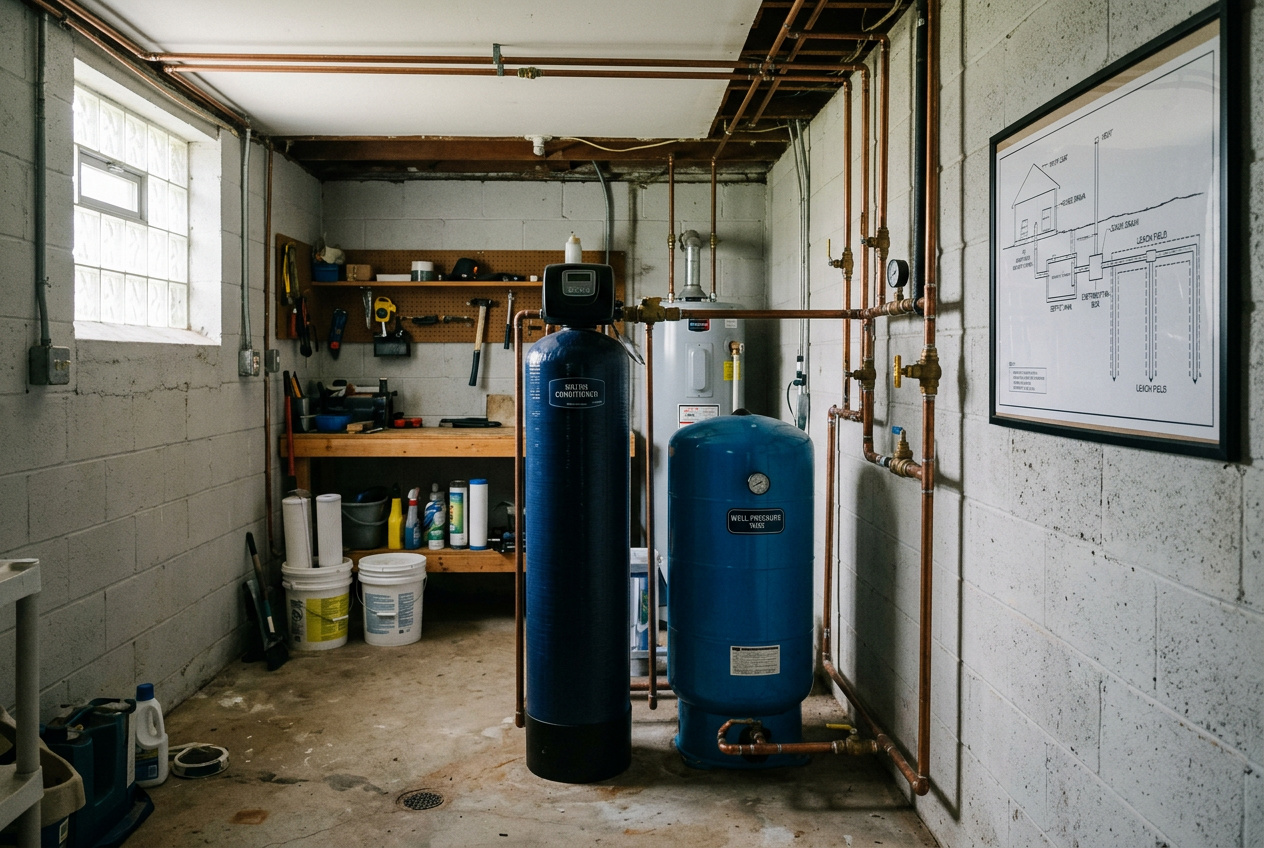
If your home is on a septic system, the wrong water softener can quietly destroy your drain field in five years. Every regeneration cycle pushes a salt-laden brine pulse into the septic tank, and once that brine reaches the leach field, the salt kills the bacterial film that makes a septic system actually work. Based on published research, manufacturer specifications and certification listings, here are the five septic-safe water softeners we trust in 2026.
Affiliate links: As an Amazon Associate, Delozone earns from qualifying purchases, at no extra cost to you. Full disclosure
A standard ion-exchange softener works like this: hard-water minerals (calcium, magnesium) bind to sulfonated polystyrene resin beads, and sodium ions are displaced into the treated water. When the resin is saturated, a regeneration cycle flushes a concentrated salt solution through the bed, displacing the captured minerals and refreshing the sodium load on the resin. The wastewater from that flush (salt, calcium, magnesium, plus rinse water) is called regen brine.
That brine pulse is the problem. A typical residential softener discharges 40 to 80 gallons of high-salinity wastewater every 4 to 7 days. Routed to a septic system, that brine pulse:
The fix is one of two paths: install a softener that doesn’t regenerate with salt at all (salt-free conditioner), or route the brine discharge to a dedicated drywell or municipal sewer line instead of the septic field.
A “salt-free water softener” isn’t technically a softener. Real softeners remove calcium and magnesium from water (that’s what “soft” means). Salt-free systems don’t remove anything, they use template-assisted crystallization (TAC) or similar processes to convert dissolved calcium into stable crystalline forms that don’t stick to pipes, water heaters, or shower glass. The mineral content of the water is unchanged.
What you get with a salt-free conditioner:
What you don’t get:
For homes that primarily want to protect their plumbing and water heater, TAC is a credible answer. For homeowners who want the lotion-skin feel of softened water, only a real ion-exchange softener delivers, which means rerouting the brine or accepting septic-field consequences.
We did not run our own installs or lab tests for this list. We compared the technology behind each product against published research, manufacturer specifications and certification listings. The University of Minnesota MnTAP summary of salt-free conditioning alternatives, which draws on the WateReuse Research Foundation study by Fox et al., is our main reference: it describes TAC as comparable to ion exchange for scale reduction, while magnetic conditioners reduce scale by only about 50% and cannot be used on their own for water conditioning. We also weighed septic impact, maintenance and how each product fits a homeowner’s plumbing.
The SpringWell FutureSoft is a template-assisted crystallization system using a high-quality TAC media in a single-tank up-flow configuration. It’s rated for whole-house service up to 20 gpm, and the lifetime warranty on the tank is the longest in the salt-free category.
TAC media is designed to prevent scale, not to remove hardness: the MnTAP summary lists scale reduction comparable to ion-exchange softeners, with no added chloride and no regeneration water. Because the calcium stays in the water, expect soap to lather less than it would with a salt softener, which is the expected trade-off.
The installation is genuinely simple: no electricity, no drain line, no brine tank. It’s a single fiberglass vessel with an inlet and outlet, mounted vertically near the main supply line. The TAC media has a 6-to-10-year service life depending on water chemistry. At year 8, you pull the bed and refill the media; the tank stays.
Pros: Lifetime tank warranty, no electricity, zero septic impact, real scale prevention.
Cons: No “soft” feel, no iron removal, premium price.
The NuvoH2O takes a different approach to salt-free conditioning. Instead of TAC media, it uses a chelation cartridge (CitraCharge, a citrus-derived sequestering agent) that binds to calcium and magnesium ions and prevents them from precipitating as scale. The chemistry is well understood: sequestering agents have been used in industrial boiler treatment for decades, and the per-cartridge cost is low.
The cartridge is a consumable: follow the manufacturer’s replacement interval for your hardness level, and budget for replacement cartridges as a recurring cost when you compare it with TAC media, which is replaced far less often.
The trade-off: NuvoH2O performance varies more with water chemistry than TAC media. Very high-hardness wells (over 25 gpg) push the cartridge to early breakthrough. For moderate hardness (8 to 15 gpg), it’s a credible budget option that’s genuinely septic-safe.
Pros: Low upfront cost, septic-safe, easy install, no electricity.
Cons: Performance drops on very hard water; cartridge replacement is recurring.
The Aquasana SimplySoft is the pick for buyers who want certification paperwork: check the exact standards it is listed under in NSF’s certified product listings before you buy, because listings change. The TAC media inside is functionally similar to the SpringWell FutureSoft, but Aquasana ships the unit as part of a bundled system with their Rhino whole-house carbon filter.
As a TAC system it should behave like the FutureSoft for scale control. The bundled carbon filter targets chlorine and chloramine at the same time, which is useful if your well is shock-chlorinated periodically or if you’re on a treated municipal supply.
The downside compared to the FutureSoft: the warranty on the tank is 10 years, not lifetime. The bundle pricing is competitive only when you actually want the Rhino carbon stage; standalone it’s about 15 percent more expensive than a SpringWell FutureSoft.
Pros: NSF certification, bundled carbon filtration, solid performance.
Cons: 10-year tank warranty (vs. lifetime); pricing only competitive in bundle form.
The Eddy Electronic Descaler is a magnetic-field water conditioner, a small electronic box that wraps two coils around the incoming cold-water line and applies an oscillating electromagnetic field as water passes through. The field is meant to alter calcium crystal formation just enough to prevent scale buildup downstream.
The MnTAP summary of the Fox et al. research puts magnetic conditioning at roughly a 50% scale reduction at best, which is less complete than a TAC system. The advantage: zero plumbing changes, no media to replace and only a small plug-in power draw. For renters who can’t modify their plumbing or for second-floor apartments where a tank installation isn’t possible, this is a genuinely useful product.
The honest assessment: magnetic conditioning is more controversial in the trade than TAC. Some independent studies have found measurable effects; others haven’t. Results depend on your water chemistry, so treat it as a low-cost experiment rather than a guaranteed fix. With no installation and minor operating cost, it is cheap enough to try.
Pros: Trivial install, no plumbing changes, very low operating cost.
Cons: Less complete scale prevention than TAC; performance is water-chemistry-dependent.
The On The Go Portable is a real ion-exchange softener (full salt regeneration, not salt-free), but in a compact format designed for RVs, boats, and vacation homes. Where does it fit on a septic-safe list? When the property isn’t on a permanent septic system. RV holding tanks, vacation cottages with seasonal use, and homes connected to municipal sewer can use the OTG without the long-term salt-loading concerns of a permanent install.
To estimate gallons between regenerations, divide the grain capacity the manufacturer lists by your hardness in grains per gallon. Regeneration is manual and uses ordinary table salt; the small volume of brine it discharges suits an RV holding tank or a municipal sewer better than a full-time septic field.
For permanent rural homes on full-time septic, this isn’t the right product. For weekenders, off-grid cabins on graywater, and RV full-timers, it delivers real soft water without infrastructure.
Pros: Real soft-water feel, manual regen with table salt, portable.
Cons: Not for full-time septic-field homes; small capacity needs frequent regen.
If you genuinely want real ion-exchange softening (the lotion-skin feel) and you’re on a septic system, the alternative to a salt-free system is rerouting the softener’s brine discharge away from the septic tank. A typical setup:
Check local code: some jurisdictions require permits for any softener brine discharge. A drywell install is a manageable project if you have access to an auger and a willing helper. For homes that want both a real softener and a working drain field, this is the workaround.
Does a salt-free system really prevent scale?
Yes, TAC media systems prevent visible scale on heated surfaces, water heater elements, and shower glass. They don’t reduce hardness as measured by a strip test, but they prevent the deposition that matters.
Will my soap and shampoo work as well with a salt-free system?
No, you’ll still need more soap than you would with real softening. The minerals are stabilized, not removed, so they still bind soap molecules.
How much can a real softener damage my drain field?
On a 15 gpg well with a 5-person household, a standard softener discharges roughly 2,000 pounds of salt per year into the septic system. Properly managed (drywell discharge), no damage. Routed to the septic field directly, you’ll typically see drain-field decline at year 8 to 12 instead of year 25 to 30.
Are salt-free systems safe for drinking water?
Yes, TAC and chelation systems add nothing to the water and remove nothing meaningful. The water that comes out is chemically essentially identical to what went in, minus the tendency to form scale.
Can I retrofit my existing softener for septic safety?
Yes, either reroute the brine discharge to a drywell (most cost-effective), or swap the resin bed for a higher-efficiency 10% cross-link resin that regenerates less often and uses less salt per cycle (about 30% reduction in lifetime salt load).
For homeowners on septic who want a permanent set-it-and-forget-it solution, the SpringWell FutureSoft is our default pick: lifetime tank warranty, zero brine, real scale prevention. Step down to the NuvoH2O when budget is tight and hardness is moderate. Choose the Aquasana SimplySoft when you want the bundled carbon filter alongside. The Eddy Descaler is a cheap experiment for apartments where nothing else is plumbing-feasible. And the On The Go Portable is for RVs and vacation homes where its small brine discharge isn’t going anywhere meaningful.
If you really want the soft-water feel and you’re on septic, route a real softener’s brine to a drywell, don’t compromise your drain field for it.
Got a hard-water test result you want a second opinion on? Our editorial team reads every reader email, paste your hardness, household size, and whether you’re on septic or sewer, and we’ll tell you which system on this list (or off it) is the right call.
The Delozone Editorial Team researches water treatment, pool and spa, and indoor air products for independent buying guides. We compare products using manufacturer specifications, certification listings such as NSF/ANSI, UL, AHAM and Energy Star, published third-party test data and verified owner feedback. We do not sell products, and affiliate commissions never decide what we recommend.