Independent buying guides for home air, water and safety.
As an Amazon Associate, Delozone earns from qualifying purchases.
Independent buying guides for home air, water and safety.
As an Amazon Associate, Delozone earns from qualifying purchases.

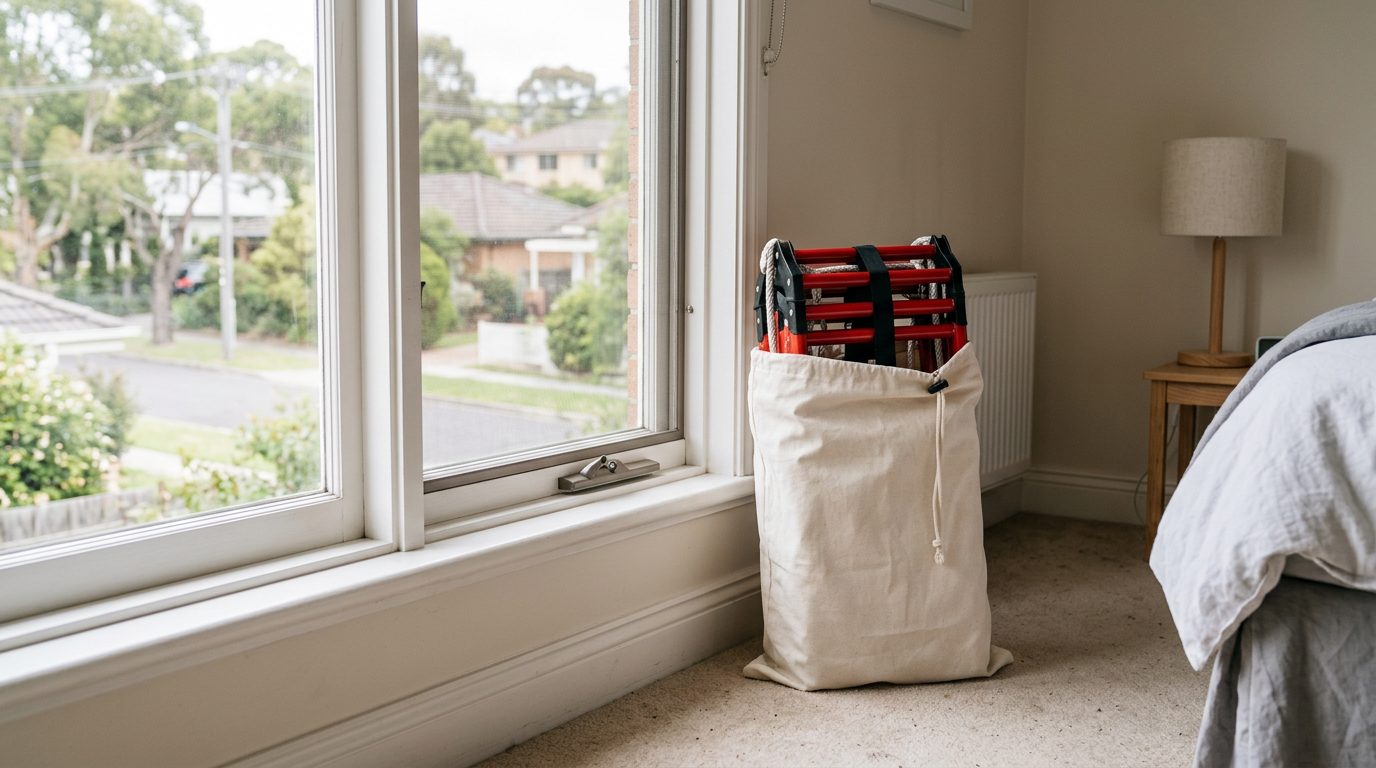
The best fire escape ladders of 2026 compared by length, sill fit, load rating and standoffs, plus how to test fit, store and use one in your escape plan.

The best fire escape ladder for most two-story homes is a fully assembled hook ladder sized to your window, such as the Kidde 2-Story ladder (13 feet, load tested to 1,000 pounds by Kidde) or the First Alert Two-Story ladder (14 feet, 375-pound load rating, steel standoffs on every rung). For a third floor, step up to a 24 or 25 foot model from the same brands. The ladder is a backup, not your main exit: the U.S. Fire Administration warns that you could have less than 2 minutes to get out once a smoke alarm sounds, and the ladder only helps if it is stored in the room, fits the sill and everyone knows how to use it.
Below we compare 6 ladders that were in stock on Amazon with a working buy box when we checked in October 2026, explain how to match ladder length and hook size to your windows, and walk through storage, inspection and the safe way to fold a ladder into your family escape plan.
Top picks at a glance
Affiliate links: As an Amazon Associate, Delozone earns from qualifying purchases, at no extra cost to you. Full disclosure
Key takeaways
Quick comparison: best fire escape ladders for 2026
| Ladder | Length | Load figure (maker) | Window fit | Notable | Buy |
|---|---|---|---|---|---|
| Kidde 2-Story | 13 ft | Tested to 1,000 lb | Most windows up to 11 in deep, 16 in wide; casement OK | Single use, tangle-free design | Check price |
| First Alert Two-Story | 14 ft | 375 lb rating | Sills 6 to 10 in deep | Steel standoffs, ASTM tested | Check price |
| X-IT 2 Story | 13 ft | Exceeds ASTM F2175 (maker) | Secures to the sill, maker says all window and wall sizes | Sold as reusable for practice | Check price |
| Hausse Retractable 2 Story | 13 ft | Tested to 1,000 lb | Retractable hooks for sill or frame | Aluminum rungs, replace every 3 years | Check price |
| Kidde 3-Story | 25 ft | Tested to 1,000 lb | Most windows up to 11 in deep, 16 in wide | Single use | Check price |
| First Alert Three-Story | 24 ft | 375 lb at a time | Opening at least 20 x 32 in, sill 6 to 13 in deep | Extra-wide hooks, steel stabilizers | Check price |

An escape ladder exists for one situation: you are on an upper floor, the smoke alarm is sounding, and the hallway or stairs are blocked by smoke or fire. In that moment a window becomes your second way out, and a ladder turns a dangerous drop into a controlled climb down. ESFI puts it plainly in its escape ladder safety tips: a ladder can provide a means of escape from a second or third story room, but it should not be your primary route, and you should use a window exit only if the other exits are blocked.
That framing matters when you shop. You are not buying a ladder for daily use or for chores. You are buying a device that will sit folded in a bag or box for years, then has to work the first time, in the dark, possibly with smoke in the room and a frightened child next to you. Simplicity, a secure fit on your specific window and a clear storage spot beat any extra feature.
It also means the ladder is one part of a plan, not the plan itself. First Alert’s user manual says its ladder is intended to supplement, not replace, fire drills, evacuation plans, smoke alarms and fire extinguishers. Working smoke alarms buy you the warning time, and the ladder gives you a route when the normal one is gone.
“Residents could have less than 2 minutes to escape a home fire once the smoke alarm sounds.”
U.S. Fire Administration, Home Fire Escape Plans
Most homes use a portable hook ladder. It stores folded, and in an emergency you set two hooks over the inside of the windowsill and drop the rest of the ladder out of the window. The rungs hang on nylon straps or steel chains and unfold as they fall. All 6 of our picks are this type, because they need no installation and you can move them if you rearrange bedrooms.
Permanent ladders are mounted under the window, either hidden in a wall box or bolted to the exterior, and they deploy when you pull a release. They remove the step of carrying and hooking a ladder, which helps for people who would struggle with a portable unit, but they usually need a contractor, involve cutting into the wall, and may need approval from a homeowners association or landlord. ASTM covers both types in the same standard.
Rope ladders with hard rungs are sold widely too, often with very high breaking strength figures. Some of these listings also market the same ladder for tree houses and play sets. For fire escape use we preferred ladders built specifically for window escape, with stiff hooks shaped for a sill, flat anti-slip rungs and, ideally, standoffs that keep your feet off the wall.
The U.S. reference standard is ASTM F2175, Standard Specification for Portable and Permanent Emergency Escape Ladders for Residential Use. The current edition is F2175-23, and it replaced an earlier provisional standard called PS 117. The ASTM abstract lists the areas a ladder has to meet, including vertical and horizontal static load, rung strength, deployment weight, deployment time, hook or attachment stability, rung size and spacing, standoff, designed length, rated load, heat deflection temperature and heat aging.
In plain terms, that list tells you what good looks like. A compliant ladder should hold its rated load without the hooks slipping, should deploy within a set time, should keep rungs wide and evenly spaced, should hold you away from the wall, and should not soften quickly near heat. When a listing says “tested to ASTM standards” or “complies with ASTM F2175”, it is claiming those checks.
ESFI adds a simple buying rule: purchase ladders that bear the label of a nationally recognized testing laboratory. If a product page shows neither an ASTM reference nor a lab label, treat its strength numbers as marketing until the maker can show otherwise. Also note that a “test load” (for example 1,000 pounds) is not the same as a “rated load” (for example 375 pounds); we explain the difference below.
Length is the first decision, and it is set by the height of the window, not the height of the house. Second floor ladders are usually 13 to 15 feet long and third floor ladders about 24 to 25 feet. First Alert’s manual for its two-story ladder says to use it only from second floor windows no more than 16 feet above the ground, so measure from the sill down to the ground outside, especially on sloping lots where one side of the house sits higher.
A ladder that is too short leaves you hanging above the ground, and a ladder that is far too long can pile up at the bottom, which is a trip hazard but much less serious than a short ladder. If a measurement falls between sizes, go longer. If a window is higher than a ladder of that class allows, use a different window or a three-story model rated for that height.
Do not try to use a two-story ladder from a third floor, and do not plan ladder escapes above the third story at all. ESFI says escape ladders should not be used from floors higher than the third story. For apartments above that, your plan depends on the building’s stairs, as covered later.
The hooks have to fit your sill. First Alert’s two-story manual says the sill should be at least 6 inches and no more than 10 inches deep, measured from outside to inside, and warns against using the ladder on sills that are too large or too small for the hooks. Kidde lists its ladders for most common windows up to 11 inches deep and 16 inches wide, including casement windows. Retractable hooks, like the ones on the Hausse ladder, adjust to more sizes.
The window opening matters as much as the sill. First Alert recommends a window at least 20 inches wide and 32 inches high, and says storm windows, screens and multi-track windows can make a ladder hard to use in an emergency. Check that every window you plan to use opens easily and fully, and that every family member who might use it can open it. ESFI also says security bars must have an emergency release on the inside.
Finally, walk outside and look up. First Alert tells owners to check the path below for trees, bushes, windows and fixtures, and its manual says the ladder is not intended for second floor windows directly above first floor windows, because the rung stabilizers could break the lower window. Also look for power and phone lines, and fences close to the wall.
Standoffs are short arms on the rungs that push the ladder away from the wall. Without them the rungs lie flat against siding or brick, and your toes have nowhere to go. With them you get a few inches of space for your feet and a steadier climb. The First Alert ladders have steel stabilizers on every rung, and ASTM F2175 includes standoff among its requirements.
Rung design is the next thing to check. Look for wide, flat, slip-resistant rungs: Kidde describes zinc-plated rungs about 1 foot wide, and First Alert uses epoxy-coated steel rungs. Round or narrow rungs are harder to stand on in socks or bare feet, which is how most people will be dressed during a night fire.
Rails are usually nylon webbing (straps) or chain. Webbing is lighter and quieter, and both Kidde and First Alert describe flame-resistant or heavy nylon construction. Whatever the material, the ladder should arrive fully assembled, because nobody should be clipping parts together in a smoky room.
Two numbers show up on listings, and they mean different things. The rated load is how much weight the maker says the ladder should carry in use; First Alert rates its two-story and three-story ladders at 375 pounds. The test load is the weight the ladder survived in a strength test; Kidde and Hausse both state their ladders were tested to 1,000 pounds.
A big test number is a sign of a margin, but it does not mean several people should climb at once. First Alert’s manual says its ladder is designed for one person at a time, and that is the safe way to use any escape ladder: the first person climbs down and steps away, then the next starts.
Weight also affects carrying and hooking. A three-story ladder is heavier and bulkier than a two-story one, so check that the adults who would deploy it can lift it to the sill. If someone in the household could not handle a portable ladder, a permanent unit or a bedroom on the ground floor may be the safer plan.
Some ladders are designed to be used once. The Kidde listing says single use only and to discard the ladder when it has been unfolded or used. That keeps the folding pattern factory-fresh, but it means you cannot practice by actually dropping it out of a window. You can still rehearse every other step.
Others are sold for repeat use. X-IT markets its ladder as multi use for safe practice and says it will replace a ladder used in a documented emergency. Hausse asks owners to replace its ladder every three years. First Alert says its ladder should be inspected periodically for damage, loose parts or deteriorated materials.
Whichever you choose, follow the maker’s instructions on practice. ESFI recommends practicing the setup from a first floor window so you know how to do it quickly and correctly, and not practicing climbing during family fire drills.
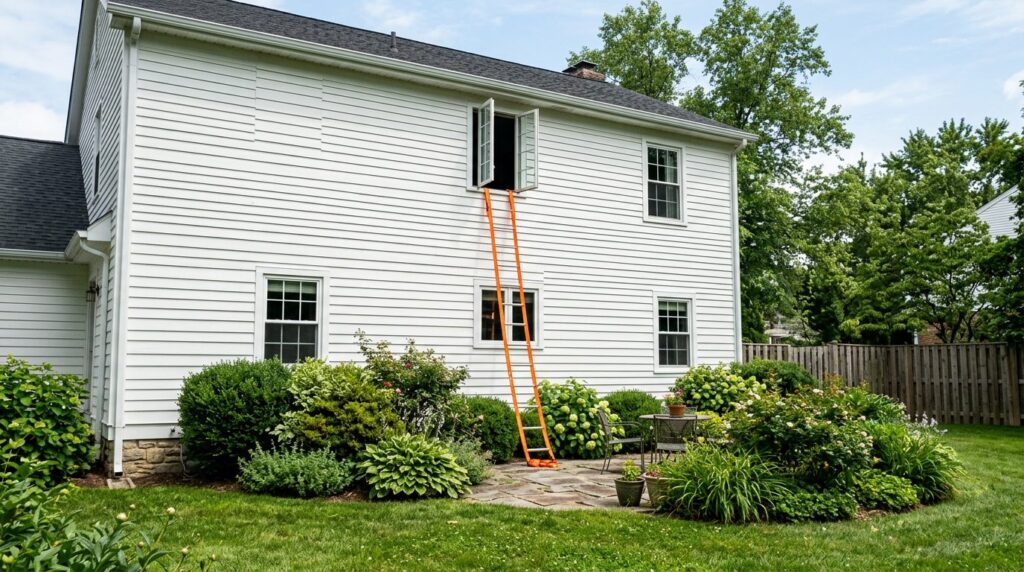
All 6 picks were in stock on Amazon with a working buy box when we checked in October 2026. We chose them on length options, window fit, rated and test load figures, standoffs and rung design, standards references, how easy each looks to deploy from the manual and listing, and the pattern of verified owner feedback. Four are for second floors and two are for third floors.
Every product spec below comes from the Amazon listing or the maker’s own documents. Where a figure is only a claim by the seller, we say so.
The Kidde 2-Story ladder (sold as model KL-2S) is the most widely owned ladder in this category and the one we would put in most second floor bedrooms first. It extends to 13 feet, arrives with no assembly needed, and attaches to most common windows up to 11 inches deep and 16 inches wide, including casement windows. The hooks go on before the rungs are released, which keeps the sequence simple.
Kidde describes it as flame resistant and tested to 1,000 pounds, with zinc-plated anti-slip rungs about 1 foot wide and red nylon strap rails for grip. It uses a tangle-free folding design so the rungs drop in order when you let go. Kidde’s own safety article says its 2-story and 3-story ladders attach quickly without tools and are compact enough to store in a closet or under a bed.
The one thing to plan around is that it is single use. The listing says to discard the ladder once it has been unfolded or used, so do not drop it out of the window as a test. Instead, read the instructions, set the folded unit on the sill to check that the hooks fit, and rehearse the steps without releasing the rungs.
Check Kidde 2-Story price on Amazon
The First Alert Two-Story ladder is 14 feet long and built from steel and nylon, with steel stabilizers that hold the rungs away from the wall so your feet land on the rung, not on siding. That design detail is the reason we picked it, because standoffs make the climb steadier for adults and children alike. The listing says it is tested to ASTM standards and rated to 375 pounds.
First Alert’s user manual for its nylon and steel two-story ladder is one of the clearest documents in the category. It covers window choice (an opening at least 20 by 32 inches), sill depth (6 to 10 inches), maximum height (16 feet), storage in the original box to prevent tangling, and the warning not to use it from a window directly above a first floor window because the stabilizers could break it.
The trade-off is the narrower sill range. If your sills are deeper than 10 inches, as in many brick or block homes, this ladder is not the right fit for those windows, and a Kidde or a ladder with retractable hooks is the better choice. Measure before you order.
Check First Alert Two-Story price on Amazon
The X-IT 2 Story ladder is 13 feet long and is the pick for households that want to rehearse with the real thing. X-IT sells it as multi use for safe practice, and says that if you use it in a documented emergency, X-IT will replace it. That pairs well with a family that wants older children to have climbed it once from a ground floor window under supervision.
The listing says it exceeds ASTM F2175 safety standards, including UL, and that it fits window and wall sizes by securing to the window sill. It comes with a storage bag. X-IT also markets the ladder as small and light, which matters if a teenager or an older adult is the person most likely to lift it onto the sill.
It is a smaller brand than Kidde and First Alert, and owner feedback is thinner. Read the instructions in the box carefully, check the fit on your actual sill before you store it, and follow the maker’s guidance on how to practice. If you want the largest base of owner experience, start with the Kidde instead.
Check X-IT 2 Story price on Amazon
The Hausse Retractable 2 Story ladder is 13 feet long with retractable hooks that secure the ladder to the window frame or to the sill of most windows. The listing tells owners to extend the hooks at both ends to the maximum before use. That adjustability is why we picked it for homes with sills that fall outside a fixed-hook ladder’s range.
Hausse says it is tested to 1,000 pounds, needs no assembly or tools, and has slip-resistant rungs; the listing specs show aluminum construction with 12 steps. It comes in a red canvas bag sized to store under a bed or near the window. Hausse also asks owners to replace the ladder every three years, which is a useful reminder to put a date on the bag.
Because the hooks adjust, take a few minutes when it arrives to set them on your actual sill and confirm they sit flat and tight. An adjustable hook that has been left half extended is the most likely way to get a poor fit in a hurry, so practice the extend-and-hook step until it is automatic.
Check Hausse Retractable price on Amazon
The Kidde 3-Story ladder uses the same design as our top pick, extended to 25 feet for third floor windows. It shares the hook system for most common windows up to 11 inches deep and 16 inches wide, the flame-resistant nylon strap rails, the zinc-plated anti-slip rungs about 1 foot wide and the 1,000-pound test figure.
A 25 foot ladder is bulkier and heavier than a 13 foot one, so store it on the floor or a low shelf near the window rather than on a high closet shelf. In a third floor room, the time spent climbing is longer too, so rehearse who goes first and who helps children before anyone needs to climb.
Like the 2-story model, it is single use: the listing says to discard it once unfolded. Families with both two-story and three-story rooms can buy the matching Kidde pair, which keeps the instructions the same everywhere in the house.
Check Kidde 3-Story price on Amazon
The First Alert Three-Story ladder is fully assembled, 24 feet long and made of steel and nylon, with slip-resistant rungs and steel stabilizers that keep a steady foothold away from the wall. The listing says it can hold up to 375 pounds at a time and is tested to ASTM standards.
Its extra-wide hooks work with windowsills at least 20 inches wide and 32 inches high, and 6 to 13 inches deep, so it covers deeper sills than the two-story First Alert. That makes it a good fit for third floor rooms in homes with thicker walls.
The same placement rules from the First Alert manual apply. Check the full drop below the window for obstructions, avoid windows directly above lower windows where stabilizers could strike glass, and store it near the window in its box so the rungs stay in order.
Check First Alert Three-Story price on Amazon
We started from the ladders that appear across the top search results and editorial guides for this topic, then narrowed the list to products from established safety brands and a few specialists with clear specifications. For each one we read the Amazon listing and, where available, the maker’s manual or safety pages, and we checked the current ASTM F2175 scope so we could compare claims against the standard’s list of requirements.
We weighed six factors: whether the ladder comes in the right lengths for two and three story homes, how clearly the maker states the sill and window range, rated load and test load figures, standoff and rung design, references to ASTM F2175 or a testing laboratory label, and the overall pattern of verified owner feedback. We also checked that each pick had a working Amazon buy box for U.S. shoppers in October 2026.
We did not hang off ladders or drop them out of windows ourselves. Escape ladders are life-safety products, and we think the most useful thing we can do is put the manufacturers’ limits side by side so you can match a ladder to your windows.
We skipped generic rope ladders whose listings market the same product for tree houses, play sets and fire escape, because their hooks and rungs are not designed around a windowsill, and their strength figures are rarely tied to a standard. Some of them may be fine, but the listings do not give enough to judge.
We also left out permanent, in-wall ladders from this list. They are a good option for some homes, but they require installation, and the right model depends on your wall construction. If you want one, get a quote from a contractor who has installed that model before.
Finally, we did not include products for babies or pets that are lowered on a line. Fire safety agencies focus on adults guiding children down a ladder or waiting at a window for firefighters, and we would rather point you to that advice than to a device we cannot verify.
Escape ladder listings change often: the same ASIN can switch sellers, packaging or even ladder length. We recheck stock and buy box status before every update, and we update the page when a maker changes a specification or ASTM publishes a new edition of F2175.
If you find that a listed ladder no longer matches what we describe, check the box and the manual that arrive with it. The printed instructions are the final word on how your specific ladder should be fitted and used.
For related fire safety gear, see our guides to the best smoke detectors and the best fire extinguisher for home.
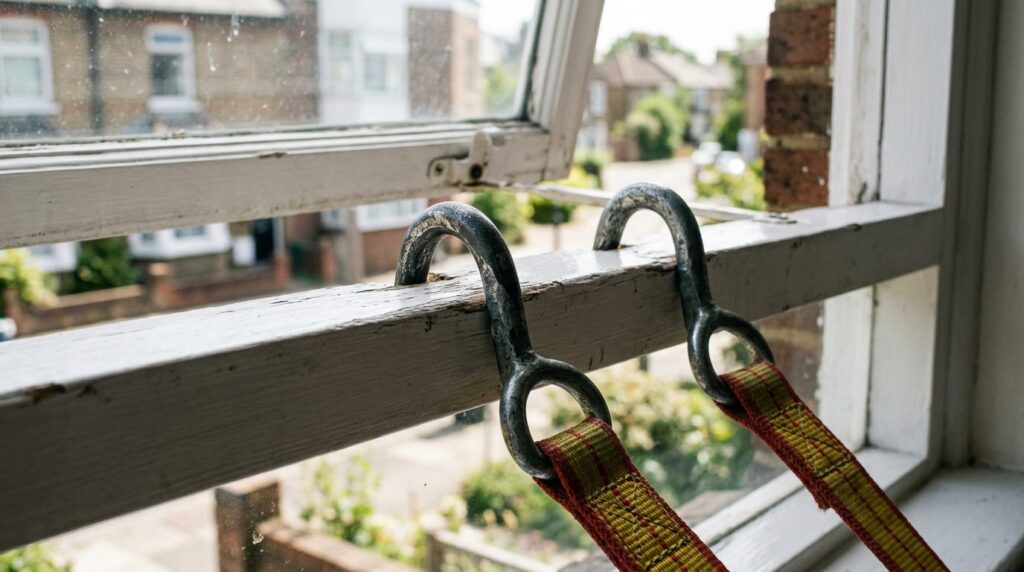
As soon as the ladder arrives, read the instructions, then take it to the window you plan to use. First Alert’s manual is blunt about this: you must test fit the ladder on the chosen window before storing it, because in a fire you will not have time to work out whether a window is suitable. Open the window fully and set the hooks on the sill without releasing the rungs.
Check that the hooks sit flat and tight, that the sill is solid (no rotted wood or loose boards), and that the crosspiece between the hooks is straight. If the sill is damaged, First Alert says to have it repaired before relying on the ladder. If the hooks do not fit, return the ladder and choose a model with a different range.
Then go outside and look at the path the ladder will take. Note anything in the way, from shrubs to a lower window, an air conditioning unit or a fence. If the path is poor, choose a different window for that room, or move the obstacle.
Store the ladder in the room it serves, near the window. First Alert’s manual says not to store the ladder on another floor of your home, and to put a ladder in each second floor room that needs an alternate exit. Good spots are under the bed on the window side, or the front of a closet near the window.
Keep the path clear. ESFI says everyone in the family should know where the ladders are kept, and First Alert warns against burying the ladder behind heavy storage. Store it in its original box or bag so the rungs stay in order, as First Alert recommends to prevent tangling.
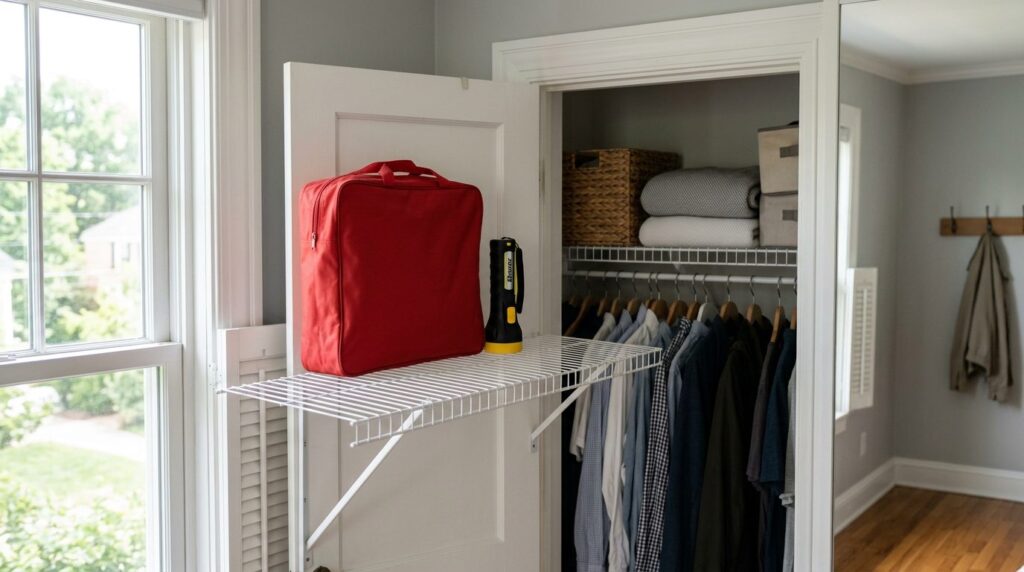
Keep a flashlight with the ladder if you can. Night fires often knock out power, and finding the hooks, the window latch and the first rung is much easier with a light. A small label on the bag with the room name helps if ladders get moved during cleaning.
Put ladder checks on the same calendar as your smoke alarm tests. First Alert says the ladder should be inspected periodically for damage, loose parts or deterioration of its materials. Open the box or bag, look at the straps for fraying, cuts or mildew, look at the rungs and hooks for rust or bends, and fold everything back as it came.
Note the purchase date on the bag. Hausse asks owners to replace its ladder every three years, and any ladder that has been unfolded in a single-use design, damaged or stored somewhere damp should be replaced. Keep the receipt and manual with the ladder.
Recheck the window each time too. Paint can seal a sash shut, new furniture can block the opening and a new storm window can change the fit. ESFI also recommends confirming that any security bars have a working inside release.
If the smoke alarm sounds and your door is the way out, use the door. If you cannot leave through the door because of smoke or heat, keep it closed. First Alert’s manual says to close doors before opening windows to keep fire from being drawn into the room. Put a towel or clothing along the gap under the door if smoke is coming in.
Call 911 if you have a phone, and tell the dispatcher where you are. Then get the ladder from its storage spot and move to the window you checked. Open the window fully and clear anything on the sill.
Look out before you deploy. First Alert warns not to deploy the ladder into flames. If fire is directly below the window, use another window or stay at the window, signal for help and wait for firefighters, which is the advice fire services give when escape is not possible.
Every model has its own sequence, but the pattern is similar. First Alert’s guidance describes it this way: attach or position the hooks on the windowsill as directed, make sure the ladder is stable and hanging correctly outside the window, and lower it fully before anyone begins climbing. Kidde’s ladders attach to the window before the rungs are released.
Make sure the hooks are tight against the inside of the sill and the crosspiece is straight. For the First Alert models, the rung standoffs should face the wall once the ladder hangs. For adjustable hooks, extend them fully as the maker directs before you set them.
Let the ladder fall in a controlled way, and look down to confirm it reaches the ground and is not twisted around itself. If the straps are tangled, pull the ladder back in and drop it again rather than climbing onto a twisted section.
Climb out backward, facing the house, with both hands on the rails or the window frame. First Alert’s manual says to keep your body close to the ladder. Move one hand or foot at a time and keep three points of contact as you go down.
Only one person should be on the ladder at a time. First Alert says its ladder is designed for one person at a time, and it also advises against carrying pets or other objects, and against carrying a child unless absolutely necessary. Once you reach the ground, step away from the wall so the next person has a clear landing.
Once outside, go straight to your meeting place and stay there. The U.S. Fire Administration says to choose an outside meeting place in front of your home. Tell firefighters if anyone is still inside; do not go back in.
Plan who goes first. A common approach is for an adult to send an older child down first while another adult waits below, or for an adult to go first to steady the bottom. Decide this as a family and practice it in words, so no one has to improvise.
Teach children what the ladder is for. First Alert says children should be told the ladder is not a toy and is only for emergencies. First Alert’s home safety guide also suggests teaching children to go to the window and wait for help if they need an adult.
For older adults or anyone with limited mobility, a ladder may not be realistic. The U.S. Fire Administration publishes separate escape planning material for older adults and people with disabilities, and the safest plan may be a ground floor bedroom close to an exit. Talk to your local fire department if you are unsure.
The U.S. Fire Administration’s home fire escape plan guidance starts with a simple drawing: map your home, include all doors and windows, and find 2 ways out of every room. For an upstairs bedroom, the first way out is usually the door and stairs, and the second is the window and a ladder.
Mark on the map which window each ladder is for, and where each ladder is stored. Make sure doors and windows are not blocked, as the USFA advises. If a room has no window that a ladder can work from, that room may be better as a study than a bedroom.
Keep the plan where everyone can see it, for example on the fridge, and update it whenever you move furniture or change who sleeps where. Babysitters and overnight guests should hear about the ladders too.
Choose an outside meeting place in front of your home, such as a mailbox, a tree or a neighbor’s driveway, as the USFA recommends. It lets you count heads quickly and tell firefighters whether anyone is still inside.
Practice your fire drill with everyone in the home. The USFA suggests pushing the smoke alarm test button to start the drill and then getting outside to the meeting place. Fire safety groups, Kidde among them, recommend practicing twice a year.
For the ladder part of the drill, follow ESFI and your ladder’s manual. ESFI says to practice the setup from a first floor window and not to practice with the escape ladder during your family fire drills, and to use it only in a real emergency. Walk to the window, open it, take the ladder out and place the hooks without unfolding a single-use ladder.
A ladder is only useful if you wake up in time. Install smoke alarms inside each bedroom, outside each sleeping area and on every level, and test them monthly. Our guide to the best smoke detectors covers interconnected and 10-year sealed models that sound throughout the house.
Add carbon monoxide alarms on every level and near sleeping areas if you have fuel-burning appliances or an attached garage. Our carbon monoxide detector guide explains placement.
Keep a fire extinguisher in the kitchen and on each level, and know when not to use it. The point of the whole kit is to get everyone out, and the ladder is the last step in that chain.
Brick, block and stone homes often have deep sills. Measure yours from inside to outside before you buy. A two-story First Alert fits 6 to 10 inches, the Kidde models list up to 11 inches, and the First Alert three-story covers 6 to 13 inches. For anything deeper, look at adjustable hooks like the Hausse, and confirm the fit on your sill as soon as it arrives.
Deep sills can also make it harder to reach out and lower a ladder. Practice the reach with the ladder still folded, and check whether a chair or step stool would be needed to climb out; if so, plan where it will be kept.
If no portable ladder fits safely, ask a contractor about a permanent ladder designed for your wall, or about changing the window.
Third floor rooms need a three-story ladder, typically 24 to 25 feet. Climbing that height takes longer and is harder for children, so keep the climbing order and the meeting place clear in your plan.
Check whether a lower roof, porch or deck below the window changes the path. A ladder that lands on a roof is not a safe route. Choose the window with the clearest drop to the ground.
ESFI says escape ladders should not be used above the third story. For higher floors, rely on the building’s exit stairs and the fire department.
If you live in a high-rise or condominium, the USFA advice is to know where the exit stairs are, leave the apartment and close the door behind you, pull the fire alarm on the way out, use the stairs and not the elevator unless the fire department directs you, and go to your outside meeting place.
For a second or third floor apartment with a window or balcony over open ground, a portable ladder can be a sensible backup, but check your lease and ask the landlord before installing anything permanent. Portable hook ladders need no drilling.
From a balcony, make sure the ladder can hook securely on a solid edge, which balcony railings often do not provide. Many portable ladders are designed for windowsills only, so read the manual before you plan to use a balcony.

Your escape plan covers getting out, but the most common home fire starts on the stove. A fire blanket mounted near the kitchen exit lets you smother a small pan fire in seconds; see our picks for the best fire blanket, including an extra large size for clothing fires.
For most second floor rooms, a 13 to 14 foot hook ladder from an established safety brand that states ASTM F2175 compliance or a testing laboratory label is the best buy. Our top pick is the Kidde 2-Story for its window range and simple design, with the First Alert Two-Story as the pick if you want steel standoffs.
For thick walls and deep sills, choose a ladder with adjustable or extra-wide hooks and check the maker’s sill range before buying. Fixed hooks fit only a set depth, such as 6 to 10 inches, while adjustable hooks and some three-story designs cover deeper sills.
A ladder about 13 to 15 feet long is the right size for most second floor windows. Measure from the sill to the ground first, and buy one ladder for every occupied upstairs room, which is the NFPA recommendation cited by Kidde.
Most three-story ladders are 24 to 25 feet long. Measure the drop from the third floor sill to the ground, and do not plan ladder escapes above the third story, as ESFI advises.
Newer apartment buildings generally rely on enclosed exit stairs, alarms and, in many cases, sprinklers rather than the open metal fire escapes seen on older buildings. In houses, a portable escape ladder now fills the role of a second exit from upper rooms.
It depends on the model. Some are single use and should be discarded once unfolded, while others are sold for practice and repeat use. Always follow the instructions that come with your ladder.
One for every occupied room above the main level. Storing one ladder in a hallway closet does not help someone trapped in a bedroom, so each room’s ladder should stay in that room.
Children should practice only with an adult, and only following the ladder’s instructions. ESFI recommends practicing the setup from a first floor window and not practicing climbing during family drills. Many families rehearse every step except the climb.
Many do, as long as the window opens fully and the sill or frame matches the hooks. Kidde lists its ladders as compatible with casement windows. Always test fit the folded ladder on the actual window before storing it.
For more home safety gear, see our picks for the best smoke detector, the best fire extinguisher for home and the best carbon monoxide detectors.
Written by the Delozone Editorial Team. We research products using manufacturer specifications and manuals, ASTM standards, U.S. Fire Administration and ESFI guidance and verified owner feedback, and we update guides when products or guidance change. How we work.
The Delozone Editorial Team researches water treatment, pool and spa, and indoor air products for independent buying guides. We compare products using manufacturer specifications, certification listings such as NSF/ANSI, UL, AHAM and Energy Star, published third-party test data and verified owner feedback. We do not sell products, and affiliate commissions never decide what we recommend.