Independent buying guides for home air, water and safety.
As an Amazon Associate, Delozone earns from qualifying purchases.
Independent buying guides for home air, water and safety.
As an Amazon Associate, Delozone earns from qualifying purchases.

Best whole-house reverse osmosis systems for well water tested on 1200 and 2100 mg/L TDS samples. iSpring, Crystal Quest, WECO, Express Water, APEC compared.

A whole-house reverse osmosis system is the heaviest tool in well-water treatment. It pushes water through a semi-permeable membrane that rejects most dissolved solids, including the sodium, sulfate, chloride and nitrate that softeners, iron filters and UV lamps can’t touch. The trade-offs are real: cost, floor space, pumps, a storage tank and a steady stream of reject water. The EPA’s secondary guideline for total dissolved solids (TDS) is 500 mg/L, and wells well above that are where whole-house RO starts to make sense. Below we explain when you actually need it, how a complete system is put together, and which systems are worth shortlisting in 2026, from dealer-built whole-house packages to high-output units that only make sense for a cabin or a single drinking-water line.
Affiliate links: As an Amazon Associate, Delozone earns from qualifying purchases, at no extra cost to you. Full disclosure
We did not install or run these systems ourselves. We compared them on published information: the manufacturer’s product page, spec sheet or Amazon listing for rated output (gallons per day or gallons per minute), feed-pressure range, maximum feed TDS, pure-to-drain ratio, what is included (storage tank, delivery pump, UV, remineralization) and whether the pre-treatment can be matched to a lab report. Where a number appears below, it comes from that listing and we say so. We set the “do you need it” thresholds with the EPA secondary drinking water standards and the CDC guidelines for testing well water, and we read verified owner feedback for recurring problems such as pump noise, early membrane fouling or tanks running dry at peak times.
One honest note on the market: true whole-house RO is mostly sold by water-treatment dealers and specialist manufacturers, sized per home. Very few complete whole-house packages are sold on Amazon. That is why three of our five picks are dealer systems and the two Amazon picks are clearly labeled as point-of-use or small-cabin options.
Whole-house RO is expensive to buy and to run, so it should be driven by a lab report, not a hunch. The CDC recommends testing a private well at least once a year for total coliform bacteria, nitrates, total dissolved solids and pH, and asking your local health department what else to test for in your area. Use a state-certified laboratory. For an RO decision, also ask the lab for hardness, iron, manganese, sulfate, chloride, sodium and silica, because those decide the pre-treatment you need in front of the membrane.
| Parameter | EPA reference level | Why it matters for whole-house RO |
|---|---|---|
| Total dissolved solids | 500 mg/L (secondary) | The main reason to consider RO; also decides membrane choice and reject volume |
| Chloride | 250 mg/L (secondary) | Salty taste and corrosion; softeners can’t remove it, RO can |
| Sulfate | 250 mg/L (secondary) | Salty or bitter taste; another contaminant ion exchange leaves behind |
| Iron | 0.3 mg/L (secondary) | Fouls RO membranes; remove it upstream with an iron filter |
| pH | 6.5 to 8.5 (secondary) | RO permeate is corrosive, so plan a post pH correction stage |
Whole-house RO is the right call in one of three situations:
For most wells with TDS under 500 mg/L, a point-of-use RO at the kitchen sink covers drinking and cooking water, and a softener or iron filter handles the rest for a fraction of the cost and complexity. Don’t install whole-house RO unless the test results call for it. If your problem is mainly iron, sulfur or hardness, start with our guide to the best well water filter systems instead.
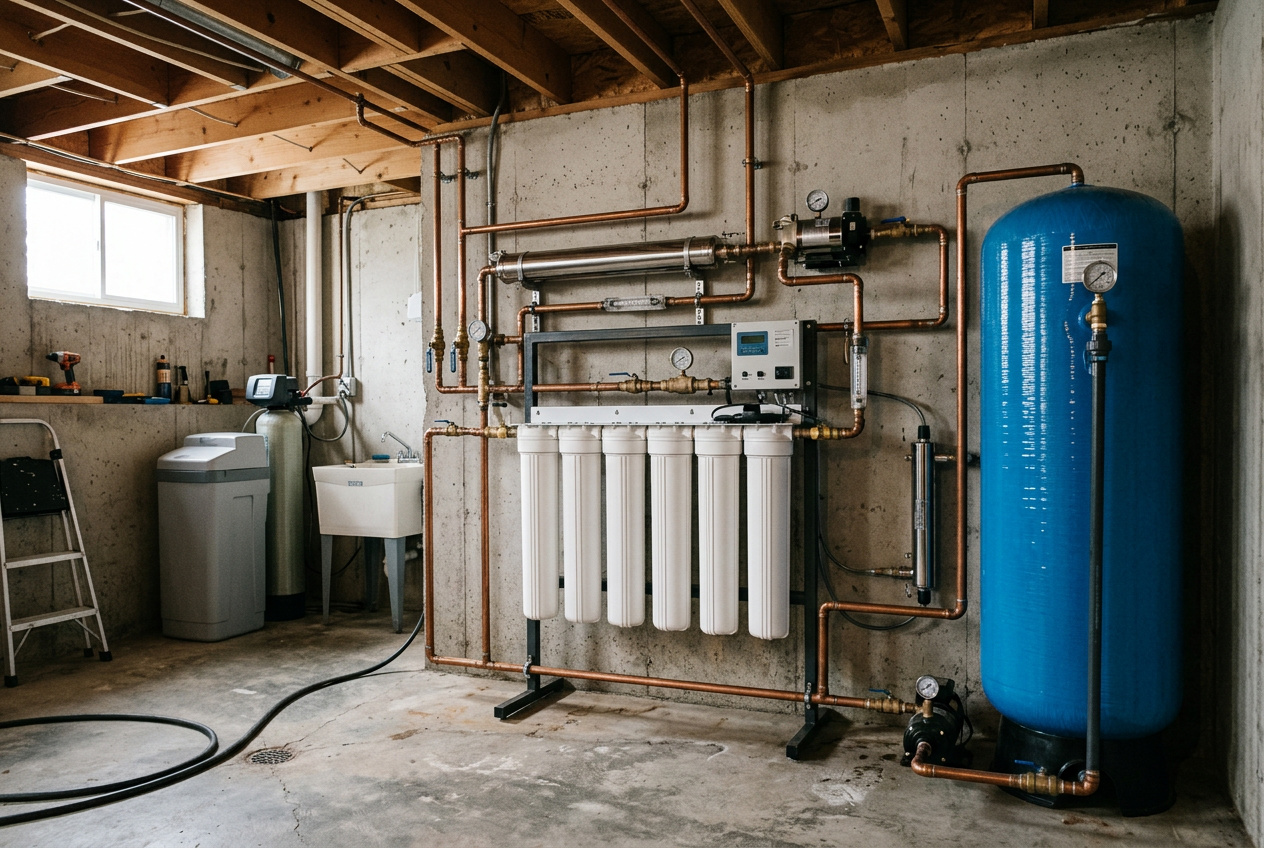
A complete whole-house RO system has five parts that have to work together:
The system also needs a drain for reject water (the concentrate the membrane rejects). Unremineralized RO water is low in minerals and slightly acidic, which is why post pH correction is standard on dealer-built packages.
Crystal Quest sells whole-house RO as part of its well-water line, configured with a storage tank and UV, and asks for your water details before confirming the fit. Its well-water page lists the RO system next to its iron and sulfur filters, softeners and UV sterilizers, which makes it easy to build the full chain (pre-treatment, RO, post-treatment) from one supplier. Output, tank size and pump depend on the configuration you choose, so get those numbers in writing from the quote rather than relying on a generic rating.
Who it suits: homeowners who want a coordinated system from one brand and are comfortable having their own plumber install it. Check the quoted daily output against the sizing table below before you order.
Pros: Sold as a complete package with tank and UV, matching pre-treatment from the same supplier.
Cons: Specs vary by configuration; large footprint; professional installation strongly advised.
The Defender is US Water Systems’ flagship whole-house RO. The company says it is designed to deliver up to 20 gpm at 60 psi and comes standard with a 140-gallon tank, which is the kind of delivery rate that keeps several showers and appliances running at once. It uses multi-stage stainless steel centrifugal delivery pumps, and the company recommends one of its water tests before you buy so the pre-treatment matches your well. A more compact model, the Falcon, is aimed at smaller homes.
Who it suits: larger homes, high-TDS wells and buyers who want a system built around commercial-grade pumps. It is sold direct, not on Amazon.
Pros: High rated delivery flow, large standard tank, centrifugal pumps, water-test-first process.
Cons: Top of the market on cost; sold direct only; needs plenty of floor space.
RainDance builds whole-house RO to order from your most recent well test. It runs the numbers through its design software to estimate treated-water quality, then picks pre-filters and post-filters to match. The company says its systems are designed for problem wells with brackish water, arsenic, silica, nitrates, heavy metals, sulfates, chlorides, sodium, fluoride and high TDS, that every whole-house RO it sells includes UV disinfection, and that it uses mostly stainless steel frames.
Who it suits: wells with an unusual mix of contaminants where an off-the-shelf package might be undersized or missing a stage.
Pros: Designed around your actual lab report, UV included, free technical support before purchase.
Cons: Custom builds take longer to quote and ship; you still need a qualified installer.
The iSpring RCB3P is often listed as whole-house RO online, but its own Amazon listing describes it as a tankless under-sink system for residential and light commercial use. Per that listing it is rated at up to 300 gallons per day with a 1.5:1 pure-to-drain ratio, has a built-in booster pump, works with feed pressure from 25 to 90 psi and feed water up to 2,000 ppm TDS, and has a maximum flow rate of 0.2 gpm. It is compatible with iSpring’s 11- or 20-gallon storage tanks, which are not included.
That flow rate is the key point: 0.2 gpm can feed a kitchen line, an ice maker, a small office or a very small cabin with a storage tank, but it can’t supply a family home’s showers directly. Treat it as a high-output point-of-use system, not a whole-house replacement.
High-output RO for a cabin or dedicated line
Specs from the Amazon listing. Storage tank sold separately.
Pros: Booster pump built in, efficient 1.5:1 ratio per the listing, rated for feed TDS up to 2,000 ppm.
Cons: 0.2 gpm maximum flow; not a true whole-house system; tank not included.
If your well’s TDS is borderline and the real complaint is the taste of drinking water, you may not need whole-house RO at all. The APEC ROES-PHUV75 is an under-sink system. Per its Amazon listing it is a 75 GPD, 7-stage RO with continuous UV sterilization and a calcium carbonate stage that adds minerals back, and it is made for both tap and well water.
Pair it with a softener or iron filter for the rest of the house and you cover the most common well complaints for far less than a whole-house RO package costs to buy and run.
Drinking-water RO for well water
Covers one faucet only. Specs from the Amazon listing.
Pros: UV and remineralization built in, made for well water, simple under-sink install.
Cons: One faucet only; 75 GPD is drinking and cooking volume, not household volume.
Size on two numbers: daily production (gallons per day) to refill the tank, and delivery flow (gallons per minute) from the tank to your taps. The table below is a planning starting point; ask the supplier to confirm both numbers against your household and fixture count.
| Household size + use | What to plan for | Typical fit |
|---|---|---|
| 1 to 2 person cabin | Low daily volume, short peaks | High-output RO with a storage tank, such as the iSpring RCB3P |
| 2-bath family home | Morning and evening peaks with two showers running | Entry dealer package with a large atmospheric tank |
| 3 to 4 bath family home | Several fixtures at once, laundry and dishwasher | Dealer package with a large tank and a centrifugal delivery pump |
| 5+ bath or multigenerational | Long, overlapping peaks | High-flow systems such as the Defender, or a custom build |
Always size up rather than down. Once the storage tank drains, an RO system can’t catch up quickly, and a system that bypasses to raw water at peak times defeats the purpose of installing it.
Every RO system sends part of the feed water to drain as concentrate. The ratio depends on the membranes, the pump, recovery settings and your feed water, and many whole-house suppliers only quote it per installation. For reference, the iSpring RCB3P listing states a 1.5:1 pure-to-drain ratio, which means roughly 1 gallon to drain for every 1.5 gallons of purified water.
At that ratio, a home using 300 gallons of RO water a day would send about 200 gallons a day to drain, or roughly 73,000 gallons a year of extra well draw. On a low-yield well or in a drought-affected area, that matters, so ask the supplier for the expected recovery on your water and check your well’s yield. Some homeowners route reject water to garden irrigation where local rules and the water’s salt content allow it.
RO membranes foul and scale quickly without the right pre-treatment, and replacement membranes are a significant cost. Typical requirements, set by your test results:
A common sequence: well, pressure tank, sediment filter, iron and sulfur filter, softener or anti-scalant, carbon if needed, RO, atmospheric tank, delivery pump, UV, pH correction, then the house. If your pressure tank is undersized or cycling hard, fix that first; see our guide to the best pressure tanks for well systems.
| Stage | What to expect |
|---|---|
| Sediment pre-filter | Most frequent change; follow the manual and watch the pressure gauge |
| Carbon pre-filter | Change on the manual’s schedule or sooner if chlorine breaks through |
| RO membrane | Lasts years with good pre-treatment; falling output or rising TDS means it’s time |
| UV lamp | Replace on the manufacturer’s schedule, even if it still glows |
| Storage tank and delivery pump | Long-life parts; check warranty length when you compare quotes |
A cheap handheld TDS meter on the RO output is the simplest way to spot membrane wear early. Check it monthly and compare with the reading the installer recorded at start-up.
Can you have a reverse osmosis system with well water?
Yes. RO works well on well water, and it is often the only practical way to lower high TDS, sodium, sulfate, chloride or nitrate. The key is pre-treatment: iron, manganese, sulfur and hardness must be handled upstream, and UV is strongly recommended because well water is not disinfected.
What is a major downside of reverse osmosis water?
Waste and cost. Every RO system sends part of the feed water to drain, needs pumps and a storage tank at whole-house scale, and produces low-mineral, slightly acidic water that needs pH correction to protect plumbing.
What is the best whole-house water filtration system for well water?
It depends on the test. Most wells are best served by targeted treatment (sediment, iron and sulfur, softening, UV). Whole-house RO is for wells with high dissolved solids or several dissolved contaminants that those filters can’t remove.
Does whole-house RO remove all minerals from my water?
Most of them, yes. If you want minerals back for taste or to reduce corrosion, add a calcite or other remineralizing stage after the membrane.
Can I install whole-house RO myself?
A point-of-use unit like the APEC is a typical DIY install. Whole-house systems involve pumps, a large tank, electrical work and drain connections, so most suppliers recommend a licensed plumber.
What’s the energy cost?
It depends on the booster and delivery pumps and how many hours a day they run. Ask for the pump wattage on the spec sheet and multiply by estimated run hours and your electricity rate before you buy.
Will RO affect my water heater?
Unremineralized RO water is more corrosive, which can shorten the life of the anode rod and metal parts. A pH correction stage before the water heater reduces that risk; check the anode rod more often in the first years.
Whole-house RO is a specialist fix for wells with high dissolved solids or several dissolved contaminants, so start with a certified lab test. If you need it, shortlist a dealer-built package such as Crystal Quest, the US Water Systems Defender for big homes with heavy peak demand, or a RainDance custom build for unusual wells, and compare written quotes on daily output, delivery flow, tank size, pump type, UV and pH correction. If your TDS is borderline or the problem is only drinking water, a high-output unit like the iSpring RCB3P for a cabin or line, or the APEC ROES-PHUV75 under the sink, solves it for much less.
Have a well test result you’d like a second opinion on? Our editorial team reads every reader email. Send your TDS, hardness, iron and household size and we’ll point you to whether whole-house RO is worth it or whether cheaper, more targeted equipment will do the job.
The Delozone Editorial Team researches water treatment, pool and spa, and indoor air products for independent buying guides. We compare products using manufacturer specifications, certification listings such as NSF/ANSI, UL, AHAM and Energy Star, published third-party test data and verified owner feedback. We do not sell products, and affiliate commissions never decide what we recommend.