Independent buying guides for home air, water and safety.
As an Amazon Associate, Delozone earns from qualifying purchases.
Independent buying guides for home air, water and safety.
As an Amazon Associate, Delozone earns from qualifying purchases.

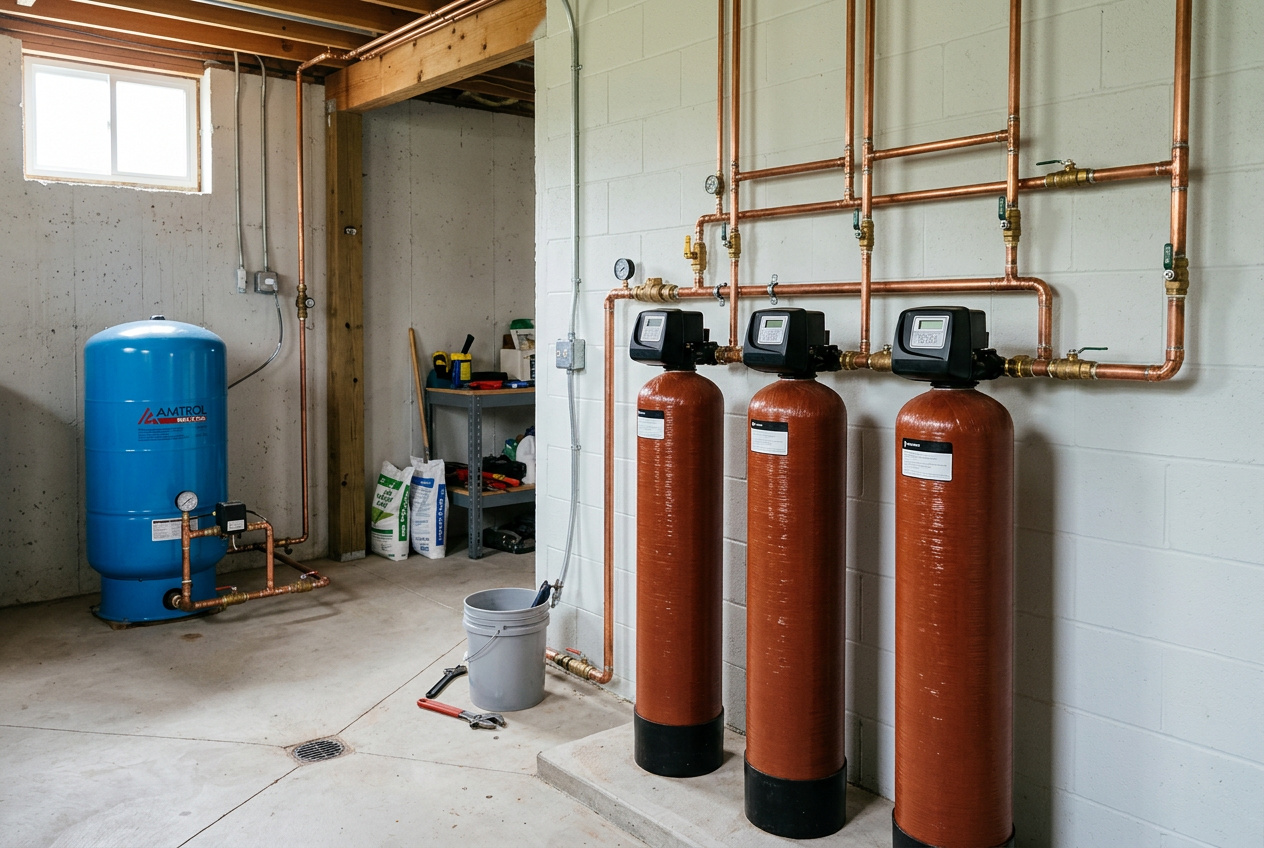
Best iron filters for well water tested on 1.5 to 12 ppm iron. Air-injection, greensand-plus, and catalytic carbon systems compared by senior reviewer Daniel Reeves.

A good iron filter for well water turns rust-stained laundry, brown bathtub rings and metallic-tasting coffee into a non-issue. The wrong one wastes money on cartridges, fouls quickly or, worse, lets iron straight back into your plumbing as soon as your softener regenerates. The EPA’s secondary standard for iron is 0.3 mg/L (the same as 0.3 ppm), and staining usually starts right around that level. Below we compare five iron filters that cover the realistic range of home wells, from under 1 ppm up to double digits, and explain which iron level each technology is actually built for.
Below: a quick comparison, a short water-testing checklist, then deeper reviews and the chemistry of why each technology works.
Affiliate links: As an Amazon Associate, Delozone earns from qualifying purchases, at no extra cost to you. Full disclosure
We compared each system on what it is rated to remove, not on marketing claims. For every pick we read the manufacturer’s product listing, spec sheet or installation manual and checked five things: the maximum iron, manganese and hydrogen sulfide the system is rated for; the pH range the media needs (most oxidizing media stop working well below about pH 6.8); flow rate against a typical 2-bath household demand of about 8 gpm; how the media regenerates (air, potassium permanganate, or cartridge replacement); and whether the media or components carry an NSF/ANSI listing. We then read verified owner feedback for recurring problems such as air-pocket loss, valve failures or early iron breakthrough, and used public guidance from the EPA and university extension services to set the iron-level brackets below.
What this article doesn’t cover: point-of-use cartridges that only protect a single faucet, and aeration tanks that need their own pump. Those are useful in commercial contexts but overkill for most homes.
Every recommendation on this page depends on four numbers: iron, manganese, pH and hydrogen sulfide. Hardness and TDS matter too if you also run a softener. A certified lab test through your county health department or a state-certified lab is the best starting point, because it separates ferrous from total iron and also screens for bacteria. For quick checks between lab tests, or to see whether a new filter is doing its job at the kitchen tap, iron test strips are cheap and fast.
| Parameter | Reference level | Why it matters for an iron filter |
|---|---|---|
| Iron | 0.3 mg/L (EPA secondary standard) | Above this you get orange staining and a metallic taste; it sets which technology you need |
| Manganese | 0.05 mg/L (EPA secondary standard); 0.3 mg/L EPA lifetime health advisory | Causes black or brown staining; greensand and some air-injection media handle it, basic cartridges often don’t |
| pH | About 6.8 or higher for most oxidizing media | Low pH water needs a calcite or soda-ash neutralizer ahead of the iron filter |
| Hydrogen sulfide | Any rotten-egg smell | Decides whether you need air injection, catalytic carbon or a separate sulfur stage |
Quick iron test strips for well water
Strips are a screening tool. Use a certified lab test before you size a whole-house system.
Iron shows up in two oxidation states that behave very differently.
Most well water contains a mix. Around iron-related bacteria (the gelatinous orange slime in toilet tanks), you also have to remove biofilm, which needs periodic chlorination or peroxide injection. Iron filter chemistry breaks down into four categories:
| Iron level | Recommended technology | Why |
|---|---|---|
| Trace to 0.3 ppm | Whole-house carbon, or skip | At or below the EPA secondary standard; mostly aesthetic |
| 0.3 to 3 ppm | Air injection (Durawater, Pentair), or a cartridge system for renters | Best chemistry-free option; long media life |
| 3 to 7 ppm plus H₂S | Air injection or greensand-plus (ABCwaters Fleck 5600 SXT) | Handles iron and sulfur together; predictable regen |
| 7 to 12 ppm | Catalytic carbon plus KDF (Crystal Quest) | Higher loading capacity than greensand alone |
| 12 ppm and up | Chemical injection plus retention tank plus filter | Single-tank systems get overwhelmed; pre-oxidation is mandatory |
The Durawater Air Injection Filter is the sensible default when a test shows roughly 1 to 5 ppm iron and no manganese problem. It’s a single-tank air-injection system built on a Fleck 2510SXT control valve, with an air pocket at the top of the tank that oxidizes incoming iron before the media bed traps it. Filox-type media is dense and long-lived, which is why air-injection systems like this one rarely need a media change inside the first decade on moderate iron.
The Fleck 2510SXT is a metered, programmable valve, so you can set the backwash frequency to your iron level instead of living with a factory default: every few days on heavier iron, less often on light iron. Each backwash sends several dozen gallons to the drain, so check that your well pump and drain can keep up before you commit.
The trade-off: the air pocket needs a draw-and-purge cycle, which is why proper setup matters. If the tank is overcharged the unit chokes on its own air; if undercharged, oxidation drops off. Most sellers ship it pre-set, but DIYers should follow the inflate-and-blowoff sequence in the manual exactly. Beyond that, day-to-day running cost is mostly the small amount of electricity the valve uses.
Pros: No salt, no chemicals, long media life, suited to low-to-moderate H₂S alongside iron.
Cons: Needs adequate inlet pressure and a drain for backwash; not a freeze-friendly install (don’t put it in an unheated garage).
Pentair makes the Fleck valves used on many third-party iron filters, and its own whole-house air-injection iron reduction systems are the step up when a well combines moderate iron (3 to 6 ppm) with a noticeable hydrogen sulfide smell, the sulfur load that tends to overwhelm the cheapest air-injection units. Pentair’s installation manual for these systems specifies incoming water between pH 6.8 and 9.0, so check pH before you buy.
Look for a configuration that pairs the air-injection stage with a catalytic media bed if sulfur is your main complaint; that combination gives you sulfur scrubbing without bolting on a second tank. A larger, better-supported brand also matters years from now, when you need seals, injectors or a replacement valve head.
Expect to pay noticeably more than for the Durawater. The justification is the build quality of the head assembly and bypass, and a dealer and parts network that is easy to find across the U.S. For a larger home on a sulfur well, this is the tier we would look at first, even when iron alone is moderate.
Pros: Established brand and parts supply, suited to iron plus H₂S, heavier-duty hardware.
Cons: Price premium; larger tank versions are overkill for smaller homes.
For homes with iron and manganese above the EPA secondary standards, a greensand-plus media bed is the predictable choice, and the ABCwaters Fleck 5600 SXT package puts one of the most widely used residential control valves on top of it. Manganese greensand uses a potassium permanganate (KMnO₄) regenerant: on a set schedule the valve draws KMnO₄ solution through the bed, restoring its oxidizing capacity.
Greensand is the classic answer when manganese is the stubborn part of the problem, because it oxidizes and traps manganese as well as iron and hydrogen sulfide. The downside: you must keep KMnO₄ on hand (it’s a strong oxidizer that stains skin and needs gloves and goggles), keep an eye on the regenerant level, and plan where the regeneration wastewater goes if you are on a septic system.
The Fleck 5600 SXT valve is the workhorse of the residential market, and rebuild kits and seal packs are easy to find, so a well-maintained unit can run for many years.
Pros: Proven control valve, handles iron, manganese and H₂S together, predictable maintenance schedule.
Cons: Requires KMnO₄ handling (gloves and goggles); plan the regeneration discharge if you have a septic system.
When iron creeps above 7 ppm, single-tank air-injection systems start to choke unless they’re oversized. Crystal Quest’s whole-house iron systems combine catalytic carbon with KDF-85 in a layered bed and run without atmospheric injection: the surface chemistry of the media handles oxidation directly. It’s a practical choice on heavy-iron wells where space rules out a chemical-injection setup.
Catalytic carbon backwashes less aggressively than greensand, so water use per cycle is lower. KDF media also reduces chlorine, which helps if the well is occasionally shock-chlorinated to control iron bacteria.
The trade-off is media cost: KDF is among the more expensive filter media, and replacing a full bed at the end of its life is a real expense, so ask for the replacement media price before you buy. For high-iron homes that already own a softener, it still beats running iron through the resin.
Pros: No air injection complexity, lower backwash water use, also reduces chlorine.
Cons: Expensive media replacement; not the best value when iron is below 5 ppm.
If you already have a water softener and your iron problem is mild (under 3 ppm), a cartridge-based add-on is faster, cheaper and good enough for a few years. The iSpring WGB32BM is a 3-stage system with 20-inch by 4.5-inch big-blue housings: a 5-micron sediment first stage, a coconut-shell CTO carbon block second stage, and an iron and manganese third stage (FM25B). iSpring rates that third stage for up to 3.0 ppm iron and 1.0 ppm manganese, with flow up to 15 gpm through 1-inch NPT ports. The current Amazon bundle also includes a reusable 50-micron spin-down sediment pre-filter.
Cartridge life depends entirely on your iron load: the closer you are to 3 ppm, the sooner the iron stage loads up. Check the tap with a test strip every month or two, and change the iron cartridge when readings climb back toward 0.3 ppm. Per gallon, replacement cartridges cost more over five years than a backwashing system, but the install is screw-thread-only and there’s no electricity or backwash plumbing required.
This is the unit we suggest for renters, off-grid cabins, or homeowners who want iron control now while they plan for a permanent backwashing solution.
Check price on Amazon: iSpring WGB32BM
Replacement set: iSpring F3WGB32BM 3-stage replacement pack.
Pros: Easy install, no electricity, no backwash, low upfront cost.
Cons: Cartridge cost stacks up; not viable above 3 ppm iron; no hydrogen sulfide treatment.
If you want a backwashing system from the same maker as pick #5, the iSpring WCFM400K is a whole-house central filter for dissolved iron and manganese that regenerates its media with air only, with no potassium permanganate or chemical feed, and iSpring states the media is certified to NSF/ANSI Standard 61. The current Amazon listing bundles it with a 50-micron spin-down sediment pre-filter. iSpring notes the system does not remove everything, so read the listing’s exclusions against your water test results first.
Check price on Amazon: iSpring WCFM400K
Most iron filter complaints trace back to water conditions, not the brand. Check these before you blame the equipment:
If you also need sediment control or a full well-water treatment train, see our guides to the best sediment filters for well water and the best well water filter systems.
Iron-filter sizing is driven by two numbers: peak flow rate and total iron loading per regeneration cycle.
| Household size | Peak flow (gpm) | Recommended tank size |
|---|---|---|
| 1 to 2 bathrooms | 7 | 9×48 (1.0 ft³ media) |
| 3 bathrooms | 10 | 10×54 (1.5 ft³ media) |
| 4+ bathrooms | 13 | 13×54 (2.0 ft³ media) |
Undersize the tank and you’ll see iron breakthrough during the morning shower-and-dishwasher peak. Oversize and you’ll waste backwash water on cycles that don’t need to run. Most backwashing iron filters, including the Durawater and Pentair units, are sold in these tank sizes; confirm the media volume on the spec sheet before you order.
For a backwashing iron filter (the first four picks), you need:
A homeowner with soldering or PEX experience can usually handle a single-tank air-injection install in a day. For greensand systems that draw potassium permanganate, and for any install where you are unsure about drain or bypass plumbing, a licensed plumber is worth the call.
| Year | Air injection | Greensand | Catalytic carbon | Cartridge |
|---|---|---|---|---|
| 1 | Sanitize valve | Refill KMnO₄ monthly | Sanitize valve | Replace cartridge x4 |
| 2 | Air-recharge check | Replace brine valve seals | Air-recharge n/a | Replace cartridge x4 |
| 3 | Inspect Filox bed | Partial media swap | Inspect KDF for channeling | Replace cartridge x4 |
| 4 | Replace bypass o-rings | KMnO₄ refill cadence check | Replace bypass o-rings | Replace cartridge x4 |
| 5 | Top off media | Half-bed media replacement | Consider mid-life media top-up | Replace cartridge x4 |
Almost always: iron filter first, softener second. Iron fouls softener resin over time, and a season of moderate ferrous iron through unprotected resin can noticeably cut its capacity. The exception is when iron is under 0.5 ppm and you’re using an iron-tolerant softener resin (we’ll cover those in our well-water softener guide); below that level, a single resin bed handles both jobs.
Do I need a water softener if I have an iron filter?
Only if your hardness is above 7 grains per gallon. Iron and hardness are separate problems; an iron filter doesn’t soften water and a softener doesn’t reliably remove iron. Many wells need both.
Does a water softener remove iron?
Only small amounts of dissolved ferrous iron, and at a cost: iron gradually fouls softener resin, and already-oxidized rust particles clog it. Treat a softener as a hardness tool and put a dedicated iron filter ahead of it whenever iron is above roughly 0.5 ppm.
Do iron filters work on well water?
Yes, when the filter matches the water. The common failures come from pH below about 6.8, iron bacteria, organic (tannin-bound) iron, or a well pump that can’t deliver the backwash flow. Test those four things first and a correctly sized iron filter will bring iron under the 0.3 mg/L EPA secondary standard.
What is the most effective way to remove iron from well water?
For most homes, oxidation followed by filtration: an air-injection or catalytic media tank for up to about 7 ppm, greensand when manganese is also high, and chemical injection with a retention tank above roughly 12 ppm. Cartridge systems work for low iron but cost more to run.
Will an iron filter remove rotten-egg smell?
Air-injection and catalytic-carbon systems remove low-to-moderate H₂S as a side effect. For higher sulfur, you’ll need a dedicated sulfur removal stage, usually peroxide injection.
How often does the system backwash?
It depends on your iron load and the valve settings. As a rule of thumb, air-injection systems backwash every few days to once a week, greensand regenerates on a similar or slightly longer schedule, and catalytic carbon can often go one to two weeks. Cartridge systems never backwash; you replace the cartridges instead.
Can I install an iron filter myself?
Cartridge systems like the iSpring WGB32BM are DIY-friendly with basic plumbing experience, and many homeowners install single-tank air-injection units themselves. Greensand systems and installs with tricky drain or bypass plumbing are easier with a licensed plumber the first time.
How long does iron-filter media last?
Oxidizing media such as Filox typically lasts many years; manganese greensand and catalytic carbon usually need replacement somewhere in the 5 to 10 year range depending on iron load and backwash quality. Cartridges last weeks to months, depending on how much iron they see.
For most well-water homes with iron between 1 and 7 ppm, the Durawater Air Injection Filter is the sensible default: no chemicals, long media life, and a control valve that’s still common enough to find rebuild kits for. Step up to a Pentair air-injection system when sulfur is in the mix, switch to the ABCwaters Fleck 5600 SXT for manganese, and reach for a Crystal Quest catalytic carbon system only when iron is genuinely above 7 ppm. The iSpring WGB32BM is your stopgap when you can’t yet commit to a tank-mounted system. Whatever you choose, test iron, manganese, pH and sulfur first.
Got a well-water test result you’d like a second opinion on? Contact our editorial team with the iron, manganese, hardness, pH and TDS numbers from your water test and we’ll point you to the system on this list (or off it) that fits your water.
The Delozone Editorial Team researches water treatment, pool and spa, and indoor air products for independent buying guides. We compare products using manufacturer specifications, certification listings such as NSF/ANSI, UL, AHAM and Energy Star, published third-party test data and verified owner feedback. We do not sell products, and affiliate commissions never decide what we recommend.