Independent buying guides for home air, water and safety.
As an Amazon Associate, Delozone earns from qualifying purchases.
Independent buying guides for home air, water and safety.
As an Amazon Associate, Delozone earns from qualifying purchases.

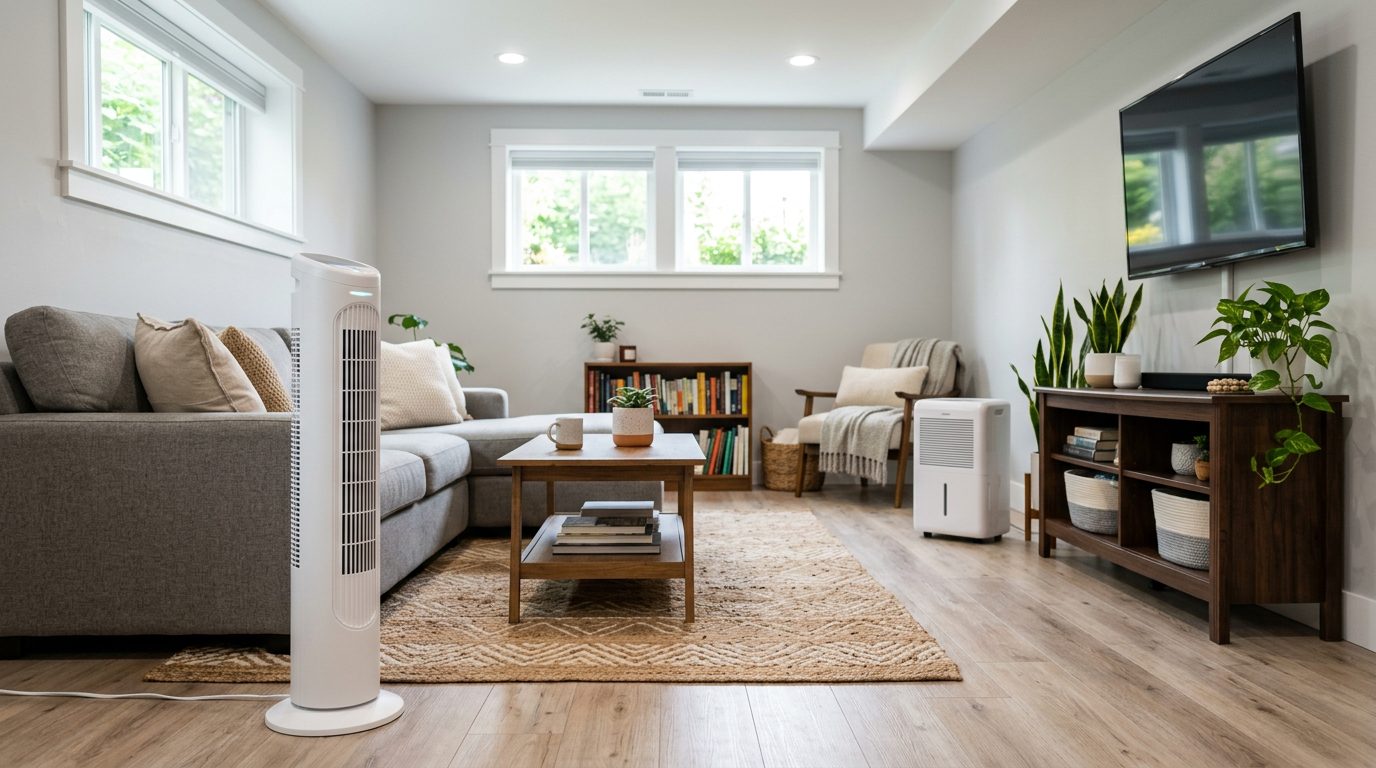

The best air purifier for mold is a sealed True HEPA or H13 unit with a solid activated carbon stage, a smoke CADR of at least two-thirds of your room’s square footage and no ozone output, and our top pick for most homes is the Winix 5510 (AHAM-verified for 392 sq ft, CADR 253 smoke / 252 dust / 247 pollen). Because most airborne mold spores measure roughly 2 to 10 micrometers and a True HEPA filter is rated to catch at least 99.97% of particles at 0.3 micrometers, a correctly sized HEPA purifier can pull spores out of the air, but it cannot stop mold that is still growing on a damp wall, so moisture control has to come first.
Top picks at a glance
Affiliate links: As an Amazon Associate, Delozone earns from qualifying purchases, at no extra cost to you. Full disclosure
Key takeaways
Quick comparison: air purifiers for mold spores
| Model | Filtration | Published CADR or airflow | Room size (maker/AHAM) | Best for | Buy |
|---|---|---|---|---|---|
| Winix 5510 | True HEPA + AOC carbon | 253 smoke / 252 dust / 247 pollen | 392 sq ft (AHAM) | Most homes | Check price |
| Coway Airmega 250 | HEPA + activated carbon (Max2) | 249 smoke | 465 sq ft at 4 ACH | Open living areas | Check price |
| Honeywell Allergen Plus HPA4300B | True HEPA + activated carbon | 4.8 ACH in 354 sq ft (AHAM Verifide) | 354 sq ft (AHAM) | Auto mode on a budget | Check price |
| Levoit Core 400S | True HEPA + carbon | 231 CFM | Up to 1,733 sq ft per hour (maker) | Smart home users | Check price |
| Medify MA-40 | H13 True HEPA + carbon | 239 CFM (406 m³/h) | 448 sq ft at 4 ACH (maker) | H13 filtration | Check price |
| Rabbit Air BioGS 2.0 | BioGS HEPA + charcoal carbon | See maker specs | 550 sq ft (275 for allergies) | Bedrooms | Check price |
| Alen BreatheSmart 45i | HEPA with filter options | 245 CADR | 950 sq ft per 30 min (maker) | Custom filter needs | Check price |
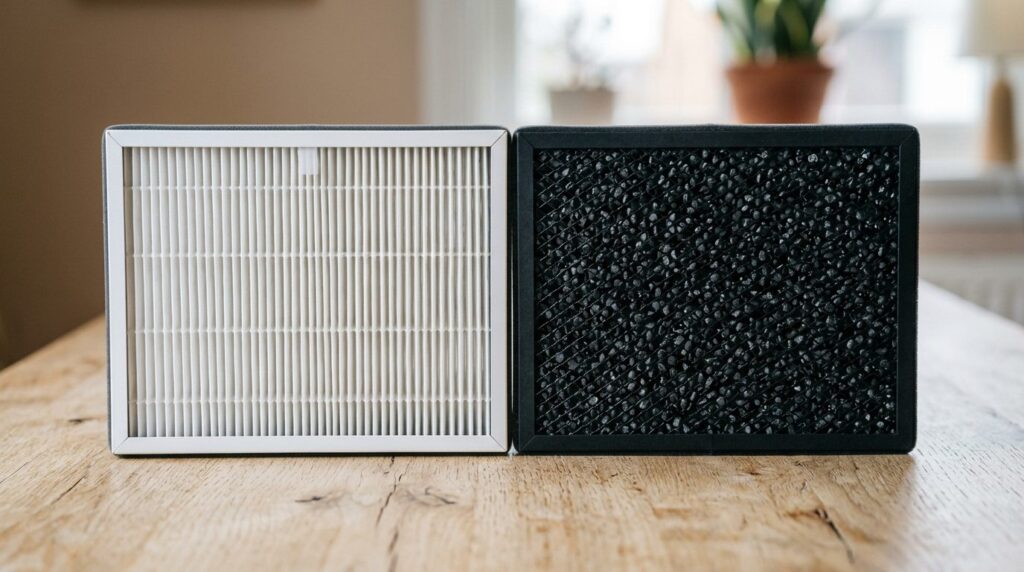
Mold reproduces by releasing microscopic spores, and those spores drift through the air until they land somewhere damp enough to grow. A HEPA air purifier works on the airborne part of that cycle: it pulls room air through a dense filter and traps particles, including spores, before they settle again. Because most airborne mold spores fall in the 2 to 10 micrometer range, they are larger than the 0.3 micrometer test particle that True HEPA filters are rated against, which is why HEPA is the right technology for this job.
The molds most often found indoors, according to the CDC, include Cladosporium, Penicillium, Aspergillus and Alternaria, while Stachybotrys chartarum is the dark species people usually mean by “black mold.” All of them spread through spores in the same 2 to 10 micrometer class, so the same True HEPA filtration applies to each.
What a purifier cannot do is reach the colony itself. Mold growing behind drywall, under carpet padding or on a window frame keeps producing new spores for as long as it has moisture and food, and no amount of room filtration changes that. Think of the purifier as a mop for a leaking pipe: it keeps the floor dry while you work, but it does not stop the leak.
That distinction matters when you read marketing claims. Phrases like “eliminates mold” or “kills mold” usually refer to spores captured in a filter or to lab tests on a surface, not to a moldy basement being cleaned by a box in the corner. We treat any purifier as one part of a plan that also includes fixing moisture and cleaning visible growth.
The U.S. Environmental Protection Agency is direct about the order of operations. In its guide A Brief Guide to Mold, Moisture and Your Home, the agency says the key to mold control is moisture control, and that if mold is growing in your home you need to clean it up and fix the water problem.
“If wet or damp materials or areas are dried 24-48 hours after a leak or spill happens, in most cases mold will not grow.”
U.S. Environmental Protection Agency, A Brief Guide to Mold, Moisture and Your Home
In practice, that means a purifier earns its place after you have dealt with the leak, the condensation or the flooding that started the problem. Running a purifier in a room that still has a wet wall is expensive and frustrating, because the filter keeps loading with spores that the wall keeps producing.
The musty smell that people associate with mold comes from microbial volatile organic compounds, gases that mold releases as it grows. HEPA filters are designed for particles, not gases, so a HEPA-only purifier will not do much for that smell. That is why every model on our list pairs HEPA with an activated carbon stage.
Two of the best-known microbial VOCs are 1-octen-3-ol, sometimes called mushroom alcohol, and geosmin, the compound behind the earthy smell of a damp basement. Both are gases rather than particles, which is why the carbon stage, not the HEPA stage, handles them.
Carbon adsorbs odor molecules onto its surface, and more carbon generally means longer odor control before the filter saturates. Thin carbon-impregnated sheets work for light odors; granular carbon beds last longer in basements and bathrooms where the smell is persistent. If odor is your main complaint, a heavier carbon filter matters more than a slightly higher CADR.
Carbon also has limits. Once it is full, it stops adsorbing and can even release some odor back into the air, so a purifier that has been running for 12 months on an old filter may smell worse than one with a fresh filter. We cover replacement schedules later in this guide.
According to the CDC’s mold guidance, exposure to damp and moldy environments may cause a stuffy nose, sore throat, coughing or wheezing, burning eyes or skin rash in some people, while others have no symptoms at all. People with asthma or mold allergies may have more severe reactions.
The CDC also notes that in 2004 the Institute of Medicine found sufficient evidence to link indoor mold exposure with upper respiratory symptoms, cough and wheeze in otherwise healthy people. That is the practical case for a purifier: lowering the number of spores you breathe while the underlying problem is being fixed and afterwards.
A purifier is not a medical treatment, though. If someone in your home has persistent symptoms, a doctor should be the first call, and a purifier is a supporting measure rather than a cure.
These seven models all combine HEPA-class filtration with activated carbon, publish their airflow or CADR, and were in stock on Amazon when we checked in September 2026. We ranked them on filtration, verified clean air delivery, room size, odor control, ozone safety and running costs.
The order reflects how well each purifier fits a typical mold-prone room, not a single overall score. A bedroom, a damp basement and an open living area need different trade-offs between airflow, noise and carbon capacity, so we note the best room type for each pick and list the published specifications that support it.
The Winix 5510 is the 2024 successor to the long-running Winix 5500-2, and it keeps the formula that made its predecessor a common recommendation for damp homes: a washable pre-filter, a True HEPA filter rated at 99.97% and Winix’s AOC granular carbon filter for odors. Winix lists an AHAM-verified room size of 392 sq ft, with CADR figures of 253 for smoke, 252 for dust and 247 for pollen.
Those numbers put it comfortably above the AHAM two-thirds rule for a typical 300 to 350 sq ft living room or finished basement area. The granular carbon layer is the other reason it sits at the top of our list, because musty basement odors are exactly where a thin carbon sheet runs out of capacity first.
The 5510 is also CARB certified. It includes Winix’s PlasmaWave technology, which can be switched off from the control panel if you would rather run the purifier on filtration alone. For mold, the filters do the important work, so we suggest leaving PlasmaWave off unless you have a specific reason to use it.
Check Winix 5510 price on Amazon
Coway publishes a smoke CADR of 249 for the Airmega 250 and rates it for 465 sq ft at four air changes per hour, which is the level most allergy guidance aims for. At two air changes per hour Coway lists 930 sq ft, so it can handle an open-plan kitchen and living area if the goal is general spore reduction rather than intensive cleaning.
The filter is Coway’s Max2, which combines activated carbon and HEPA in one cartridge behind a washable pre-filter. That makes filter changes simple, since there is only one main filter to buy, and the combined design keeps the carbon layer in the airflow path the whole time the unit runs.
The Airmega 250 also has an air quality indicator and an auto mode that raises fan speed when particle levels climb. In a mold context, that is useful after cleaning: disturbing a moldy area releases spores, and an auto mode reacts to that spike without you having to change settings.
Check Coway Airmega 250 price on Amazon
Honeywell’s Allergen Plus HPA4300B is AHAM Verifide to circulate and filter room air 4.8 times per hour in a 354 sq ft room, and once per hour in rooms up to 1,718 sq ft. That puts it slightly below the Winix 5510 on room size, but it is a good match for a bedroom, home office or a smaller finished basement area where mold spores and mustiness are the main complaints.
The filtration stack has four layers: a pre-filter for hair and larger dust, a True HEPA filter rated at 99.97%, an activated carbon layer for odors and volatile organic compounds, and an additional fourth layer that Honeywell adds for extra protection. As with the other picks, the HEPA and carbon stages are the parts that matter for spores and musty smells.
Its AQSense auto mode tracks air quality in real time and adjusts the fan, with a color-coded indicator that shows when the air needs extra cleaning. Honeywell also lists four cleaning levels, a timer, sleep mode, a child lock and a filter change indicator, plus a one-click filter change system that keeps dusty filters at arm’s length, which is useful when the filter is full of spores.
Check Honeywell HPA4300B price on Amazon
Levoit lists a CADR of 231 CFM for the Core 400S and says it can cycle the air in spaces up to 1,733 sq ft once per hour. Most mold guidance aims for four or more air changes per hour, which works out to roughly 430 sq ft for this unit, so we treat it as a medium to large room purifier rather than a whole-floor solution.
Its main advantage is the smart feature set. A laser particle sensor drives auto mode, and the VeSync app shows air quality history, so you can see whether particle levels jump after the laundry runs or after rain. Those patterns are often the first clue to where moisture is getting in.
The Core 400S uses a three-stage filter with a pre-filter, a True HEPA layer and activated carbon, and it is listed as CARB compliant. Levoit also sells alternative filter versions for the Core 400S, such as pet allergy and toxin absorber filters, so you can choose the carbon emphasis that fits your room.
Check Levoit Core 400S price on Amazon
The Medify MA-40 uses an H13 True HEPA filter, a medical-grade classification under the European EN 1822 standard that is rated to capture 99.95% of the most penetrating particle size. Medify lists a CADR of 239 CFM (406 cubic meters per hour) at top speed, with coverage of 448 sq ft at four air changes per hour and 1,793 sq ft at one air change per hour.
The filter combines H13 media with a carbon layer, which covers both spores and mild odors. The unit also includes an ionizer. If you prefer to avoid ionizers, you can run the MA-40 with that function switched off, and the HEPA stage still does the spore-capture work on its own.
The MA-40 is a good fit for households where someone has asthma or a diagnosed mold allergy and you want the tightest filter grade in this price class. The trade-off is running cost: H13 replacement filters generally cost more than standard True HEPA cartridges, so check filter pricing before you commit.
Check Medify MA-40 price on Amazon
Rabbit Air rates the BioGS 2.0 SPA-550A for 550 sq ft under normal use and 275 sq ft for allergy sufferers, which is a refreshingly honest distinction. The four-stage system combines a pre-filter, a charcoal-based activated carbon filter, a BioGS HEPA filter and a negative ion generator.
Its strongest point is noise. Rabbit Air lists a range of 22.8 to 48.6 dBA, and the quietest setting is close to the level of a whisper, which makes it the easiest model on our list to run all night in a bedroom. Since people spend around a third of the day asleep, a bedroom is often where reducing airborne spores pays off most.
The BioGS 2.0 is CARB certified, which means its ozone emissions fall below the California limit of 0.050 ppm for indoor air cleaners. Rabbit Air frames its coverage around two room sizes rather than a headline CADR, so we suggest staying within the 275 sq ft allergy rating if mold symptoms are the reason you are buying.
Check Rabbit Air BioGS 2.0 price on Amazon
The Alen BreatheSmart 45i lists a CADR of 245 and is California Air Resources Board certified. On its current listing, Alen rates it for 950 sq ft every 30 minutes, which is equivalent to about 475 sq ft at four air changes per hour, so it sits in the same class as the Coway and Winix models.
What sets it apart is the filter choice. Alen offers several filter types for the same machine, including Pure, Fresh, Odor and VOC/Smoke options, so you can choose heavier carbon for a musty basement or a standard HEPA filter for a bedroom. That flexibility is useful if your mold problem moves from active odor to occasional spore spikes over time.
The 45i uses a large panel filter, and Alen publishes replacement guidance for each filter type on its site. The listing we checked was newer and had fewer owner reviews than the others on this list, so read recent reviews before buying.
Check Alen BreatheSmart 45i price on Amazon
Every pick uses True HEPA or H13 media. Under the U.S. Department of Energy standard, True HEPA means capturing at least 99.97% of particles at 0.3 micrometers, and because mold spores are several times larger than that, a well-sealed HEPA filter captures them efficiently. We excluded “HEPA-type” and “HEPA-like” filters, because those terms have no standard behind them.
Sealing matters as much as the filter grade. A HEPA sheet that lets air bypass around its edges delivers far less than its rating suggests, which is why published, independently verified CADR numbers carry more weight in our ranking than filter-grade claims alone.
We also favored designs with a washable or replaceable pre-filter. In a mold-prone room, a pre-filter catches larger dust and lint before it reaches the HEPA layer, which extends the life of the more expensive filter and keeps airflow closer to the rated level between changes.
The Clean Air Delivery Rate (CADR) is the volume of filtered air a purifier delivers, measured in cubic feet per minute under the AHAM test standard. AHAM’s widely cited rule of thumb is that the smoke CADR should be at least two-thirds of the room’s area in square feet for a room with 8-foot ceilings, so a 300 sq ft room needs a smoke CADR of at least 200.
For mold, we lean toward the upper end of that range. Spores are released in bursts, for example when you vacuum, open a closet or clean a moldy area, and a purifier with headroom clears those spikes faster. That is why the Winix 5510, with a smoke CADR of 253, and the Coway Airmega 250, rated for 465 sq ft at four air changes per hour, rank highly for larger rooms.
Where a manufacturer publishes coverage in air changes per hour rather than CADR, we converted it to the same basis. A purifier that covers 1,733 sq ft at one air change per hour, for instance, delivers about four changes per hour in a 430 sq ft room.
Every model here includes carbon, but the amount varies a lot. Granular carbon beds, like Winix’s AOC filter and the carbon options in Alen’s range, hold more adsorbent material than thin carbon-impregnated sheets, so they keep controlling musty odors for longer before they saturate.
We gave extra weight to carbon capacity for basement and bathroom use, because those rooms tend to have persistent low-level mustiness. In a bedroom with no odor issue, a thinner carbon layer is perfectly adequate and usually cheaper to replace.
No carbon filter substitutes for fixing the moisture source. If the smell returns quickly after a filter change, that is a strong sign of active growth somewhere in the room that needs cleaning.
We only included purifiers that are ozone-safe. The California Air Resources Board limits ozone emissions from certified indoor air cleaning devices to 0.050 parts per million, and its list of certified air cleaning devices is the easiest way to check a model before you buy.
Several of our picks include secondary technologies such as PlasmaWave or negative ion generators. Where that is the case, we note it and explain whether you can switch the feature off, because HEPA and carbon do the essential work against mold on their own.
Devices sold specifically as ozone generators are excluded entirely, for reasons we explain in the section on technologies to avoid.
The purchase price is only part of the cost. We compared recommended filter replacement intervals, how many separate filters each model uses and whether pre-filters are washable, because a cheap purifier with expensive, frequent filters can cost more over three years than a pricier unit with long-life filters.
The EPA’s Guide to Air Cleaners in the Home (2nd edition, 2018) makes a similar point, advising buyers to consider the ongoing cost of replacement filters and electricity, not just the purchase price.
We also read long-term owner feedback on each model for recurring problems, such as fan noise that grows over time, sensors that drift or filters that are hard to find. Models with persistent reliability complaints did not make the list regardless of their specifications.
Finally, we checked that every model was in stock on Amazon when this guide was updated. Availability changes, so if a model sells out we will update the list rather than point you to an empty listing.
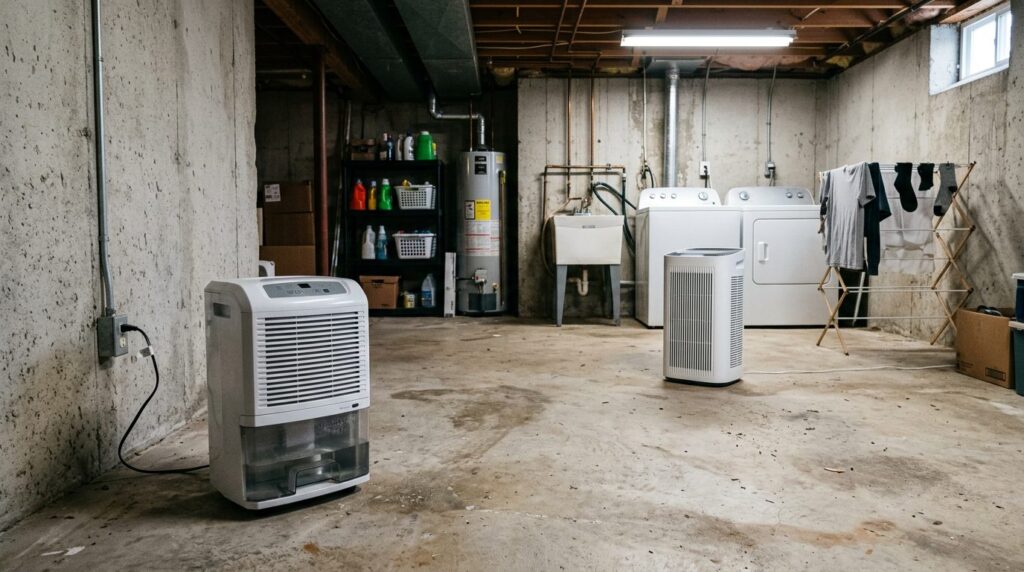
Basements are the most common place people buy a purifier for mold, and they are also where sizing mistakes happen most. Measure the actual open area, not the whole footprint of the house, and apply the two-thirds rule: a 600 sq ft finished basement needs a smoke CADR of about 400, which usually means either one large unit or two medium units placed in different zones.
For reference, a 20 by 30 foot basement is 600 sq ft, a 15 by 20 foot finished room is 300 sq ft and a 12 by 12 foot storage room is 144 sq ft, which translates to minimum smoke CADR figures of about 400, 200 and 96 under the AHAM two-thirds rule.
Place the purifier where air can circulate on all sides, at least a foot away from walls and furniture, and away from the dehumidifier’s exhaust so the two machines are not fighting over the same air. Near a known problem area, such as a laundry corner or a foundation wall that has had moisture, is usually the best spot.
A basement also needs humidity control more than any other room. We cover dehumidifier sizing in our guide to the best dehumidifiers for mold prevention, and in most basements a dehumidifier is the first purchase and the purifier is the second.
Bathrooms produce short, intense bursts of humidity, and the exhaust fan is the most important tool there. A small HEPA purifier can help in a windowless bathroom or an en suite next to a bedroom, but it should run in addition to the fan, not instead of it.
The Home Ventilating Institute suggests about 1 CFM of exhaust per square foot of floor area for a typical bathroom, so a 50 sq ft bathroom needs a fan rated for at least 50 CFM. A purifier cannot make up for an undersized or broken exhaust fan.
Keep any purifier out of the direct splash zone and away from the shower door, since most units are not designed for condensing moisture. A spot near the doorway, where it can pull air from both the bathroom and the adjoining room, usually works better than inside the bathroom itself.
Laundry rooms follow the same logic. A vented dryer, a dehumidifier during wet months and a purifier sized for the room will together keep spores and humidity under control far better than any one of them alone.
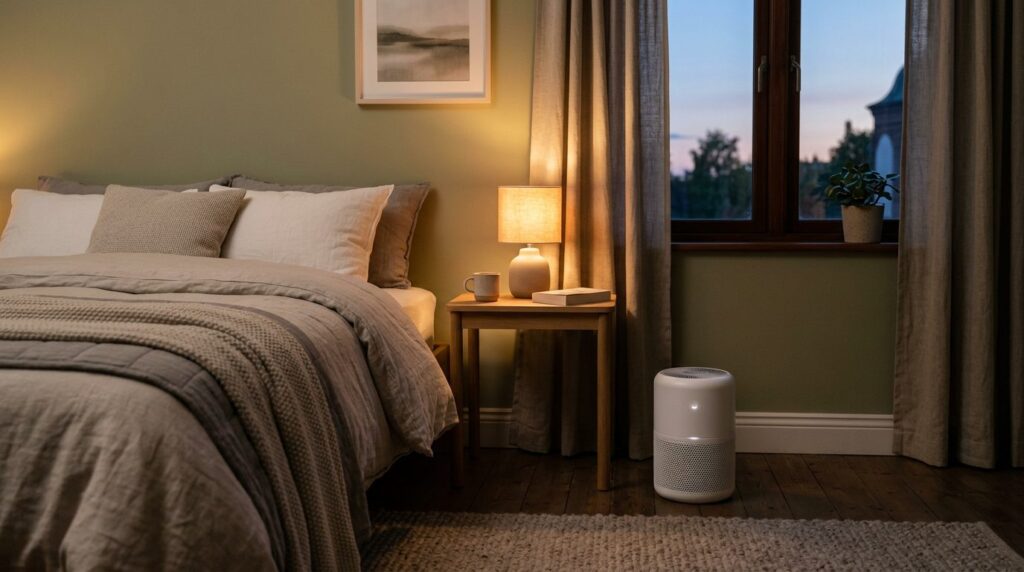
Bedrooms are where most people spend the longest continuous stretch of time, so reducing spores there has an outsized effect on how much you breathe in. For a 150 to 250 sq ft bedroom, a quiet unit like the Rabbit Air BioGS 2.0 or the Levoit Core 400S on a low setting is usually enough.
Noise is the main constraint. A purifier that is too loud at the speed you need will end up switched off, so compare published decibel levels at the fan speed that delivers enough CADR for your room, not just the quietest setting.
If you also want to track humidity and particles in the bedroom, an indoor air quality monitor shows whether levels actually drop when the purifier runs, and flags rising humidity before condensation starts.
For rooms up to about 275 sq ft, such as most bedrooms and small home offices, the Rabbit Air BioGS 2.0 on its allergy rating or the Levoit Core 400S on a medium setting delivers four or more air changes per hour. Both are quiet enough to run overnight, which matters more in a bedroom than a few extra cubic feet per minute.
For 300 to 400 sq ft rooms, including many living rooms and finished basement zones, the Honeywell HPA4300B (AHAM Verifide for 354 sq ft) and the Winix 5510 remain strong choices, and the Winix is our first pick because its AHAM-verified 392 sq ft rating and granular carbon filter cover both spores and mustiness. The Medify MA-40 fits the same range if you want H13 filtration, with Medify listing 448 sq ft at four air changes per hour.
For 450 sq ft and above, the Coway Airmega 250 lists 465 sq ft at four air changes per hour, and the Alen BreatheSmart 45i comes in at roughly 475 sq ft at four changes per hour. For open basements larger than about 600 sq ft, two medium units placed at opposite ends usually clear the air more evenly than one large unit in the middle.
Air purifiers work best running continuously. A unit switched on for an hour a day spends most of that hour clearing spores that accumulated overnight, while a unit left running on a low or auto setting keeps the level down all the time.
Among our picks, the Coway Airmega 250, Levoit Core 400S and Honeywell HPA4300B all offer auto modes driven by a particle sensor, and the Winix 5510 adds app support to the classic 5500-2 design, so you can check readings from a phone rather than walking to the basement.
Auto mode, which several of our picks offer, raises the fan speed when the particle sensor detects a spike and drops it again when the air clears. That suits mold well, because spore releases are often triggered by activity such as cleaning, vacuuming or moving stored boxes.
Running costs are modest for most modern purifiers. A portable HEPA purifier typically draws far less power than a dehumidifier running the same hours, and Energy Star models are the most efficient, though the exact figure depends on the model, the fan speed and your electricity rate.
Ozone generators are sometimes marketed as mold killers, and they are the one category we recommend avoiding for occupied homes. The EPA’s page on ozone generators that are sold as air cleaners states that available scientific evidence shows ozone at concentrations that do not exceed public health standards is generally ineffective in controlling indoor air pollution.
For context, the EPA page also notes that OSHA limits workplace exposure to an average of 0.10 ppm over 8 hours and that NIOSH recommends an upper limit of 0.10 ppm, figures that ozone generators marketed for “shock treatment” can exceed in a closed room.
The same EPA page notes that the FDA requires ozone output from indoor medical devices to be no more than 0.05 ppm, and that ozone can irritate the lungs, especially in people with asthma. To be effective against mold, ozone concentrations would have to far exceed those health limits, which is not safe in a room people use.
We cover the topic in more depth in our article on whether ozone kills mold. The short version: if a device’s main feature is producing ozone, it does not belong in a bedroom, living room or finished basement.
Ionizers release charged particles that make airborne particles clump together or stick to surfaces. They can reduce particle counts, but they do not capture particles the way a filter does, and some older designs produced ozone as a by-product.
Modern CARB-certified models keep ozone below the 0.050 ppm limit, and several of our picks include an ionizer or PlasmaWave function as a secondary feature. Where you can switch it off, as with the Winix 5510 and the Medify MA-40, the HEPA and carbon stages still do the core work.
If anyone in your home has asthma or is sensitive to air quality changes, running the purifier with the ionizer off is a reasonable default. You lose very little spore-removal performance by doing so.
Some purifiers add a UV-C lamp or a photocatalytic oxidation stage and claim to kill mold spores as they pass through. In a portable purifier, air moves past the lamp in a fraction of a second, which limits how much exposure each spore actually gets.
UV-C works best where exposure time is long and controlled, which is why it is commonly installed on the cooling coils inside HVAC air handlers rather than relied on for air that passes a small lamp in under a second.
These features are not harmful in a CARB-certified unit, but we did not give them extra credit in our ranking. The HEPA filter already traps the spores, and a trapped spore on a filter is not recirculating in the room regardless of whether it has been exposed to UV.
UV-C has proven uses in HVAC coils and water treatment, where exposure time is controlled. If you want to read more about how UV compares with other treatment methods, our explainer on ozone versus UV covers the differences.
Be cautious with product listings that promise to “eliminate mold” or “stop mold growth.” A purifier can reduce airborne spores and musty odors; it cannot remove mold from surfaces, dry a wet wall or prevent new growth where moisture remains.
Look instead for measurable claims: an AHAM-verified room size, published CADR numbers, a True HEPA or H13 filter rating and CARB certification. Those are the figures that describe what the machine actually does to the air in your room.
If a listing leans heavily on vague phrases and offers none of those numbers, treat it as a warning sign rather than a feature.
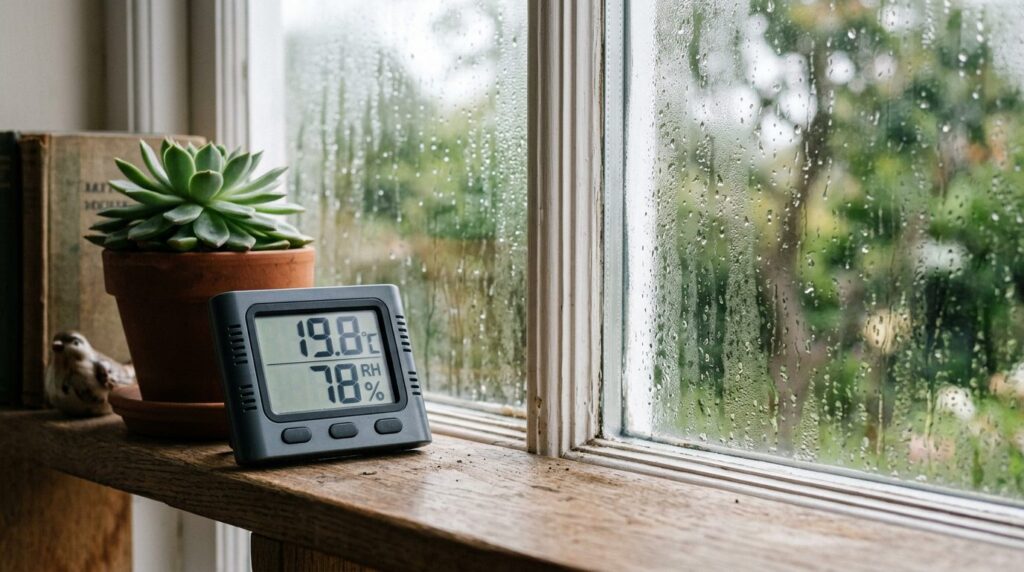
The EPA recommends keeping indoor humidity below 60 percent and ideally between 30 and 50 percent. Mold needs moisture to grow, and holding relative humidity in that range removes the condition that most household molds depend on.
A basic hygrometer, which the EPA describes as a small, inexpensive instrument available at many hardware stores, tells you where you stand. Many air quality monitors also track humidity, which is convenient if you want one device for both measurements.
Check readings in different seasons. A basement that sits at 45 percent in winter can climb well above 60 percent in a humid summer, and that is when mold problems usually start.
In most basements and many crawl-space-adjacent rooms, a dehumidifier does more for mold prevention than any air purifier, because it attacks the cause rather than the spores. Dehumidifier capacity is rated in pints per day under the Department of Energy’s 2019 test standard, and Energy Star models use noticeably less electricity for the same moisture removal.
Under the 2019 DOE standard, capacity is measured at 65°F and 60 percent relative humidity, which is closer to real basement conditions than the older 80°F test, so a unit sold today as 35 pints might have been advertised as 50 pints before 2019.
Look for a model with a continuous drain option or a built-in pump if you have a floor drain or a sump, so the unit keeps working without you emptying a bucket every day. Set it to hold around 45 to 50 percent and let it cycle on its own.
Our guide to the best dehumidifiers for mold prevention walks through sizing by room area and moisture level, and pairs well with any purifier on this list.
According to the EPA, drying wet or damp materials within 24 to 48 hours after a leak or spill prevents mold growth in most cases. That window is the single most useful number in mold prevention, and it is why fast action after a leak matters more than any equipment purchase.
Common sources include roof and gutter leaks, plumbing drips under sinks, condensation on cold pipes and windows, and poor grading that sends rainwater toward the foundation. The EPA’s guidance also recommends keeping air conditioner drip pans clean and drain lines flowing.
Once the source is fixed and the area is dry, run your purifier on a higher setting for a few days to clear spores released during cleanup, then drop back to a normal setting.
The EPA suggests that you can usually clean up a moldy area of less than about 10 square feet yourself, roughly a 3 foot by 3 foot patch. If mold covers more than that, or if there has been significant water damage, the agency points to professional remediation guidance.
For larger jobs, the EPA points to its Mold Remediation in Schools and Commercial Buildings guide, and many contractors follow the IICRC S520 standard for professional mold remediation. For small DIY cleanups, the EPA recommends an N-95 respirator, gloves and goggles.
A professional is also worth calling if you smell mold but cannot find it, if mold returns after cleaning, or if it appears to be inside walls or HVAC ducts. In those situations a purifier can help with air quality in the meantime, but it will not solve a hidden source.
If anyone in the home has health concerns related to mold exposure, talk to a doctor as well. The CDC’s mold pages are a good starting point for understanding symptoms and risks.
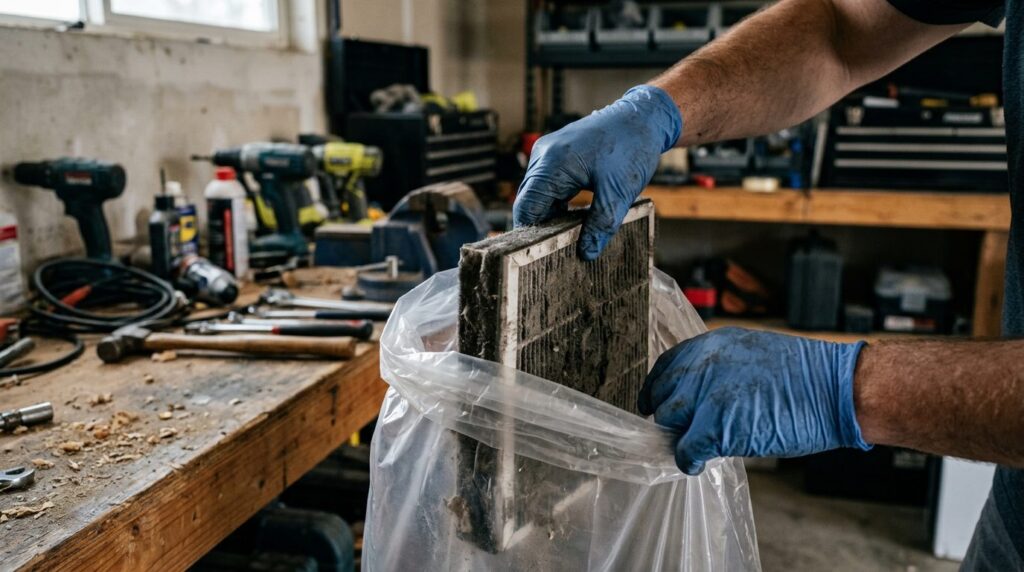
Most manufacturers recommend replacing HEPA filters every 6 to 12 months and carbon filters every 3 to 6 months under typical use, but a mold-prone room often sits at the shorter end of those ranges. A filter that is loaded with spores and dust moves less air, which lowers the real CADR even though the fan is still running.
Many of our picks include a filter change indicator. Treat it as a reminder rather than a precise measurement, since most indicators track running hours rather than how dirty the filter actually is.
If musty odor returns before the indicator says to change the filter, the carbon has probably saturated. In that case, replacing the carbon stage early is usually worth it.
Washable or vacuumable pre-filters are one of the easiest ways to keep a purifier running at full airflow. A monthly vacuum or rinse removes the lint, pet hair and larger dust that would otherwise reach the HEPA layer.
On our picks, the Winix 5510, Coway Airmega 250 and Levoit Core 400S all use a washable or vacuumable pre-filter, while Rabbit Air and Alen publish their own care instructions for each filter type, so check the manual for your model.
Let a washed pre-filter dry completely before reinstalling it. Putting a damp filter back into a purifier in a mold-prone room is counterproductive, since it creates exactly the moist surface mold likes.
A clean pre-filter also keeps the fan quieter. Restricted airflow often makes purifiers louder at the same speed setting, which is a common reason people turn them down or off.
A used filter from a mold-prone room contains trapped spores, so handle it with a little care. Change it outdoors or in a garage if you can, and slide it straight into a plastic bag before sealing it for the trash.
The same N-95 respirator the EPA recommends for small mold cleanups works well for filter changes, and a 3 mil or thicker contractor bag is less likely to tear on the filter frame than a thin kitchen bag.
People with mold allergies or asthma may want to wear a disposable mask and gloves during the change. Wipe down the purifier housing with a damp cloth afterwards and let it dry before restarting the unit.
Keep a spare filter on hand. Filters for popular models can go out of stock, and a purifier running on an overdue filter delivers far less than its rated performance.
To compare purifiers fairly, add the purchase price to three years of filter replacements and estimated electricity. A model with a lower sticker price but separate HEPA, carbon and pre-filters that all need regular replacement can end up costing more than a model with a single combined filter.
H13 filters, such as those in the Medify MA-40, generally cost more to replace than standard True HEPA filters. That is a reasonable trade-off for allergy households, but worth planning for.
Because filter prices change often, we do not list them here. Check current prices on each product page before you buy, and consider buying a spare filter at the same time.
Dealing with smoke rather than damp? See our best air purifiers for smoke.
Homes with dogs or cats have extra dander and odor to deal with; see our picks for the best air purifier for pets.
Many mold problems begin with an unnoticed leak; see our guide to the best water leak detector for sensors that alert you within seconds.
Yes, for airborne spores. A correctly sized True HEPA purifier captures mold spores floating in the air and a carbon stage reduces musty odors. It will not remove mold growing on surfaces or fix the moisture problem behind it, so it works best alongside humidity control and cleanup.
No household device reliably kills airborne spores in an occupied room, and ozone at safe levels is generally ineffective according to the EPA. The practical approach is to capture spores with a HEPA filter and keep humidity below 60 percent, ideally 30 to 50 percent, so spores cannot grow when they land.
For most homes, we recommend the Winix 5510 for its AHAM-verified 392 sq ft rating, True HEPA filter and granular carbon. For large open rooms the Coway Airmega 250 offers more coverage.0 is the quietest option on our list.
They can, if the purifier has a meaningful activated carbon stage. HEPA filters capture particles but not the gases that cause musty odors, so choose a model with granular carbon or a dedicated odor filter, and replace the carbon when the smell returns.
Yes, especially in basements. The dehumidifier addresses the cause by keeping humidity in the 30 to 50 percent range, while the purifier captures spores already in the air. Place them apart so each has room to circulate air.
A standard HEPA purifier will not make mold worse. The only risks come from ozone-producing devices, which can irritate the lungs, and from reinstalling a damp washable pre-filter, which creates a moist surface inside the unit.
A HEPA filter captures spores from all common household molds, including the dark-colored species people call black mold. It cannot deal with the growth itself, so visible black mold needs proper cleanup, and areas over about 10 square feet may need a professional according to the EPA.
Written by the Delozone Editorial Team. We research products using manufacturer specifications, certification listings and published test data, and we update guides when products or standards change. How we work.
The Delozone Editorial Team researches water treatment, pool and spa, and indoor air products for independent buying guides. We compare products using manufacturer specifications, certification listings such as NSF/ANSI, UL, AHAM and Energy Star, published third-party test data and verified owner feedback. We do not sell products, and affiliate commissions never decide what we recommend.