Independent buying guides for home air, water and safety.
As an Amazon Associate, Delozone earns from qualifying purchases.
Independent buying guides for home air, water and safety.
As an Amazon Associate, Delozone earns from qualifying purchases.

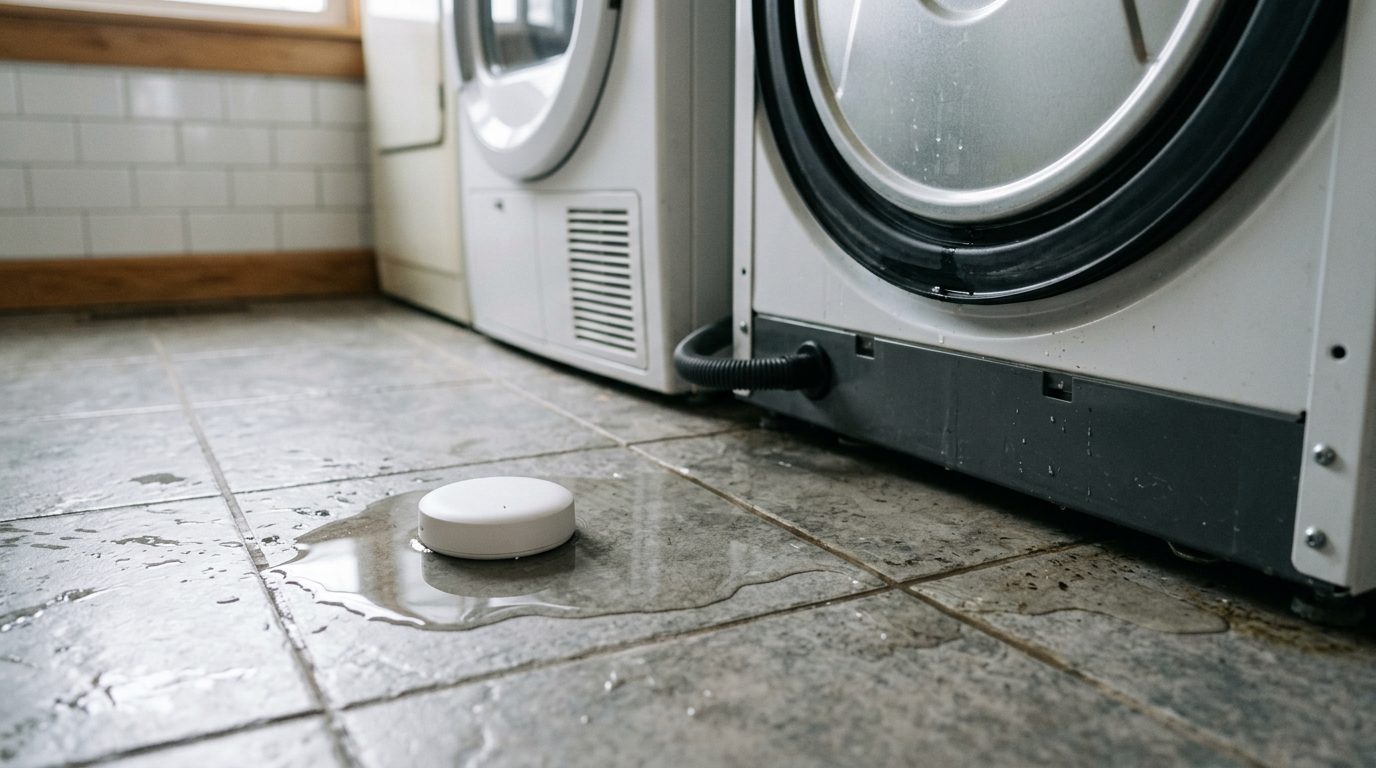
The best water leak detectors of 2026: smart Wi-Fi sensors, freeze alarms and automatic shutoff valves, plus where to place them and what to do after an alert.

The best water leak detector for most homes is a Wi-Fi sensor kit that sounds a loud local alarm and sends a phone alert the moment water touches the floor, and our top pick is the X-Sense SWS54 kit, which pairs three sensors that detect water as shallow as 0.4 mm with a base station, 120 dB alarms and up to 1,804 ft of wireless range. If you want the house to protect itself when you are away, add an automatic shutoff valve such as the Moen Flo Shutoff, which monitors flow, pressure and temperature on the main water line and can turn off the water before a leak becomes a flood.
Top picks at a glance
Affiliate links: As an Amazon Associate, Delozone earns from qualifying purchases, at no extra cost to you. Full disclosure
Key takeaways
Quick comparison: best water leak detectors for 2026
| Product | Type | Alerts | Key specs (maker) | Best for | Buy |
|---|---|---|---|---|---|
| X-Sense SWS54 kit | Spot sensors plus base | 120 dB, app | 0.4 mm detection, 1,804 ft range, IP66 | Most homes | Check price |
| SwitchBot 4-pack | Wi-Fi spot sensors, no hub | 100 dB, app, email | 0.5 mm detection, IP67, 2 AAA up to 24 months | No hub, smart home | Check price |
| Moen Flo Shutoff | Main-line shutoff valve | App, automatic shutoff | Monitors flow, pressure, temperature; daily MicroLeak test | Whole-home protection | Check price |
| Flo by Moen detectors, 3-pack | Spot sensors plus 6 ft cable | Alarm, LED, app | Also senses humidity and temperature | Pairing with Flo Shutoff | Check price |
| Kidde Wi-Fi leak and freeze | Wi-Fi spot sensor | App | Freeze alert at 37°F or rapid drop; 2 AA | Cold climates | Check price |
| Tapo T300 | Hub-based spot sensor | 90 dB, app | 6 probes, IP67, up to 3 years on AAA | Tapo smart homes | Check price |
| Honeywell Home Water Alarm 4-pack | Standalone spot alarms | Local alarm only | One-time use, built-in batteries | Budget, no Wi-Fi | Check price |
According to the Insurance Information Institute’s homeowners insurance statistics, water damage and freezing made up 22.6% of homeowners insurance losses in 2023, behind wind and hail and ahead of fire and lightning in several recent years. From 2019 to 2023, the claim frequency for water damage and freezing averaged 1.50 claims per 100 insured homes.
Those claims are expensive, and they are only part of the picture. Slow leaks under sinks, behind appliances and inside walls often go unnoticed until they cause rot and mold, and damage from a slow, long-term leak is often treated differently by insurers than a sudden burst.
Leak detectors turn a hidden problem into an alert within seconds of water reaching the floor. The earlier you find a leak, the smaller the cleanup and the less chance mold has to grow.
The EPA’s WaterSense Fix a Leak Week page says household leaks can waste nearly 1 trillion gallons of water annually nationwide. The average household’s leaks can account for more than 9,300 gallons wasted every year, and 9% of homes have leaks that waste 50 gallons or more per day.
WaterSense notes that common household leaks include worn toilet flappers, dripping faucets and other leaking valves, and that fixing easily corrected leaks can save homeowners about 10% on their water bills.
Spot sensors catch water on the floor, not a dripping faucet or a running toilet. Whole-home flow monitors, like the Moen Flo Shutoff, can detect those continuous small flows by watching the main line, which is why the two types work best together.
“Household leaks can waste nearly 1 trillion gallons of water annually nationwide.”
U.S. EPA WaterSense, Fix a Leak Week
The EPA’s brief guide to mold and moisture says moisture control is the key to mold control. A leak that soaks a subfloor or drywall for days creates exactly the conditions mold needs.
That is why the fastest alert pays off: water cleaned up and dried quickly is far less likely to lead to mold. The EPA recommends drying water-damaged areas within 24 to 48 hours to prevent mold growth.
If a leak has already caused damp areas, see our guides to the best dehumidifiers for mold prevention and the best air purifier for mold.
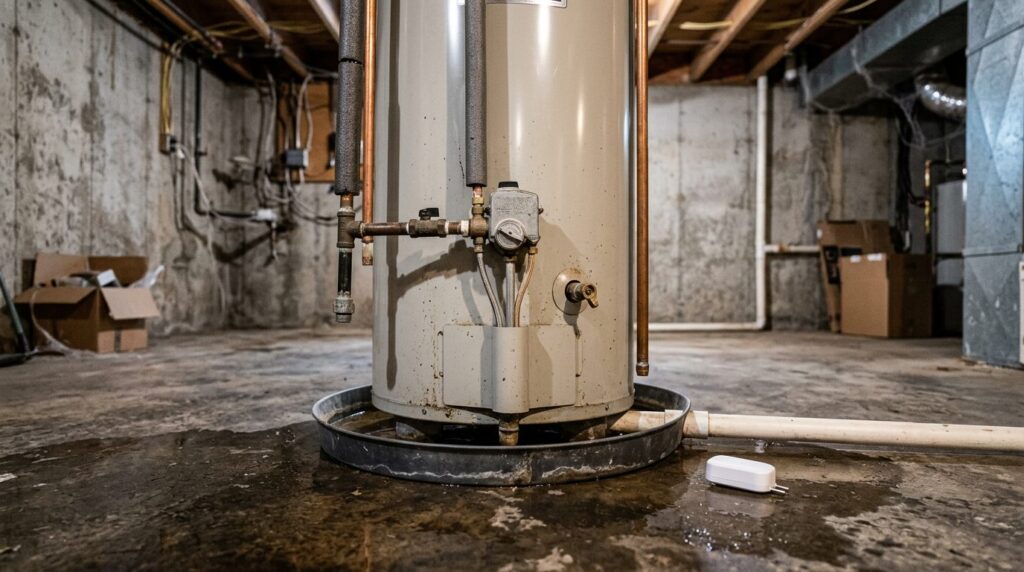
The simplest detectors are battery-powered spot alarms that sound when their metal contacts touch water. They need no Wi-Fi or app and are inexpensive, which makes them easy to place under every sink and appliance.
The trade-off is that nobody hears them when the house is empty. A standalone alarm in a basement protects you while you are home but does nothing during a vacation.
The Honeywell Home Water Alarm 4-pack is an example: four one-time use spot detectors with built-in, non-replaceable batteries, designed for areas not usually observed such as behind washers and under sinks.
Smart sensors add phone notifications, so a leak in the basement reaches you at work or on vacation. Some connect directly to Wi-Fi, like the SwitchBot and Kidde sensors, while others connect to a base station or hub, like the X-Sense kit and the Tapo T300.
Hub-based systems often have longer wireless range and longer battery life, because each sensor does not have to maintain a Wi-Fi connection. Direct Wi-Fi sensors are simpler to add one at a time but may need a strong signal where you place them.
Most smart sensors also sound a local alarm, which matters when the internet is down or your phone is on silent.
A smart shutoff valve installs on the main water line and monitors flow, pressure and temperature for the whole house. When it detects an abnormal flow, such as a burst pipe, or a spot sensor reports water, it can close the main valve automatically.
Moen says its Flo Shutoff runs a daily MicroLeak test that proactively checks the home’s water system, including behind walls, and cites its own device data that 60% of new Flo owners discover a hidden leak within their first 30 days.
Shutoff valves cost much more than sensors and usually need a plumber to install, but they are the only option that stops the water rather than just reporting it.
A spot sensor detects water only at its probes. Leak sensing cables detect water anywhere along their length, which is useful along a wall behind appliances or around the base of a water heater or furnace.
The Flo by Moen bundle includes a 6-ft Leak Sensing Cable that connects to one of its Smart Water Detectors, extending the protected area along its whole length.
Cables are especially useful where water could appear anywhere along a run, such as under a long run of cabinets or beside a row of appliances.
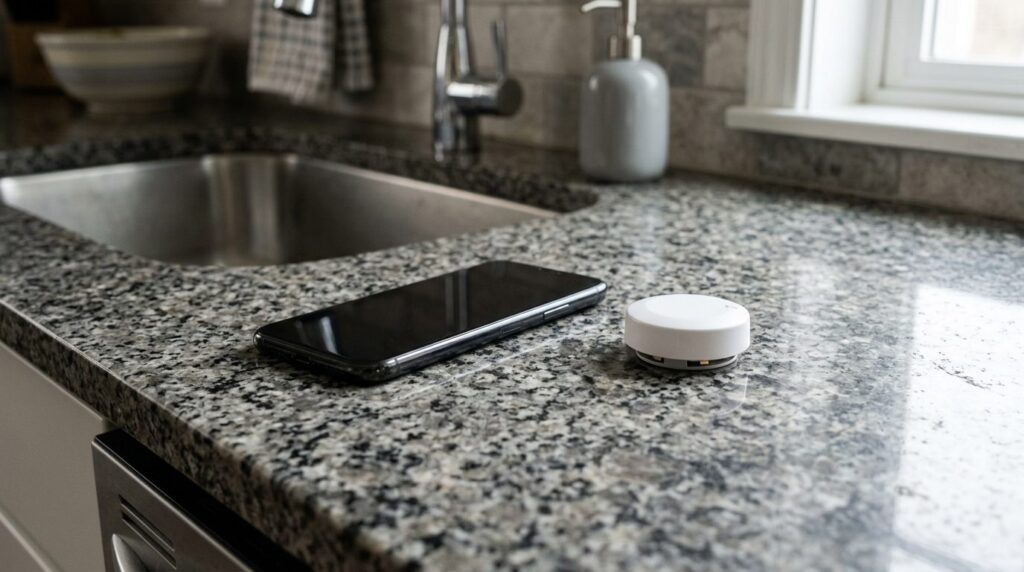
All 7 picks were in stock on Amazon with a working buy box when we checked in September 2026. We chose them on detection sensitivity, alarm loudness, alert options, wireless range, battery life, water resistance and the pattern of verified owner feedback.
The list covers smart sensor kits, single smart sensors, a whole-home shutoff valve and a basic non-smart option, so there is a fit for renters, homeowners and second homes.
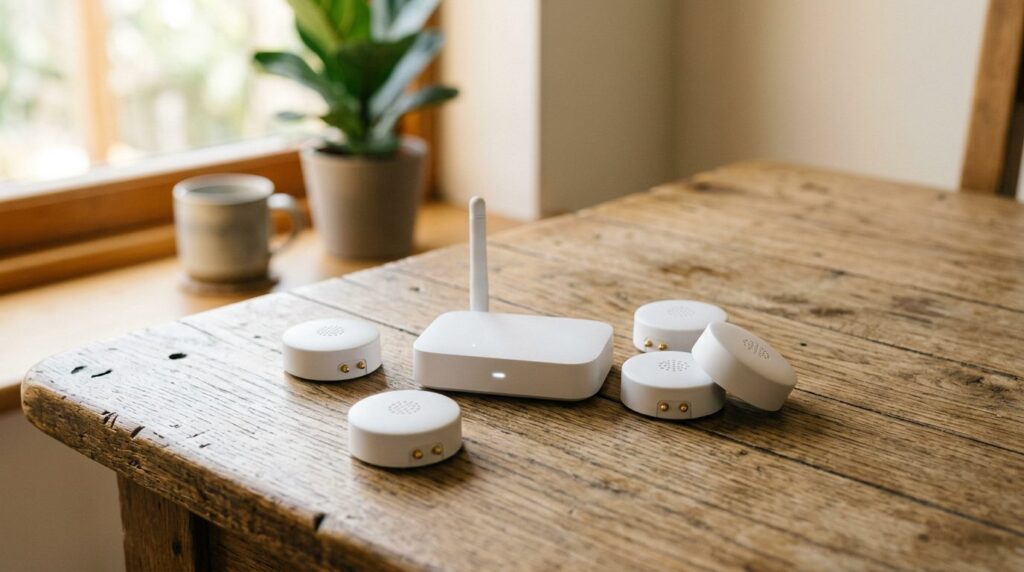
The X-Sense SWS54 kit includes three water sensors and a base station. Each sensor has 2 upper probes that detect dripping water and 4 bottom probes that sense pooling water as shallow as 0.4 mm, according to X-Sense, so it catches both drips from above and puddles on the floor.
When a sensor detects water, it and the base station both sound 120 dB alarms, and the app sends a phone notification that can be shared with up to 12 users. X-Sense lists a wireless range of up to 1,804 ft in open areas, which covers basements, detached garages and outbuildings, and the sensors carry an IP66 rating.
It needs a 2.4 GHz Wi-Fi network for the base station. For most homes, it is the best combination of sensitivity, loudness and range we found.
Check X-Sense SWS54 price on Amazon
The SwitchBot Water Leak Detector connects directly to 2.4 GHz Wi-Fi, so it sends app and email alerts without a hub. SwitchBot says its 4 probes detect leaks as small as 0.5 mm, and each sensor has a 100 dB siren.
It is IP67 waterproof, runs on 2 AAA batteries for up to 24 months with low-battery alerts in the app, and works with Alexa, Google and Siri. SwitchBot also notes it can pair with its Plug Mini to cut power to a leaking appliance automatically.
Because each sensor is its own Wi-Fi device, check the signal where you place them, especially in basements. For smart homes that want to add sensors without a base station, it is our pick.
Check SwitchBot Water Leak Detector price on Amazon
The Moen Flo Shutoff is a whole-home leak detection device that installs on the main water line and monitors flow, pressure and temperature 24/7, according to Moen. If it detects a problem, it can shut off the water automatically before the leak becomes serious damage.
Moen’s FloSense technology learns your home’s water use to spot abnormalities such as running water or small leaks, and daily MicroLeak tests look for hidden leaks. The Moen Flo app lets you monitor water use and shut off the water from anywhere, and Moen cites its own data that 60% of new owners find a hidden leak within 30 days.
It must be sized to your main line, this model is 1 inch, and most homeowners should have a plumber install it. For homes that sit empty during travel, second homes and anyone who wants the house to protect itself, it is the most complete option.
Check Moen Flo Shutoff price on Amazon
The Flo by Moen Smart Water Detector bundle includes three detectors and a 6-ft Leak Sensing Cable. Moen says the detectors also measure room temperature and humidity, so they can warn about frost risk and long-term moisture as well as leaks.
When a detector senses water, excess humidity or extreme temperatures, it sends an app alert, sounds an audible alarm and blinks an LED. Used with the Flo Shutoff, which is sold separately, a detector can trigger the whole-home water shutoff.
They work on their own, but they are most valuable as part of the Moen system. If you are installing a Flo Shutoff, these are the natural companions.
Check Flo by Moen Smart Water Detector price on Amazon
The Kidde WiFi Water Leak Detector and Freeze Alarm detects leaks and warns when the temperature reaches 37°F or drops rapidly, according to Kidde, giving you time to protect pipes before they freeze and burst.
It runs on 2 AA batteries, connects to Wi-Fi and sends notifications to your phone and to friends and family through the Kidde app. Kidde lists compatibility with Amazon Alexa, Google Home, iPhone and Android, and a 1-year limited warranty.
Place it in unheated spaces with pipes, such as crawl spaces, garages and basements near exterior walls. For homes in cold climates, the freeze alert is the feature that sets it apart.
Check Kidde WiFi Water Leak Detector price on Amazon
The Tapo T300 is a smart water leak detector with six sensor probes that TP-Link says can trigger its siren in as little as 1 second. It sends app notifications for leaks and low batteries and has an adjustable 90 dB built-in alarm.
It is IP67 rated and runs on two AAA batteries for up to 3 years, based on TP-Link’s laboratory results. It requires a Tapo hub, which can also sound its own alarm for extra coverage.
If you already use Tapo cameras or a Tapo hub, it is an easy, inexpensive way to add leak sensors. Without a hub, the SwitchBot or X-Sense kits are simpler.
Check Tapo T300 price on Amazon
The Honeywell Home Water Alarm 4-pack contains four one-time use spot detectors with built-in, non-replaceable batteries. Each combines a water sensor and alarm in one unit, with no Wi-Fi, app or setup.
Honeywell positions them as an economical way to guard multiple locations, especially places you do not usually look, such as behind washing machines, beside water heaters and under sinks.
They only help when someone is home to hear them, and they must be replaced after use. For renters, tight budgets or adding coverage under every sink, they are a sensible starting point.
Check Honeywell Home Water Alarm price on Amazon
Most spot sensors detect water when it bridges two metal probes on the bottom of the unit. More probes, spread around the base, catch water arriving from any direction, which is why the X-Sense sensors use 4 bottom probes and the Tapo T300 uses 6.
Sensitivity is usually quoted as the depth of water detected, such as 0.4 mm for X-Sense and 0.5 mm for SwitchBot. Lower is better, because it means an alert while the puddle is still small.
Probes on the top of the sensor, as on the X-Sense, detect water dripping from above, such as a leak from a pipe or a failing water heater fitting overhead.
Local alarms are rated in decibels. The picks on our list range from 90 dB for the Tapo T300 to 100 dB for SwitchBot and 120 dB for the X-Sense sensors and base station.
Loudness matters most for sensors in basements, garages and utility rooms, where a quiet alarm can go unheard behind a closed door. A base station elsewhere in the house, like the X-Sense’s, repeats the alarm where people actually are.
Some apps let you adjust or silence the alarm after you have found the leak, which prevents people from pulling batteries to stop the noise.
IP ratings describe how well a device resists dust and water. The SwitchBot and Tapo sensors are rated IP67, and the X-Sense sensors IP66, all suitable for the damp, splash-prone spots where leak sensors live.
A sensor sitting in a puddle has to keep working, so a good water resistance rating is not optional. Check it before buying any sensor for a basement or laundry room.
Base stations and hubs are not usually waterproof, so place them in a dry spot within range of the sensors.
Direct Wi-Fi sensors, like SwitchBot and Kidde, need a 2.4 GHz network; X-Sense notes that 5 GHz Wi-Fi is not supported for its base station, and many smart home devices have the same limit. Hub-based sensors talk to their hub or base station, which then connects to Wi-Fi.
Battery life varies widely: up to 24 months on 2 AAA for SwitchBot, up to 3 years on 2 AAA for the Tapo T300 based on TP-Link’s lab results, and one-time use built-in batteries for the Honeywell Home alarms. Low-battery alerts in the app prevent silent failures.
Shutoff valves like the Moen Flo Shutoff need standard AC power and Wi-Fi, so place them where both are available and consider how they behave during a power outage.
We compared published detection sensitivity, probe design and whether a sensor detects drips from above as well as pooling water. We gave weight to loud local alarms, since a detector should work even without internet.
For smart sensors, we looked at alert options, sharing with family members, and integration with voice assistants and smart home systems.
For whole-home protection, we included a shutoff valve that monitors the main line, because it is the only device that stops the water.
We compared wireless range, battery type and published battery life, and water resistance ratings such as IP66 and IP67. Hub-based systems often reach farther and last longer on a battery.
We also noted setup requirements: 2.4 GHz Wi-Fi, a hub, or a plumber for shutoff valves.
We did not assign scores or star ratings. Each pick is labeled with the situation it suits best.
We read verified owner reviews for patterns rather than star averages: false alarms, missed alerts, app reliability, battery life and support. Every product was checked on Amazon in September 2026 for a working buy box.
Prices change often, so we link to current prices instead of printing numbers that go stale.
We did not flood-test any detectors. Our choices rely on manufacturer specifications, EPA WaterSense and insurance industry data and verified owner feedback.
A leak that starts the day you leave can run for a week before anyone notices. For homes that sit empty, phone alerts are the minimum, and a main-line shutoff valve is the real protection, because it can close the water without anyone on site.
The Moen Flo Shutoff monitors flow, pressure and temperature on the main line and can shut the water off automatically, and Flo by Moen detectors placed near appliances can trigger it when they sense water. That combination covers both sudden bursts and leaks at specific appliances.
Before a long trip, check that every sensor is online in the app, that notifications reach at least two people and that a neighbor or friend can get into the house if needed.
In multi-unit buildings, a leak in your unit can damage the units below, and a leak above can damage yours. Spot sensors under sinks, behind the washer and next to the water heater give early warning in both directions.
Renters usually cannot install a shutoff valve, but Wi-Fi sensors like the SwitchBot or standalone alarms like the Honeywell Home Water Alarm need no installation and move with you.
Tell your landlord or building manager immediately when a sensor alerts, and check your lease and renters insurance for who is responsible for water damage.
Older supply lines, water heaters near the end of their life and original fixtures are more likely to fail. Put sensors at the water heater and every supply connection, and consider a flow monitor that can spot small continuous leaks behind walls.
The EPA’s WaterSense program notes that common leaks include worn toilet flappers, dripping faucets and other leaking valves, the kind of wear that older homes accumulate.
A plumber’s inspection of supply lines, shutoff valves and the water heater, alongside sensors, is the most complete approach for an older house.
A sump pump that fails during a storm can flood a basement quickly. A leak sensor placed on the floor beside the sump pit, or in the pit area where the manufacturer recommends, warns you when water rises beyond where it should.
Long-range systems like the X-Sense kit, with its 1,804 ft range, are reliable in basements where Wi-Fi is weak. Loud local alarms also matter, because a sump failure often happens at night during heavy rain.
Sensors do not replace a working pump. Test the pump before storm season, and consider a battery backup pump if power outages are common in your area.
Frozen pipes can burst and cause serious water damage. The Kidde Wi-Fi detector warns when the temperature reaches 37°F or drops rapidly, and the Flo by Moen detectors report temperature and humidity as well as water.
Place freeze-sensing detectors near pipes in crawl spaces, unheated garages, basements along exterior walls and under sinks on exterior walls.
When a freeze alert arrives, raise the heat, open cabinet doors under sinks on exterior walls and let a faucet drip, following your local utility’s winter advice.
An alert is only useful if someone acts on it. Most smart sensors let you share alerts with family members: X-Sense supports up to 12 users, and Kidde lets you notify friends and family through its app.
Set up alerts for at least two people, including someone local who can reach the house quickly, and test that each person actually receives them.
SwitchBot adds email alerts alongside app notifications, which is useful for anyone who silences app notifications at night.
SwitchBot lists compatibility with Alexa, Google and Siri, and Kidde lists Alexa and Google Home. That allows voice announcements on smart speakers when a leak is detected and simple routines, such as turning on lights to guide you to the problem at night.
SwitchBot also notes that its sensors can pair with its Plug Mini to cut power to a leaking appliance automatically, which is useful for appliances like portable dehumidifiers or aquarium equipment.
Keep automations simple and test them. A routine that fails silently gives a false sense of security.
The most powerful automation is closing the main water valve. Moen says its Flo Shutoff can be controlled from the app anywhere and can shut off the water automatically, and the Flo detectors can trigger it when they sense water.
Moen lists compatibility with Alarm.com, Ring, Google Assistant and NICE for the shutoff bundle, so it can fit into an existing home security system.
Plan for water you might need during a leak: know how to turn the water back on manually, and make sure a family member can override the valve if the app or Wi-Fi is down.
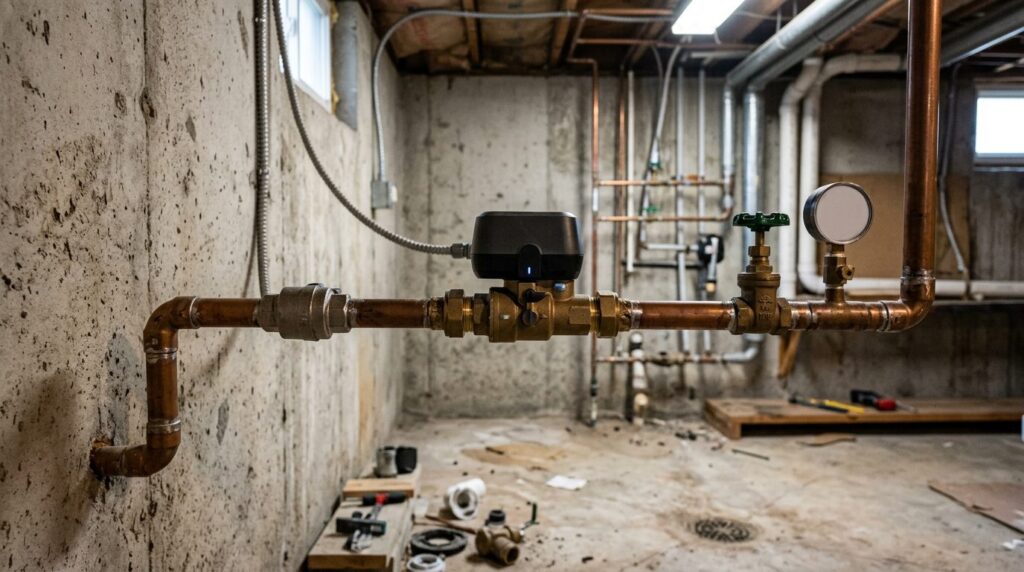
Place sensors where water supply lines, drains or tanks can fail: under the kitchen and bathroom sinks, behind the washing machine, next to the water heater, beside the dishwasher and refrigerator ice maker line, near toilets and next to the sump pump.
Water heaters and washing machine hoses are common sources of sudden, large leaks, so they deserve sensors even if you place nowhere else. Sump pits are another, because a failed pump can flood a basement quickly.
Put each sensor on the floor at the lowest point where water would collect, not on a shelf, and make sure its probes touch the surface.
Basements collect water from above and from outside, so place sensors near floor drains, around the water heater and furnace and along foundation walls that have leaked before.
Crawl spaces and unheated areas with pipes benefit from sensors with freeze alerts, like the Kidde model. Attics with air handlers or water heaters need a sensor in the drain pan.
Long-range systems like the X-Sense kit reach basements and detached garages more reliably than single Wi-Fi sensors.
Count the water sources in your home: each sink, toilet, appliance, water heater and sump pump. Most homes need at least 4 to 6 sensors to cover the high-risk spots, which is why multipacks are the best value.
Start with the water heater, washing machine, kitchen sink and any basement sump, then add sensors under bathroom sinks and toilets. Keep a written list of where each sensor sits, labeled the same way as in the app, so an alert tells everyone exactly where to look.
If you travel often or own a second home, pair sensors with a main-line shutoff, so a leak is stopped as well as reported.
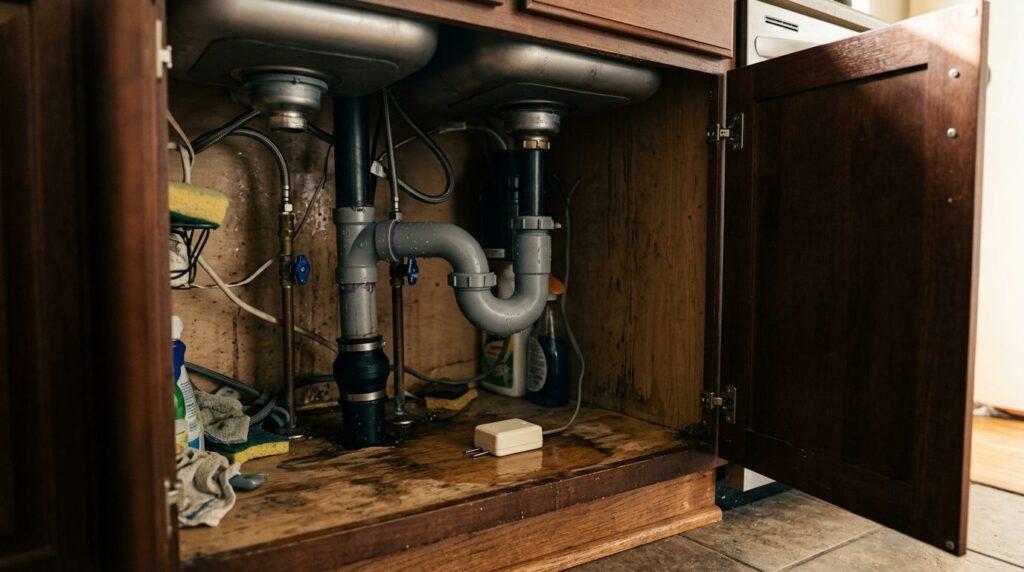
Inspect washing machine hoses and replace any that are cracked, bulging or old, check under sinks for drips, and follow the EPA WaterSense advice to fix worn toilet flappers, dripping faucets and leaking valves. WaterSense also suggests looking at your water use in a cold month such as January or February: if a family of four uses more than 12,000 gallons a month, there could be serious leaks.
WaterSense suggests checking your water meter before and after a 2-hour period when no water is used; if it changes, you probably have a leak. A flow monitor like the Moen Flo Shutoff does this automatically every day. For toilets, WaterSense recommends putting a few drops of food coloring in the tank; if color shows up in the bowl without flushing, the flapper is leaking.
Insulate pipes in unheated spaces and keep the heat on when you travel in winter, since frozen pipes are a major source of water damage claims.
Find the source and stop the water: close the shutoff valve for that fixture or appliance, or the main water valve if you cannot find the source quickly. Everyone in the home should know where the main shutoff is.
Turn off power to any wet electrical appliance before touching it, and keep people away from standing water near outlets or cords.
Take photos of the damage and the source before cleaning up, note the time of the alert from the app history, and call your insurer promptly if the damage is significant. Keep receipts for drying equipment and repairs.
Dry the area as fast as possible. The EPA recommends drying water-damaged areas within 24 to 48 hours to prevent mold growth, and a dehumidifier helps in basements.
Test sensors regularly according to the manufacturer’s instructions, and replace batteries when the app or device warns you. Standalone alarms with built-in batteries must be replaced after use or when they stop working.
Keep sensors clean and dry after an alert, and check that nothing has moved them away from the spot where water would collect. Mops, storage boxes and pets can nudge a sensor out of place without anyone noticing.
Update apps and firmware, and confirm alerts still reach every family member’s phone after changing Wi-Fi routers or passwords.
Once a year, walk through the house with the list of sensor locations, confirm each one is still in place and online, and add sensors for any new appliances, such as a new dishwasher, refrigerator with an ice maker or water softener.
Yes, for water that reaches the sensor. Spot sensors alarm within seconds when their probes touch water, and smart models send phone alerts. They do not detect leaks inside walls unless water reaches the sensor, which is where whole-home flow monitors help.
For most homes, a Wi-Fi sensor kit with loud alarms and phone alerts, such as the X-Sense SWS54. Add a main-line shutoff like the Moen Flo Shutoff if you want the water turned off automatically.
For leaks you cannot see, a whole-home flow monitor such as the Moen Flo Shutoff, which runs daily MicroLeak tests on the main line. For leaks on the floor, spot sensors near appliances and fixtures.
On the floor next to the water heater, washing machine, dishwasher, refrigerator ice maker line, under sinks, near toilets and beside the sump pump. Place it where water would collect first.
Not always. SwitchBot and Kidde sensors connect directly to Wi-Fi, while the X-Sense kit uses its own base station and the Tapo T300 needs a Tapo hub. Hubs often give longer range and battery life.
Spot sensors cannot on their own, but they can trigger a smart shutoff valve. The Flo by Moen detectors can trigger the Moen Flo Shutoff to close the main water line.
Some insurers offer discounts for leak detection or automatic shutoff devices. Ask your insurer which devices qualify before you buy, and whether they require professional installation or monitoring for the discount to apply.
It varies by model. SwitchBot lists up to 24 months on 2 AAA batteries and TP-Link up to 3 years for the Tapo T300, while basic alarms with built-in batteries are replaced when used or expired.
A spot sensor only detects water that reaches its probes, so it will not find a leak hidden inside a wall until water appears on the floor. A whole-home flow monitor like the Moen Flo Shutoff, which runs daily MicroLeak tests on the main line, can reveal hidden leaks, and WaterSense’s water meter test is a free way to check.
Yes. Renters cannot install shutoff valves, but Wi-Fi sensors and standalone alarms need no installation, move with you and can warn you before a leak damages your belongings or the unit below. Report any leak to your landlord right away.
The terms are often used for the same device: a sensor that alarms when water touches its probes. Some products add a float or a sensing cable to cover a larger area, and some, like the Flo by Moen detectors, also track humidity and temperature.
Most still sound their local alarm without internet, but phone alerts need a working connection. That is why a loud local alarm, like the 120 dB alarms on the X-Sense kit, is worth having even with a smart sensor.
For more home safety, see our guides to the best carbon monoxide detectors and the best smoke detector, and for water quality, our whole house water filter systems guide.
Written by the Delozone Editorial Team. We research products using manufacturer specifications, EPA WaterSense and insurance industry data and verified owner feedback, and we update guides when products change. How we work.
The Delozone Editorial Team researches water treatment, pool and spa, and indoor air products for independent buying guides. We compare products using manufacturer specifications, certification listings such as NSF/ANSI, UL, AHAM and Energy Star, published third-party test data and verified owner feedback. We do not sell products, and affiliate commissions never decide what we recommend.