Independent buying guides for home air, water and safety.
As an Amazon Associate, Delozone earns from qualifying purchases.
Independent buying guides for home air, water and safety.
As an Amazon Associate, Delozone earns from qualifying purchases.

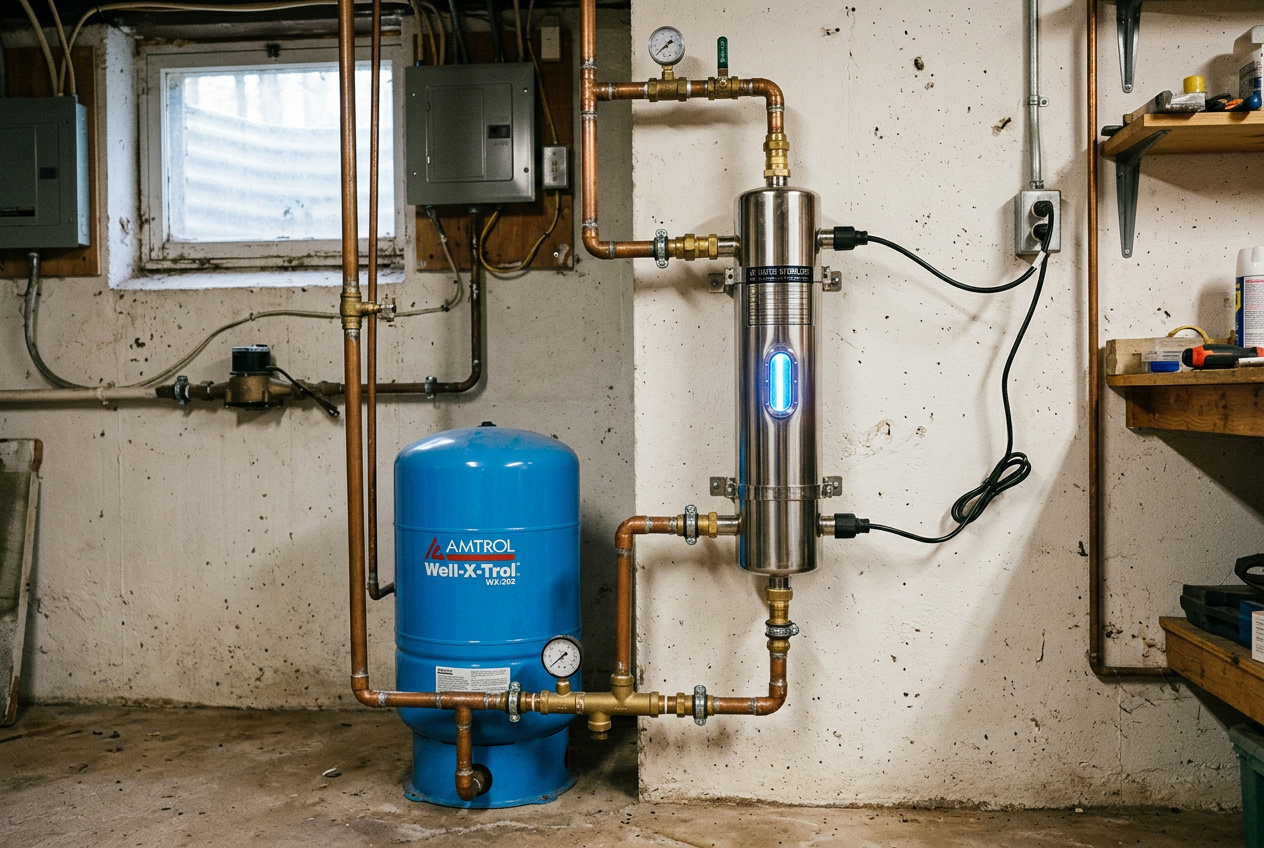
Best UV water purifiers for well water tested on seeded E. coli surrogate at 8 gpm. NSF 55 Class A vs Class B explained. Viqua, Bluonics, HQUA, SpringWell, Pelican compared.

The best UV water purifier for well water is a small, quiet UV chamber that disinfects every drop of water leaving your pressure tank, with no chemicals, no taste change and no waste water. Below are the systems we recommend for 2026, chosen from manufacturer spec sheets, NSF/ANSI 55 requirements and CDC well guidance, and ranked by how well their rated flow matches a typical home.
Quick picks
Flow ratings come from the manufacturer spec pages and Amazon listings, not from our own testing.
Affiliate links: As an Amazon Associate, Delozone earns from qualifying purchases, at no extra cost to you. Full disclosure
Many UV sterilizers claim to “kill 99.99% of bacteria”, but a claim is not a certification. NSF/ANSI 55 sets two classes, as summarized by UV manufacturer Luminor’s guide to UV regulations:
If your well has ever tested positive for coliform, size the system at 40 mJ/cm² (the Class A dose) and fix the source of contamination. Few residential units carry formal NSF 55 certification; most manufacturers publish flow ratings at several doses instead. That is why we list each unit’s flow at 30 and 40 mJ/cm² wherever the maker publishes it, so you can size for the dose you need.
We did not install, seed or lab-test these systems. We built this list from published evidence:
Performance figures on this page come from the manufacturer or the listing, and we say which. We do not publish our own log-reduction or pressure-drop numbers.
The Viqua VH410 is Viqua’s larger home system. Its spec page rates it at 34 gpm at 16 mJ/cm², 18 gpm at 30 mJ/cm² and 14 gpm at 40 mJ/cm², which covers peak demand in most 3 to 4 bathroom homes even at the higher dose. Viqua states it inactivates Cryptosporidium, Giardia, E. coli and fecal coliform.
The controller has an audible lamp replacement reminder, a countdown timer with digital display, and an alarm if the lamp fails. Viqua rates the lamp for 9,000 hours, roughly one year of continuous use. A constant-current ballast is designed to keep lamp output steady through power fluctuations.
What it lacks: Viqua’s product page does not list a UV intensity sensor or a solenoid shutoff for this model, and we did not find an NSF 55 certification for it. If a local code or lender requires a certified Class A system with a sensor, check Viqua’s professional line or ask your installer.
Pros: High flow at a 40 mJ/cm² dose, lamp-failure alarm and countdown, widely stocked lamps and sleeves.
Cons: No listed intensity sensor, longer chamber needs more wall space.
Check Viqua VH410 price on Amazon
The Viqua VH200 is the compact version, at about 15 by 3.5 inches according to Viqua. Its spec page rates it at 16 gpm at 16 mJ/cm², 9 gpm at 30 mJ/cm² and 7 gpm at 40 mJ/cm². That suits cabins and 1 to 2 bathroom homes; in a bigger house with several showers and a washing machine running at once, flow can exceed the rated dose, so step up to the VH410.
It has the same controller features as the VH410: lamp replacement reminder, countdown timer and lamp-failure alarm, with a 9,000-hour lamp. Replacement lamps and sleeves are sold as the QL-200 kit, so annual maintenance is one part number.
Pros: Compact, clear dose-based ratings, lamp-failure alarm, single maintenance kit.
Cons: 7 gpm at 40 mJ/cm² is too low for larger homes; no listed intensity sensor.
Check Viqua VH200 price on Amazon
The HQUA-TWS-12 is a lower-cost 12 gpm whole-house UV unit, according to its Amazon listing, and it ships with an extra UV lamp and an extra quartz sleeve, which covers the first year of maintenance parts. It runs on 120V.
The listing gives a single 12 gpm rating without stating the UV dose behind it, and we found no NSF 55 certification. Treat it as a preventive unit for a well with a clean coliform history rather than a fix for a contaminated well, and size conservatively: if your peak demand is close to 12 gpm, a dose-rated system such as the VH410 is the safer choice.
Pros: Low entry cost, spare lamp and sleeve in the box, simple install.
Cons: No published dose basis, no certification, basic monitoring.
Check HQUA-TWS-12 price on Amazon
The Aquasana Max Flow UV AQ-UV-15C combines a whole-house carbon filter with a UV stage. Its listing quotes 16 gpm peak flow and says the system sterilizes up to 99.99% of viruses and bacteria and reduces chlorine. Buying the filter and UV together means the stages are matched in pipe size and flow.
On a private well the carbon stage mainly helps with taste and odor; it does not replace iron, manganese or hardness treatment, which still need to go in front of the UV (see the pre-filtration section below). Check that your water meets the UV pre-treatment limits before choosing a bundle.
Pros: One purchase for carbon plus UV, matched flow, higher peak flow than compact units.
Cons: Carbon stage adds cartridge cost; no iron or hardness treatment included.
Check Aquasana Max Flow UV price on Amazon
Bluonics, SpringWell and Pelican also sell whole-house UV units. We left them out of the ranked list this time because we could not confirm current dose-based flow ratings or certifications from the manufacturer for the specific models in stock. If you are considering one, ask the seller for the flow rating at 30 and 40 mJ/cm² and for any NSF 55 or WQA certification listing before you buy.
UV lamps lose germicidal output gradually even while they still light up, so they are replaced on a schedule, not when they burn out. Viqua rates its VH-series lamps for 9,000 hours, which is roughly 12 months of continuous service. Plan on one lamp per year for every system on this list.
| System | Rated flow (source) | Lamp life | Lamp alarm |
|---|---|---|---|
| Viqua VH410 | 18 gpm at 30 mJ/cm², 14 gpm at 40 mJ/cm² (Viqua) | 9,000 h (Viqua) | Yes, plus countdown |
| Viqua VH200 | 9 gpm at 30 mJ/cm², 7 gpm at 40 mJ/cm² (Viqua) | 9,000 h (Viqua) | Yes, plus countdown |
| HQUA-TWS-12 | 12 gpm, dose not stated (listing) | Replace yearly | Check listing |
| Aquasana AQ-UV-15C | 16 gpm peak (listing) | Replace yearly | Check listing |
Set a calendar reminder for lamp replacement. A UV system running on a dead or weak lamp passes water through untreated, and on units without an alarm there is nothing to warn you.
The quartz sleeve isolates the lamp from the water. Over time it fouls with iron, calcium or biofilm, and a coated sleeve blocks part of the UV dose. Clean the sleeve whenever you change the lamp, and replace it when it stays cloudy after cleaning or shows scratches. On iron-heavy or hard water, check it more often. Shut off power and water and drain the chamber before you open it.
UV doesn’t remove anything; it only inactivates microorganisms. Viqua’s pretreatment guide lists the ideal water quality for UV treatment as turbidity under 1 NTU, suspended solids under 10 mg/L, no color, total iron under 0.3 mg/L, manganese under 0.05 mg/L and hardness under 7 gpg (120 ppm). If your water has:
The usual sequence is: well, pressure tank, sediment filter (5 micron), iron/manganese filter, softener, UV, then distribution. UV goes last so it sees the clearest water and nothing downstream can recontaminate it before the taps.
Do UV systems remove chemicals?
No. UV only inactivates living organisms. For chemical contaminants (lead, arsenic, PFAS, nitrates) you need adsorption media or reverse osmosis.
How fast does UV kill bacteria?
UV works during the few seconds water spends in the chamber, which is why flow rating and dose are linked: faster flow means less exposure. There is no residual disinfection after the water leaves the chamber, so plumbing downstream must be clean when the system is first installed.
Do I need a UV system on a clean well?
If your well is properly sealed and your annual coliform tests are clean, not necessarily. UV makes most sense for shallow wells, springs, wells that occasionally test positive, wells in flood-prone areas, and households with immunocompromised members. Either way, the CDC recommends testing at least once a year for total coliform bacteria.
What dose should I size for?
Use 40 mJ/cm² (the NSF 55 Class A dose) if there is any history of contamination, For preventive treatment, Viqua headlines its ratings at 30 mJ/cm². Compare your home’s peak flow with the manufacturer’s rating at that dose, not the headline gpm.
Can UV systems be run on solar or off-grid power?
Often, yes, because a residential UV controller draws continuous but modest power. Check the wattage on the spec sheet and size your solar and battery for 24-hour operation, since the lamp should stay on.
How loud are UV systems?
Very quiet. There are no moving parts; you may hear a faint hum from the controller and an alarm if a lamp fails.
For most private wells, the Viqua VH410 is the right default: it publishes flow at the 40 mJ/cm² dose, alarms on lamp failure and handles the peak flow of a typical family home. Choose the VH200 for smaller homes and cabins, the HQUA-TWS-12 when budget is tight and the well has a clean history, and the Aquasana Max Flow UV if you also want whole-house carbon filtration. Whatever you pick, test first and pre-treat iron, manganese and hardness.
Have a coliform result you are unsure about? Send it to our editorial team. We can point you to the right guide, but a positive result should always go to your local health department or a licensed well contractor first.
The Delozone Editorial Team researches water treatment, pool and spa, and indoor air products for independent buying guides. We compare products using manufacturer specifications, certification listings such as NSF/ANSI, UL, AHAM and Energy Star, published third-party test data and verified owner feedback. We do not sell products, and affiliate commissions never decide what we recommend.