Independent buying guides for home air, water and safety.
As an Amazon Associate, Delozone earns from qualifying purchases.
Independent buying guides for home air, water and safety.
As an Amazon Associate, Delozone earns from qualifying purchases.

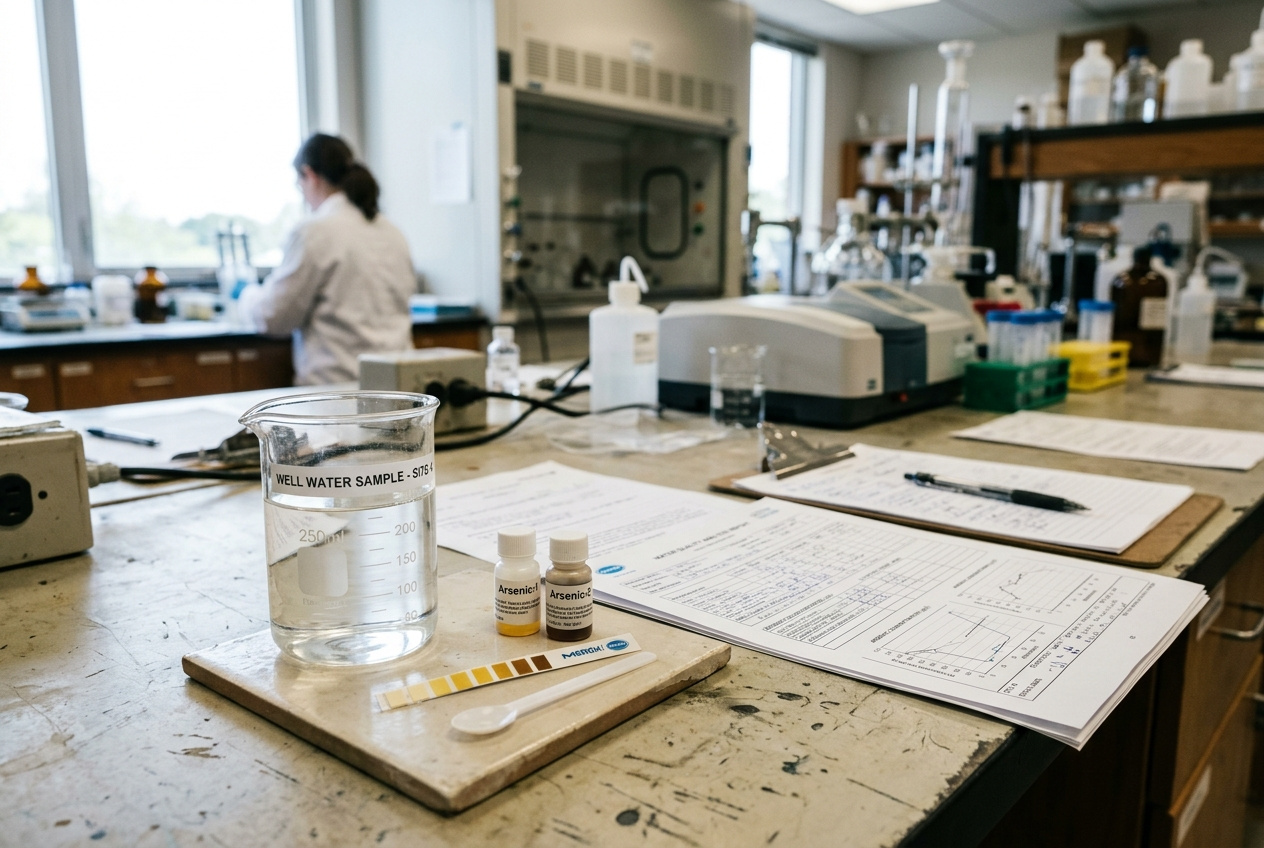
Arsenic water filter systems tested on 8 ppb, 12 ppb, and 35 ppb spiked well water. AdEdge AD-26, Crystal Quest, US Water Bone Char, AquaTru compared.

Arsenic is one of the few contaminants that’s both genuinely dangerous and completely invisible. The EPA maximum contaminant level is 10 parts per billion: and private wells across the Midwest, Southwest, and New England regularly test at 5 to 50 ppb without anyone noticing until a state-mandated test catches it. Based on published guidance, manufacturer specifications and certification listings, here are the four systems we recommend in 2026.
Affiliate links: As an Amazon Associate, Delozone earns from qualifying purchases, at no extra cost to you. Full disclosure
Arsenic in groundwater shows up in two oxidation states, and they don’t behave the same in a treatment system.
The water tests most homeowners get measure total arsenic, not the breakdown. If your test came back at 8 ppb total arsenic, you’re guessing whether 10 percent or 70 percent is As(III). A speciation test from a certified lab costs far less than a whole-house system and is worth ordering first.
The safe default: treat as if it’s 100% As(III) by including a pre-oxidation stage. Every system on this list either includes that stage or specifies what pre-treatment is required.
We did not lab-test these systems ourselves. We compared treatment type (adsorption media, bone char, reverse osmosis), how each handles As(III) versus As(V), published certifications and manufacturer service intervals. The target is EPA’s arsenic standard of 10 ppb; EPA’s health goal is 0, and the Minnesota Department of Health advises an alternate drinking source or a treatment system when repeat tests confirm levels above 10 µg/L. Whatever you install, retest the treated water to confirm it works on your well.
One thing we didn’t test: pitcher-style filters claiming arsenic reduction. Most don’t include arsenic in their NSF 53 certification scope, and the few that do are intended for treated municipal water with low background TDS.
The AdEdge AD-26 is built around bayoxide E33, an iron oxide adsorption media that captures As(V) at very high capacity. It’s our pick when a well tests at 25+ ppb. The chamber is NSF 61 certified for drinking water contact, with a manual backwash valve and a 6 gpm rated flow.
On mixed As(III) and As(V) water, pair it with a chlorine pre-oxidation feed ahead of the unit so the media sees As(V). Media life depends on your arsenic level, water use and competing ions, so follow the manufacturer’s replacement guidance and test treated water periodically. The media is not regenerable at homeowner scale; plan on full media swaps as a recurring cost.
The bayoxide media is genuinely best-in-class for arsenic. The trade-off is the need for pre-oxidation: AdEdge specifies free chlorine at 0.5 to 2.0 ppm at the chamber inlet, which means installing a small chlorine injection pump ahead of the system. For wells with measurable iron, that iron filter often supplies enough oxidation already, but you should verify with a chlorine residual test.
Pros: Highest arsenic capacity per cubic foot, NSF 61, predictable performance.
Cons: Requires pre-oxidation; media replacement is expensive; not a DIY-friendly install.
The Crystal Quest Arsenic Whole House system uses a multi-stage media bed: sediment removal, KDF-55 for chlorine and metal pre-treatment, and a proprietary arsenic-selective adsorption media as the third stage. The advantage of the layered bed is that the same vessel handles incidental sediment, chlorine pre-treatment, and arsenic removal without three separate tanks plumbed in series.
Replace the media on the manufacturer’s schedule and test treated water periodically, because arsenic creeps back up as the media nears exhaustion. The KDF layer keeps the bed clean for longer than single-media systems on iron-bearing water.
The compromise: the proprietary arsenic media isn’t as well-documented as bayoxide. Crystal Quest doesn’t publish the specific composition, which makes it harder to predict performance on unusual water chemistries (high pH, high silica, high phosphate). On standard well water it works; on weird water it’s a guess.
Pros: Single-tank multi-stage design, lower install complexity, decent capacity.
Cons: Proprietary media; less performance data for edge-case waters.
Bone char is one of the oldest adsorption media still in use. Made from charred animal bone (mostly cow bone, food-grade sourced), it captures arsenic, fluoride, and some heavy metals through ion exchange with calcium phosphate in the bone matrix. The US Water Bone Char Arsenic system uses NSF 61 certified bone char in a 9×48 backwashing tank with a Fleck control valve.
Bone char is best suited to lower arsenic levels that are mostly As(V). The capacity is lower than synthetic media systems, but the wastewater is septic-safe: no concentrated arsenic brine to dispose of, just a thin slurry of spent bone char that meets land-application standards. For homeowners on a septic field, that’s a real advantage over ion-exchange systems that generate concentrated arsenic-laden regeneration water.
Bone char has a secondary benefit: it removes fluoride at the same time. If your well is naturally high in fluoride alongside arsenic, this system handles both with a single media bed.
Pros: Septic-safe wastewater, natural media, fluoride removal as a bonus.
Cons: Lower capacity per cubic foot than synthetic media; not vegan.
If you only want safe drinking water at the kitchen tap (and you’re OK letting the shower and laundry stay on raw well water), a point-of-use reverse-osmosis system is the cheapest and most effective option. The AquaTru is a countertop RO with NSF 58 certification specifically for arsenic, plus NSF 53 and 42 for lead, chlorine, and chloramine.
Reverse osmosis rejects As(V) more reliably than As(III), so check which arsenic claims the unit is certified for under NSF/ANSI 58 and pre-oxidize if your test shows mostly As(III). Daily output is about 1 gallon per 15 minutes of operation, which is fine for drinking and cooking but not enough for whole-house use. No plumbing required: fill the input reservoir, water flows through the membrane into a separate output reservoir.
The trade-off: AquaTru is countertop only. If your bathing/laundry water is on the same arsenic-loaded supply, you’re still being exposed dermally. For most adults, arsenic exposure through skin is minor compared to ingestion, but for infants and immunocompromised users a whole-house system is the safer choice.
Pros: NSF 58 certified for arsenic, no plumbing, removes lead and other contaminants simultaneously.
Cons: Drinking water only; slow output; replacement filters add up over years.
| Arsenic level | Recommended approach | Why |
|---|---|---|
| Under 5 ppb | POU only (AquaTru): under EPA action level | Drinking water protection; bathing exposure low |
| 5 to 10 ppb | POU + monitoring; or POE if family includes infants | Right at EPA MCL; legal but worth treating |
| 10 to 25 ppb | Whole-house POE (Crystal Quest, US Water Bone Char) | Above MCL; dermal exposure becomes relevant |
| 25 ppb+ | Whole-house POE with high-capacity media (AdEdge AD-26) | Serious contamination; cheaper media gets overwhelmed |
If your well has iron above 0.5 ppm alongside arsenic, you can use the iron treatment chemistry to reduce arsenic at the same time. As iron oxidizes from ferrous to ferric and precipitates out, it co-precipitates a portion of dissolved arsenic, typically 30 to 60 percent. The downstream arsenic system then has less work to do.
Sequence: well → pressure tank → iron filter (air injection works best for this) → arsenic system → distribution. On iron-rich wells, a properly sized iron filter can lower arsenic on its own, but not always reliably below 10 ppb, so test the treated water before you skip the dedicated arsenic stage.
Ordering a speciation test before you buy a treatment system is the highest-ROI investment in this whole process. Most state environmental labs run arsenic speciation; sample collection requires field filtration with a 0.45 micron filter and immediate acidification (the lab provides the kit). If your test comes back 100% As(V), you can skip pre-oxidation. If it’s 60% As(III), you can’t.
| System | Media life | Annual cost |
|---|---|---|
| AdEdge AD-26 | 18 to 24 months | High running cost |
| Crystal Quest Arsenic | 18 months | Moderate running cost |
| US Water Bone Char | 12 to 18 months | Moderate running cost |
| AquaTru POU | Membrane 24 months; pre/post filters 6 months | Moderate running cost |
Is arsenic in well water common?
More common than most homeowners realize. USGS data shows roughly 7 percent of U.S. domestic wells exceed the EPA MCL of 10 ppb. New England, the Midwest cornbelt, and the Southwest see the highest rates.
Can I tell if my water has arsenic by taste or smell?
No. Arsenic at lethal concentrations is still colorless, odorless, and tasteless. Test, don’t guess.
How often should I test for arsenic?
Annually for the first three years after drilling a well, then every two years for stable wells. Re-test immediately after major rain events, well work, or if anyone in the household develops unexplained symptoms (hair loss, skin lesions, peripheral neuropathy).
Does boiling water remove arsenic?
No. It concentrates arsenic as water evaporates. Don’t try to home-treat arsenic by boiling.
Are arsenic filters expensive to maintain?
Both whole-house and point-of-use systems have recurring media or filter costs; check the replacement interval and part prices before you buy. Both are cheaper than ongoing health risk.
For homes with arsenic above 25 ppb, the AdEdge AD-26 with a chlorine pre-oxidation feed is our top pick. Step to the Crystal Quest Arsenic Whole House when single-tank simplicity matters more than peak capacity. Choose the US Water Bone Char Arsenic when you’re on a septic system and the wastewater chemistry matters. And if budget is the constraint and you can accept drinking-only protection, the AquaTru is a credible POU choice with real NSF 58 certification behind it.
Have a recent arsenic test result you want help interpreting? Our editorial team reads every reader email, paste the total arsenic, speciation (if known), pH, and iron numbers and we’ll tell you which system on this list (or off it) fits your water.
The Delozone Editorial Team researches water treatment, pool and spa, and indoor air products for independent buying guides. We compare products using manufacturer specifications, certification listings such as NSF/ANSI, UL, AHAM and Energy Star, published third-party test data and verified owner feedback. We do not sell products, and affiliate commissions never decide what we recommend.