Independent buying guides for home air, water and safety.
As an Amazon Associate, Delozone earns from qualifying purchases.
Independent buying guides for home air, water and safety.
As an Amazon Associate, Delozone earns from qualifying purchases.

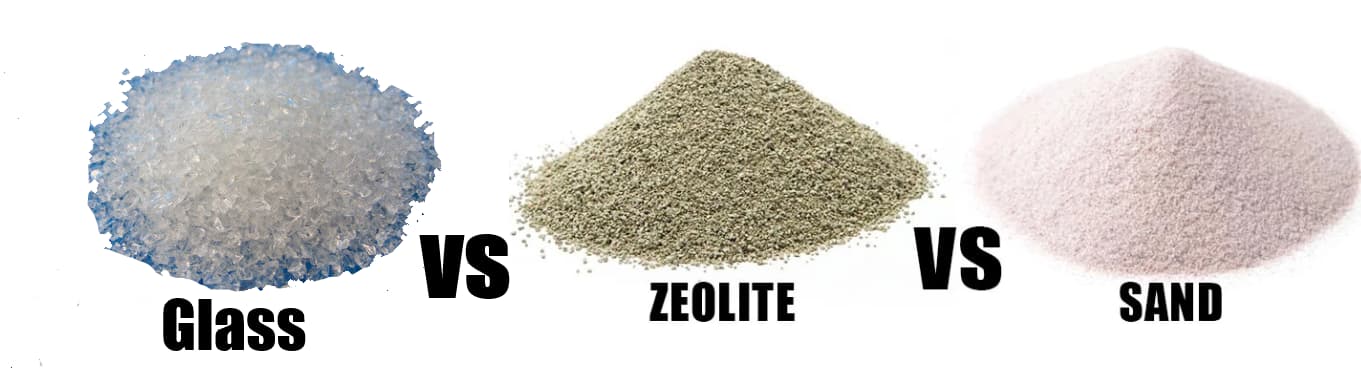

If you own a pool sand filter, the tank does not care whether it holds sand, crushed glass or zeolite. Your water clarity, backwash schedule and media budget do. These three are the media you can pour into the same sand filter tank, and the choice changes how fine the filter catches dirt, how often you backwash and how many years pass before you dig the bed out again.
Below we compare the three using what filter and media makers actually publish: Hayward’s sand filter manual, the media makers’ own specification pages and the trade press. Where a number is a manufacturer claim rather than an independent measurement, we say so.
| Media | What it is | Published capture claim | Main strength | Main catch |
|---|---|---|---|---|
| Silica sand (#20) | Natural quartz sand, 0.45 to 0.55 mm | About 20 to 40 microns (common industry figure) | Cheapest, specified by filter makers | Shortest life, most backwash water |
| Recycled glass | Crushed, screened bottle glass | Down to about 5 microns (Vitroclean claim) | Longer life, fewer backwashes | Highest purchase cost, fill amount varies by brand |
| Zeolite | Natural volcanic mineral (clinoptilolite) | 2 to 5 microns (ZeoSand claim) | Finest capture, ammonium exchange | Much lighter, so fill by volume, not by sand weight |
Micron ratings come from manufacturers and are measured in different ways, so treat them as a ranking (zeolite and glass finer than sand), not as precise lab numbers.
Filter media is the granular bed inside a sand filter tank. Pool water is pushed in at the top, passes down through the bed and leaves through slotted laterals at the bottom. Dirt gets caught in the gaps between the grains and stays there until you backwash, which reverses the flow and flushes the trapped dirt to waste.
Sand dominated pool filtration for decades because it is cheap, stable and easy to find. Glass and zeolite arrived as drop-in replacements that use the same tank and valve. Each one trades purchase cost against clarity, backwash frequency and media life.
We compare media on three things: grain size and shape (how fine the bed catches dirt and how fast water moves through it), surface chemistry (whether the grain does anything beyond straining) and durability (how long the grains keep their shape before they round off or clump).
A sand filter removes particles, not dissolved chemicals. Cloudiness, fine silt, dead algae and pollen are what the media handles. Sanitizing, pH and dissolved metals stay the job of your chlorine, salt cell, ozone or other treatment, whichever media you pick.
Where the media types differ is the size of particle they hold on to and how much of the bed does the work. Pool & Spa News notes that in a sand filter mostly the top six inches of the bed load up with dirt, while glass media uses more of the bed depth. Zeolite adds a chemical job on top of straining: its crystal structure exchanges ions, which lets it hold ammonium, a nitrogen compound that reacts with chlorine to form chloramines.
Flow also matters. A bed that packs tight raises filter pressure, makes the pump work harder and shortens the time between backwashes. A media that holds fine dirt without packing tight keeps pressure lower for longer, which is why glass and zeolite sellers lead with backwash savings.
The first metric is grain size. Hayward’s ProSeries sand filter manual specifies #20 silica sand with a 0.45 to 0.55 mm particle size, and that grade is the baseline every alternative is compared with. Larger grains let water through faster but catch less fine dirt; smaller grains catch more but clog sooner.
The second is bulk density, which decides how much media fills your tank. Sand weighs about 100 pounds per cubic foot and ZeoSand about 55, according to ZeoSand’s own comparison page, so a bag of zeolite fills far more tank than the same weight of sand. Glass sits in between, and brands disagree on how much you need, so always use the fill chart on the bag you buy.
The third is how fast pressure climbs. Hayward tells owners to note the clean starting pressure and backwash when the gauge reads 6 to 8 PSI higher. If a new media makes that rise slower, you backwash less often and send less water to waste. That is the practical number to track after any media change.
Pool filter sand is graded silica (quartz) sand screened to a narrow size range so the bed packs evenly. Quartz is hard and chemically stable, and the angular grains leave small gaps that trap particles as water moves down through the bed.
Grain size sets the trade-off. Coarser sand lowers pressure but lets more fine dirt pass; finer sand catches more but clogs faster. That is why manuals ask for one specific grade instead of any sand from a hardware store, and why play sand or masonry sand is a poor substitute.
Because sand is inert, it strains particles and does nothing else. It does not remove dissolved metals, phosphates or chloramines. In a balanced, well sanitized pool that is fine, because the chemistry handles those jobs.
Sand is the cheapest of the three by a wide margin and is sold at every pool store. For a pool with ordinary debris and good chemistry, it gives clear water at the lowest media cost.
It also has the longest track record. Rapid sand filtration has been used in water treatment for well over a century, and filter makers design and test their tanks around it. Using the grade your manual specifies keeps you squarely inside that design.
Maintenance is simple: watch the gauge, backwash when pressure climbs 6 to 8 PSI over clean, rinse, and return to filter. No special procedure is needed when you replace it, beyond protecting the laterals while you pour.
Sand catches the coarsest particles of the three, so very fine cloudiness can pass through and may need a clarifier. In pools with heavy pollen, silt or organic load, pressure climbs quickly and you backwash more often, which costs water and chemicals each time.
Over the years the grains round off and can clump with oils, scale or calcium. A clumped bed lets water channel through cracks instead of passing through the media, and clarity drops even though the pressure looks normal. If backwashing no longer brings the pressure back down, or the water stays dull with good chemistry, the bed is due for replacement.
Channeling can also come from a bed that was poured unevenly or overfilled. Hayward asks for the sand surface to be level and about 6 inches below the top of the tank, and warns against using more than the recommended amount.
Most pool glass media is recycled bottle glass that is crushed, cleaned, dried and screened into size fractions. Vitroclean, one of the best known brands, markets its media as 100% recycled glass that replaces #20 silica sand. The finished grains are angular, not round beads, and the processing removes the sharp edges so the media is safe to handle.
Pool & Spa News points out that bottle glass is harder than the plate or window glass used in some early glass filters, which gives longer media life. Because glass has no internal crystal structure, the grains have no grain boundaries where they can crack apart during years of backwashing.
Certification is worth checking. Vitroclean Aquatic is certified to NSF/ANSI Standard 50, the standard for pool and spa equipment, and Pool & Spa News reports that some glass media has also earned NSF/ANSI 61, the drinking water component standard. An NSF/ANSI 50 listing is the minimum we would want for pool use.
The main selling point is finer capture without a finer, tighter bed. Vitroclean claims filtration down to about 5 microns compared with about 40 for #20 sand. Pool & Spa News explains that glass grains carry a slight negative surface charge that helps hold fine particles during filtering and releases them during backwash.
Glass also spreads the work across more of the bed. Where sand mostly loads in its top six inches, glass media uses more of the bed depth, according to the same trade article. A deeper working bed means pressure climbs more slowly, so backwashes are spaced further apart.
Pool & Spa News reports glass media is designed for backwashing about every fifth week on average, against roughly weekly for many sand filters, and that some technicians report large savings in backwash water per season. Your own interval depends on bather load, debris and pump run time, so let the pressure gauge decide.
Glass costs more per bag than sand. The argument for it is the replacement cycle: Vitroclean says its media lasts 50% longer than typical silica sand, and the trade press notes large commercial pools budget glass media changeouts on an eight year cycle. Fewer changeouts also means fewer afternoons digging out a tank.
Fill amount is where buyers get confused. Some glass is sold as an equal weight swap for sand, while other brands say you need 15 to 20% less weight because glass is lighter. Both can be true for different products, so use the fill chart for the exact media you buy and keep the freeboard your filter manual asks for.
We look at total cost over the life of the media rather than the bag price: media cost divided by years of service, plus the water and chemicals that go out with every backwash. In pools that backwash often, glass tends to close the gap with sand. In a lightly used pool with few backwashes, sand may stay the cheaper choice.
Zeolite is a natural aluminosilicate mineral formed from volcanic ash; the type sold for pools is usually clinoptilolite. Its crystal lattice is full of tiny channels with a negative charge, which lets it hold positively charged ions and swap them for others. That ion exchange is what sets it apart from sand and glass, which only strain.
The other difference is surface area. ZeoSand, a leading pool zeolite brand, says its media has more than 100 times the surface area of conventional sand and rates it at 2 to 5 microns against 20 to 40 for sand. Those are manufacturer figures, but they explain why zeolite gives the finest capture of the three.
Zeolite is also much lighter. At roughly 55 pounds per cubic foot against about 100 for sand (ZeoSand figures), you need far less weight to fill the same tank. Filling by sand weight would overfill the filter, so the fill chart matters even more here than with glass.
The pool benefit of ion exchange is ammonium removal. Ammonium comes in with sweat, urine and debris, and it combines with chlorine to form chloramines, the compounds behind the “chlorine smell” and eye sting in a busy pool. A zeolite bed holds some of that ammonium before the chlorine has to deal with it.
Media sellers often turn this into chemical savings claims, with figures quoted between 40 and 50% lower chlorine demand. We have not found an independent study behind those numbers, so we treat them as best case marketing figures. The direction is plausible for heavily used pools; the size of the saving will vary.
Ion exchange capacity is finite. Backwashing removes trapped dirt, but the exchange sites can fill up over time, so the ammonium benefit fades even while the bed keeps straining well. Check whether your product’s maker recommends a recharge step or a replacement interval, and follow that rather than a general rule.
Ozone is a strong oxidizer that breaks down organic matter and kills microbes, then reverts to oxygen without leaving a residual. In a pool it works alongside a small chlorine or bromine residual, and the filter removes the particles that ozone and chlorine leave behind.
Our ozone water treatment guide covers how ozone is generated and dosed. For filter media, the practical point is compatibility: Pool & Spa News lists glass media as compatible with ozone, salt chlorination, UV, ionization and conventional chlorine or bromine, so adding ozone does not force a media change.
Ozone does not replace backwashing or media replacement. Oxidized organics still end up as fine particles that the bed has to catch, which is why finer media and a well maintained filter help an ozone pool stay clear. If you are adding ozone to a pool, see our pool ozone system guide for sizing and placement.
Start with what bothers you about the pool. If the water is clear and you backwash rarely, #20 sand is doing its job and there is little reason to pay more. If you fight fine cloudiness, backwash every week or two, or live with strong chloramine smell in a busy pool, glass or zeolite earns a closer look.
Season and location matter too. Pools near trees, dusty roads or farmland load the filter faster in spring and summer, and pools in dry areas pay more for every gallon of backwash water. Those are the pools where a slower pressure rise pays off most.
Pool media is not drinking water media. If your question is really about tap or well water, the right tools are different (sediment, carbon, softening, RO), and our home water filtration guide walks through testing and choosing a system for the house.
Replacement pool filter media
Buy by the fill chart for your filter model, not by sand weight. Glass and zeolite are lighter than sand.
Affiliate links: As an Amazon Associate, Delozone earns from qualifying purchases, at no extra cost to you. Full disclosure
Sand has the lowest entry cost and the shortest life. Glass and zeolite cost more per bag but are sold on longer service and fewer backwashes. The honest comparison is cost per year of service plus what each backwash costs you in water, heat and chemicals.
A simple way to run the numbers: count your backwashes per season, multiply by the gallons your filter sends to waste in one backwash and rinse, and price that against your water bill and the chemicals needed to rebalance the refill. If that figure is high, a media that halves your backwash count can cover its own premium within a few seasons.
If budget is tight, sand plus good habits (clean skimmer baskets, correct pump run time, backwash only on the 6 to 8 PSI rise) gets most pools to clear water. The premium media are an upgrade, not a requirement.
The good news is that switching media later is a media swap, not a new filter. You empty the tank, inspect the laterals for cracks, refill with the new media to the right depth and rinse before returning to filter. Many owners make the switch at the next scheduled sand change rather than tearing out a good bed early.
Before you switch, read your filter manual and warranty. Manuals from major makers such as Hayward are written around #20 silica sand, and some media brands state their product is approved by filter manufacturers. If your filter is still under warranty, confirm with the filter maker that the media you want will not void it.
Keep watching performance after any change. Note the new clean pressure on day one, track how many days it takes to rise 6 to 8 PSI, and keep an eye on clarity. Those two numbers tell you more about your media than any brochure.
Start with how often you backwash and whether fine cloudiness or chloramine smell is a problem. Then weigh media cost against expected life, and check what your filter manual and warranty allow. For a clear pool that backwashes rarely, sand is usually enough.
Media makers generally advise against mixing media in one pool filter tank, because grains of different weight and size separate during backwash and the bed stops working evenly. Pick one media and replace the whole bed. Some commercial multimedia filters use designed layers, but that is a different filter design, not a home sand filter refill.
Sand is commonly replaced every few years, often quoted as 3 to 5. Vitroclean says its glass lasts 50% longer than typical sand, and commercial pools budget glass changeouts on an eight year cycle according to Pool & Spa News. Zeolite life depends on the product and on recharge. Replace sooner if backwashing no longer brings pressure back down or clarity drops with good chemistry.
Zeolite is a natural mineral and is used in water treatment, but safety depends on the specific product. For pool use, look for media listed to NSF/ANSI Standard 50. For anything that touches drinking water, look for NSF/ANSI 61 certification of that exact product, and do not move pool media into a drinking water system.
Most owners can change media in a residential sand filter with a shop vacuum, the right amount of new media and an afternoon. Protect the laterals while pouring, fill to the depth the manual specifies and rinse before filtering. If a lateral is cracked or the valve needs work, a pool technician is worth the call.
Yes, both are sold as drop-in replacements for #20 silica sand in standard pool sand filters. The tank, valve and laterals stay the same. Check your filter warranty first, and fill using the media maker’s chart because both are lighter than sand.
It depends on the brand. Some glass is sold as an equal weight replacement, while other brands say 15 to 20% less weight fills the same tank. Use the chart for your exact product and leave the freeboard your manual asks for, which is about 6 inches below the top of the tank in Hayward’s ProSeries manual.
The Delozone Editorial Team researches water treatment, pool and spa, and indoor air products for independent buying guides. We compare products using manufacturer specifications, certification listings such as NSF/ANSI, UL, AHAM and Energy Star, published third-party test data and verified owner feedback. We do not sell products, and affiliate commissions never decide what we recommend.