Independent buying guides for home air, water and safety.
As an Amazon Associate, Delozone earns from qualifying purchases.
Independent buying guides for home air, water and safety.
As an Amazon Associate, Delozone earns from qualifying purchases.

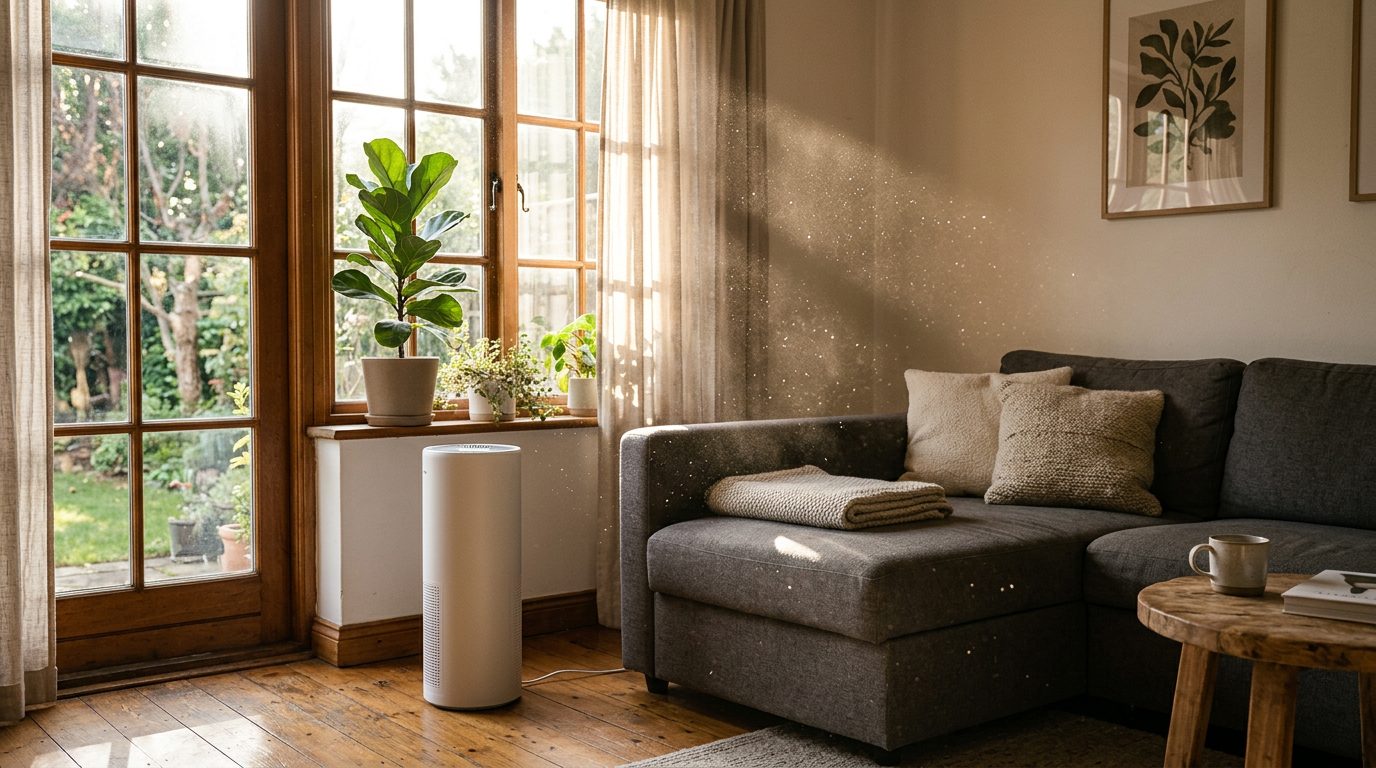
The best air purifiers for dust in 2026, compared by dust CADR, room size and pre-filters, plus EPA steps for dust mites, cleaning and HVAC filters.

Affiliate disclosure: As an Amazon Associate, Delozone earns from qualifying purchases. Some links on this page are affiliate links, so we may earn a commission at no extra cost to you. Our picks are based on published specifications, AHAM Verifide, Energy Star and CARB listings, EPA guidance and verified owner feedback. We did not run our own lab tests, and commissions never decide what we recommend.
The best air purifier for dust is a HEPA purifier with a high dust CADR for your room, a washable pre-filter and an auto mode driven by a particle sensor, and our top pick for most homes is the Coway Airmega 400, which lists a CADR of 328 for both smoke and dust and 400 for pollen, an Energy Star room size of 583 sq ft and CARB certification. Dust is a mix of particles from about 0.5 to 3 microns that a HEPA filter captures well, but heavier particles settle onto surfaces and dust mites live in bedding and fabrics rather than in the air, so a purifier works best alongside HEPA vacuuming, damp dusting and weekly hot washing of bedding.
Top picks at a glance
Key takeaways
Quick comparison: best air purifiers for dust in 2026
| Model | Published rating | Room size or coverage | Filtration | Best for | Buy |
|---|---|---|---|---|---|
| Coway Airmega 400 | CADR 328 dust and smoke, 400 pollen | 583 sq ft (Energy Star) | Pre-filter, carbon, HEPA | Most homes | Check price |
| Levoit Core 600S-P | CADR 391 cfm; AHAM Verifide | 2,933 sq ft once per hour | 3-in-1 filter | Large rooms, high ceilings | Check price |
| Medify MA-112 | CADR 1,009 m³/h, about 594 cfm (maker) | 2,228 sq ft in 30 minutes | Dual H13 HEPA | Whole floors, workshops | Check price |
| Honeywell HPA5300B | AHAM Verifide, 4.8 air changes per hour | 500 sq ft | HEPA plus carbon pre-filters | Living rooms, bedrooms | Check price |
| Levoit Vital 200S-P | Dust CADR 254, smoke 250 cfm; AHAM Verifide | 1,875 sq ft once per hour | Pre-filter, HEPA-grade, carbon | Mid-sized rooms | Check price |
| Winix 5510 | AHAM Verifide 392 sq ft | 1,882 sq ft once per hour | Pre-filter, carbon, True HEPA | Bedrooms, budget | Check price |
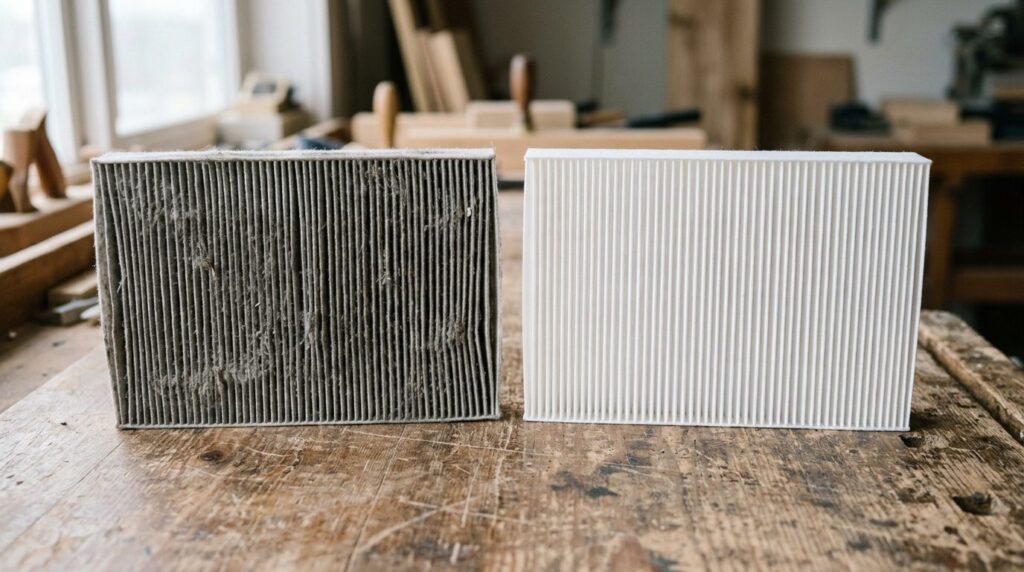
Household dust is a mixture rather than a single thing. It typically includes skin cells, fabric fibers, soil tracked in from outside, pollen, pet dander, dust mite debris and particles from cooking and combustion. The mix varies from home to home and season to season.
The EPA’s page on indoor particulate matter explains that particle pollution is a complex mixture of solid and liquid particles that vary in size, shape and composition. The EPA is especially concerned about particles of 10 micrometers or smaller because they are inhalable, and says particles smaller than that can get deep into the lungs.
Indoor particles come from outdoor air that migrates inside and from indoor sources such as cooking, candles, fireplaces, unvented heaters, smoking and some hobbies, according to the EPA. The EPA notes that indoor PM levels can exceed outdoor levels, although in homes without smoking or other strong sources they are expected to be the same as or lower than outdoors.
A True HEPA filter, under the U.S. Department of Energy definition, captures at least 99.97% of particles at 0.3 microns, the size that is hardest to catch. Larger and smaller particles are captured even more efficiently, so HEPA handles the fine fraction of dust that floats in the air well.
AHAM, the Association of Home Appliance Manufacturers, measures purifiers with three test particles: dust from 0.5 to 3 microns, pollen from 5 to 11 microns and smoke from 0.09 to 1 micron. The dust CADR tells you how much clean air a purifier delivers against exactly the particle sizes that make up much of airborne household dust.
A purifier cannot capture what does not reach it. Larger dust particles settle onto floors, shelves and fabrics quickly, and they come back into the air every time someone walks across a rug, sits on a sofa or makes a bed. That is why purifiers work best in rooms that are also cleaned regularly.
“The most effective ways to improve your indoor air are to reduce or remove the sources of pollutants and to ventilate with clean outdoor air.”
U.S. EPA, Guide to Air Cleaners in the Home
Dust mites are tiny bugs that live in mattresses, pillows, carpets, upholstered furniture, bedcovers and stuffed toys, and feed on human skin flakes, according to the EPA’s asthma triggers guide. Their body parts and droppings can trigger asthma in people allergic to them, and the EPA says every home has dust mites.
Because mite allergens sit in fabrics rather than floating in the air, a purifier alone does little for a dust mite allergy. The EPA recommends washing bedding in hot water once a week and drying it completely, using dust-proof covers on pillows and mattresses, vacuuming carpets and furniture weekly with a HEPA vacuum, washing stuffed toys and dusting often with a damp cloth.
Humidity matters too: the EPA recommends keeping indoor humidity between 30% and 50%, which helps control dust mites. A purifier then catches the allergen particles that are stirred up during cleaning and bed-making.
The EPA’s Guide to Air Cleaners in the Home says that multiple studies with portable HEPA air cleaners found improvements in one or more allergy or asthma symptoms, although the studies do not always show major improvements or improvements in every symptom.
The same guide notes that several studies found small improvements in cardiovascular and respiratory health with portable HEPA cleaners, often measurable by health professionals rather than noticeable to the individual. For many households, the everyday benefit is simpler: less visible dust on surfaces and less sneezing when dust is stirred up.
The EPA also cautions that no air cleaner or filter will eliminate all pollutants in a home. A purifier is one layer, alongside source control, cleaning and ventilation.
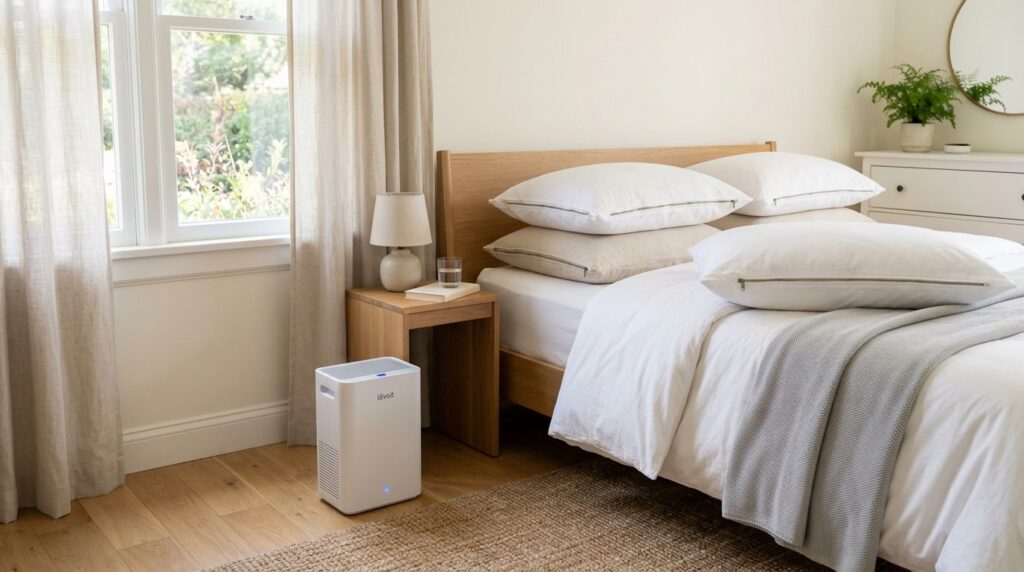
The EPA tells you to choose a portable air cleaner with a CADR large enough for the room. Its sizing chart, based on 8-foot ceilings, calls for a minimum CADR of 65 cfm for 100 sq ft, 130 cfm for 200 sq ft, 195 cfm for 300 sq ft, 260 cfm for 400 sq ft, 325 cfm for 500 sq ft and 390 cfm for 600 sq ft.
For dust, use the dust CADR where a manufacturer publishes it, such as 328 for the Coway Airmega 400 and 254 for the Levoit Vital 200S-P. If only one CADR is listed, check whether it is for smoke, which is the most demanding test and therefore a conservative figure for dust.
The EPA notes CADR is typically measured at the highest speed. A purifier sized with headroom can clean the room on a quieter middle setting, which makes you more likely to leave it running.
Dusty homes load filters fast. A washable pre-filter catches larger particles and fibers before they reach the HEPA filter, which protects the most expensive part and keeps airflow up. All of our picks include a pre-filter or a pre-filter layer.
Check the price and life of replacement filters before buying. Filter replacement is the largest long-term cost of a purifier, and a model with cheap filters that need changing often can cost more over 3 years than a pricier unit with long-life filters.
Filter indicators usually count hours rather than measuring the filter, so in a dusty home, inspect the pre-filter and HEPA filter every few weeks and replace them when they are gray or airflow drops.
A particle sensor that drives an auto mode is especially useful for dust, which spikes when you vacuum, make beds or walk across carpet. The purifier speeds up during those spikes and slows down once the air clears.
Some models show PM2.5 readings on a display or in an app, like the Medify MA-112’s PM2.5 indicator and the Levoit and Winix apps. Watching the numbers after cleaning shows how quickly the room recovers.
Built-in sensors are useful for control rather than precise measurement. For accurate tracking of indoor particles, see our guide to the best air quality monitors for home.
AHAM Verifide confirms a purifier’s CADR and room size claims through independent testing, as described in AHAM’s air cleaner performance FAQ. Energy Star confirms efficiency, and the California Air Resources Board lists air cleaners that meet its ozone emission limit.
The EPA advises avoiding air cleaners that intentionally produce ozone and notes that some ionizers, electrostatic precipitators and plasma devices may emit ozone. If a purifier has an ionizer, such as the optional one on the Medify MA-112, you can leave it switched off; the HEPA filter does the work.
Every pick on our list carries at least one of these listings, and several carry more than one.
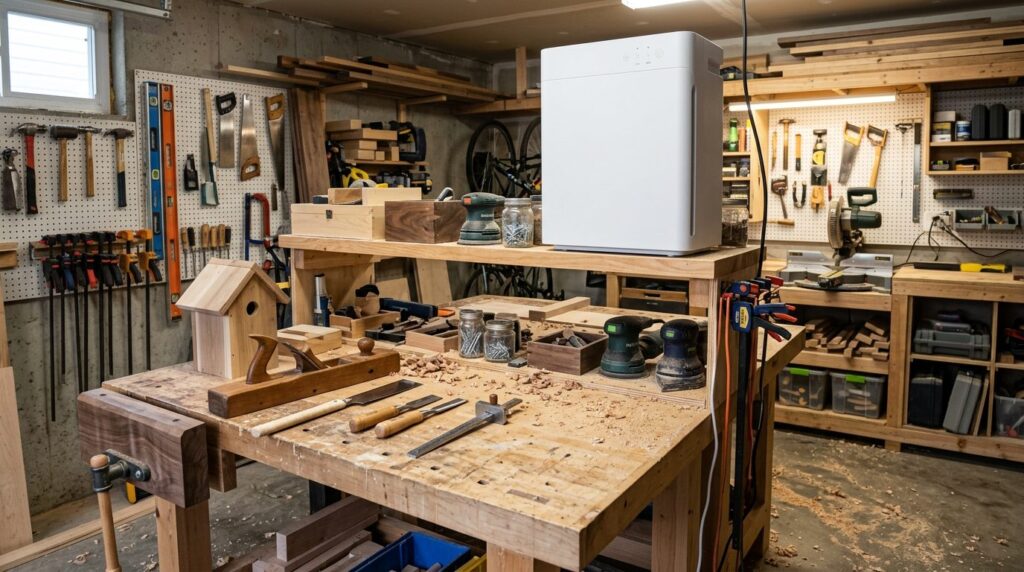
All 6 picks use a HEPA or HEPA-grade filter with a pre-filter, carry an AHAM Verifide, Energy Star or CARB listing or a published CADR, and were in stock on Amazon with a working buy box when we checked in September 2026. We ranked them on dust-relevant CADR, pre-filter design, running costs, noise and the pattern of verified owner feedback.
Each pick is labeled with the room or situation it suits best, from a small bedroom to a dusty workshop.
Coway lists the Airmega 400 with a CADR of 328 for both smoke and dust and 400 for pollen, and Energy Star lists it with a room size of 583 sq ft. Coway rates it to clean up to 3,120 sq ft once per hour, and the listing notes CARB, ETL and Energy Star certification.
Its HyperCaptive system uses a washable pre-filter, an activated carbon filter and a HEPA filter that Coway rates at 99.97% for 0.3 micron particles. The pre-filter matters most in a dusty home, catching fibers and larger particles before they reach the HEPA.
Smart Mode adjusts the fan to the air quality sensor, Eco Mode turns the fan off after 30 minutes of clean air, and Sleep Mode quiets it at night. For living rooms and open-plan spaces where dust is a daily fact of life, it is the best balance of verified airflow and running cost we found.
Check Coway Airmega 400 price on Amazon
The Levoit Core 600S-P lists a CADR of 391 cfm and is AHAM Verifide. Levoit rates it to clean up to 2,933 sq ft once per hour and positions it for extra-large rooms, open floor plans and high ceilings. By the EPA chart, 391 cfm covers a room of about 600 sq ft.
Its 3-stage filter has a 99.97% efficiency rating for 0.1 to 0.3 micron particles, including dust and pollen, according to Levoit, and Levoit says it remains HEPA-grade in Sleep Mode with its original filter, based on independent testing. Auto mode adjusts the fan to the particle sensor.
App and Alexa control make it easy to schedule a high-speed run while you clean. For a large living room, a basement family room or a home with vaulted ceilings, it is our pick.
Check Levoit Core 600S-P price on Amazon
The Medify MA-112 is the highest-airflow purifier on our list. Medify lists a CADR of 1,009 m³/h, which is about 594 cfm, and rates it to clean 4,455 sq ft in one hour and 2,228 sq ft in 30 minutes, which makes it suitable for open floors, home workshops and spaces during renovation.
It uses dual H13 HEPA filters that Medify says remove 99.9% of particles down to 0.1 microns, including dust, pollen and pet dander. Controls include auto mode with a dust sensor, a PM2.5 indicator, sleep mode, a timer, a filter replacement indicator and an optional ionizer, which you can leave off.
It is a large, powerful machine, so it is louder at high speed and its filters cost more than smaller models. For a woodworking garage, a craft room or a home going through drywall work, the raw airflow is worth it.
Check Medify MA-112 price on Amazon
The Honeywell HPA5300B is AHAM Verifide to filter and recirculate air the recommended 4.8 times an hour, every 12.5 minutes, in rooms up to 500 sq ft, according to Honeywell. That published air change rate is exactly the metric that matters for allergy sufferers.
It uses HEPA filters and carbon pre-filters, and Honeywell says its HEPA filtration captures over 99.99% of airborne dust, pollen, pet dander and smoke. An air quality indicator and auto mode adjust the fan automatically, and it refreshes the air at least once an hour in rooms up to 2,400 sq ft.
The carbon pre-filters catch larger dust and need regular replacement, so budget for them. For a living room or large bedroom where you want a verified air change rate, it is a solid choice.
Check Honeywell HPA5300B price on Amazon
The Levoit Vital 200S-P is AHAM Verifide with a dust CADR of 254 cfm and a smoke CADR of 250 cfm. By the EPA chart, that suits a room of about 375 sq ft, and Levoit rates it to clean up to 1,875 sq ft once per hour.
Its washable pre-filter sits in front of a 3-stage filter with a HEPA-grade layer and activated carbon, and Levoit states 99.97% efficiency for 0.1 to 0.3 micron particles, including dust, based on independent testing. An extra U-shaped inlet pulls in more air, and Levoit lists 27 dB for quiet use.
The VeSync app adds schedules and filter tracking. For a bedroom, home office or mid-sized living room, it is a well-balanced pick.
Check Levoit Vital 200S-P price on Amazon
The Winix 5510 is AHAM Verifide at 392 sq ft, and Winix rates it to clean 1,882 sq ft in 1 hour, 941 sq ft in 30 minutes and 470 sq ft in 15 minutes. It is the new generation of the popular Winix 5500-2.
It uses a washable fine mesh pre-filter, a carbon filter that Winix says also helps prolong the True HEPA filter’s life, and a True HEPA filter that Winix rates at 99.99% for particles as small as 0.01 microns. An air quality indicator and smart sensors drive auto mode, and Winix lists 23.5 dB on the slowest speed.
PlasmaWave, its ionization feature, can be switched off. For a bedroom or small living room on a budget, it is the best value we found.
Check Winix 5510 price on Amazon
We started with purifiers that publish CADR figures or carry AHAM Verifide, Energy Star or CARB listings, and gave the most weight to dust CADR or verified room size. Marketing coverage figures such as “cleans 3,000 sq ft” were treated as once-per-hour claims, not as realistic room sizes.
We then checked filter design for dusty homes: a washable pre-filter, a real HEPA or HEPA-grade stage and easy filter access.
Models that depend on ionizers or ozone, or that publish no verifiable airflow figure, were excluded.
Dusty homes change filters more often, so we compared filter life and whether stages can be replaced separately. We also looked at published low-speed noise levels and sleep modes, since a purifier that is too loud gets switched off.
Energy Star certification, like the Coway Airmega 400’s, was a plus because purifiers in dusty homes often run all day.
We did not assign scores or star ratings. Each pick is labeled with the room or situation it fits best.
We read verified owner reviews for recurring patterns rather than star averages: how quickly filters clog, sensor behavior, noise and durability. Every product was checked on Amazon in September 2026 for a working buy box.
Prices change often, so we link to current prices instead of printing numbers that go stale.
We did not run our own lab tests. Our choices rely on manufacturer specifications, AHAM, Energy Star and CARB listings, EPA guidance and verified owner feedback, and we update the guide when products change.
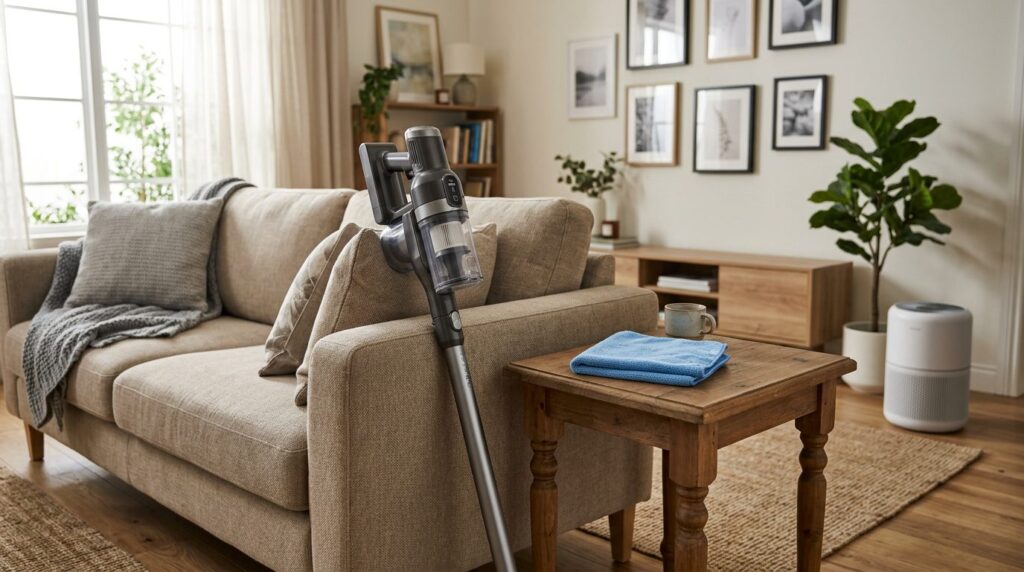
Dust from the top down: shelves, furniture and then floors, so that what falls is picked up last. Use a damp or microfiber cloth, which the EPA recommends for asthma triggers, because dry dusting pushes particles back into the air.
Vacuum carpets and upholstered furniture weekly with a HEPA-filter vacuum, as the EPA recommends. The EPA also suggests that people with asthma or allergies leave the area while it is being vacuumed.
Run the purifier on high during and for an hour after cleaning, when the most dust is airborne, then return it to auto mode.
Bedrooms matter most, because people spend a third of their lives there and dust mites live in bedding. Follow the EPA’s steps: wash bedding in hot water weekly and dry it completely, and use dust-proof covers on pillows and mattresses.
Reduce dust reservoirs where you can: fewer throw pillows and stuffed toys, washable rugs instead of wall-to-wall carpet in bedrooms, and blinds you can wipe instead of heavy curtains.
Keep humidity between 30% and 50%, as the EPA recommends. If your bedroom air is very dry in winter, our guide to the best humidifier for bedroom use explains how to stay within that range, and in damp basements our dehumidifier guide covers the other side.
Much dust comes in from outside. Doormats at every entrance and a shoes-off habit reduce tracked-in soil, and closing windows on windy or high-pollen days keeps outdoor particles out.
The EPA also lists indoor particle sources to control: vent combustion appliances outdoors, use a range hood vented outside when cooking, avoid unvented heaters and burn candles and fireplaces sparingly.
For renovation dust, seal off the work area with plastic sheeting, run a high-airflow purifier like the Medify MA-112 in the work zone and clean with a HEPA vacuum rather than a broom.
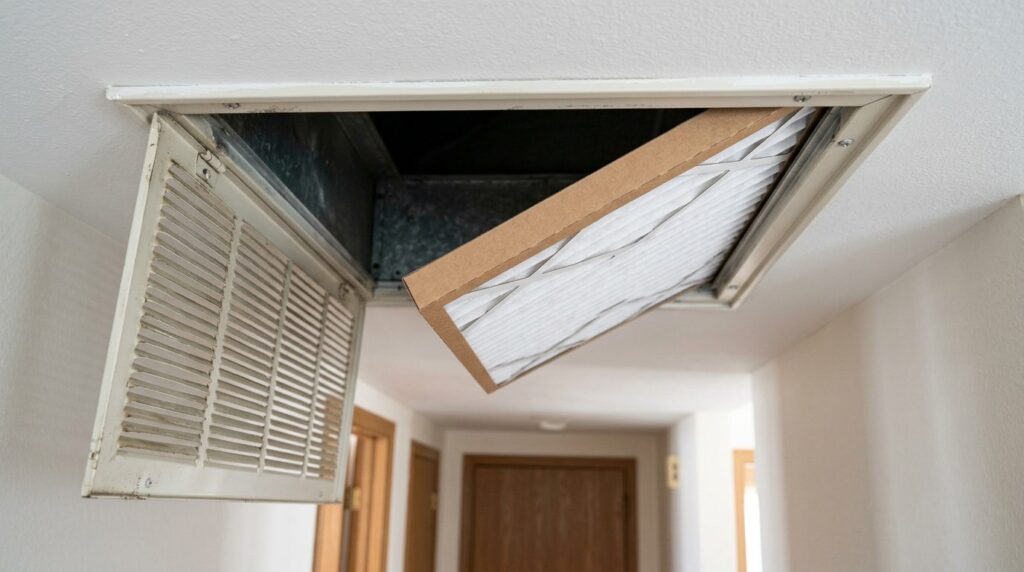
A portable purifier cleans one room. For the whole house, the EPA recommends a furnace or HVAC filter rated at least MERV 13, or as high as your system can accommodate, and suggests consulting an HVAC technician if you are unsure.
The EPA notes that HVAC filters only filter air while the system runs, which is often less than 25% of the time during heating and cooling seasons. Running the fan more often increases filtration, at some cost in electricity.
Our HVAC filter and MERV rating guide explains how to choose one, and the EPA says to change filters on central systems and air cleaners according to the manufacturer’s directions.
Yes, airborne dust. A HEPA purifier captures fine dust particles that float in the air, and AHAM’s dust CADR measures how quickly it does so. Heavier dust settles on surfaces, so cleaning with a damp cloth and a HEPA vacuum is still needed.
A HEPA purifier with a high dust CADR for the room size, a washable pre-filter and an auto mode. Use the EPA’s chart as a minimum, such as 195 cfm for a 300 sq ft room, and size up for dusty spaces.
Any good HEPA purifier helps catch mite allergens stirred into the air, but dust mites live in fabrics, so the EPA’s steps matter more: weekly hot washing of bedding, dust-proof covers and HEPA vacuuming. Keep humidity between 30% and 50%.
In the room where you spend the most time, usually the bedroom or living room, with space around the intake. Keep it away from walls and furniture and run it during and after cleaning.
Yes. The EPA notes that longer run times and higher fan speeds filter more air. Auto mode running all day, with a boost after cleaning, works well in most homes.
More often than the typical-use estimate. Clean washable pre-filters every few weeks, inspect the HEPA filter regularly and replace it when it is gray or airflow drops, and follow the EPA’s advice to change filters according to the manufacturer’s directions.
They do different jobs. A portable purifier cleans one room continuously, while a MERV 13 or higher HVAC filter, which the EPA recommends where the system allows, cleans the whole house but only when the system runs. Many homes benefit from both.
They are not necessary. The EPA advises avoiding air cleaners that intentionally produce ozone and notes some ionizers may emit ozone. HEPA filtration captures dust without that risk, and optional ionizers can be switched off.
For related guides, see our picks for the best HEPA air purifiers for allergies and the best air purifier for pets.
Written by the Delozone Editorial Team. We research products using manufacturer specifications, AHAM, Energy Star and CARB listings, EPA guidance and verified owner feedback, and we update guides when products or guidance change. How we work.
The Delozone Editorial Team researches water treatment, pool and spa, and indoor air products for independent buying guides. We compare products using manufacturer specifications, certification listings such as NSF/ANSI, UL, AHAM and Energy Star, published third-party test data and verified owner feedback. We do not sell products, and affiliate commissions never decide what we recommend.