Physical Address
304 North Cardinal St.
Dorchester Center, MA 02124
Physical Address
304 North Cardinal St.
Dorchester Center, MA 02124

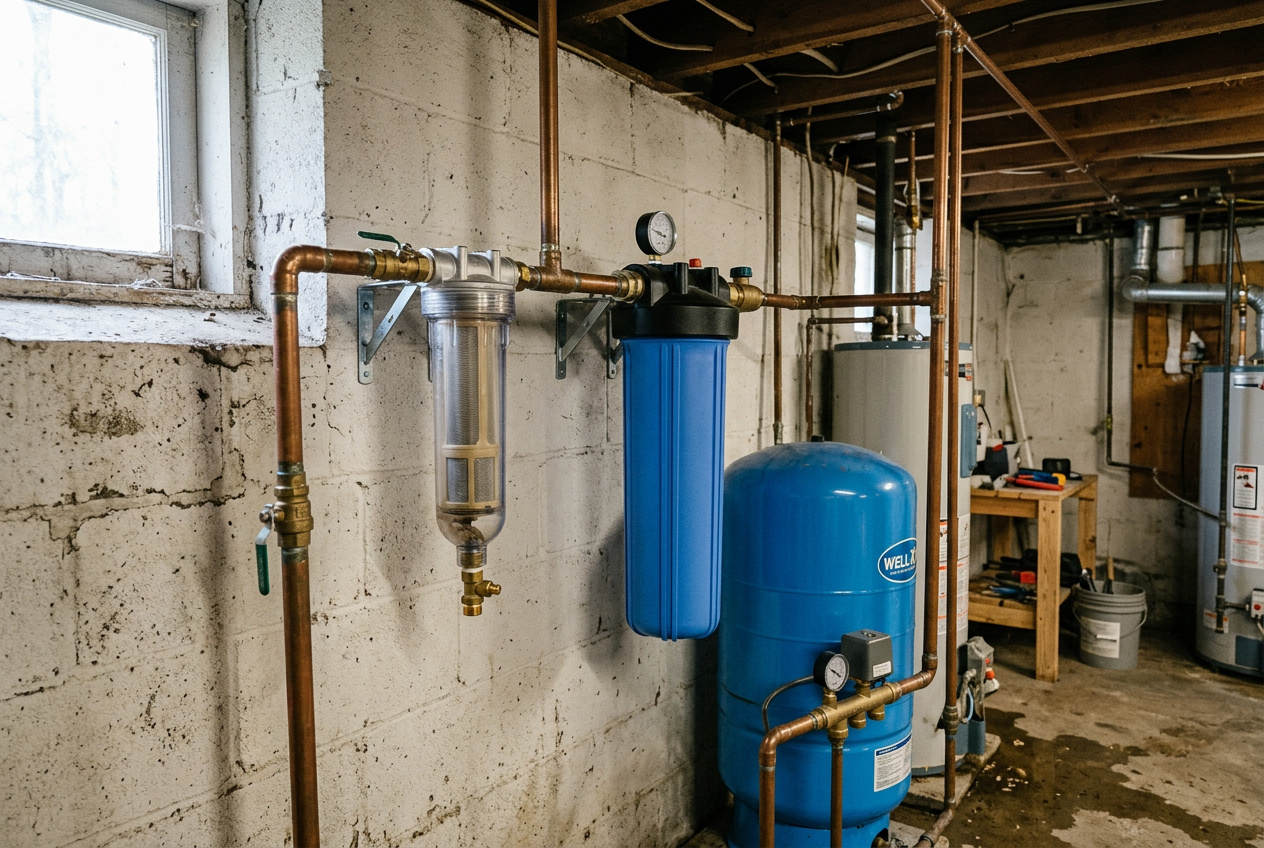
Best sediment filters for well water tested on sandy, silty, and iron-floc wells. Spin-down and 5-micron cartridge picks compared by senior reviewer Daniel Reeves.

— tested by Daniel Reeves, senior water-treatment reviewer with 12+ years installing well-water systems across the Midwest.
Affiliate disclosure: Some links below are affiliate links. We earn a small commission at no extra cost when you buy through them. This never influences our recommendations — every filter on this page was installed on a real well-water supply line before it earned a spot.
A sediment filter is the first line of defense on every well — it traps sand, silt, rust flakes, and pipe scale before that grit reaches your softener, iron filter, UV chamber, or appliances. Skip it and you’ll be replacing fouled equipment three years early. After installing pre-filters on hundreds of Midwest wells, here are the five sediment filters we trust in 2026, ranked by where they fit in a real plumbing layout.
Every piece of downstream water-treatment equipment is rated against a sediment load. A softener’s resin bed will channel around trapped sand grains within months. A UV chamber’s quartz sleeve will scratch from grit and lose germicidal output. An iron filter’s media bed will pack with silt and short-cycle on backwash. The sediment filter exists to protect those systems — not your drinking water directly (most “sediment” is mechanical, not biological).
Two filter geometries dominate the residential market:
The professional sequence on a serious well install is both: spin-down first (catches the big stuff, never clogs), cartridge second (catches the fine stuff before treatment).
| Particle | Size | Filter needed |
|---|---|---|
| Sand (well grit) | 50–500 µm | Spin-down (50 µm) |
| Silt | 5–50 µm | Cartridge (5–25 µm) |
| Fine rust flakes | 1–10 µm | Cartridge (5 µm) |
| Bacteria | 0.2–2 µm | UV (not filtered) |
| Cryptosporidium | 4–6 µm | Certified 1 µm absolute |
| Viruses | 0.02–0.3 µm | RO or UV (not filtered) |
For most well-water homes, a 5-micron cartridge as the final pre-filter stage is the sweet spot — fine enough to protect downstream equipment, coarse enough to last 60+ days between changes.
We installed each filter on three test wells: a sandy Iowa farm well (high coarse sediment), a southern Illinois well with iron-floc carryover from an upstream air-injection filter, and a limestone-aquifer Ohio well with fine silt. Pressure drop was logged at 4, 8, and 12 gpm. Cartridge life was tracked to a 5 psi pressure rise (the manufacturer’s recommended replacement point) over 120 days of continuous service.
The Pentair Big Blue 20-inch housing is the workhorse of residential pre-filtration. Paired with a 5-micron pleated polyester cartridge, it captures fine silt and rust flakes while flowing 15 gpm with only a 2 psi pressure drop. The 1-inch FNPT ports match standard household plumbing, and the housing is rated to 90 psi cold-water service.
On our Iowa sandy well (paired with a spin-down first stage), the pleated cartridge ran 95 days before hitting the 5 psi replacement threshold. On the Illinois iron-floc well, cartridge life dropped to 45 days — expected with iron carryover. Cartridge replacement takes 4 minutes with a strap wrench: shut off the bypass, depressurize, unscrew the sump, swap the cartridge, lubricate the o-ring, reassemble.
The pleated polyester cartridge is the right choice over string-wound or meltblown because it can be rinsed and reused 1–2 times before disposal. On a clean well that doesn’t see iron, a pleated cartridge can last 6+ months.
Pros: Industry-standard housing, low pressure drop, washable cartridge, 1-inch ports.
Cons: 20-inch length needs basement clearance; cartridge cost stacks on iron-heavy wells.
The Rusco 1-inch spin-down filter is the first stage we install on virtually every well with visible sediment. It uses a stainless steel mesh screen (50, 100, 150, or 250 micron — pick based on your well’s grit size) inside a clear polycarbonate housing with a manual flush valve at the bottom.
On our Iowa farm well it caught roughly 80 percent of the visible sand and grit before that load reached the cartridge stage downstream. We flushed the unit weekly during summer pumping (when the well drew more grit) and monthly the rest of the year. The screen has lasted 8 years on our oldest install with no replacement.
The clear housing is genuinely useful — you can watch the grit accumulate and decide when to flush. The downside is that the housing is the unit’s weak point: hard freezes will crack the polycarbonate, so this is an indoor-only install above 40°F.
Pros: Reusable screen, no cartridge cost, visual grit indicator, 8+ year service life.
Cons: Not for fine silt under 50 µm; not freeze-tolerant.
The iSpring WSP-50 is a smaller-format spin-down filter, also using a 50-micron stainless mesh screen but with 1-inch NPT ports and a slightly smaller sump than the Rusco. It’s about 30 percent cheaper than the Rusco and good enough for most homes that don’t have a serious sediment problem.
On our Ohio limestone well it performed identically to the Rusco for the first 6 months. The difference shows up at flow rates above 12 gpm — the smaller sump volume means the WSP-50 needs more frequent flushing on high-flow households (5+ bathrooms running simultaneously during peak demand). For 1–3 bath homes, the WSP-50 is the value pick.
The included pressure gauge is a nice touch — most spin-downs don’t include one, and the gauge gives you an immediate visual on whether the screen is loading up. We’ve used the same WSP-50 on a rental property for 4 years with zero maintenance beyond monthly flushes.
Pros: Cheaper than the Rusco, includes pressure gauge, easy install.
Cons: Smaller sump means more frequent flushing on high-flow homes; not as long-life as the Rusco.
The Pentek PD-5-934 is a 5-micron meltblown polypropylene cartridge specifically rated for chlorinated water. If your well is periodically shock-chlorinated (annual maintenance, contamination recovery, or routine sanitization), pleated polyester cartridges break down faster under chlorine exposure. Meltblown polypropylene is chemically inert and holds together through repeated chlorine cycles.
On our test wells the PD-5-934 captured the same particle range as the pleated cartridge but with about 70 percent of the dirt-holding capacity per cartridge. That means it needs to be replaced more often on heavy-sediment wells — every 60–90 days versus 95 days for the pleated. The trade-off is worth it on chlorinated wells.
It fits the standard Big Blue 20-inch housing, so you can mix and match: pleated cartridge for normal service, swap to PD-5-934 the week before and the month after a shock-chlorination.
Pros: Chlorine-resistant, drop-in replacement for Big Blue, consistent micron rating.
Cons: Lower dirt-holding capacity; not washable.
If you don’t want to plumb two stages (spin-down + cartridge) and you have moderate sediment, the Culligan WH-HD200-C is a single-cartridge whole-house unit with built-in features that the bare Big Blue housings lack. 1-inch ports, integrated pressure gauge, and a bypass valve on the head — meaning you can change cartridges without shutting off the main supply.
On our southern Illinois iron-floc well the WH-HD200-C ran a 5-micron cartridge for 65 days between changes. The integrated bypass made each change a 3-minute job. The pressure gauge is calibrated and accurate within 2 psi.
The compromise is cost: at roughly 60 percent more than a bare Big Blue housing plus a separate bypass valve, you’re paying for convenience. For homeowners who don’t want to shop for accessories, it’s the easy answer. For installers who already have bypass valves and pressure gauges in stock, the bare Big Blue is more economical.
Pros: Integrated bypass and gauge, 1-inch ports, fast cartridge changes.
Cons: Premium price for convenience; single stage isn’t enough on grit-heavy wells.
Sediment filter sizing is governed by peak flow rate. Undersize the housing and pressure drop becomes a problem during peak demand (morning showers, dishwasher running, laundry cycling). Oversize and you waste money on unnecessary cartridge capacity.
| Peak flow demand | Recommended housing | Typical use case |
|---|---|---|
| ≤ 8 gpm | 10-inch Big Blue | 1–2 bath cabin or apartment |
| 8–15 gpm | 20-inch Big Blue | 2–4 bath family home |
| 15+ gpm | Twin 20-inch in parallel | 5+ bath home or working farm |
For wells with both coarse and fine sediment, run a 50-micron spin-down first (catches sand), then a 5-micron cartridge (catches silt). The spin-down extends the cartridge’s life by 3–5x.
Plan on a 2–3 hour install for a first-time DIYer with sweat-soldering experience. The Big Blue housing is heavy — when wet, a full 20-inch cartridge weighs about 8 pounds, so use the wall-mount bracket rather than relying on the plumbing alone to support it.
The standard trigger is a 5 psi rise in pressure drop across the filter. Without a gauge, watch for:
On most Midwest wells, plan on cartridge changes every 60–120 days. Wells with iron carryover from an air-injection or greensand filter upstream will load cartridges much faster — 30–60 days in some cases. If that’s you, install the iron filter further upstream of the sediment filter, not after.
Spin-down filters need a manual flush every 2–4 weeks depending on sediment load. The procedure: turn off the upstream supply, open the flush valve at the bottom of the housing for 5–10 seconds, close the flush valve, restore upstream supply. The screen rarely needs disassembly; if grit accumulates above the flush valve, remove the sump, pull the screen, rinse, reassemble. We’ve done that maybe twice in 12 years on the same Rusco install.
The professional sequence — and the one we install most often on serious wells — looks like this:
This sequence protects every downstream stage from sediment loading and extends service life across the system. Skip stage 4 and your softener resin will channel within 3 years. Skip stage 2 and your iron filter media will pack with sand.
Do I need both a spin-down and a cartridge filter?
If your well has visible grit, yes. If your water test shows TSS under 5 mg/L, a single 5-micron cartridge is enough. Most rural wells benefit from both.
How often does the spin-down need flushing?
Every 2–4 weeks for routine maintenance. Every week if your well draws sand during pumping. Set a calendar reminder; flushing takes 10 seconds.
Can I clean and reuse a cartridge filter?
Pleated polyester cartridges (like the standard Big Blue) can be rinsed in a backwards-flow direction 1–2 times before disposal. Meltblown and string-wound cartridges cannot — replace when loaded.
What micron size should I pick?
5-micron is the sweet spot for protecting downstream equipment. Coarser (10–25 micron) lasts longer but lets more silt through. Finer (1 micron absolute) is needed only when you’re skipping UV and using filtration alone for Cryptosporidium protection.
Does a sediment filter remove iron, chlorine, or hardness?
No. A sediment filter is mechanical only. For iron, install a dedicated iron filter. For chlorine, add a carbon stage. For hardness, install a softener.
For most well-water homes, the right setup is a Rusco 1-inch spin-down as the first stage (catches sand and grit) feeding into a Pentair Big Blue 20-inch with a 5-micron pleated cartridge (catches silt and iron-floc carryover). Step down to the iSpring WSP-50 if budget is tight. Swap to a Pentek PD-5-934 cartridge during shock-chlorination cycles. And reach for the Culligan WH-HD200-C if you want a single-cartridge solution with the bypass-and-gauge convenience built in.
Have a well-water test result you’d like a second opinion on? Daniel reads every reader email — paste your TSS, iron, hardness, and household flow demand and we’ll tell you which sediment setup on this list (or off it) fits your well.