Independent buying guides for home air, water and safety.
As an Amazon Associate, Delozone earns from qualifying purchases.
Independent buying guides for home air, water and safety.
As an Amazon Associate, Delozone earns from qualifying purchases.


Ozone vs chlorine is a question pool owners, spa owners and water-treatment pros all ask when they plan a system. We walk through the science, the costs and the day-to-day upkeep so you can decide which disinfectant fits your water, and why most pools end up using both.
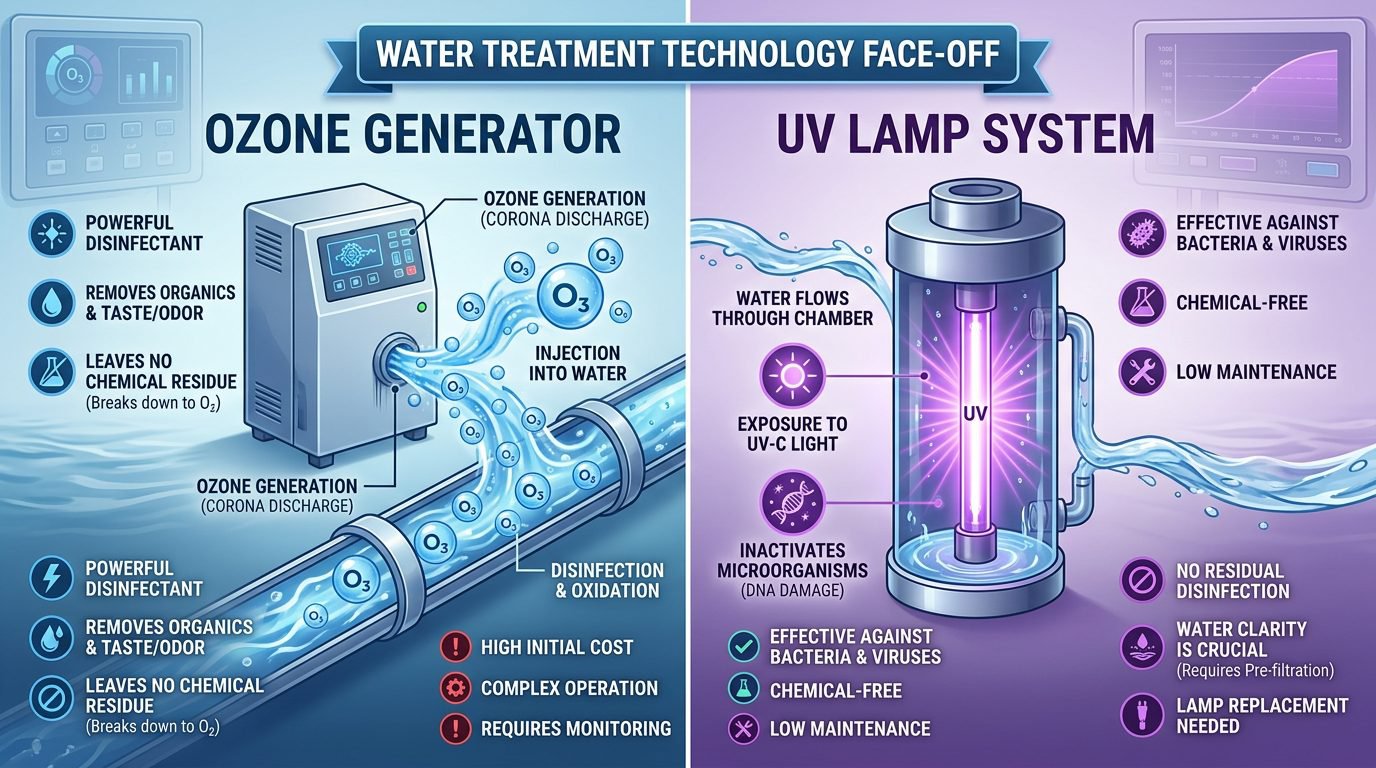
Most ozone generators pass dry air or concentrated oxygen through a high-voltage corona discharge (CD). The electrical field splits O₂ molecules, and the free oxygen atoms recombine into O₃. Older and cheaper units use a UV lamp instead; pool equipment maker CMP notes that CD cells produce more ozone per unit and hold their output longer, while UV lamp output drops steadily with every hour of use.
The gas is drawn into the water through a venturi injector or a diffuser that makes tiny bubbles, which maximizes contact surface. Because ozone is unstable, it decomposes back to oxygen within minutes, so it does most of its work in the plumbing before it reaches the pool. That rapid decay is why the generator sits close to the injection point.
Commercial controllers monitor ozone output and oxidation-reduction potential (ORP) and adjust the feed to match the water load. Residential units are simpler: most run on a timer or whenever the circulation pump runs.
Chlorine is usually added as sodium hypochlorite (liquid), calcium hypochlorite (granules or tablets), trichlor tablets, a salt chlorine generator or, at large plants, chlorine gas. In each case it forms hypochlorous acid (HOCl), the killing form of chlorine, which stays in the water as a measurable residual. The chemistry is well understood and has been in use for over a century.
That residual protects against re-contamination downstream or between swimmers, and it can be measured with simple test kits, so operators can verify compliance quickly. The ability to keep a lingering disinfectant in the water is chlorine’s key advantage, both for pools and for large distribution networks.
Chlorine dosing can be automated with feeders, metering pumps or a salt cell. The equipment is inexpensive compared with ozone generators, and spare parts are widely available. The chemicals must be stored safely to avoid degradation and accidental exposure.
For a deeper dive into practical applications, explore our ozone water treatment guide, pool ozone system guide, and benefits of ozone water treatment.
Ozone attacks microorganisms by oxidizing cell walls, nucleic acids and enzymes from the outside. This makes it effective against bacteria, viruses and the chlorine-tolerant protozoa Giardia and Cryptosporidium. The 2024 Model Aquatic Health Code (MAHC) sizes ozone systems by a CT value (concentration times contact time): 4.9 mg/L·min at 77°F for a 2-log (99%) reduction of Cryptosporidium and 7.4 mg/L·min for a 3-log (99.9%) reduction.
Chlorine inactivates microbes mainly through hypochlorous acid, which penetrates cell membranes. It kills most germs within minutes at normal pool levels and keeps working for hours after the dose. Its weak spot is Cryptosporidium: the CDC states that Crypto can stay alive for more than 7 days even in properly disinfected pool water.
That is why the two are paired. Ozone handles the tough organisms and the organic load as water passes through the equipment, while chlorine protects the water in the pool itself, where ozone residual is kept very low for swimmer safety.
Ozone has a standard oxidation potential of about 2.07 V, well above chlorine’s 1.36 V. This higher potential lets ozone break down complex organic compounds, oils and chloramines (the combined chlorine behind the classic “chlorine smell” and red eyes) more efficiently. The result is clearer water and less need to shock.
Chlorine’s lower potential still provides strong oxidation for most common contaminants, but it can struggle with stubborn organics and it creates chloramines when it reacts with sweat and urine. In drinking-water plants, operators sometimes add other oxidizers like potassium permanganate to deal with taste, odor and metals.
When water contains high levels of dissolved iron, manganese or hydrogen sulfide, ozone can convert these species into insoluble forms that are easy to filter out. Chlorine oxidizes them too, but the reaction is slower and can leave odors. Selecting the right oxidant therefore depends on the specific water chemistry you encounter.
Ozone systems require a generator, an injector and, on larger systems, a contact or degas vessel, which together cost more up front. The cost reflects the high-voltage components and control electronics. On large facilities, lower chemical demand can offset part of that outlay over the life of the equipment.
Chlorine dosing equipment is comparatively inexpensive. A tablet feeder, a metering pump or a salt cell costs a fraction of a commercial ozone generator. This makes chlorine attractive for budget-constrained projects.
When we evaluate total cost of ownership, we also look at installation complexity. Ozone needs correct placement of the injection point, a check valve to keep water out of the generator and, indoors, adequate ventilation, while chlorine installations are more straightforward. For a full cost breakdown, see our ozone pool vs chlorine pool cost comparison.
Ozone consumes electricity to maintain the corona discharge. Large industrial generators use roughly 14 kWh per kilogram of ozone on air feed and 7 to 8 kWh per kilogram on oxygen feed, per Toshiba’s published specifications, so the energy cost per gram is small. Ozone cuts chemical purchases, but a pool still needs chlorine for its residual.
Chlorine incurs recurring expenses for the chemical itself, plus safe storage and handling. Prices swing with supply and demand, which can affect budgeting. Operators also need to budget for regular testing and corrective dosing.
Both technologies benefit from routine maintenance that prevents efficiency loss. For ozone, that means checking the injector suction, the check valve and the feed tubing. For chlorine, it means inspecting pumps or feeders and replacing worn seals. Proper upkeep keeps operating costs within expected ranges.
Plan an ozone check at least once or twice a season: confirm the indicator light, look for bubbles at the injection point and check that no water has backed up into the tubing. CMP notes that corona discharge units can build up nitric acid in humid conditions, so the ozone feed tube may need replacing about once a year. Follow your generator’s manual for cell or lamp replacement intervals.
Chlorine dosing systems require pump or feeder calibration and occasional replacement of seals and gaskets. Salt cells need periodic inspection and descaling. The chemical storage area must be checked for corrosion and leaks. Regular checks help avoid unexpected downtime.
Both systems benefit from water-quality monitoring to detect early signs of performance drift. Sensors can trigger alerts when ORP or residual chlorine falls outside target ranges. Integrating these alerts into a central control panel simplifies troubleshooting.
Ozone does not form trihalomethanes or haloacetic acids, the chlorinated by-products the EPA limits in drinking water to 0.080 mg/L and 0.060 mg/L. This matters for drinking-water utilities that must meet these limits, and it also improves taste and odor.
The high oxidation potential of ozone breaks down organic contaminants and chloramines that chlorine handles slowly. This leads to clearer water, less chlorine smell and fewer shock treatments. In swimming pools, swimmers usually notice the difference in their eyes and skin first.
Because ozone reverts to oxygen, the system does not add dissolved solids to the water, unlike chlorine products that leave salts or stabilizer behind. This helps keep total dissolved solids lower over the season.
Chlorine leaves a measurable residual that protects water throughout the pool or the distribution pipeline. This lingering disinfectant is essential wherever water sits for hours before use or swimmers keep adding contaminants. Operators can verify safety with simple test strips.
The chemical is inexpensive and widely available, making it a practical option for remote or low-budget installations. Bulk purchasing further reduces per-gallon cost, especially for large-scale facilities. The supply logistics are well established worldwide.
Chlorine dosing equipment is simple to install and repair, with many technicians familiar with the technology. Spare parts are readily stocked, and training programs are abundant. This familiarity translates to lower labor costs for routine service.
Ozone leaves no lasting residual, so water can become re-contaminated between passes or when the system is off. That is why ozone is not accepted as a stand-alone pool sanitizer and a chlorine or bromine residual is still required.
In water that contains bromide, ozone can form bromate, a disinfection by-product the EPA limits to 0.010 mg/L in drinking water. The MAHC also restricts residual ozone in pool water to below 0.1 ppm, and ozone gas is a respiratory irritant, so indoor commercial systems need off-gas control and air testing.
Because ozone is a strong oxidizer, certain materials such as natural rubber, some plastics and metal tubing degrade faster. Use the tubing, check valves and fittings your generator maker lists as ozone-resistant to avoid premature failure.
Chlorine reacts with organic matter to form trihalomethanes and haloacetic acids, which are regulated due to health concerns. In pools it also forms chloramines, which cause eye irritation and the strong smell around indoor pools. Managing these by-products takes good ventilation, regular shocking or a secondary system.
Handling and storing chlorine chemicals poses safety risks, including chemical burns and toxic fumes if products are mixed. Proper training and protective equipment are mandatory, which adds to labor costs. Accidental spills can also have environmental consequences.
Chlorine is slow against Cryptosporidium, a parasite behind many pool-related diarrheal outbreaks. Outdoor pools also need cyanuric acid to protect chlorine from sunlight, and as CMP points out, high cyanuric acid can push the chlorine level needed for good sanitation to 5 ppm or more.
For homeowners who value crystal-clear water and low chemical exposure, ozone is a strong upgrade. The rapid oxidation keeps organics and biofilm at bay and reduces how often you need to shock. Pair it with a low, steady chlorine residual to cover the “no residual” gap; our pool ozone generator comparison covers sizing by pool volume.
Chlorine alone remains popular with DIY pool owners because the chemicals are easy to buy and apply. The residual provides peace of mind that the water stays safe between visits. However, users have to manage chloramine smell and potential skin irritation.
Hybrid systems give you the strengths of both: ozone handles most of the organic load while chlorine supplies a protective residual. This approach lowers overall chemical use and improves water clarity. If you are weighing a salt system instead, see our ozone vs salt comparison.
Hotels, resorts and aquatic centers use ozone for its high throughput and low by-product profile, usually on a side-stream of the filtration flow. Under the 2024 MAHC, new or substantially altered wading pools, interactive water play venues and therapy pools must use secondary treatment, which can be ozone or UV. MAHC ozone systems must be listed to NSF/ANSI 50 and run at 600 to 900 mV ORP after remixing. Our commercial pool ozone system guide covers the details.
Municipal drinking-water plants often rely on chlorine for its long-lasting residual throughout the distribution network. The ability to maintain safety over many miles of pipe is essential for public health. Chlorine’s established regulatory framework simplifies compliance.
In many cases, a combined approach is adopted: ozone pretreats the water to remove taste, odor and organics, while chlorine provides the final barrier before distribution. This staged treatment maximizes efficiency and meets strict quality standards, provided bromate is kept within its limit.
Ozone’s strong oxidation power makes it a good fit for sanitizing process water, cleaning equipment and washing produce. Because it reverts to oxygen, it leaves no taste or odor on food products. It is common in fruit-washing lines and dairy processing.
Chlorine is still used in large-scale beverage production where a residual is needed to protect against post-process contamination. The chemical’s low cost and ease of dosing fit high-volume operations. However, manufacturers must monitor for chlorine-related off-flavors.
Regulators frequently require proof of effective disinfection without harmful by-products. Ozone can meet these demands while reducing the need for additional filtration stages. When a residual is mandatory, a low-dose chlorine step after ozone treatment satisfies both safety and quality criteria.
| Feature | Ozone | Chlorine |
|---|---|---|
| Primary Disinfection Mechanism | Oxidation by O₃, attacks cells from outside | Hypochlorous acid (HOCl) penetrates cells |
| Residual Presence | Very short (decays in minutes); MAHC limit below 0.1 ppm in pool water | Persistent residual (hours to days) |
| Standard Oxidation Potential | About 2.07 V | About 1.36 V |
| Cryptosporidium | Effective (MAHC: 7.4 mg/L·min at 77°F for 3-log) | Can survive more than 7 days (CDC) |
| By-Products | Oxygen; bromate if bromide is present | Trihalomethanes, haloacetic acids, chloramines |
| Accepted as Sole Pool Sanitizer | No, needs a chlorine or bromine residual | Yes |
| Typical Capital Cost | High (generator, injector, contact vessel) | Low (feeder, pump or salt cell) |
| Operating Cost | Electricity (low per gram of ozone) | Chemical purchase (variable) |
| Maintenance Focus | Check valve, tubing, cell or lamp | Pump or feeder calibration, chemical handling |
| Best for | High-clarity, low-chloramine, high-risk venues | Residual protection in pools and distribution networks |
What you need for an ozone plus chlorine pool
Match the ozone generator to your pool volume and pump flow, and keep testing chlorine: ozone lowers chlorine demand but does not replace the residual.
Affiliate links: As an Amazon Associate, Delozone earns from qualifying purchases, at no extra cost to you. Full disclosure
Yes, ozone is an accepted disinfectant for municipal water supplies. Because it reverts to oxygen, it leaves no chlorinated residue. Utilities still monitor for bromate, which forms when ozone reacts with bromide in the source water; the EPA limit is 0.010 mg/L.
In practice, ozone can improve taste and remove odors that chlorine sometimes leaves. It also reduces the formation of regulated chlorinated by-products. For many utilities, ozone is one part of a multi-barrier treatment strategy, with chlorine added at the end for a residual.
No. Ozone handles most microbial control and oxidation in the equipment, but it leaves almost no residual in the pool, so water can become re-contaminated between passes. Pool codes require a chlorine or bromine residual, and manufacturers such as CMP recommend keeping chlorine as your residual.
What ozone does change is how much chlorine you need and how often you shock. CMP says ozone can largely take over the job of shock treatments, so many owners run a lower, steady chlorine level. Keep the level within health guidance and test it regularly.
Large corona discharge generators use about 14 kWh per kilogram of ozone on air feed and 7 to 8 kWh per kilogram on oxygen feed, according to Toshiba’s specifications. That works out to roughly 7 to 14 watt-hours per gram of ozone.
Residential pool and spa ozonators are small, low-wattage devices that usually run with the circulation pump, so their electricity use is minor next to the pump itself. Check the rated wattage on the unit’s label or manual for your exact model.
Test before swimming and after heavy use, rain or a shock treatment. The CDC tells public pools to keep at least 1 ppm free chlorine and hot tubs at least 3 ppm (or 4 ppm bromine), with pH between 7.0 and 7.8. Ozone does not change those minimums.
Automated sensors can feed data directly to a control system, reducing the need for manual test strips. When a drop is detected, the system can automatically adjust dosing to restore the residual. Regular testing also alerts you to potential equipment failures.
Yes. Ozone is effective against Cryptosporidium, which is why the MAHC lists ozone or UV as secondary treatment for high-risk venues such as wading pools and splash pads. Chlorine alone is slow: the CDC says Crypto can survive more than 7 days in properly disinfected water.
For a home pool, ozone adds a layer of protection inside the equipment, but the best defense is still keeping people with diarrhea out of the water and following CDC fecal-incident guidance.
Not in a meaningful way. CMP explains that ozone reacts first with easier targets such as organics and contaminants, and it reacts with hypochlorous acid only slowly. It reacts faster with hypochlorite ions, which dominate when pH runs high.
Keeping pH in range limits that effect, and CMP recommends injecting ozone after the chlorine feed point as best practice.
Ozone can degrade natural rubber, some plastics and metal tubing over time. Use the tubing, check valves and fittings your generator maker lists as ozone-resistant, and consult manufacturer specifications when retrofitting existing equipment.
In most installations, the ozone concentration in the main circulation line is low after injection, so the pump and filter are not at much risk. The parts that wear are the ozone tubing and check valve, so inspect them each season.
In the United States, the EPA’s National Primary Drinking Water Regulations allow ozone as a disinfectant and set a limit of 0.010 mg/L for bromate, the main ozone by-product. Similar rules exist in the EU and other regions.
Operators must maintain records of ozone dosage, water quality parameters, and any secondary treatment steps. Compliance audits typically review these logs along with laboratory test results. Staying within the prescribed limits ensures both safety and legal protection.
Ozone is effective at breaking down many industrial contaminants, including some pharmaceuticals and endocrine disruptors. Its high oxidation potential can reduce color, odor and organic load in wastewater treatment.
However, the cost of large-scale ozone generation can be a limiting factor for municipal wastewater plants. Many facilities combine ozone with biological processes to achieve a balanced treatment train. The technology is especially valuable where discharge permits are strict.
Sources: CDC: preventing diarrheal illnesses; CDC: operating public pools and hot tubs; 2024 Model Aquatic Health Code; EPA National Primary Drinking Water Regulations; CMP: swimming pool ozone myths; Toshiba ozone generator specifications.
The Delozone Editorial Team researches water treatment, pool and spa, and indoor air products for independent buying guides. We compare products using manufacturer specifications, certification listings such as NSF/ANSI, UL, AHAM and Energy Star, published third-party test data and verified owner feedback. We do not sell products, and affiliate commissions never decide what we recommend.