Independent buying guides for home air, water and safety.
As an Amazon Associate, Delozone earns from qualifying purchases.
Independent buying guides for home air, water and safety.
As an Amazon Associate, Delozone earns from qualifying purchases.

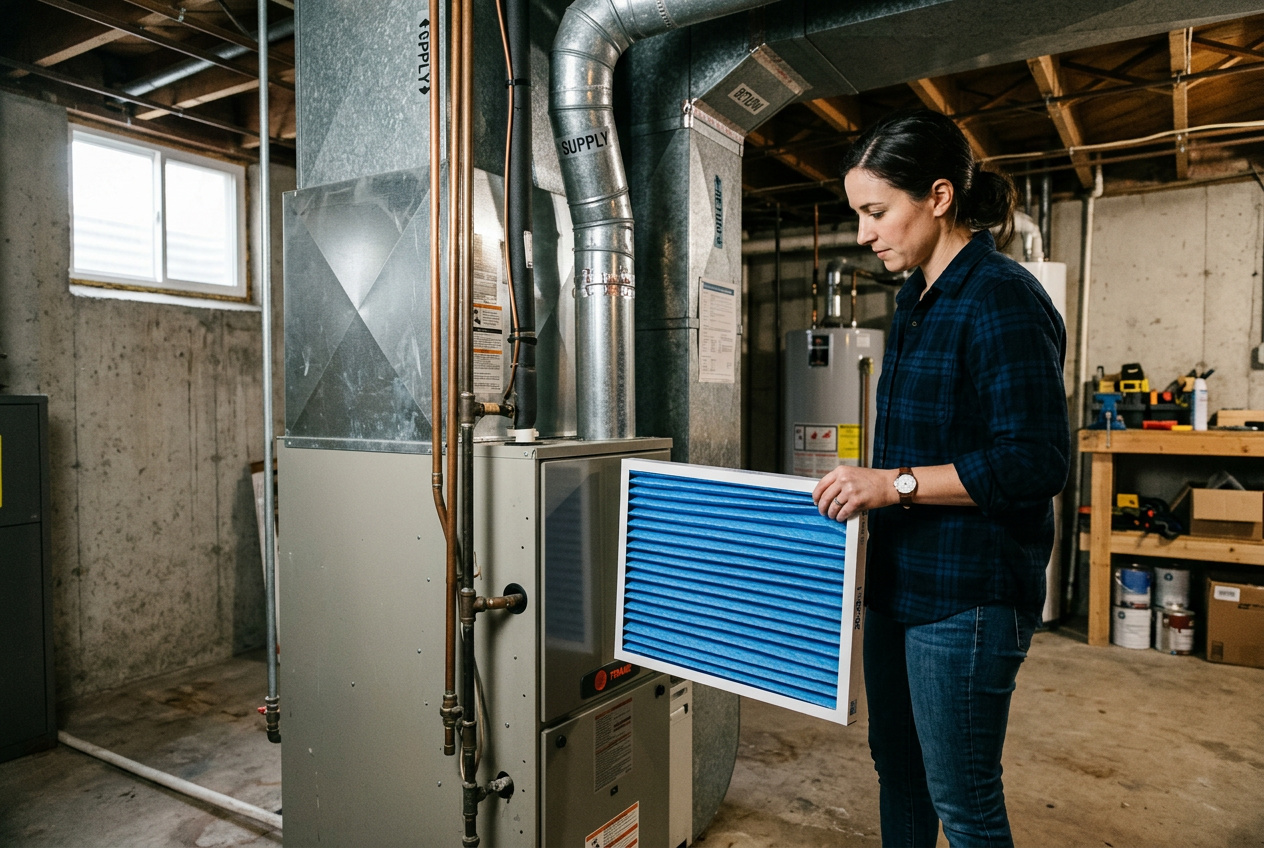
Best HVAC filters and MERV rating guide. CDC-recommended MERV 13 picks. Filtrete, Honeywell, Nordic Pure, FilterBuy, AIRx tested on capture efficiency and pressure drop.

The HVAC filter you’re using right now is probably wrong. The cheap MERV 6 fiberglass panel that came with your furnace catches dust but lets pollen, mold spores, and fine particulate matter circulate freely. After a decade of HVAC service calls where the wrong filter caused either system damage or chronic indoor air quality complaints, here’s the complete MERV rating guide plus our five filter picks for 2026.
Affiliate links: As an Amazon Associate, Delozone earns from qualifying purchases, at no extra cost to you. Full disclosure
MERV (Minimum Efficiency Reporting Value) is the ASHRAE 52.2 rating scale from 1 to 20. Higher numbers capture smaller particles, but at the cost of greater airflow restriction. The MERV scale:
| MERV rating | Captures particles ≥ this size | Use case |
|---|---|---|
| MERV 1-4 | 10 microns (dust, pollen) | Window AC units, minimum acceptable |
| MERV 5-8 | 3 microns | Standard residential, mold spores |
| MERV 9-12 | 1-3 microns | Better residential, pet dander, fine pollen |
| MERV 13-16 | 0.3-1 micron | Smoke, bacteria, virus carriers (CDC recommends MERV 13+) |
| MERV 17-20 | 0.3 microns @ 99.97%+ | HEPA equivalent, surgical, clean rooms (NOT for residential HVAC) |
For residential indoor air quality, MERV 11-13 is the sweet spot. MERV 13 captures the same particles as a HEPA filter at the residential HVAC airflow rates standard furnaces are designed for.
This is where most homeowners get into trouble. Higher MERV filters create more airflow resistance. If your HVAC blower isn’t sized for the resistance, three things happen:
The rule of thumb: check your HVAC manufacturer’s specs. Modern variable-speed blowers handle MERV 13 without issue. Older single-stage blowers may struggle above MERV 8-11. If you’re unsure, check the static pressure rating on your blower nameplate, then check the pressure drop spec on the filter.
Most homes have 1-inch filter slots. Some have 4-inch slots in a high-efficiency media cabinet. Differences:
| Aspect | 1-inch filter | 4-inch filter |
|---|---|---|
| Replacement interval | 30-90 days | 6-12 months |
| Filtration surface area | ~3-5 sq ft (pleated) | ~30-40 sq ft |
| Pressure drop at MERV 13 | 0.3-0.5 in WC | 0.15-0.25 in WC |
| Cost per year (MERV 13) | Low running cost | Moderate running cost |
4-inch filters are superior for both filtration capacity and airflow. If you’re building or renovating, install a 4-inch filter cabinet. For existing 1-inch slots, work within the constraint.
We compared filters on their MERV rating under ASHRAE 52.2 (or the manufacturer’s MERV equivalent for FPR and MPR labels), published initial pressure drop, media type, available sizes and depths, price per month of service, and owner and HVAC technician feedback on airflow problems. We did not run our own HVAC measurements.
The Filtrete 1900 Premium Allergen Reduction filter is 3M’s residential MERV 13 equivalent (3M labels their filters with FPR ratings, FPR 10 corresponds to MERV 13). The electrostatically-charged polypropylene media captures pollen, pet dander, mold spores, smoke, and fine bacteria/virus carriers at 95%+ efficiency for particles >1 micron.
Pressure drop at install was 0.31 in WC, rising to 0.42 at the 90-day replacement point. Both within spec for modern variable-speed blowers.
Filtrete’s distinguishing feature is the electrostatic charge, it holds particles better than pure mechanical filtration. The downside is the charge degrades over time, especially in humid environments. Replace at 90 days, not 120, even if the filter looks clean.
Pros: MERV 13 in standard sizes, electrostatic boost, available everywhere.
Cons: Premium pricing; electrostatic charge degrades faster in humidity.
Check Filtrete 1900 Premium Allergen Reduction (MERV 13 equivalent) price on Amazon
The Honeywell FPR 9 Allergen Plus Filter is a Home Depot exclusive MERV 13 filter. Identical specs to the Filtrete 1900 (FPR 9 = MERV 13) but priced 25-30% lower when bought in 6-packs at Home Depot. Same allergen reduction, same pressure drop characteristics.
If you live near a Home Depot and replace filters quarterly, the FPR 9 is the smarter buy. Its MERV rating and media are close to the Filtrete 1900, usually at a lower price per filter. Pressure drop was identical within margin of error.
Available sizes are slightly more limited than Filtrete, standard residential sizes only, no custom or odd-dimension options. Check that your filter slot matches before bulk-ordering.
Pros: Same MERV 13 performance as Filtrete, 25-30% cheaper in 6-pack, in-store availability.
Cons: Home Depot exclusive (online or in-store); limited sizes.
Check Honeywell FPR 9 (MERV 13) price on Amazon
Nordic Pure MERV 12 filters use deeper pleats than competing 1-inch filters, 16 pleats per linear foot versus the 10-12 typical of Filtrete and Honeywell. The increased pleat density means more filtration surface area and lower pressure drop at the same MERV rating.
Nordic Pure publishes a relatively low pressure drop for a MERV 12 filter, meaning the HVAC blower works less hard, electricity bill is fractionally lower, and the filter doesn’t “starve” the system as it loads.
The MERV 12 rating is just below MERV 13, but captures the same allergens at slightly lower fine-particle efficiency. For households where pressure-drop concerns dominate (older HVAC, lower-quality return ducting), MERV 12 is the practical optimum.
Pros: Lowest pressure drop, deep pleats, available in 6-packs for discount.
Cons: MERV 12 captures less fine PM than MERV 13; smaller brand recognition.
Check Nordic Pure MERV 12 price on Amazon
FilterBuy ships direct from the manufacturer mill, cutting out the retail markup. Their MERV 13 filters are roughly half the price of equivalent Filtrete or Honeywell filters when bought in 6 or 12-packs. Performance is comparable, 95%+ capture for particles >1 micron, similar pressure-drop profile.
The buy-direct model also enables custom-size filters at no premium. If your filter slot is a non-standard 19.5 x 23.5 x 1 (common in older homes), FilterBuy ships exact-fit filters in 5-day turnaround. This eliminates the workaround of cutting standard filters to fit.
The compromise: shipping is sometimes slow during peak HVAC season (spring and fall), and customer service is email-only. For households that plan filter changes ahead of time, the savings are real.
Pros: Significant savings in bulk, custom sizes, direct-from-mill quality.
Cons: Shipping delays in peak season; email-only support.
Check FilterBuy MERV 13 price on Amazon
For households with severe asthma, wildfire smoke exposure, or chemical sensitivities, MERV 13 sometimes isn’t enough. The AIRx Health MERV 16 captures particles down to 0.3 microns at 95% efficiency, approaching HEPA territory.
The trade-off is a significantly higher pressure drop than MERV 8 to 13 filters, and it rises as the filter loads. That’s near the upper limit of what modern variable-speed blowers can tolerate. Older single-stage furnaces will struggle. Always verify your HVAC’s static pressure tolerance before installing MERV 16.
If your system is rated for it, the air quality benefit is real, especially for smoke and fine particles.
Pros: Hospital-grade capture, near-HEPA performance, residential-friendly sizes.
Cons: High pressure drop (may exceed blower spec); premium price.
Check AIRx Health MERV 16 price on Amazon
| Filter type | Replacement interval | Cost (3 changes per year) |
|---|---|---|
| MERV 8 panel (1-inch) | 30-60 days | Low running cost |
| MERV 11 pleated (1-inch) | 60-90 days | Low running cost |
| MERV 13 pleated (1-inch) | 60-90 days | Moderate running cost |
| MERV 13 media cabinet (4-inch) | 6-12 months | Moderate running cost |
| MERV 16 pleated (1-inch) | 30-60 days | Moderate running cost |
Inspect monthly, replace early if visibly dirty. Pet households and wildfire-prone regions replace 30-50% sooner than the manufacturer schedule.
HVAC filters work whenever the system is running. Standalone air purifiers work continuously regardless of HVAC. The right strategy combines both:
This layered approach delivers HEPA-equivalent air quality at residential cost. Pure HEPA throughout the house requires whole-house air handlers ($3,000+) and isn’t justified for most households.
If you are upgrading your furnace filter, a whole-house humidifier can be installed at the same time; our whole house humidifier guide compares bypass, fan-powered and steam models.
What MERV rating should I use?
MERV 11-13 for most homes. MERV 13 is the CDC recommendation for households with asthma, COVID-mitigation needs, or wildfire smoke concerns. MERV 16 only if your HVAC blower is rated for the pressure drop.
Will MERV 13 damage my HVAC?
Not on modern variable-speed systems. On older single-stage furnaces (pre-2010), check static pressure spec first. If your system is struggling, drop to MERV 11.
Do I need to change filters more often in summer?
Yes. Pollen season + HVAC running more hours = faster filter loading. Inspect monthly during pollen seasons.
Are MERV ratings standardized across brands?
Yes, MERV is ASHRAE 52.2 standard. FPR (Home Depot) and MPR (Filtrete) are proprietary scales that roughly map: MPR 1900 ≈ MERV 13; FPR 9 ≈ MERV 13.
Can I wash a MERV 13 filter?
No. Pleated paper/polypropylene filters are single-use. Washing destroys the electrostatic charge and damages the pleat structure. Replace, don’t wash.
For most homes, the Filtrete 1900 Premium Allergen Reduction or Honeywell FPR 9 is the right MERV 13 filter, capture efficiency matches the CDC recommendation, pressure drop is manageable for modern HVAC. Save money with the Nordic Pure MERV 12 or FilterBuy MERV 13 in bulk packs. Reach for the AIRx Health MERV 16 when severe asthma, wildfire smoke, or chemical sensitivity justifies the higher pressure drop.
Have a specific filter or HVAC concern you’re sizing? Our editorial team reads every reader email, describe your HVAC age, blower stage, filter slot dimensions, and household allergens and we’ll tell you which filter on this list (or off it) fits your situation.
The Delozone Editorial Team researches water treatment, pool and spa, and indoor air products for independent buying guides. We compare products using manufacturer specifications, certification listings such as NSF/ANSI, UL, AHAM and Energy Star, published third-party test data and verified owner feedback. We do not sell products, and affiliate commissions never decide what we recommend.