Independent buying guides for home air, water and safety.
As an Amazon Associate, Delozone earns from qualifying purchases.
Independent buying guides for home air, water and safety.
As an Amazon Associate, Delozone earns from qualifying purchases.


Affiliate disclosure: As an Amazon Associate, Delozone earns from qualifying purchases. Some links on this page are affiliate links, so we may earn a commission at no extra cost to you. Our picks are based on published specifications, EPA radon testing guidance, NRPP device and laboratory listings and verified owner feedback. We did not run our own lab tests, and commissions never decide what we recommend.
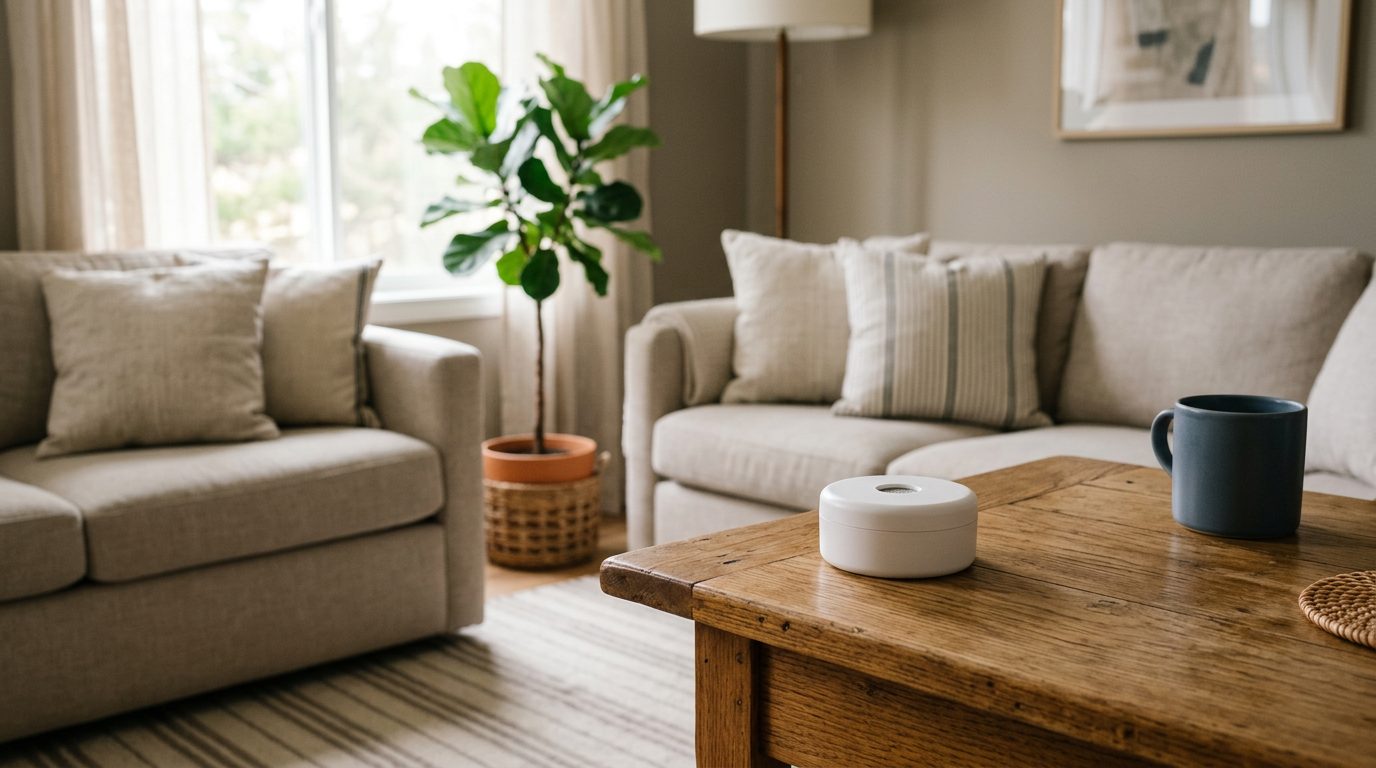
The best radon test kit for most homes is a short-term charcoal kit with lab analysis included, such as the First Alert RD1, followed by a long-term alpha track test like the Radonova Radtrak³ if the first result comes back near or above the EPA action level of 4 pCi/L. The EPA estimates that nearly 1 in 15 U.S. homes has high radon and that radon causes about 21,000 lung cancer deaths a year, and the only way to know your own level is to test, because radon has no color, smell or taste.
Top picks at a glance
Key takeaways
Quick comparison: best radon test kits for 2026
| Product | Type | Test length | Lab analysis | Best for | Buy |
|---|---|---|---|---|---|
| First Alert RD1 | Charcoal, short-term | A few days (per kit instructions) | Fee included (NJ state fee extra) | First screen of any home | Check price |
| PRO-LAB RA100 (2 detectors) | Short-term | From 48 hours | Separate fee per detector | Side-by-side tests, home sales | Check price |
| Radonova QuickScreen | Charcoal, short-term | 2 to 4 days | Included (return postage not included) | Humid basements, low-level sensitivity | Check price |
| AccuStar PicoCan 275 | Charcoal, short-term | 48 to 96 hours | Per kit instructions | Checking a mitigation system | Check price |
| Radonova Radtrak³ | Alpha track, long-term | 90 days to 1 year | Included, postage included | Year-round average | Check price |
| Airthings Corentium Home | Digital monitor | Continuous, first reading after 24 hours | None needed | Ongoing monitoring | Check price |
| Airthings Wave Radon | Smart digital monitor | Continuous, app history | None needed | Phone data and trends | Check price |
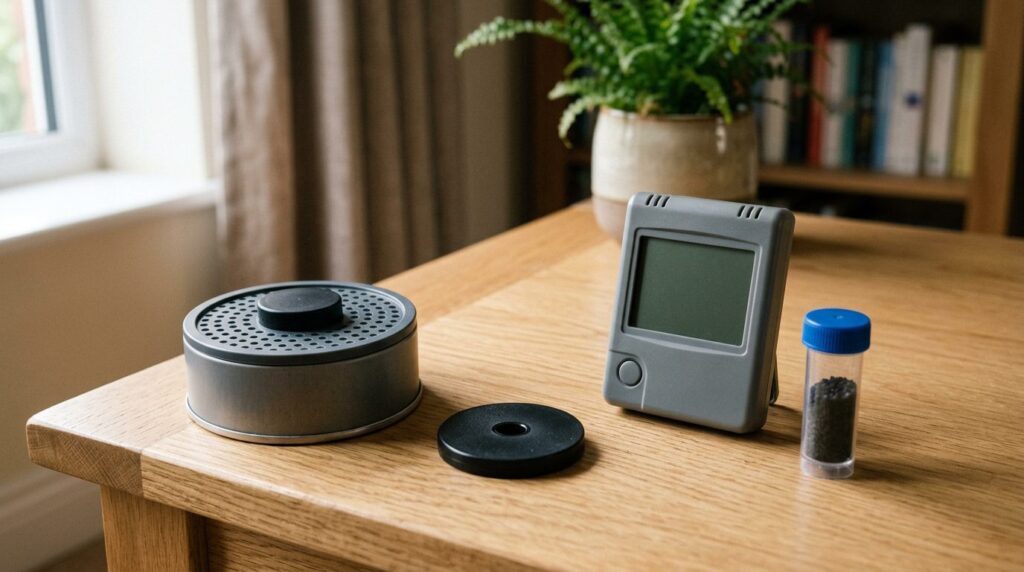
Radon is a radioactive gas released by the natural breakdown of uranium in soil and rock. It enters homes through cracks in foundations, gaps around pipes, sump pits and crawl spaces, and it can build up in any house, old or new, drafty or tight, with or without a basement. The CDC’s radon page notes that radon levels are often higher in basements and lower levels.
The health risk is lung cancer. According to the EPA’s page on the health risk of radon, radon is the number one cause of lung cancer among people who have never smoked and the second leading cause overall, responsible for about 21,000 lung cancer deaths every year, about 2,900 of them among people who never smoked. The risk for smokers exposed to radon is much higher because the two combine.
You cannot sense radon, and your neighbor’s result does not predict yours, because radon entry depends on the soil under each house and how the house is built. The EPA estimates that nearly 1 in 15 U.S. homes has high radon levels. That is why the EPA, the CDC and the Surgeon General all recommend testing every home.
“There is no known safe level of radon. You should always aim to have the lowest level.”
Centers for Disease Control and Prevention, Radon and Your Health
Radon in U.S. homes is measured in picocuries per liter of air, written pCi/L. The EPA recommends fixing your home if the level is 4 pCi/L or higher, and considering a fix between 2 and 4 pCi/L. The average indoor level in the U.S. is about 1.3 pCi/L, and outdoor air averages about 0.4 pCi/L, according to the EPA’s Citizen’s Guide to Radon.
The World Health Organization sets a lower reference level of 100 becquerels per cubic meter, which is about 2.7 pCi/L. The EPA’s action level has stayed at 4 pCi/L, but both agencies agree that no level is completely safe and that lower is better.
The EPA’s risk table in the Citizen’s Guide puts numbers on that. At 4 pCi/L over a lifetime, about 62 of every 1,000 people who smoke could get lung cancer, and about 7 of every 1,000 people who never smoked. At 2 pCi/L, those figures drop to about 32 and 4. Most homes can be brought to 2 pCi/L or below with a mitigation system.
The EPA’s Citizen’s Guide to Radon describes two general ways to test. Short-term tests stay in your home for 2 to 90 days, depending on the device, and include charcoal canisters, alpha track, electret ion chamber, continuous monitors and charcoal liquid scintillation detectors. Long-term tests stay for more than 90 days, usually alpha track or electret detectors.
Radon levels change from day to day and season to season, so a short-term test is less likely to tell you your year-round average. A long-term test is more likely to reflect the level you actually live with. The trade-off is time: a short-term kit gives an answer within a week or two, a long-term kit takes months.
The practical approach is to use both. Start with a short-term kit to find out quickly whether you have a problem, then confirm any borderline or high result with a long-term test or a second short-term test, as the EPA’s step-by-step process below explains.
Mail-in kits, charcoal and alpha track, collect radon passively and are analyzed by a laboratory. They are the standard for a documented result, and some kits include the lab fee while others charge it separately. You mail the kit back and receive a report by email or online, typically within days of the lab receiving it.
Digital monitors, such as the Airthings models on our list, measure radon continuously and show averages on a screen or in an app, with no lab involved. They are useful for tracking seasonal changes, checking whether a mitigation system keeps working and seeing the effect of a finished basement or a new HVAC setup. Their readings are estimates from a consumer sensor, and the manufacturers note that longer averages are the most accurate.
For a first test or a documented result, choose a lab-analyzed kit. For peace of mind over time, add a digital monitor. Many households end up with both: a kit to establish the level and a monitor to watch it.
Many kits say “EPA approved” or refer to an EPA proficiency program. The EPA’s own Radon Measurement Proficiency program closed in October 1998, and today device and laboratory listings are maintained by two private programs: the AARST National Radon Proficiency Program (NRPP) and the National Radon Safety Board (NRSB). The NRPP approved device list is public.
That does not make older wording on a box wrong, only out of date. The useful check is whether the laboratory that analyzes your kit is currently listed by NRPP or NRSB. Radonova’s Radtrak³ appears on NRPP device lists, and established kit brands in this guide state that their labs are accredited.
Consumer digital monitors are a different category. The professional Airthings Corentium Pro appears on NRPP and NRSB device lists, while the consumer Corentium Home and Wave models are sold for homeowner monitoring. For a real estate test, most buyers and agents expect a lab-analyzed kit or a certified professional, so use a monitor for monitoring and a kit for documentation.
All 7 picks were in stock on Amazon with a working buy box when we checked in September 2026. We chose them on test type, laboratory arrangements, what is included in the price, clarity of instructions, how results are delivered and the pattern of verified owner feedback, with at least one strong option for each testing need.
The list covers 4 short-term kits, 1 long-term kit and 2 digital monitors. If you only buy one thing today, make it a short-term kit, and plan the follow-up based on its result.
The First Alert RD1 is one of the most widely sold radon kits in the U.S. and a straightforward first test. It is a short-term charcoal kit that includes the test materials and the lab fee, excluding a state fee for New Jersey residents, and results are emailed once the lab has analyzed it: the Amazon listing says within 72 hours of lab receipt, while First Alert’s own FAQ says 3 to 5 business days.
Setup takes a few minutes: open the kit, place it in the lowest lived-in level following the instructions, record the start and end times, seal it and mail it to the lab. Because the lab fee is already included, there is no second payment step, which is where some cheaper kits catch buyers out. First Alert notes the kit is recommended for use only within the United States.
The listing still refers to the EPA proficiency program, which, as explained above, closed in 1998. That does not affect how the kit works, but if you need a result for a formal purpose, check the lab’s current NRPP or NRSB status. For a first screen of your home, the RD1 is the simplest choice we found.
Check First Alert RD1 price on Amazon
The PRO-LAB RA100 includes two short-term detectors that can be deployed together. PRO-LAB says the test can run in as little as 48 hours and that standard results arrive within a work week of the lab receiving the detectors, with email or text notifications along the way.
Two detectors make this kit useful for the EPA’s side-by-side method: the Citizen’s Guide says you can use the results of two short-term tests placed four inches apart to decide whether to fix your home, and PRO-LAB positions the 2-detector kit for real estate transactions. You can also use the two detectors on different floors of the same house.
The important detail is the fee structure. The RA100 requires a separate lab analysis fee for each detector, plus an additional fee for New Jersey residents, so budget for that when comparing it with kits that include analysis. PRO-LAB also sells a single-detector kit, the RA155, with the lab fee included.
Check PRO-LAB RA100 price on Amazon
Radonova’s QuickScreen is a 2 to 4 day charcoal test from a company that describes itself as operating in more than 50 countries and that runs its own accredited laboratory. Radonova says the QuickScreen contains more than 3 times the charcoal of other industry test kits, which it says makes it sensitive to low radon levels and tolerant of high humidity.
That humidity tolerance matters in basements, where charcoal can absorb moisture and where many first tests take place. The laboratory analysis and report are included in the kit. Note that return postage is not included, and that Radonova says the kit is not available in New Jersey because of state regulations.
If you live in a damp region or plan to test a basement in summer, the QuickScreen is a good alternative to the RD1. If humidity is a regular problem in that basement, our guide to the best dehumidifiers for mold prevention covers the moisture side.
Check Radonova QuickScreen price on Amazon
The AccuStar PicoCan 275 is a charcoal canister for short-term tests of 48 to 96 hours. AccuStar positions it both for screening a home and for assessing the performance of a radon mitigation system, which is where a quick, inexpensive retest is most useful.
The EPA and CDC both say to test again after any repairs to confirm they worked. A charcoal canister placed in the same spot as the original test, under the same closed-house conditions, gives you a direct before-and-after comparison once a mitigation fan is running.
Follow the kit instructions for the lab and any fees, since arrangements for AccuStar kits vary by listing. If you want continuous confirmation instead of a single retest, pair the mitigation system with a digital monitor from later on this list.
Check AccuStar PicoCan 275 price on Amazon
The Radonova Radtrak³ is an alpha track detector that measures radon over 90 days to one year, which the EPA classes as a long-term test. It is the most useful single measurement of your year-round exposure, because it averages out the daily and seasonal swings that can mislead a 2 or 3 day test.
Radonova includes the laboratory analysis, reporting and return postage. Setup is simple: register the detector, place it where the instructions say, leave it for at least 90 days and mail it back. Radtrak³ appears on NRPP device lists, which makes it a good documented follow-up to a short-term result.
The obvious downside is time. Use it after a short-term screen when the result was between 2 and 8 pCi/L, or as your first test if you are not in a hurry. For a result above 8 pCi/L, the EPA recommends a second short-term test right away rather than waiting months.
Check Radonova Radtrak³ price on Amazon
The Airthings Corentium Home (model 223) is a battery-powered digital radon detector that runs on 3 AAA batteries, so it can sit anywhere in the house without an outlet. Airthings describes it as the first battery-operated digital radon detector. It is one of the best-selling radon devices on Amazon.
According to Airthings, the first reading appears after 24 hours, and the screen shows 1-day, 7-day and long-term averages. Airthings says the long-term average is the most accurate picture of your radon level, which matches the EPA’s advice that longer measurements are more representative. It can also generate a radon self-inspection report.
It has no app or Wi-Fi, which some owners prefer. Use it to monitor the lowest lived-in level year-round, to see whether a newly finished basement changes your levels or to confirm a mitigation system keeps working, and use a lab kit when you need a documented result.
Check Airthings Corentium Home price on Amazon
The Airthings Wave Radon (model 2950) adds a smartphone app to continuous radon monitoring, along with humidity and temperature sensors. You wave a hand in front of it for a color-coded status light, and the app shows short- and long-term radon history via Bluetooth, with no lab fees.
Airthings says the first radon measurement typically appears after 24 hours, and that after 30 days of use the 7-day average is typically within about 10%, improving to about 5% after two months. With the separate Airthings Hub, data can go online around the clock, and Airthings lists compatibility with Google Assistant and Alexa.
It is the best fit if you want to see how radon changes with seasons, weather and HVAC use. If you also want particles, CO2 and VOCs in one device, our guide to the best air quality monitors for home covers the Airthings View Plus, which includes radon among its sensors.
Check Airthings Wave Radon price on Amazon
We started with the kit types the EPA lists for home testing: charcoal canisters and other short-term devices, alpha track long-term detectors and continuous monitors. For mail-in kits, we favored brands whose laboratories state current accreditation and whose kits include clear instructions for placement and timing.
We also looked at what the lab arrangement means for you: whether the fee is included, whether return postage is included, how results are delivered and whether any state is excluded. Those details decide the real cost and hassle of a kit more than the box price does.
Unknown-brand kits and monitors with no verifiable lab or listing were excluded, even when they looked attractive on price, because a radon result is only useful if you can trust it enough to act on it.
No single kit covers every situation, so we picked for roles: a simple first screen, a 2-detector kit for side-by-side and home sale tests, a humidity-tolerant kit for basements, a canister for mitigation checks, a long-term kit for the year-round average and two monitors for ongoing tracking.
That structure follows the EPA’s own process, which starts with a short-term test and uses either a long-term test or a second short-term test to confirm. Following it with the right tools avoids both unnecessary mitigation and false reassurance.
Where a well-known product was unavailable, we said so and chose another. When we checked in September 2026, the newer Airthings Corentium Home 2 and the Ecosense EcoBlu plug-in monitor had no working Amazon buy box, so we recommend the original Corentium Home instead.
We read verified owner reviews for patterns rather than star averages: lab delays, lost kits in the mail, unexpected fees, confusing instructions and monitor reliability. Kits with recurring complaints about surprise fees or missing results were ranked lower or dropped.
Every product was checked in a browser on Amazon in September 2026 for a working buy box. Prices and lab fees change, so we link to current prices rather than printing numbers that go stale.
We did not run our own radon chamber or lab tests. Our choices rely on manufacturer specifications, EPA and CDC guidance, NRPP listings and verified owner feedback, and we update the guide when products or guidance change.
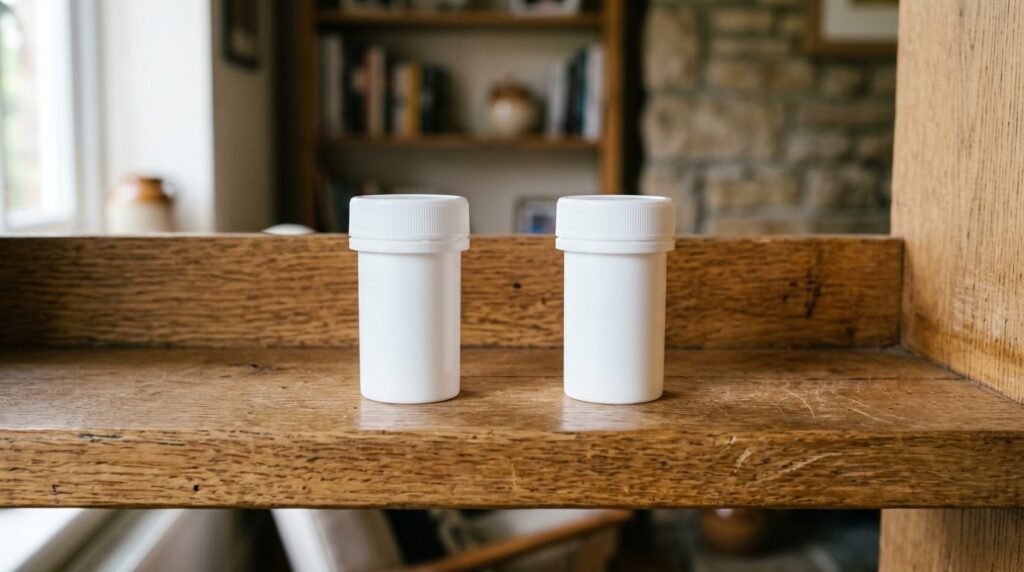
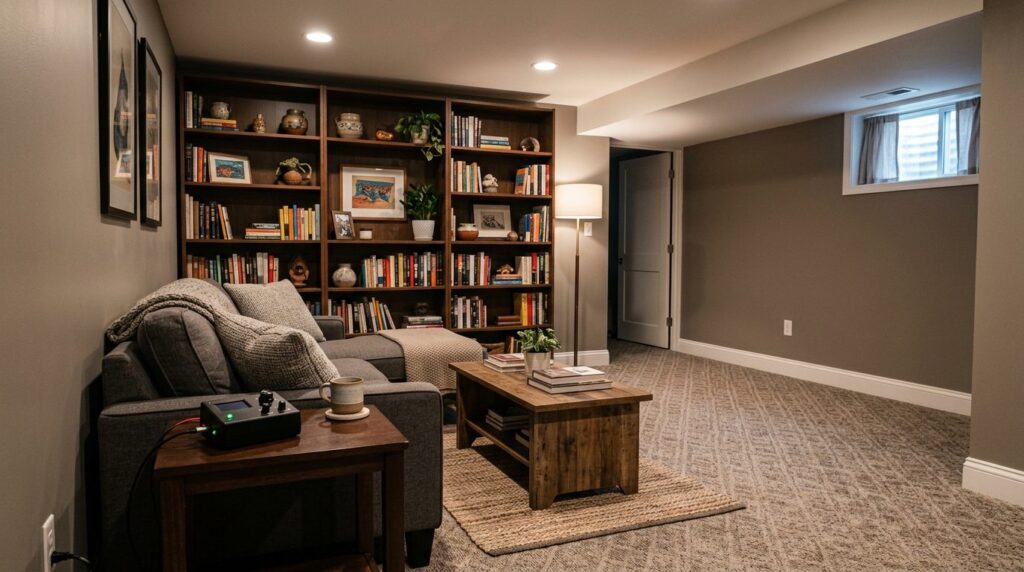
The EPA says to place the kit in the lowest lived-in level of the home: the basement if it is used regularly, otherwise the first floor. Put it in a room used regularly, such as a living room, playroom, den or bedroom, but not the kitchen or bathroom, where humidity and exhaust fans can affect the result.
Set the kit at least 20 inches above the floor, where it will not be disturbed, and away from drafts, high heat, high humidity and exterior walls. A bookshelf or side table in the middle of a room usually works well.
If you later start using a lower level, such as a newly finished basement, the EPA advises retesting on that level. The same applies after major renovations, foundation work or changes to the HVAC system.
For a short-term test, keep windows and outside doors closed as much as possible during the test. For a test lasting only 2 or 3 days, close them at least 12 hours before starting as well. Normal entry and exit through doors is fine.
Heating and air conditioning fans that recirculate air may run, but do not run fans or machines that bring in outside air. Small exhaust fans used briefly, such as a bathroom fan, are allowed, and so is the fan of an existing radon reduction system.
The EPA also advises against running a 2 or 3 day test during unusually severe storms or very high winds, which can change pressure around the house and skew the result. Note the start and end times exactly, reseal the kit and mail it right away, since delays can affect charcoal readings.
The EPA’s process has 3 steps. Step 1: take a short-term test. If the result is 4 pCi/L or higher, move to step 2. Step 2: follow up with either a long-term test, for a better picture of your year-round average, or a second short-term test if you need results quickly. If the first result is more than twice the action level, above 8 pCi/L, take the second short-term test immediately.
Step 3: if you followed up with a long-term test, fix your home if the result is 4 pCi/L or more. If you followed up with a second short-term test, consider fixing your home if the average of the two tests is 4 pCi/L or higher.
| Result | What the EPA suggests |
|---|---|
| Below 2 pCi/L | Low; consider retesting in the future or after changes to the home |
| 2 to 4 pCi/L | Consider fixing; confirm with a long-term test |
| 4 to 8 pCi/L (short-term) | Follow up with a long-term test or a second short-term test |
| Above 8 pCi/L (short-term) | Take a second short-term test immediately |
| 4 pCi/L or more (confirmed) | Fix your home with a qualified mitigation contractor |
Results near 4 pCi/L are the least certain. The EPA notes that if the average of two short-term tests is 4.1 pCi/L, there is about a 50% chance that the year-round average is somewhat below 4 pCi/L, which is why a long-term test is worth the wait for borderline results.
Real estate timelines rarely allow a 90-day test. The EPA’s Citizen’s Guide says the results of two short-term tests placed side by side, four inches apart, can be used to decide whether to fix the home, which is why 2-detector kits like the PRO-LAB RA100 exist.
The EPA also notes that buyers often want tests made by someone who is not involved in the sale, and that your state radon office can help you find a qualified tester. If you are selling, the EPA suggests testing now and keeping the results, and fixing a problem before listing so it does not complicate the sale.
New homes are not exempt. The EPA recommends that even homes built with radon-resistant features be tested after occupancy, and that owners of homes with 4 pCi/L or more consult a qualified mitigator about adding a vent fan to activate the passive system.
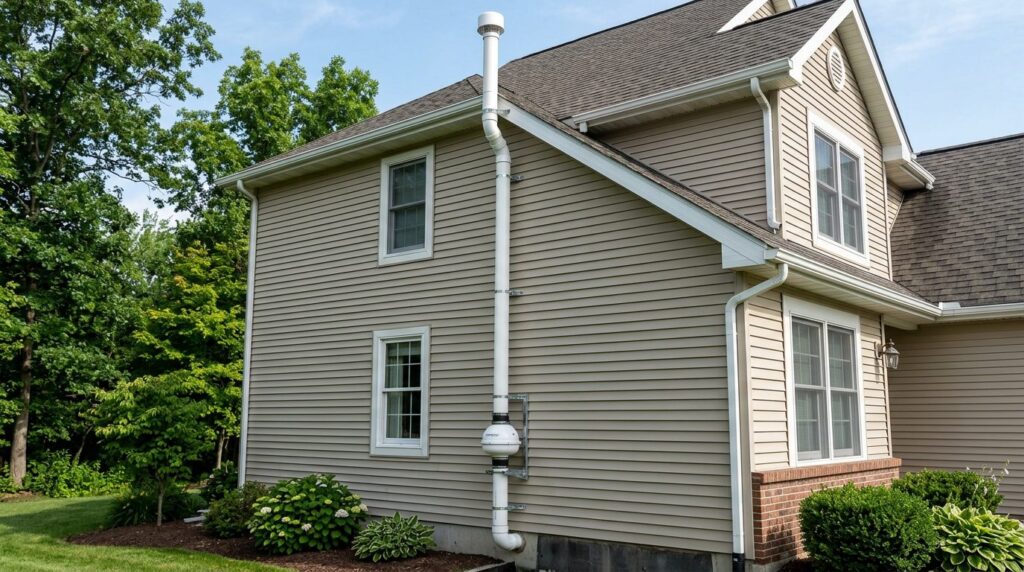
The most common fix is sub-slab depressurization: a contractor drills through the basement slab, installs a vent pipe and a fan, and draws radon from under the house to vent it above the roof. The CDC says lowering high radon levels requires technical knowledge and special skills, so rely on a qualified professional for these repairs.
Your state radon office can help you find a qualified or state-certified contractor. The EPA’s Citizen’s Guide says most homes today can be reduced to 2 pCi/L or below, and that in an existing home, installing a mitigation system costs about the same as other common home repairs.
Sealing cracks and covering an exposed earth floor in a crawl space help, and the U.S. Department of Housing and Urban Development lists them among the steps that can lower radon, but sealing alone rarely brings a high level down reliably. Opening windows and running fans is only a temporary measure.
The EPA and CDC both advise testing again after any repairs to confirm they worked. Once the system has been running for the period your installer recommends, use a short-term kit in the same location as your original test, under the same closed-house conditions.
Many homeowners then keep a digital monitor running in the lowest lived-in level. A continuous monitor shows immediately if the fan fails or levels creep up in winter, when homes are closed and the stack effect draws more soil gas indoors.
Most systems have a pressure gauge, a U-tube manometer, on the vent pipe. Check it periodically: if the liquid levels become even, the fan may have stopped, and it is time to call the installer.
If your home uses a private well, radon can also enter through water and be released into the air when you shower, wash dishes or do laundry. The EPA’s Citizen’s Guide advises testing both the air and, for private wells, the water, and it lists the Safe Drinking Water Hotline at (800) 426-4791 for water questions.
Air testing comes first, because most radon exposure in homes comes from soil gas. If your air result is high and you have a well, a water test tells you whether the well contributes. Water radon tests use a separate kit designed for water samples.
Our guide on how to test well water at home covers the other contaminants worth checking in a private well, and what each result means for treatment.
Radon levels can run higher in the heating season, when windows stay closed and warm indoor air rising through the house draws soil gas in at the lowest level. That makes winter a sensible time for a short-term screen, because it tends to show the higher end of your range.
January is National Radon Action Month in the U.S., a campaign the EPA supports to encourage testing, and many state radon programs run promotions then. Contact your state radon office before buying, because many programs offer free or discounted test kits, although availability varies by state and year.
A long-term test that spans more than one season gives the fairest year-round picture, so starting an alpha track test in autumn and letting it run through winter is a good plan.
The EPA suggests retesting in the future even if your result is below 4 pCi/L, and retesting whenever you begin using a lower level of the home. After mitigation, periodic retests confirm the system is still working, and your installer or state radon office can suggest a schedule.
Retest after major changes that affect air pressure or soil contact: finishing a basement, foundation repairs, new windows or insulation that tighten the house, or a new HVAC system. Settling and new cracks in the foundation can open new entry routes too.
A digital monitor removes the guesswork by measuring continuously. If you own one, glance at the long-term average each season and use a lab kit when you need a documented number.
Radon is one of several invisible home hazards that are cheap to check and easy to ignore. Carbon monoxide and smoke need working alarms on every level, which our guides to the best carbon monoxide detectors and the best smoke detector cover.
Together, a radon test, CO alarms and interconnected smoke alarms cover the three big household air and fire risks for a modest total cost. A digital radon monitor and a PM2.5 air quality monitor then keep an eye on the air day to day.
Keep your radon results with your home records. They are useful for insurance, for a future sale and for comparing results after any change to the house.
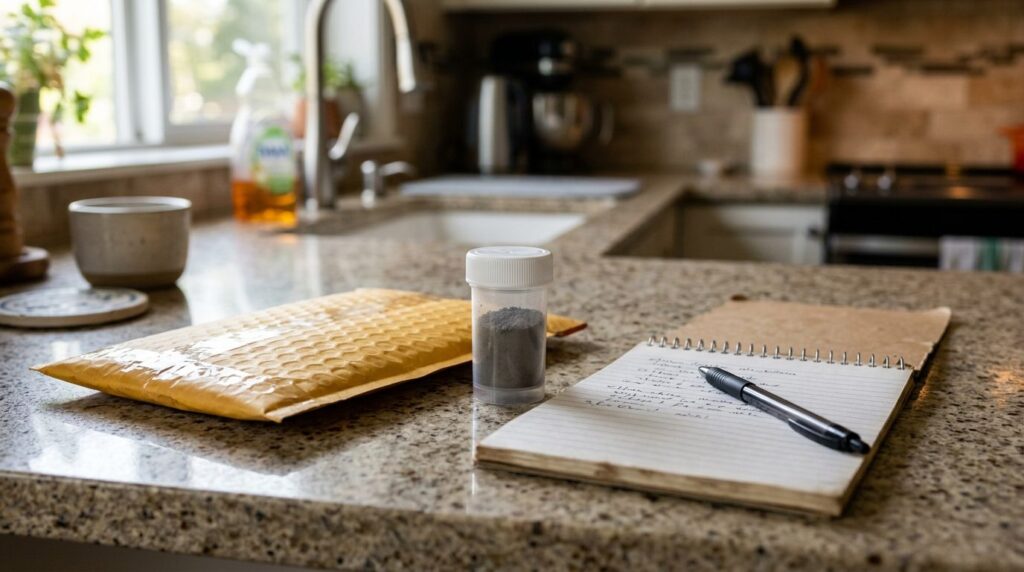
Yes, when used as instructed and analyzed by an accredited lab, DIY kits give a reliable measurement of radon during the test period. The main limitation is the short test window: radon changes day to day, so the EPA recommends confirming a result of 4 pCi/L or higher with a long-term test or a second short-term test.
A long-term test of more than 90 days, such as an alpha track kit, gives the most representative picture of your year-round average. For a quick decision, two short-term tests side by side, or a professional continuous monitor used by a certified tester, are the accepted alternatives.
Short-term tests run from 2 to 90 days, and most charcoal kits run 2 to 4 days, plus mailing and lab time. Long-term tests run more than 90 days, and digital monitors show a first reading after about 24 hours but need weeks to months for a reliable long-term average.
Place it in the lowest lived-in level, in a regularly used room that is not a kitchen or bathroom, at least 20 inches above the floor. Keep it away from drafts, high heat, high humidity and exterior walls, as the EPA recommends.
The EPA recommends fixing your home at 4 pCi/L or higher and considering a fix between 2 and 4 pCi/L. The CDC states there is no known safe level of radon, so lower is always better.
High radon levels have been found in every state, and the EPA stresses that any home may have a problem. Some regions have higher radon potential based on geology, and your state radon office can tell you about local zones, but only a test tells you about your own home.
Often, yes. Many state radon programs offer free or discounted kits, especially during National Radon Action Month in January, and some cities and counties run their own programs. Check your state radon office before buying.
A digital monitor is better for ongoing tracking and for checking a mitigation system, while a lab-analyzed kit is better for a first documented result and for home sales. Many homeowners use a kit to establish the level and a monitor to watch it over time.
For the rest of your home’s air, see our guide to the best air quality monitors for home, and for safety alarms, our carbon monoxide detector picks.
Written by the Delozone Editorial Team. We research products using manufacturer specifications, EPA and CDC guidance, certification and laboratory listings and verified owner feedback, and we update guides when products or guidance change. How we work.
The Delozone Editorial Team researches water treatment, pool and spa, and indoor air products for independent buying guides. We compare products using manufacturer specifications, certification listings such as NSF/ANSI, UL, AHAM and Energy Star, published third-party test data and verified owner feedback. We do not sell products, and affiliate commissions never decide what we recommend.