Independent buying guides for home air, water and safety.
As an Amazon Associate, Delozone earns from qualifying purchases.
Independent buying guides for home air, water and safety.
As an Amazon Associate, Delozone earns from qualifying purchases.

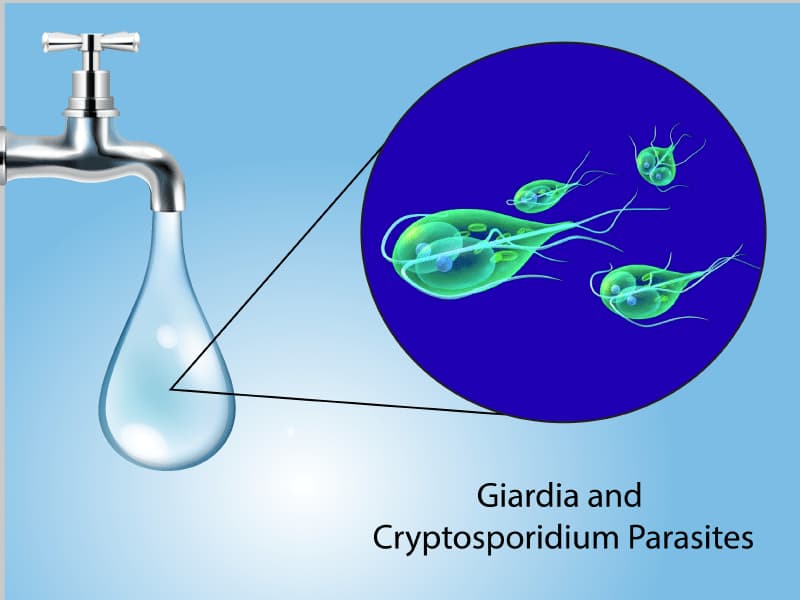

Cryptosporidium and Giardia are two of the most common waterborne parasites in the world. They are responsible for millions of infections annually, often linked to contaminated drinking water, recreational water, and improperly treated private wells. Their resistance to traditional chemical disinfectants—especially chlorine—makes them particularly dangerous. Fortunately, ozone has emerged as one of the most effective methods for neutralizing these pathogens. This guide explores what these parasites are, how they spread, and why ozone treatment outperforms chlorine and UV in eliminating them.
Cryptosporidium, often referred to as “Crypto,” is a microscopic protozoan parasite that infects the intestines of humans and animals. Its infectious stage, known as an oocyst, has an exceptionally tough outer shell, enabling it to survive harsh environmental conditions. This shell also makes Cryptosporidium resistant to chlorine at levels commonly used in municipal water treatment systems.
Crypto can cause cryptosporidiosis, an illness characterized by severe diarrhea, stomach cramps, dehydration, fever, and nausea. Symptoms may last for weeks, especially in children, the elderly, and individuals with weakened immune systems.
Giardia lamblia (also known as Giardia intestinalis or Giardia duodenalis) is another protozoan parasite that affects the digestive tract. Like Cryptosporidium, Giardia has a protective cyst form that allows it to survive outside the host for extended periods. These cysts are also resistant to chlorine at normal disinfection levels.
Giardia infection, known as giardiasis, often leads to gastrointestinal symptoms such as diarrhea, gas, bloating, weight loss, and fatigue. While rarely life-threatening, it can become chronic without proper treatment.
Cryptosporidium and Giardia typically enter drinking water systems through:
Both parasites spread through fecal contamination and require only a small number of cysts or oocysts to cause infection. Once they contaminate surface water, they can remain viable for months without proper treatment.
Chlorine has been the backbone of water disinfection for over a century. However, its effectiveness depends on concentration and contact time. Cryptosporidium and Giardia have evolved protective outer shells specifically designed to withstand chemical threats, including chlorine.
Key reasons chlorine underperforms:
Because of this, advanced disinfection methods are necessary to fully neutralize these organisms.
Ozone (O₃) is one of the strongest oxidizing agents available for water treatment. Unlike chlorine, which struggles to penetrate the tough shells of parasites, ozone destroys pathogens through powerful oxidation that breaks down organic structures rapidly.
1. Stronger Oxidation Power
Ozone has a higher oxidation potential than chlorine and chlorine dioxide. It oxidizes the parasite’s outer shell and internal cellular components within seconds.
2. Faster Inactivation Time
Ozone destroys Crypto and Giardia up to 3000 times faster than chlorine. This rapid action makes it ideal for both municipal and residential water systems.
3. Effective at Lower Concentrations
Even low doses of ozone can inactivate cysts and oocysts. No extreme chemical levels are required.
4. No Harmful Residual Chemicals
Ozone naturally decomposes into oxygen after treatment, leaving behind no chlorine taste, odor, or chemical by-products.
5. Broad-Spectrum Pathogen Control
Ozone neutralizes viruses, bacteria, protozoa, and even emerging contaminants that chlorine may miss.
These attributes make ozone one of the most powerful tools available for modern water treatment.
When ozone dissolves in water, it reacts with organic molecules and organisms instantly. For parasites like Cryptosporidium and Giardia, ozone disrupts:
Once compromised, the parasites can no longer infect humans. Because ozone breaks apart quickly, systems often rely on continuous or on-demand ozone injection to maintain effectiveness.
Each method has strengths, but ozone stands out when dealing with chlorine-resistant parasites.
| Treatment Method | Effective Against Crypto | Effective Against Giardia | Residual Chemical | Speed | Notes |
|---|---|---|---|---|---|
| Chlorine | Poor | Limited | Yes | Slow | DBPs can form |
| UV-C Light | Strong | Strong | No | Fast | Requires clear water |
| Ozone | Very Strong | Very Strong | No | Fast | Best overall parasite control |
While UV can also inactivate Crypto and Giardia, its performance depends heavily on water clarity. Ozone, on the other hand, remains effective even in moderately cloudy water and treats a wider range of contaminants simultaneously.
Ozone treatment is increasingly common in:
Homeowners with well water or recurring microbial contamination particularly benefit from ozone due to its reliability and speed.
Yes. When properly installed, ozone systems are safe, reliable, and extremely effective. Ozone gas is generated on demand and injected directly into water lines, where it dissolves quickly. Any unused ozone breaks down into oxygen before exiting taps.
Home ozone systems often pair with:
This creates a multi-barrier protective system against parasites and other pathogens.
Ozone systems require minimal upkeep compared to chemical-based systems:
With these simple steps, ozone systems can operate for years with high efficiency.
As chlorine-resistant parasites continue to challenge global water systems, the industry is shifting toward advanced oxidation technologies like ozone and hybrid ozone-UV systems. These modern approaches offer better performance, lower environmental impact, and safer drinking water for households and communities.
Q1: Are Cryptosporidium and Giardia dangerous?
Yes. Both can cause severe gastrointestinal illness and are especially risky for children, the elderly, and people with weakened immune systems.
Q2: Can chlorine kill Crypto or Giardia?
Not effectively. Their protective shells allow them to survive in chlorinated water for days.
Q3: Does ozone change the taste of water?
No. Ozone naturally decomposes into oxygen and leaves no taste, odor, or residue.
Q4: Is ozone safe for home water treatment?
Yes. When properly installed, ozone systems are safe, chemical-free, and highly effective against chlorine-resistant parasites.
Q5: Do I need filtration before using ozone?
Yes. Pre-filtration removes sediment and improves ozone contact with microorganisms, increasing effectiveness.
The Delozone Editorial Team researches water treatment, pool and spa, and indoor air products for independent buying guides. We compare products using manufacturer specifications, certification listings such as NSF/ANSI, UL, AHAM and Energy Star, published third-party test data and verified owner feedback. We do not sell products, and affiliate commissions never decide what we recommend.