Independent buying guides for home air, water and safety.
As an Amazon Associate, Delozone earns from qualifying purchases.
Independent buying guides for home air, water and safety.
As an Amazon Associate, Delozone earns from qualifying purchases.

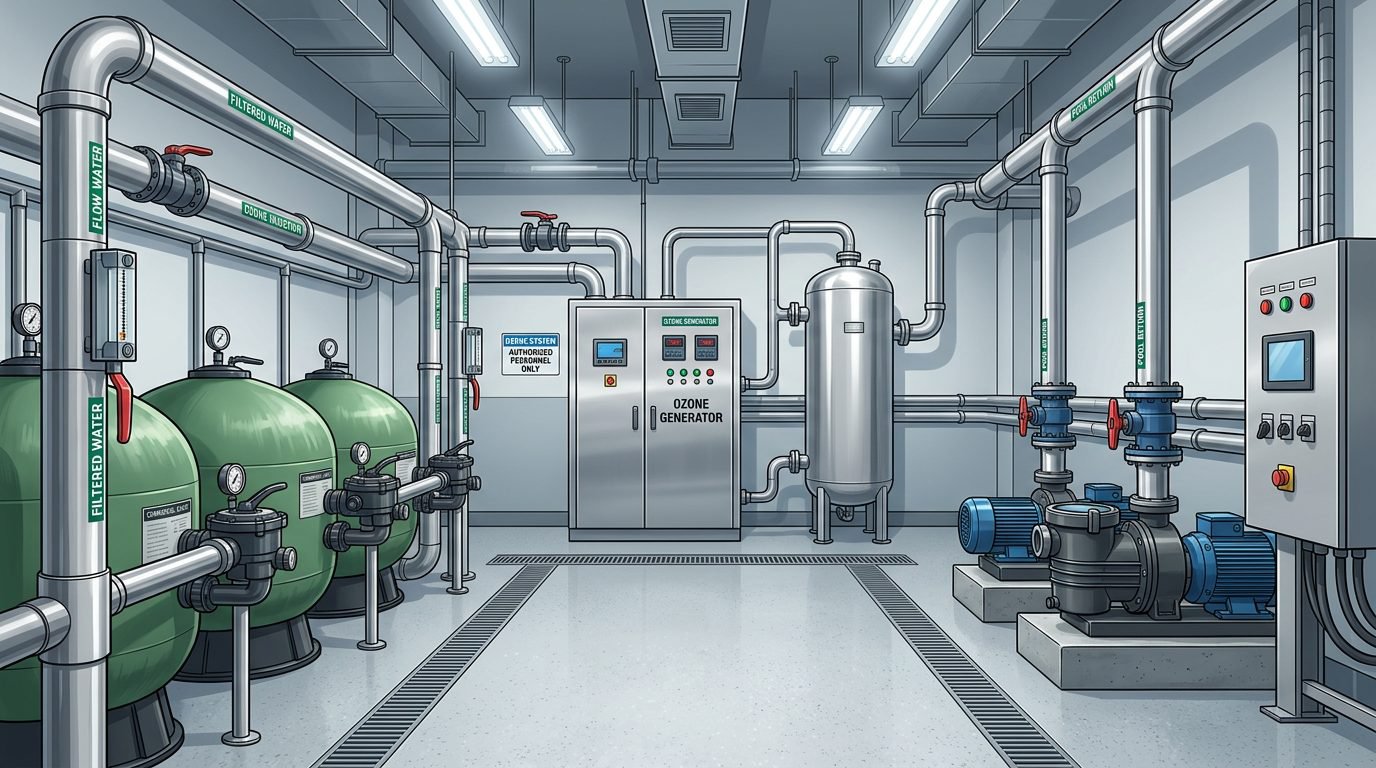

Ozone for commercial aquatics is reshaping how operators protect swimmers and keep water and air quality under control. This guide walks through the technology, the 2024 Model Aquatic Health Code (MAHC) requirements, and the cost factors that decide whether ozone makes sense for your facility.
Key Takeaways
Chloramines form when chlorine reacts with sweat, urine, and skin cells, creating a pungent odor and irritating eyes. Indoor venues often report a “chlorine smell” that is actually a mix of mono-, di-, and trichloramines. That gap between how the pool smells and how clean it really is drives operators to look for better treatment.
Ozone’s strong oxidation attacks chloramine molecules and the organic matter that feeds them. According to the Pool & Hot Tub Alliance overview of secondary and supplemental systems, ozone destroys organic contaminants that may create chloramines and breaks down existing chloramines, with oxidation starting at the injection point and continuing in the return lines. Ventilation still matters, but ozone works on the source of the odor in the water rather than only moving air.
The 2024 MAHC (section 5.7.4.4.2) tells operators to act when combined chlorine exceeds 0.4 ppm, with options such as superchlorination, water exchange or better bather hygiene. An ozone side-stream gives facilities that keep hitting that action level another tool, alongside showers before swimming and good air handling for indoor aquatics venues.
The Model Aquatic Health Code (MAHC) is the CDC’s voluntary model code that many state and local health departments use when they update their pool rules. Its biggest push toward ozone and UV comes from Cryptosporidium, a parasite that tolerates normal chlorine levels for days. Because chlorine alone can’t stop it quickly, the MAHC requires a second treatment step for the venues where young children and vulnerable bathers swim.
Disinfection byproducts (DBPs) such as chloramines are the other driver. Oxidizing organics in a side-stream means less material for chlorine to react with in the pool. Ozone does not change the chlorine rules, though: MAHC 5.7.3.2.2.3 states that use of ozone does not modify any other water quality requirement.
Compliance is a matter of engineering plus records. A listed system, the right sampling points, interlocks and logged air tests are what an inspector will ask for, and section 4.7.3.3.4.9.1 requires air test results to be kept onsite. For context on what is changing, see our article on new regulations for commercial pools in 2026.
Competitive swimmers and families alike want water that feels soft and air that is free of irritants. Indoor aquatics centers are under more scrutiny for off-gassing of chloramines, and parents notice when a swim session ends in coughing. The answer lies in oxidation that removes contaminants before they reach the air.
Ozone is capable of killing all known microorganisms, including giardia and cryptosporidium, according to the PHTA overview, and it does that work inside the equipment room instead of in the pool. A chlorine residual still protects the water between passes. The MAHC sets the ozone loop’s own ORP (oxidation-reduction potential) window at no less than 600 mV and no more than 900 mV, measured 1 to 5 feet after the side-stream remixes into the full flow.
For operators, the practical result is a pool that is easier to keep under the 0.4 ppm combined chlorine action level, with fewer odor complaints in enclosed natatoriums. Health, comfort, and a cleaner inspection record explain why ozone keeps showing up in new commercial pool designs.
Corona discharge creates ozone by passing feed gas (dried air or oxygen) through a high-voltage electrical field, which splits oxygen molecules that then recombine as O₃. It is the standard method for commercial pools because it produces higher concentrations and scales to large outputs: ClearWater Tech lists commercial corona discharge cabinets from 28 to 170 grams per hour, and Pentair rated its now-discontinued Commercial IntelliZone line from 2 to 130 g/h. UV ozone generators use 185 nm ultraviolet light to split O₂ and produce much lower concentrations, which suits small residential pools and spas better than commercial loads.
Think of it as the difference between a fire hose and a garden hose. For facilities with side-stream loops on large recirculation systems, corona discharge is the practical choice. Feed gas preparation matters just as much as the generator: the MAHC lists high dew point in feed air as one of the conditions that must trigger automatic shutdown.
Power, output, and footprint guide the selection, and the generator is only one of nine required components (see the MAHC section below). For a deeper look at ozone science, see our guide to how ozone purifies water.
Side-stream injection diverts a portion of the recirculating flow through a venturi injector and a reaction (contact) tank where ozone dissolves into the water. This design lets the system reach a high ozone concentration in a small volume of water and gives the gas time to work before the stream rejoins the main loop. Under the MAHC, the injection point sits in the return line after filtration and heating, before the primary disinfectant is injected.
Contact time is simple arithmetic: MAHC 4.7.3.3.4.1 defines it as the contact tank volume in gallons divided by the flow rate in gallons per minute through that tank. A 500-gallon tank fed at 100 gpm gives 5 minutes. The degas stage then vents undissolved ozone so it does not travel into the pool.
That vented gas goes to an ozone destruct device, which breaks it down before release. Inject, react, degas and destroy: the destruct unit protects staff in the equipment room, and an ambient ozone monitor next to the contact tank must shut the system down if it detects a leak. Learn more in our commercial ozone water treatment guide.
Oxidation-reduction potential (ORP) is the real-time signal that the ozone loop is doing its job. The MAHC requires an ozone ORP monitor/controller that is independent of the halogen ORP controller, placed downstream of the side-stream loop and before the chlorine feed. If the reading drops below 600 mV for any reason, a visual alarm must alert staff onsite or remotely.
Dissolved ozone decays quickly, which is why the residual reaching the pool is small. The PHTA notes that a residual of about 0.1 ppm may enter the pool, and MAHC 5.7.3.2.2.2 requires residual ozone in the pool water to stay below 0.1 ppm. When the ozone equipment cannot deliver its required dose as measured by ORP, the interlock must stop the venue pumps or feature valves.
By pairing ORP logs with daily manual tests of free and combined chlorine, operators can show that both the ozone loop and the primary disinfectant are on target. Monitoring, control, and documentation give inspectors and swimmers the same answer.
Daily water-check tools for operators
Your ozone system still needs its own inline ORP controller and ambient ozone monitor; these are for routine manual checks and probe verification.
Affiliate links: As an Amazon Associate, Delozone earns from qualifying purchases, at no extra cost to you. Full disclosure
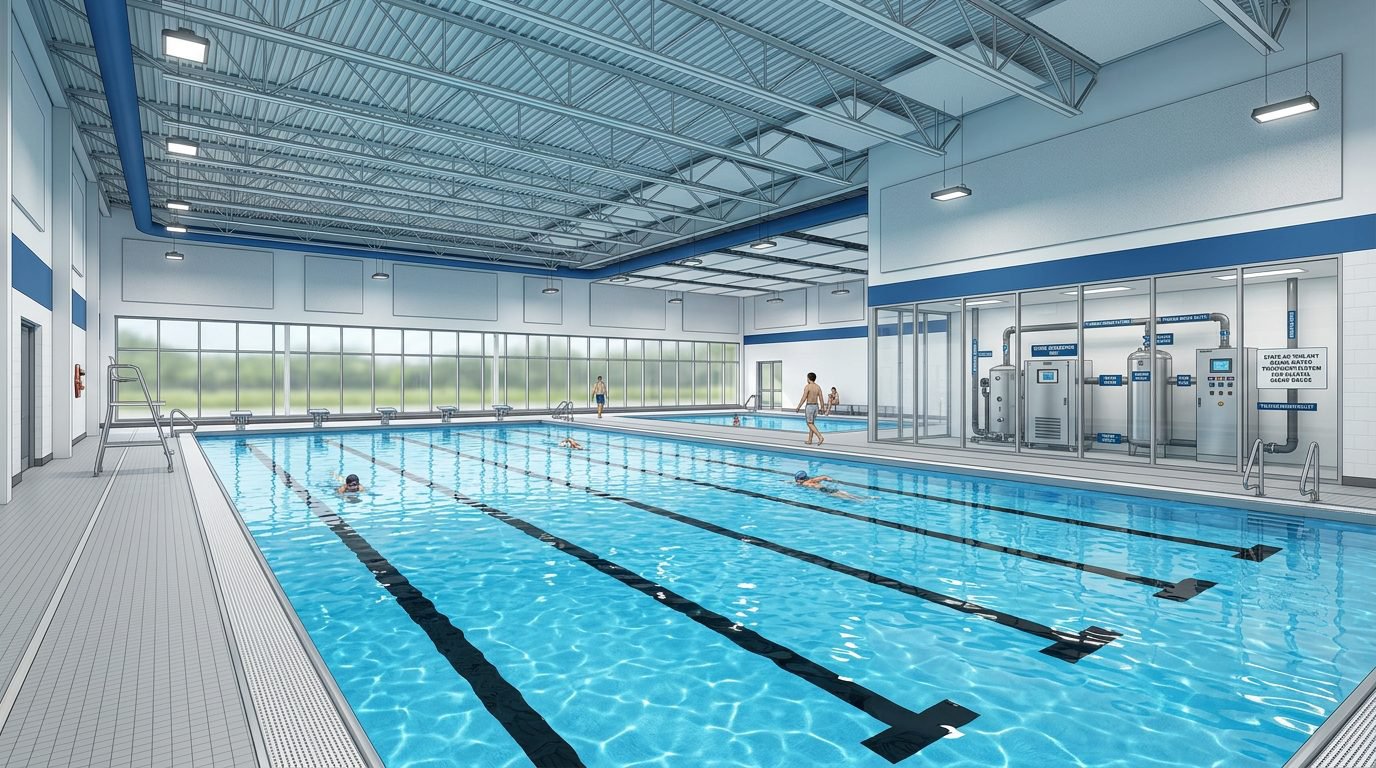
City-run pools serve diverse populations, from toddlers to senior citizens, and must meet strict health codes. Ozone is optional for a standard lap or leisure pool under the MAHC, but it is required as secondary treatment for any new or substantially altered wading pool or toddler area in the same facility. Many municipalities therefore put ozone on the children’s venue first and consider it for the main pool when chloramine complaints are frequent.
These facilities often run large filtration plants, so the ozone system usually treats a side-stream rather than the full flow. The MAHC allows secondary treatment to treat a portion (up to 100%) of the filtration flow, as long as the system is validated for the required log reduction.
Integration with existing sand or diatomaceous earth filters is straightforward: ozone is added downstream of the filter and heater, so the filter removes particles first and the ozone demand stays lower. The result is cleaner water and fewer odor problems for community members. For details on commercial pool systems, visit our commercial pool ozone system page.
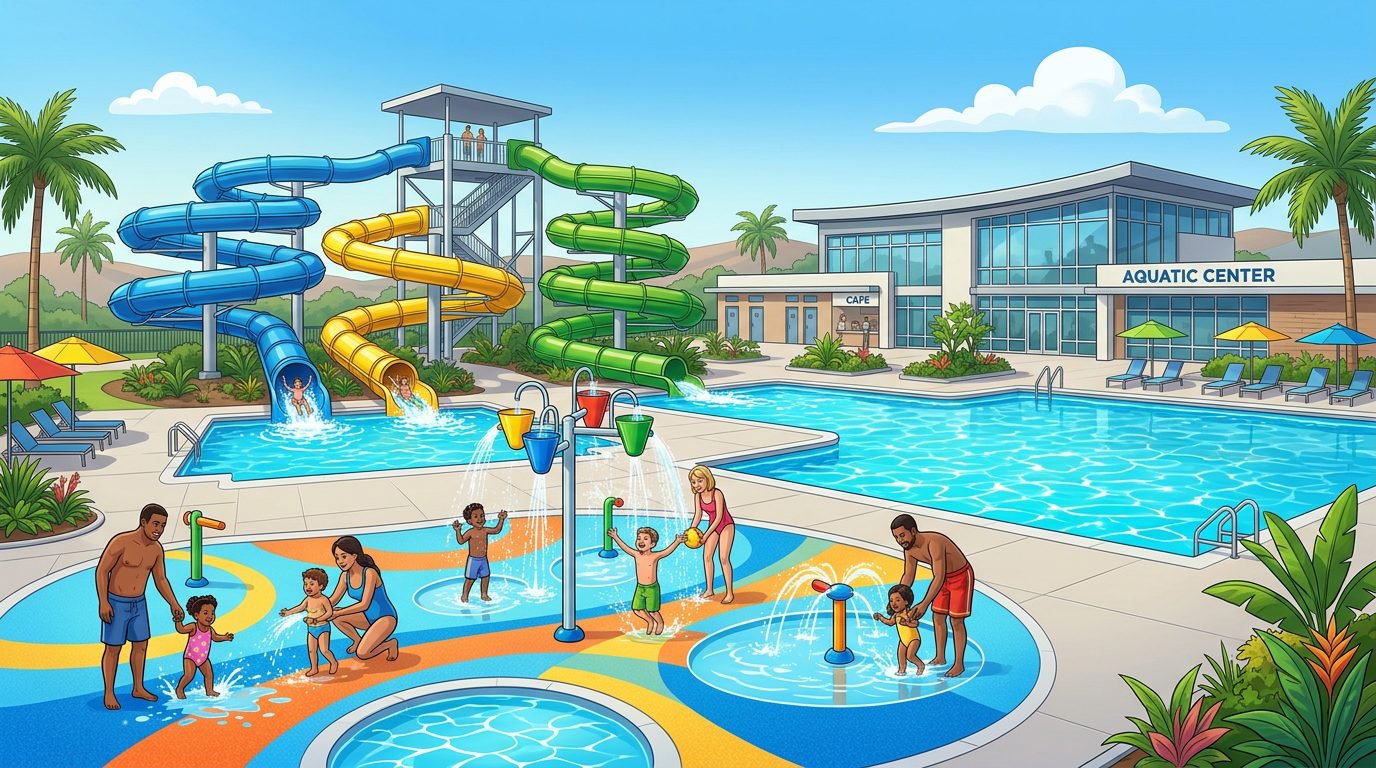
Water parks operate at high turnover rates, with rides and spray features that aerate water constantly. Off-gassing of chloramines is especially noticeable in indoor parks. Ozone’s oxidation of chloramine precursors helps keep that odor down.
Interactive water play venues with no standing water, the classic splash pad, are the strictest case in the 2024 MAHC: their secondary treatment must achieve a 3-log (99.9%) reduction of infective Cryptosporidium oocysts per pass, while other venues need a 2-log (99%) reduction. For an ozone system that means a CT value of 7.4 mg/L·min at 77°F for 3-log, versus 4.9 mg/L·min for 2-log, so the contact tank and generator are sized larger than for a typical pool.
Safety is paramount: the interlock must keep feature pumps or supply valves off when the ozone equipment fails to produce the required dose. High throughput, low odor, and Cryptosporidium protection make ozone a natural fit for these environments.
Swimming clubs and training centers want water that is clear and gentle on skin during long sessions. Ozone’s ability to keep chloramine levels down is a clear advantage for these venues, where swimmers spend hours a day breathing the air just above the water.
The air-space rule matters most here: the MAHC requires testing the air within 6 inches of the water surface at installation, after 24 hours of operation and annually, with results below 0.1 ppm by volume of gaseous ozone. Good degassing and destruct design are what keep that number low at the breathing zone of swimmers in lanes.
Coaches benefit from fewer shock-treatment closures when combined chlorine stays under control, which keeps training schedules steady. Performance, health, and operational efficiency all line up. For related reading, see how ozone reduces chloramine odors in indoor pools.
Accurate sizing begins with the design filtration flow rate (GPM), the total water volume, and the log reduction the venue needs. The key number is the CT value: dissolved ozone concentration (mg/L) multiplied by contact time (minutes). The 2024 MAHC sets 4.9 mg/L·min for 2-log and 7.4 mg/L·min for 3-log Cryptosporidium reduction at 77°F.
As a worked example of the arithmetic only: if a side-stream holds 0.5 mg/L of dissolved ozone, it needs about 9.8 minutes of contact for 2-log (4.9 ÷ 0.5) and about 14.8 minutes for 3-log (7.4 ÷ 0.5). At 100 gpm through the contact tank, that is roughly a 980-gallon or 1,480-gallon tank. Real systems are validated by the manufacturer, and the required reduction applies to the full flow after the side-stream remixes, so dilution has to be accounted for.
The MAHC also requires ozone concentration to be measured at a minimum of two sampling locations so the CT value achieved can be confirmed. Flow, dose, and contact time: getting all three right is what the validation report must show.
The 2024 Model Aquatic Health Code (5th edition) spells out what a complete ozone system includes (section 4.7.3.3.4.4):
Ozone equipment must be listed to NSF/ANSI 50 (4.7.3.3.4.12.1), installations must comply with the NFPA 1 Fire Code or the International Fire Code (4.7.3.3.4.8), and the system must ship with validation reports and a chart showing the operating parameters for which the required log inactivation is guaranteed. Performance curves without validation factors do not count as a validated system.
Documentation should list flow, dose, contact time, ORP setpoints and air test results. This file becomes part of the facility’s operating manual and audit trail, and the MAHC also requires a printed operating manual for the ozone equipment and training for all employees who run it.
The same ozone generator can be classed two ways. Installed and labeled as secondary treatment, it must meet every requirement in MAHC 4.7.3.3, including the log-inactivation validation. Installed on a venue that does not require secondary treatment, it can be labeled as supplemental treatment, which still has to meet the suitability, component, ORP, injection point, fire code and air testing rules (4.7.3.3.4.3 through 4.7.3.3.4.9) but not the Cryptosporidium log-reduction target.
Supplemental systems are a common choice for lap pools that want odor control without the full validation burden. If the facility shares one treatment system between a lap pool and a wading pool, though, the MAHC requires secondary treatment for every venue on that combined system.
Ask your designer which classification the system is labeled for before you buy, because the label decides which inspection checklist applies.
Most commercial pool plants already run sand, cartridge, or diatomaceous earth filters. Ozone is introduced after filtration and heating and before the primary disinfectant feed. A typical layout routes a side-stream through the injector and contact tank, then rejoins the main return line.
Electrical integration requires a dedicated circuit, an interlock with the venue pumps or feature valves, and automatic shutdown for any condition that would stop the system from reaching its required dose, such as low feed gas supply, loss of vacuum or pressure, high dew point in feed air, or water in the gas delivery line.
The MAHC also states that the injection and mixing system must not prevent the venue from reaching its required recirculation rate. Keeping the existing filtration train limits capital expense and downtime during installation.
| Cost factor | Ozone side-stream system | Chlorine-only system |
|---|---|---|
| Capital equipment | Higher: generator, feed gas prep, injector, contact tank, destruct, two monitors | Lower: chemical feeder and controller |
| Installation | Equipment room work, ventilation, interlocks, air testing | Feeder plumbing and controller wiring |
| Chlorine use | Still required at code minimums; demand can drop | Full oxidation and disinfection load |
| Energy | Generator, air prep and booster pump run continuously | Minimal |
| Maintenance | Generator service, ORP and ozone sensor calibration, destruct media | Feeder service, probe calibration |
| Compliance records | Validation report, ORP logs, annual air test | Chemical logs |
The upfront expense for a commercial ozone system covers the generator, feed gas preparation, injector, contact tank, degas and destruct, ORP and ambient ozone controllers, plus the equipment room itself. MAHC 4.9.2.10 adds room requirements: an ozone room cannot store other equipment beyond recirculation and ozone gear, needs emergency ventilation that starts on an ozone-leak alarm or a manual switch, and must carry a “DANGER – GASEOUS OXIDIZER – OZONE” sign on the door.
Installation effort grows with flow rate and with the log reduction required: a splash pad that needs 3-log treatment needs more contact volume than a lap pool fitted for supplemental odor control. Equipment, room work, and commissioning (including the startup and 24-hour air tests) define the total capital outlay.
Request quotes from at least three installers who can provide manufacturer validation reports for the exact model, and compare them on the same flow rate, CT target and classification.
Because ozone handles much of the oxidation work, chlorine demand typically falls. Pentair claimed its commercial ozone systems reduce chlorine consumption by up to 50 percent; treat manufacturer figures as best-case and measure your own baseline before and after. The code minimum free chlorine does not change: 1.0 ppm for pools without cyanuric acid, 2.0 ppm with it, and 3.0 ppm for spas (MAHC 5.7.3.1.1.2).
Savings depend on bather load, indoor vs outdoor use and how often the facility currently superchlorinates to fight combined chlorine. Fewer shock treatments also mean fewer closures and less staff time spent handling bulk chemicals.
Track chemical purchases, combined chlorine readings and odor complaints for a full season on each side of the installation to build an honest payback number.
Routine maintenance includes cleaning the injector, servicing the feed gas dryer, inspecting the destruct unit, and calibrating the ORP probe and ambient ozone sensor on the manufacturer’s schedule. The room’s ozone sensor must read 0 to 2 ppm and be mounted 18 to 24 inches above the floor, so check that its calibration records are current.
Energy use is continuous because the generator, air preparation and any booster pump run whenever the venue is open. Ask the manufacturer for rated power draw at your design output and multiply by your operating hours and local utility rate.
Over the system’s life, total cost of ownership depends on how much chlorine, shock treatment and water exchange it replaces. For venues where secondary treatment is mandatory, the comparison is ozone versus UV, not ozone versus nothing.
NSF/ANSI Standard 50 covers equipment for swimming pools, spas, hot tubs and other recreational water facilities. The MAHC requires secondary treatment to be certified, listed and labeled to NSF/ANSI 50 by an ANSI-accredited certification organization, or approved by the authority having jurisdiction with engineering justification.
The PHTA also notes that an ozone system is considered a pesticidal device under the US EPA Federal Insecticide, Fungicide, and Rodenticide Act (FIFRA) and carries an EPA establishment number. Check both the NSF listing and the establishment number on the data plate before accepting delivery.
Selecting a listed product simplifies the permitting process and shows inspectors the system meets a national standard. For a broader view, read our ozone water treatment guide.
OSHA sets the permissible exposure limit (PEL) for ozone at 0.1 ppm as an 8-hour time-weighted average. The MAHC builds on that: the equipment room alarm must trigger when ozone in the room air reaches 0.1 ppm by volume, and activation must shut off the ozone generator and turn on emergency ventilation.
The alarm must be audible and visible, with an indicator in plain view of the room entrance. The emergency ventilation switch must be outside the room near the door, so staff never have to walk into a leak to clear it.
Below-grade ozone rooms need forced-draft ventilation that runs whenever the ozone equipment runs, for at least 15 air changes after it stops, and whenever the ozone alarm activates.
The EPA regulates ozone generators sold for water treatment as pesticidal devices, and EPA drinking water guidance is where much of the CT approach comes from. The CDC’s Model Aquatic Health Code provides the model framework for commercial pool design and operation, which states and localities can adopt in full, in part or not at all.
State and local health departments decide what applies to your facility, so confirm which MAHC edition (if any) your jurisdiction has adopted before finalizing a design. Keep ORP logs, chlorine logs and air test results ready for inspection.
By lining up federal guidance, the MAHC and the local code, facilities avoid failed inspections and keep public trust. A well-documented ozone system makes that conversation short.
No. Ozone handles oxidation and kills pathogens in the side-stream, but a chlorine or bromine residual is still required in the pool. The 2024 MAHC states that using ozone does not change any other water quality requirement, so pools without cyanuric acid still need at least 1.0 ppm free chlorine and spas at least 3.0 ppm.
It depends on design flow, the log reduction required (2-log or 3-log), whether the system is secondary or supplemental, and how much equipment room work is needed. Get quotes from installers who can supply validation reports for the exact model, and compare them on the same CT target, then factor in continuous energy use and sensor calibration.
When the system meets the MAHC, residual ozone in the pool stays below 0.1 ppm and the air within 6 inches of the water must test below 0.1 ppm by volume at startup, after 24 hours and annually. Proper degassing and destruct design keep ozone in the equipment room, while swimmers benefit from lower chloramine levels.
The 2024 MAHC requires secondary treatment for new construction or substantial alteration of increased risk venues: wading pools, interactive water play venues with no standing water, other venues designed mainly for children under 5, and therapy pools. Ozone or UV can be used. Other pools may install it as an option.
Follow the manufacturer’s schedule for generator service, feed gas dryer upkeep, injector cleaning, destruct inspection and calibration of the ORP probe and ambient ozone sensors. Keep calibration records, the annual air-space test results and a printed operating manual onsite, and train every employee who runs the equipment.
Not long. Dissolved ozone reacts quickly with organic matter and decays, which is why it works best in a contact tank before the water returns to the pool. The MAHC requires residual ozone in the pool to stay below 0.1 ppm, and continuous ORP monitoring confirms the loop is still dosing.
Yes. Ozone is capable of killing all known microorganisms, including Cryptosporidium and Giardia, according to the PHTA. The MAHC sets the dose: a CT value of 4.9 mg/L·min for 2-log (99%) Cryptosporidium reduction and 7.4 mg/L·min for 3-log (99.9%) at 77°F, which is why validated contact time matters more than generator size alone.
The Delozone Editorial Team researches water treatment, pool and spa, and indoor air products for independent buying guides. We compare products using manufacturer specifications, certification listings such as NSF/ANSI, UL, AHAM and Energy Star, published third-party test data and verified owner feedback. We do not sell products, and affiliate commissions never decide what we recommend.