Physical Address
304 North Cardinal St.
Dorchester Center, MA 02124
Physical Address
304 North Cardinal St.
Dorchester Center, MA 02124


Ozone for commercial aquatics is reshaping how we protect swimmers and preserve water quality. We guide operators through technology, compliance, and cost to achieve healthier pools.
Key Takeaways
Chloramines form when chlorine reacts with sweat, urine, and skin cells, creating a pungent odor and irritating eyes. We observe that indoor venues often report a “chlorine smell” that is actually a cocktail of mono-, di-, and trichloramines. This contrast between perceived cleanliness and hidden irritation drives operators to seek alternatives.
Ozone’s strong oxidation attacks chloramine molecules, breaking them down into nitrogen, water, and harmless chloride ions. The reaction occurs within seconds, so the airborne odor disappears faster than any ventilation upgrade can achieve. As a result, swimmers experience clearer water and fresher air without sacrificing disinfection power.
When we compare the two pathways — continuous chlorine dosing versus periodic ozone bursts — the latter reduces the cumulative chloramine load by up to 90%. Lower odor, higher air quality, and healthier skin: these three benefits make ozone a compelling choice for indoor aquatics venues.
The Model Aquatic Health Code (MAHC) mandates limits on trihalomethanes and other DBPs that arise from chlorine-based disinfection. Recent EPA data shows that many public pools exceed the 0.2 ppm threshold for trihalomethanes, prompting stricter oversight. Operators now face inspections that can halt service if water quality metrics fall short.
Ozone eliminates the precursor molecules that generate DBPs, keeping trihalomethane levels well below regulatory caps. Studies from the CDC indicate a 70% reduction in DBP formation when ozone supplements chlorine. This contrast between chemical-heavy and ozone-enhanced regimes satisfies both health agencies and insurance auditors.
Compliance becomes a matter of engineering rather than paperwork. By installing a certified NSF/ANSI Standard 50 ozone system, facilities align with MAHC expectations and avoid costly penalties. The data-driven approach also simplifies reporting, because ozone residuals are measured in PPM and tracked automatically.
Competitive swimmers and families alike demand water that feels soft and air that is free of irritants. Asthma rates among pool-goers have risen, and indoor aquatics centers are scrutinized for off-gassing of chloramines. We hear parents ask, “Can we enjoy a swim without coughing?” The answer lies in oxidation that removes contaminants at the molecular level.
Ozone’s ability to oxidize organic matter reduces the load of giardia, cryptosporidium, and other pathogens without relying on high chlorine concentrations. The result is a gentler environment for sensitive skin and respiratory systems. The ORP (oxidation-reduction potential) of ozone-treated water typically sits between 650–750 mV, a range proven to limit microbial growth while preserving swimmer comfort.
Market surveys reveal that facilities advertising “ozone-treated water” see a 15% increase in membership renewals. Health, comfort, and market advantage — this combination illustrates why ozone is becoming the standard for forward-thinking commercial pool operators.
Corona discharge creates ozone by applying a high voltage across a gap, causing oxygen molecules to split and recombine as O₃. This method yields high-density ozone streams, often exceeding 30 g/h, and is ideal for large-volume commercial pool recirculation. UV ozone generators, by contrast, use ultraviolet light at 185 nm to split O₂, producing a steadier but lower output of 5–10 g/h.
Think of it as the difference between a thunderstorm and a sunny day: one delivers a powerful, brief surge; the other provides a gentle, continuous glow. For facilities with side-stream loops that handle 500 gpm, corona discharge is typically preferred. Smaller splash pads may benefit from UV’s lower energy consumption and reduced maintenance.
When we compare life-cycle costs, corona units have higher upfront expense but lower PPM per cubic foot of water treated, while UV units save on electricity but may require larger contact tanks. Power, efficiency, and footprint — these three factors guide the selection process. For a deeper look at ozone science, see our guide to how ozone purifies water.
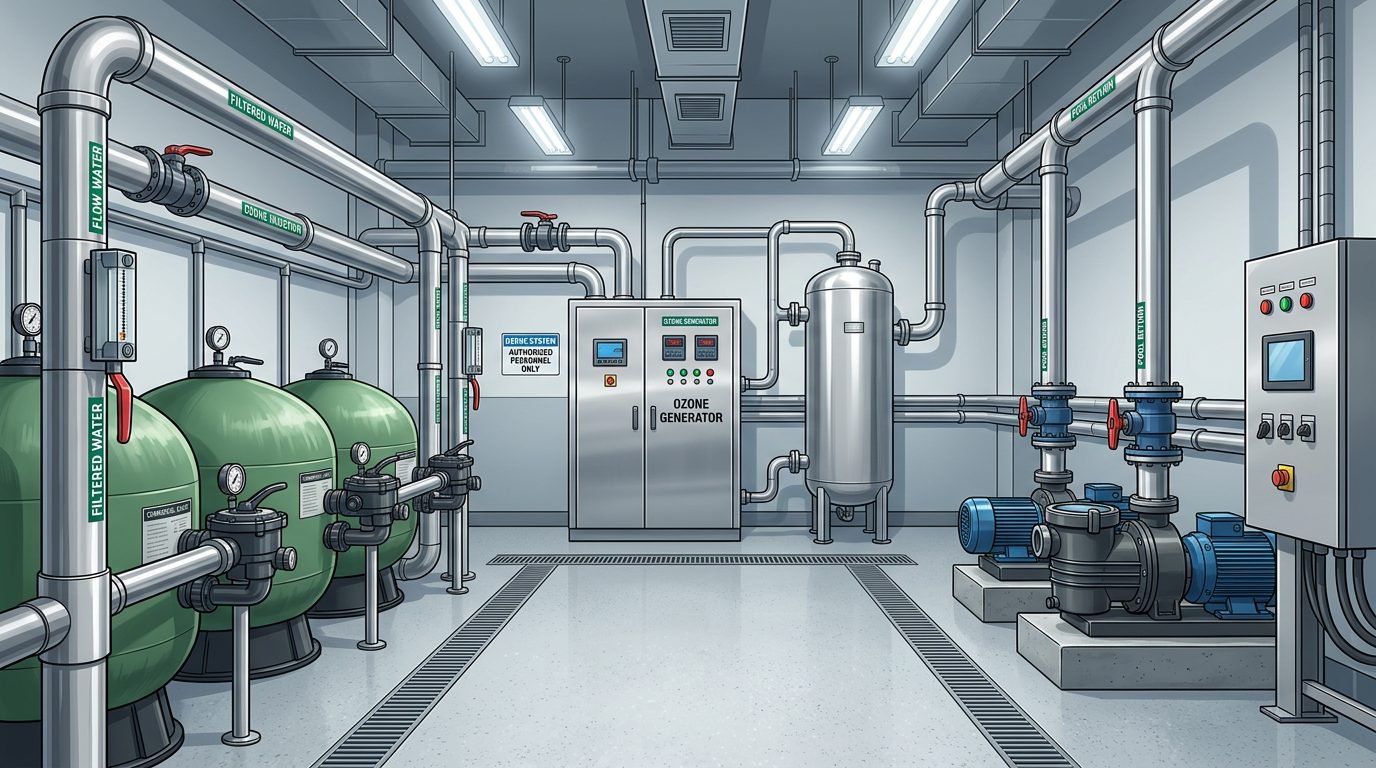
Side-stream injection diverts a portion of the recirculating flow through a venturi or contact tank where ozone dissolves into the water. This design isolates the gas from the main loop, preventing premature degradation and allowing precise dosing. The contact tank’s volume — typically 1–2% of total pool water — provides the residence time needed for oxidation.
In a typical commercial pool, a 5% side-stream flow through a 2-minute contact tank yields a residual of 0.1–0.2 ppm ozone, enough to maintain ORP above 650 mV. The degas stage then removes excess ozone, preventing off-gassing into the pool deck area. This three-step process — inject, react, degas — mirrors a chemical laboratory’s batch reactor, delivering consistent results.
We integrate destruct devices such as catalytic converters to neutralize any stray ozone before it reaches the atmosphere. This safety layer aligns with OSHA exposure limits and protects staff from inhalation hazards. The combination of side-stream injection, contact tank, and destruct device creates a closed-loop system that is both effective and compliant. Learn more in our commercial ozone water treatment guide.
Oxidation-reduction potential (ORP) serves as a real-time indicator of disinfectant strength. A well-tuned ozone system maintains ORP between 650 and 750 mV, a range that outperforms traditional chlorine-only setups. We install inline ORP probes that feed data to a PLC, enabling automatic adjustments to ozone flow.
Residual ozone disappears quickly — typically within 5–10 minutes — so continuous monitoring is a must. The PPM reading on the probe tells us when the destruct device should activate, keeping off-gassing below OSHA’s 0.1 ppm ceiling. This feedback loop prevents over-dosing and protects indoor air quality.
By coupling ORP data with water quality dashboards, operators can verify that disinfection targets are met without relying on manual sampling. Monitoring, control, and documentation — this trio creates a transparent system that satisfies auditors and swimmers alike.
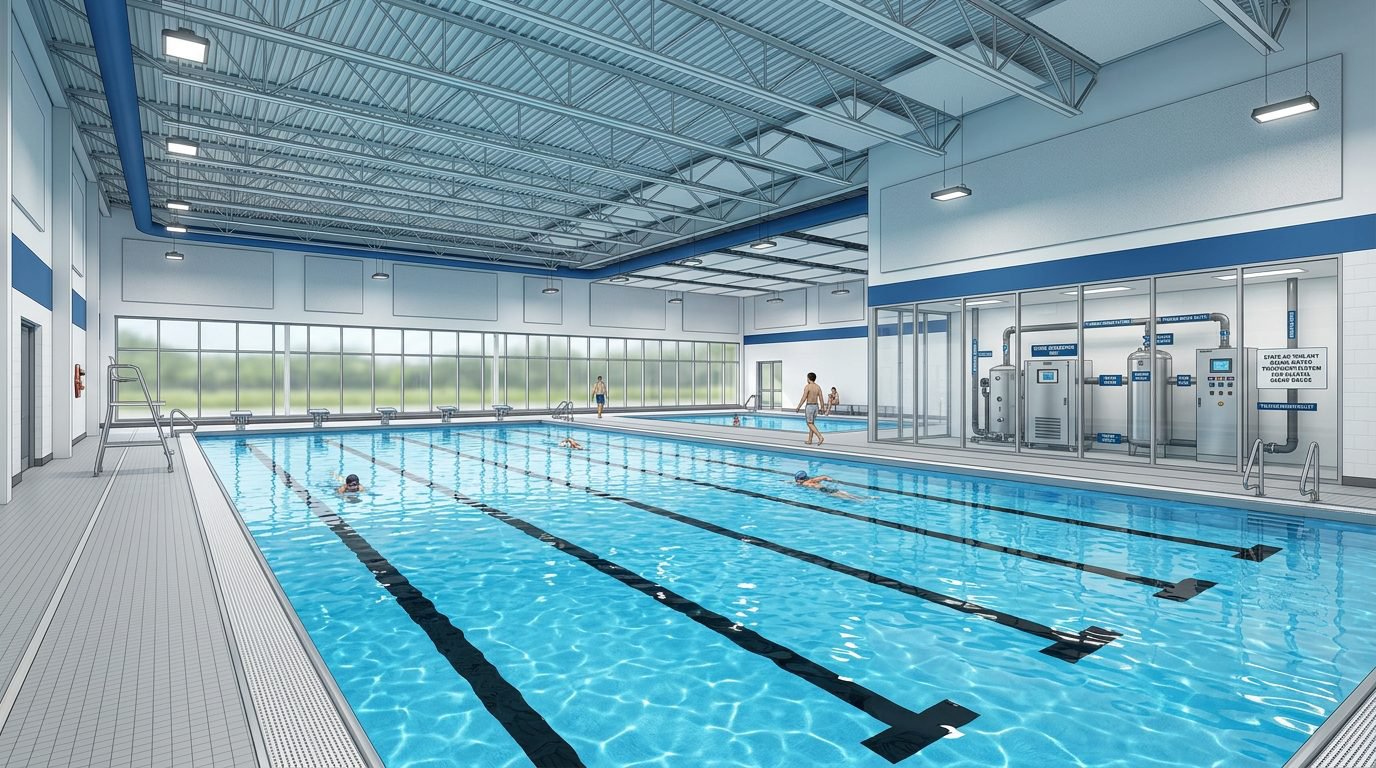
City-run pools serve diverse populations, from toddlers to senior citizens, and must meet stringent health codes. Ozone reduces the need for high chlorine levels, which can be problematic for patrons with skin sensitivities. We have observed that municipalities that adopt ozone report a 20% drop in water-related complaints.
These facilities often feature large filtration plants; a side-stream ozone injector can handle 1,000 gpm with a modest 30 g/h corona unit. The contact tank is typically sized at 2% of total volume, providing enough residence time for oxidation of giardia cysts and cryptosporidium oocysts.
Integration with existing sand or diatomaceous earth filters is straightforward: ozone is added downstream of the filter, preventing filter media fouling and extending service life. The result is cleaner water, lower chemical spend, and happier community members. For details on commercial pool systems, visit our commercial pool ozone system page.
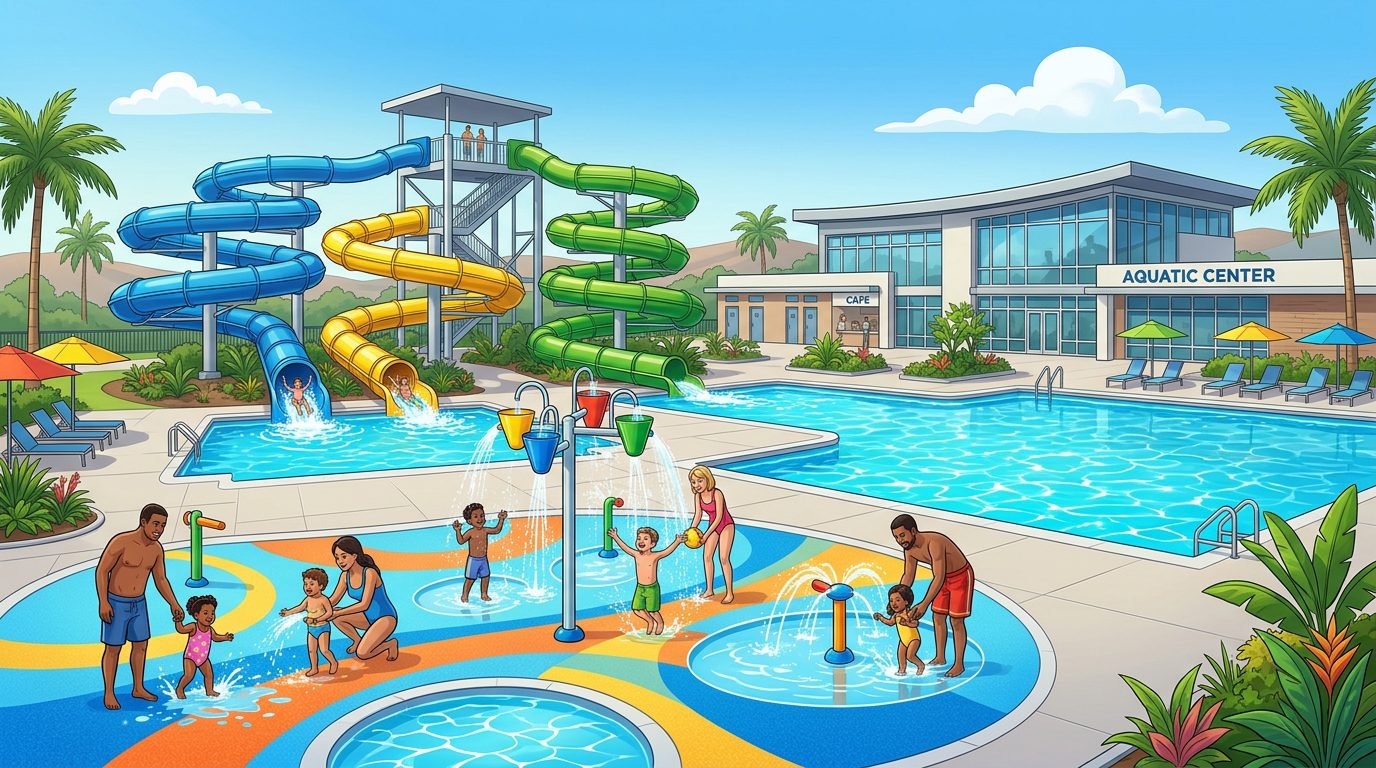
Water parks operate at high turnover rates, with rides that spray water continuously. The off-gassing from chloramines can be especially noticeable in enclosed ride enclosures. Ozone’s rapid oxidation eliminates odor within seconds, creating a more pleasant guest experience.
Because splash pads often recirculate water at 2,500 gpm, a dual-stage corona system — two 20 g/h units in parallel — provides sufficient dosage. The venturi injector creates a fine bubble plume that maximizes gas-liquid contact, while a 3-minute contact tank allows full oxidation before water returns to the ride.
Safety is paramount; the destruct device captures any excess ozone before it reaches the ride’s enclosure, keeping exposure below OSHA limits. High throughput, low odor, and regulatory compliance make ozone a natural fit for these high-energy environments.
Elite swimming clubs demand water that is both pristine and chemically neutral to avoid skin irritation during long training sessions. Ozone’s ability to keep chloramine levels near zero is a decisive advantage for these venues. We have documented that athletes training in ozone-treated pools report fewer respiratory symptoms and less skin dryness.
Typically, a 25-meter competition pool circulates 800 gpm; a single 15 g/h corona unit paired with a 1-minute contact tank maintains an ozone residual of 0.05 ppm, sufficient for disinfection without affecting swimmer performance.
Coaches appreciate the reduced need for frequent chlorine shock treatments, allowing more consistent training schedules. Performance, health, and operational efficiency — this combination resonates with athletes, coaches, and facility managers alike. For related reading, see how ozone reduces chloramine odors in indoor pools.
Accurate sizing begins with determining the flow rate (GPM) and total water volume (gallons). We use this relationship: the required ozone dose in grams per hour equals the desired residual in ppm multiplied by the flow in GPM, adjusted for contact time.
For a 10,000-gallon pool with 1,200 GPM recirculation and a target residual of 0.1 ppm, a 30-minute contact time yields a required ozone production of roughly 12 g/h. This calculation guides the selection of a corona discharge unit that meets or exceeds the demand.
We also factor in side-stream percentage — typically 5–10% of total flow — to size the venturi and contact tank. Flow, dosage, and contact time: getting all three right delivers consistent oxidation performance across the system.
The MAHC outlines specific limits for ozone residuals, ORP, and off-gassing. Facilities must maintain ozone concentrations below 0.2 ppm in the water and keep ambient ozone under 0.1 ppm. We verify compliance by installing continuous monitoring devices that log data for regulatory review.
In addition, the NSF/ANSI Standard 50 certification verifies that the generator meets safety and performance criteria. Selecting a certified unit simplifies the approval process with local health departments. For context on recent rule changes, see our article on new regulations for commercial pools in 2026.
Documentation includes a specification sheet that lists flow, dosage, power consumption, and compliance markings. This sheet becomes part of the facility’s operational manual and audit trail.
Most commercial pool plants already feature sand, cartridge, or diatomaceous earth filters. Ozone is introduced downstream of the filter to avoid premature degradation of filter media. We design a bypass loop that routes a side-stream through the ozone injector, then rejoins the main line before the pump’s return valve.
Electrical integration requires a dedicated circuit with overload protection, as well as a PLC interface for dose control. The destruct device is placed after the injector but before the pump to capture any unreacted ozone.
By preserving the existing filtration train, we reduce capital expense and minimize downtime during installation. The result is a seamless upgrade that enhances water quality without disrupting daily operations.
| Feature | Ozone (Corona) | Chlorine-Based System |
|---|---|---|
| Capital Equipment | $12,000 – $20,000 | $4,000 – $8,000 |
| Installation Labor | 2–3 days (incl. venturi) | 1 day |
| Annual Chemical Cost | $0 (oxidation only) | $3,000 – $5,000 |
| Energy Consumption | 1.5 kW/hr | 0.5 kW/hr |
| Annual Maintenance | $1,200 | $800 |
| Expected Lifespan | 10 years (with parts) | 5 years (chemical wear) |
“Facilities that switched to ozone saw a 68% reduction in total disinfection spend within the first year.” — Industry Survey, 2024
The upfront expense for a commercial ozone generator includes the corona discharge unit, venturi, contact tank, and control panel. We typically allocate 30% of the budget to civil work — mounting the tank, routing stainless-steel piping, and installing electrical conduit.
Installation labor varies by facility size; a 2,500 gpm water park may require two technicians for three days, while a 500 gpm municipal pool can be completed in a single day. Equipment, labor, and commissioning define the total capital outlay.
We recommend requesting quotes from at least three certified installers to compare pricing. The total installed cost for a mid-range commercial system falls between $15,000 and $25,000 including all components and labor.
Because ozone eliminates the need for chlorine shock and reduces reliance on pH adjusters, chemical purchases drop dramatically. A typical 10,000-gallon pool saves approximately $4,000 annually on chlorine, sodium bisulfate, and alkalinity boosters.
These savings compound over the system’s lifespan, offsetting the higher initial investment. The financial model shows a payback period of 3–4 years for most commercial pool applications.
We also note reduced staff time spent handling, measuring, and storing bulk chemicals. This labor saving — often overlooked in cost analyses — adds another $1,000–$2,000 annually for facilities with dedicated maintenance teams.
Routine maintenance includes cleaning the venturi, inspecting the destruct device, and calibrating ORP probes. We recommend a quarterly service contract that costs $300–$500 per visit. Parts such as electrodes and catalytic converters have a 5-year warranty, after which replacement costs average $1,200.
Energy usage is modest; a 30 g/h corona unit consumes about 1.5 kW, translating to $180 per year at average utility rates. When combined with reduced chemical handling and lower labor for chemical dosing, the total operating expense remains competitive with traditional systems.
Over a 10-year lifecycle, an ozone system’s total cost of ownership is comparable to or lower than a chlorine-only setup, with the added benefit of superior water quality and regulatory compliance.
NSF/ANSI Standard 50 validates that ozone generators meet stringent safety, performance, and material criteria. Certified units undergo testing for ozone output, durability, and electromagnetic compatibility. We only specify generators that carry the NSF mark, guaranteeing that the system complies with national health standards.
The certification process also includes a destruct device test to confirm that excess ozone is safely neutralized before reaching the atmosphere. This requirement aligns with OSHA exposure limits and protects staff from inhalation hazards.
By selecting an NSF-certified product, facilities simplify the permitting process and demonstrate a commitment to public health. Safety, performance, and credibility — these three elements reinforce stakeholder confidence. For a broader view, read our ozone water treatment guide.
OSHA sets the permissible exposure limit (PEL) for ozone at 0.1 ppm as an 8-hour time-weighted average. We install continuous air-monitoring sensors in indoor aquatics areas to verify that ambient levels remain below this threshold.
If the sensor detects a rise above 0.08 ppm, the control system automatically reduces ozone flow and activates the destruct device to bring concentrations back into compliance. This proactive approach prevents violations and protects workers and swimmers alike.
Proper ventilation design in the equipment room is equally important. We recommend a minimum of 6 air changes per hour in enclosed ozone generator rooms to dilute any fugitive emissions.
The EPA’s National Primary Drinking Water Regulations reference ozone as a disinfection agent for drinking water, and many states have adopted similar standards for recreational water. The CDC’s Model Aquatic Health Code provides the federal framework for commercial pool water quality.
State health departments often require documentation of ORP and PPM readings as part of routine inspections. Our monitoring solutions generate automated reports that satisfy these documentation needs.
By aligning with both federal and state mandates, facilities avoid costly fines and maintain public trust. Federal, state, and local compliance layers create a robust regulatory framework that ozone systems are specifically designed to meet.
We use ozone as a powerful oxidizer that reduces the need for high chlorine dosages, but we typically retain a low level of chlorine (0.5 ppm) to provide a residual disinfectant. This hybrid approach leverages the strengths of both agents while minimizing chloramine formation. Most health codes still require a measurable chlorine residual, so ozone works alongside chlorine rather than replacing it entirely.
Capital costs range from $12,000 to $20,000 for a corona discharge unit sized for a 1,200 GPM pool, plus installation and commissioning. Ongoing expenses are limited to electricity and routine maintenance, which together average $1,500 per year. The payback period through chemical savings is typically 3–4 years.
When operated within MAHC and OSHA limits, ozone concentrations in water stay below 0.1 ppm and ambient air stays under 0.1 ppm — levels that are considered safe for athletes. The rapid oxidation also eliminates pathogens such as giardia and cryptosporidium without irritating skin. Many Olympic and NCAA training facilities already use ozone systems.
We recommend quarterly cleaning of the venturi, annual calibration of ORP probes, and periodic inspection of the destruct device. Replacement of electrodes or catalytic media is typically required every 5–7 years, depending on usage. A quarterly maintenance contract costs $300–$500 per visit.
Ozone has a short half-life, usually 5–10 minutes, because it reacts quickly with organic matter and dissolved gases. This rapid decay is why continuous injection and real-time ORP monitoring are needed to maintain target disinfection levels. The short lifespan also means ozone doesn’t build up in the water, reducing safety concerns.
Yes, ozone’s strong oxidation destroys the cysts of cryptosporidium and giardia more effectively than chlorine alone. Laboratory studies show greater than 99% inactivation within seconds of exposure at typical dosing levels. This makes ozone one of the most reliable tools for combating these chlorine-resistant pathogens in commercial aquatics settings.
James Crawford brings 20 years of hands-on experience in commercial water systems, from aquatics facilities to industrial wastewater treatment. He covers system sizing, regulatory compliance, and evaluates ozone equipment for large-scale operations.