Independent buying guides for home air, water and safety.
As an Amazon Associate, Delozone earns from qualifying purchases.
Independent buying guides for home air, water and safety.
As an Amazon Associate, Delozone earns from qualifying purchases.

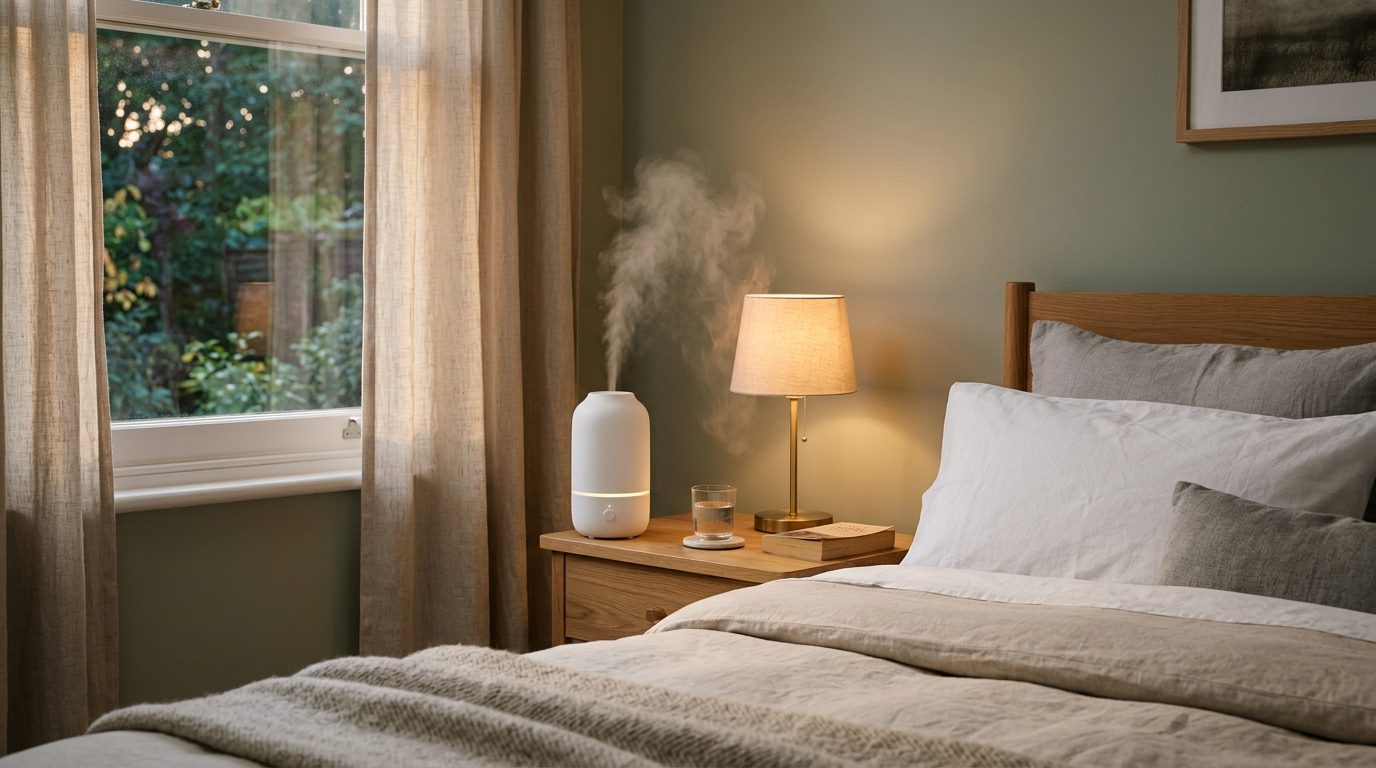
The best humidifiers for bedrooms in 2026: quiet ultrasonic, evaporative and warm mist picks, plus EPA and Mayo Clinic advice on humidity levels and cleaning.

Affiliate disclosure: As an Amazon Associate, Delozone earns from qualifying purchases. Some links on this page are affiliate links, so we may earn a commission at no extra cost to you. Our picks are based on published specifications, EPA and Mayo Clinic guidance and verified owner feedback. We did not run our own lab tests, and commissions never decide what we recommend.
The best humidifier for a bedroom is quiet enough to sleep beside, holds enough water to run all night, lets you set a target humidity so the room stays between 30% and 50%, and is easy to empty and clean, and our top pick is the Levoit Classic 300S, a 6-liter top-fill ultrasonic humidifier with a humidity sensor, auto mode and up to 60 hours of runtime for rooms up to 505 sq ft. If white dust from tap water bothers you, or you want the lowest risk of spraying minerals into the air, an evaporative model such as the Honeywell HCM-350B or the Vornado EV100 is the better choice.
Top picks at a glance
Key takeaways
Quick comparison: best humidifiers for bedrooms in 2026
| Model | Type | Tank | Coverage (maker) | Runtime (maker) | Best for | Buy |
|---|---|---|---|---|---|---|
| Levoit Classic 300S | Ultrasonic cool mist | 6 L | 505 sq ft | Up to 60 h | Most bedrooms | Check price |
| Honeywell HCM-350B | Evaporative | 1.1 gal | Medium rooms | Up to 24 h | No white dust | Check price |
| Vornado EV100 | Evaporative | 1 gal | 260 sq ft | About 24 h | Precise humidity settings | Check price |
| Levoit LV600HH | Ultrasonic, warm or cool | 6 L | 753 sq ft | Up to 50 h | Large bedrooms, winter | Check price |
| Levoit Dual 200S | Ultrasonic cool mist | 3 L | 290 sq ft | Up to 25 h | Small bedrooms, smart control | Check price |
| Dreo 3L (DR-HHM006) | Ultrasonic cool mist | 3 L | 300 sq ft | Up to 30 h | Light sleepers | Check price |
| Pure Enrichment MistAire | Ultrasonic cool mist | 1.5 L | 250 sq ft | Up to 25 h | Budget, small rooms | Check price |
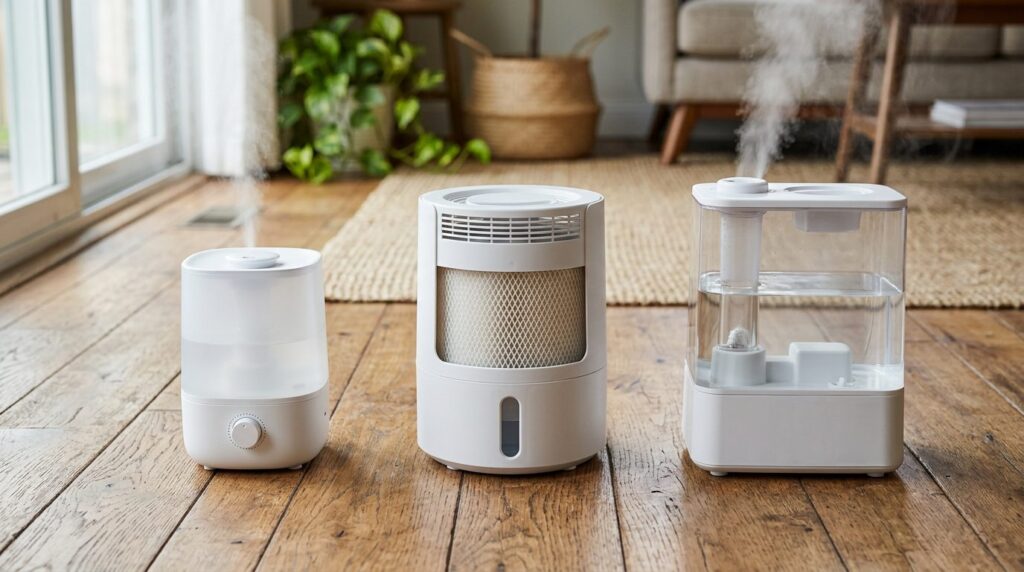
Ultrasonic humidifiers use a vibrating plate to turn water into a fine, visible mist. They are the most common bedroom humidifiers because they are quiet, energy efficient and inexpensive, and they need no filter. All of the Levoit, Dreo and Pure Enrichment models on our list are ultrasonic.
The trade-off is what they put in the air along with the water. In its Indoor Air Facts No. 8 on home humidifiers, the EPA’s guide to the use and care of home humidifiers reports that ultrasonic and impeller humidifiers can disperse materials such as microorganisms and minerals from their tanks into indoor air, and that they are very efficient at dispersing the minerals in tap water. That is the “white dust” that settles on furniture.
The fix is simple: use distilled water, which the EPA recommends because distillation is the most effective way to remove minerals, and clean the tank often. With those habits, an ultrasonic humidifier is a quiet, practical bedroom choice.
Evaporative humidifiers use a fan to blow air through a wet wick or filter. The moisture enters the air invisibly, and the wick traps minerals, so there is no white dust. The EPA notes that evaporative and steam humidifiers generally disperse less, if any, of these pollutants into the air than ultrasonic and impeller models.
Evaporative humidifiers are also self-limiting: as the air gets more humid, less water evaporates, which makes it harder to over-humidify a room. The Honeywell HCM-350B and Vornado EV100 on our list are both evaporative.
The downsides are fan noise, which some people like as white noise and others do not, and wicks that need replacing. Wicks cost money and must be kept clean, because a dirty, crusted wick loses output and can grow mold.
Warm mist humidifiers heat water to create steam, which is cooled slightly before it leaves the machine. Boiling kills many microorganisms, and the EPA says a steam vaporizer it tested did not disperse measurable amounts of minerals. The Levoit LV600HH offers both warm and cool mist.
The risk is burns. Mayo Clinic advises against buying a steam vaporizer if you have children, because the hot water inside can cause burns if spilled, and the EPA says to keep steam vaporizers out of the reach of children. Warm mist models also use far more electricity: the LV600HH is listed at 280 W on warm mist, while cool mist ultrasonic models run at around 12 to 26 W.
Mayo Clinic also notes that cool-mist humidifiers may ease a stuffy nose during a cold, while heated humidified air does not seem to have the same effect. For most bedrooms, cool mist is the practical default, and warm mist is a personal comfort choice for adults in cold climates.
A bedroom humidifier needs to run through the night without running dry. Tank capacity and output decide that: a 3-liter tank at a moderate setting typically lasts a full night, while a 6-liter tank lasts two or more nights. Manufacturers quote maximum runtimes at the lowest setting, such as 60 hours for the Levoit Classic 300S.
Bigger is not always better. The EPA recommends emptying the tank and refilling with fresh water daily, so a huge tank mostly means more water to pour out. Match the tank to your room and routine rather than buying the largest available.
Top-fill designs, used on most of our picks, let you pour water in from above without flipping the tank, which makes daily refills and cleaning easier and reduces the temptation to leave old water standing.
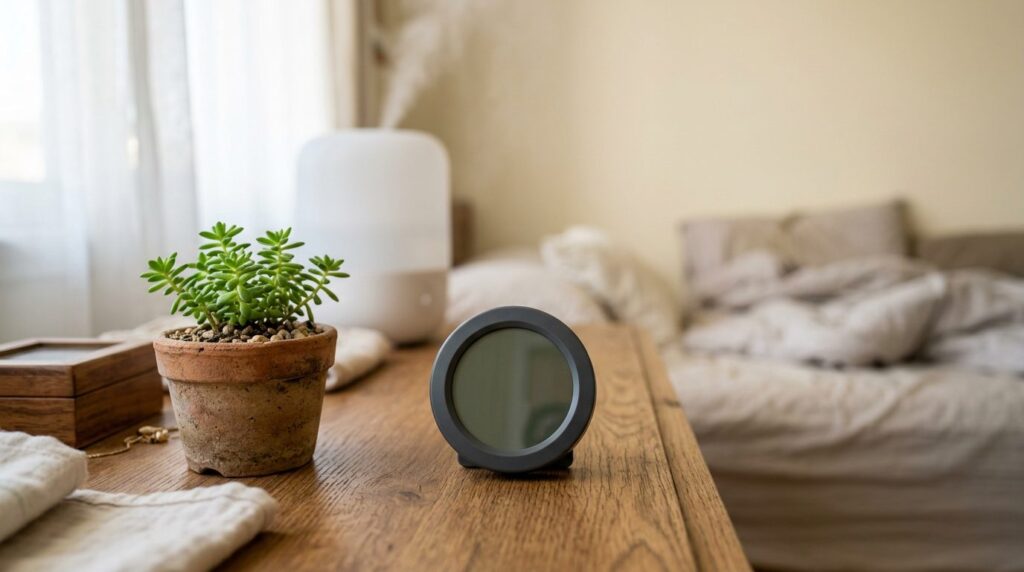
Mayo Clinic recommends measuring humidity with a hygrometer and suggests choosing a humidifier with a built-in humidistat, which keeps humidity within a healthy range. Auto mode on models like the Levoit Classic 300S and Dual 200S uses that sensor to slow or stop the mist once the room reaches your target.
Built-in sensors sit close to the mist outlet and can read higher or lower than the rest of the room. A separate hygrometer across the room is a cheap way to check. If the two disagree, trust the one away from the humidifier.
Set the target within the 30% to 50% range Mayo Clinic recommends. Some manufacturers suggest 40% to 60%, but the EPA advises not humidifying above 50%, and in cold weather even 40% can cause condensation on windows.
All 7 picks were in stock on Amazon with a working buy box when we checked in September 2026. We chose them on noise, tank size and runtime, humidity control, how easy they are to clean, water and mineral handling, and the pattern of verified owner feedback from bedroom and nursery use.
Several popular models, including the Levoit OasisMist 450S, the Dreo HM311 and the Vicks V745 warm mist humidifier, had no working Amazon buy box when we checked, so they are not on the list.
The Levoit Classic 300S is an ultrasonic cool mist humidifier with a 6-liter top-fill tank. Levoit rates it for rooms up to 505 sq ft with up to 60 hours of runtime, which covers even a large primary bedroom for more than two nights between refills at low output.
Its built-in sensor drives an auto mode that adjusts mist output to hold your target humidity, and the VeSync app adds schedules, timers and remote control, with Alexa and Google Assistant support. Levoit also offers Sleep Mode and a Plant Mode, and the top-fill design has no hard-to-clean corners, which matters for the EPA’s every-third-day cleaning routine.
Levoit recommends distilled or purified water, and a replacement filter is available to help reduce minerals. Like any ultrasonic model, it will leave white dust with hard tap water, so plan to use distilled water in the bedroom. For most people, it is the best balance of capacity, control and quiet we found.
Check Levoit Classic 300S price on Amazon
The Honeywell HCM-350B is an evaporative humidifier that adds invisible moisture without white dust. Honeywell says it uses UV technology and a wicking filter to help treat the water and capture minerals for cleaner output, and its 1.1-gallon tank runs up to 24 hours.
All parts that touch water can go in the dishwasher, according to Honeywell, which makes it one of the easiest humidifiers to keep clean. The fan produces a soft, steady sound that Honeywell describes as restful, which many people use as white noise at night.
Honeywell recommends using only its genuine replacement wicking filter A for best performance, so budget for wicks. For households with hard water, allergy sufferers who want to avoid minerals in the air, or anyone tired of wiping white dust off the nightstand, it is our pick.
Check Honeywell HCM-350B price on Amazon
The Vornado EV100 is an evaporative humidifier with an electronic humidistat that lets you choose 6 humidity levels from 40% to 60%, or continuous output, plus 3 fan speeds. Vornado rates it for bedrooms and living rooms up to 260 sq ft with a 1-gallon tank.
Its antimicrobial-treated wick eliminates white dust and visible mist, according to Vornado, and the SimpleTank design has a carrying handle and removable cap for easy filling and cleaning. Vornado offers a 5-year replacement guarantee.
Set it at the 40% level in most bedrooms to stay within Mayo Clinic’s 30% to 50% range, since the lowest setting is already 40%. If your room is small and you want a no-dust evaporative unit with a real humidistat, it is a strong alternative to the Honeywell.
Check Vornado EV100 price on Amazon
The Levoit LV600HH offers both warm and cool mist from a 6-liter tank, with up to 500 mL per hour of output and coverage up to 753 sq ft, according to Levoit. It runs up to 50 hours and has a built-in sensor with auto mode and a customizable target humidity.
Levoit says the warm mist can raise relative humidity by 10% in 20 minutes, and the display lights can be turned off for sleep. A remote control lets you adjust it from bed. On warm mist it is listed at 280 W, so running costs are much higher than with cool mist.
Because warm mist involves hot water, keep it out of reach of children and pets, as the EPA and Mayo Clinic advise for steam humidifiers. For adults in large, cold bedrooms who like the feel of warm mist, it is the most versatile pick.
Check Levoit LV600HH price on Amazon
The Levoit Dual 200S packs a built-in humidistat, auto mode and VeSync app control into a compact 3-liter top-fill unit rated for rooms up to 290 sq ft and up to 25 hours of runtime.
Its scheduling is its strength: you can have it turn on before you get home and off when you leave, or run on a timer overnight. Auto mode uses the built-in humidistat to maintain your chosen humidity, which is exactly what Mayo Clinic recommends a bedroom humidifier should do.
It includes an aroma tray, but note Mayo Clinic’s point that humidifiers only add moisture and are not a way to breathe in essential oils. For a guest room, a child’s room or a small primary bedroom, the Dual 200S gives smart control at a modest size.
Check Levoit Dual 200S price on Amazon
The Dreo 3L humidifier is rated at 26 dB in sleep mode, one of the quietest figures among the bedroom humidifiers we considered. Dreo says its 3-liter top-fill tank provides up to 30 hours in sleep mode and covers up to 300 sq ft, with a mist output of 250 mL per hour.
A 360-degree rotating nozzle directs the mist, and Dreo says its 2.4 MHz ultrasonic atomization produces a fine 5-micron mist that humidifies evenly without dampening furniture. The ambient light can be switched off for sleep.
As an ultrasonic model, it benefits from distilled water. For light sleepers who notice every hum, or for a baby’s room where quiet matters most, it is the pick.
Check Dreo 3L humidifier price on Amazon
The Pure Enrichment MistAire is a simple ultrasonic cool mist humidifier with a 1.5-liter tank, high and low settings and up to 25 hours of runtime for rooms up to 250 sq ft, according to Pure Enrichment. It has been one of the best-selling small humidifiers for years.
It has a 360-degree mist nozzle, an optional night light and automatic shut-off when the water runs low or the tank is removed. The tank fits under most sinks for filling, and Pure Enrichment includes a cleaning brush and a 5-year warranty.
There is no humidistat, so pair it with an inexpensive hygrometer to keep the room within 30% to 50%. For a dorm, a small guest room or a child’s bedroom on a tight budget, it does the basic job well.
Check Pure Enrichment MistAire price on Amazon
A bedroom humidifier has to disappear at night. We favored models with a published low noise level or sleep mode, lights that turn off completely and enough runtime to last until morning at a useful setting.
We also considered the kind of sound each type makes. Ultrasonic models are nearly silent, with occasional gurgling from the tank, while evaporative models produce steady fan noise. Neither is better for everyone, so we included strong options of both types.
Warm mist was included for adults who prefer it, with clear safety notes, because Mayo Clinic advises against steam vaporizers in homes with children.
Because too much humidity causes condensation and mold, we gave extra weight to humidistats and auto modes, and noted where a model needs a separate hygrometer. We also looked at how each design handles minerals: evaporative wicks, demineralization filters or a clear recommendation to use distilled water.
Cleaning ease mattered just as much. The EPA’s every-third-day cleaning schedule is only realistic with a wide tank opening, few crevices and parts that are easy to reach or dishwasher safe.
We excluded models whose instructions encourage running continuously at maximum output without a humidity target, which invites over-humidification in a closed bedroom.
We read verified owner reviews for recurring patterns rather than star averages: leaks, sensor accuracy, noise changes over time, mold in hard-to-clean parts and customer support. Models with frequent leak or mold complaints were ranked lower or dropped.
Every product was checked in a browser on Amazon in September 2026 for a working buy box. Prices change often, so we link to current prices instead of printing numbers that go stale.
We did not run our own lab tests. Our choices rely on manufacturer specifications, EPA and Mayo Clinic guidance and verified owner feedback, and we update the guide when products change.
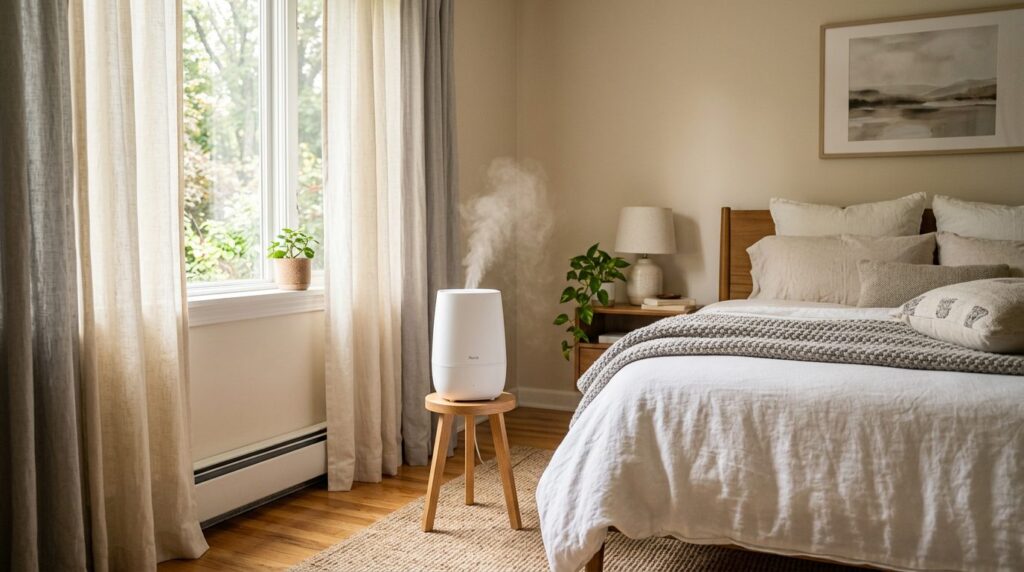
According to Mayo Clinic’s guide to humidifiers, it is ideal to keep indoor humidity between 30% and 50%. Low humidity can cause dry skin and irritate the nose, throat and eyes, while high humidity can make a home feel stuffy and cause condensation that feeds bacteria, dust mites and mold.
“Humidifiers can make you sick if they aren’t maintained or if humidity levels stay too high.”
Mayo Clinic Staff, Humidifiers: Ease skin, breathing symptoms
The EPA gives a practical warning sign: if water condenses on windows, walls or pictures, move the humidifier, lower its setting or use it less. In cold weather, windows fog at lower humidity, so you may need to aim for the low end of the range in winter.
A hygrometer, which Mayo Clinic calls the best way to test home humidity, removes the guesswork. Keep one in the bedroom even if your humidifier has a built-in sensor.
Put the humidifier on a stable, water-resistant surface at least a few feet from the bed, walls and curtains, so the mist can spread before it settles. The EPA warns not to let the area around the humidifier become damp and not to let carpets, drapes or tablecloths get wet.
Raising it off the floor on a table or stand helps the mist disperse. Avoid placing it next to electronics, books or wood furniture that can be damaged by moisture.
In a child’s room, place it well out of reach, secure the cord and never use a hot-water steam model where a child could knock it over.
The EPA says researchers have documented that ultrasonic and impeller humidifiers efficiently disperse the minerals in tap water into the air, and that minerals also build up as scale, which can be a breeding ground for microorganisms. Its first recommendation is to use water labeled “distilled”.
The EPA notes that “spring”, “artesian” or “mineral” bottled waters have not been treated to remove minerals, so they are not a substitute. Demineralization cartridges and filters help, but the EPA says their ability to remove minerals varies widely, and white dust is a sign they are not working.
Evaporative humidifiers are less sensitive to water type because the wick traps minerals, but hard water shortens wick life. In very hard water areas, the EPA points out that distilled water may be cheaper than replacement cartridges.
Many bedroom humidifiers include an aroma tray or pad. Mayo Clinic’s position is that humidifiers only add moisture to the air and cannot be used to breathe in products such as essential oils for aromatherapy.
Never add oils directly to the water tank unless the manufacturer explicitly allows it; follow the manual and use only the dedicated aroma tray if you use scents at all.
If anyone in the room has asthma or allergies, Mayo Clinic recommends talking to a healthcare professional before using a humidifier, and scents are one more variable to leave out.

The EPA recommends emptying the tank, wiping all surfaces dry and refilling with fresh water daily. Water left standing in a tank is where bacteria and mold start, and a humidifier sprays whatever is in the tank into the air you breathe all night.
Make it part of your morning routine: unplug the humidifier, pour out the remaining water, let the tank air dry during the day and refill at bedtime.
If you go away, empty and dry the humidifier completely rather than leaving water in it.
The EPA says to clean portable humidifiers every third day: empty the tank, use a brush to remove scale, deposits or film from the tank and interior surfaces, and wipe everything dry, with the unit unplugged.
Follow the manufacturer’s instructions for cleaning products. Where there are none, the EPA suggests cleaning all surfaces that contact water with a 3% hydrogen peroxide solution, then rinsing thoroughly with several changes of tap water so no chemicals are dispersed into the air.
Replace wicks and demineralization filters as the manufacturer recommends, and sooner if they are crusted or discolored. A clean humidifier is the difference between relief from dry air and a new source of indoor pollution.
At the end of the humidifying season, the EPA recommends cleaning the humidifier as directed, making sure all parts are dry, disposing of used cartridges or filters and storing the unit in a dry place. Clean it again when you bring it back out.
Check the tank and base for cracks and the cord for damage before the next season. Replace old wicks rather than reusing them.
The EPA also advises stopping use and contacting your physician if you have respiratory symptoms that you believe are linked to your humidifier, even if you are following the maintenance directions.
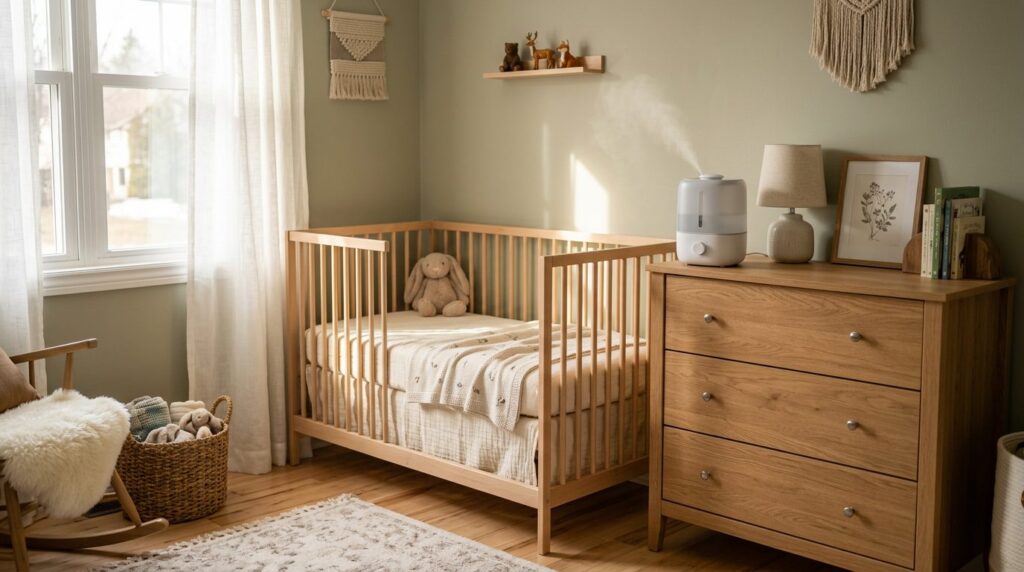
For a baby or child, choose a cool mist humidifier. Mayo Clinic advises against steam vaporizers in homes with children because of burn risk, and the EPA says to keep steam vaporizers out of children’s reach. Quiet models like the Dreo 3L and evaporative models like the Vornado EV100 suit nurseries.
Place it out of reach, keep humidity within 30% to 50% and follow the daily emptying and every-third-day cleaning schedule strictly, since young children may be particularly susceptible to airborne pollutants, according to the EPA.
Ask your pediatrician before using a humidifier for a child with a medical condition.
Humidity is a double-edged sword for allergies. Dry air irritates airways, but the EPA and Mayo Clinic both warn that humidity above 50% encourages dust mites and mold, two of the most common indoor allergens.
Mayo Clinic advises talking to a healthcare professional before using a humidifier if you or your child has asthma or allergies, and warns that mist from a dirty humidifier may contain bacteria or mold that trigger symptoms. An evaporative model with a humidistat, cleaned on schedule, is the lower-risk choice.
If airborne allergens are your main problem, a HEPA air purifier may help more than humidity; see our guide to the best HEPA air purifiers for allergies.
If your bedroom already feels stuffy, windows fog or you see mold spots, you have the opposite problem. Mayo Clinic notes that air conditioners and dehumidifiers lower indoor humidity, and the EPA’s brief guide to mold, moisture and your home explains that the key to mold control is moisture control.
Our guide to the best dehumidifiers for mold prevention covers sizing for damp rooms and basements, and our best air purifier for mold guide covers airborne spores.
A combined air quality monitor tracks humidity alongside particles and CO2; see our picks for the best air quality monitors for home.
For most bedrooms, a quiet ultrasonic cool mist humidifier with a humidistat, used with distilled water, is the best fit. If white dust or minerals in the air concern you, choose an evaporative model, which the EPA says generally disperses fewer minerals and microorganisms.
Yes, if the room stays between 30% and 50% humidity and the humidifier is cleaned regularly. Mayo Clinic says humidifiers can ease dry skin, dry nose and throat, but can make you sick if they are not maintained or if humidity stays too high.
Evaporative and steam humidifiers disperse fewer minerals and microorganisms than ultrasonic and impeller models, according to the EPA, but steam models carry a burn risk around children. Whatever the type, daily emptying and cleaning every third day matter more than the technology.
Mayo Clinic notes that a cool-mist humidifier may ease a stuffy nose, while heated humidified air does not seem to have the same effect. Choose a cool mist model with a humidistat and keep it clean, and see a doctor for ongoing sinus symptoms.
Run it through the night on auto mode with a target humidity, so it slows down once the room reaches your setting. Choose a tank that lasts the whole night at your usual output, such as the 3 L or 6 L models on our list.
Use distilled water in ultrasonic and impeller humidifiers. The EPA says they efficiently disperse the minerals in tap water into the air and that minerals build scale, which can harbor microorganisms.
Empty and refill it daily, and clean it thoroughly every third day, as the EPA recommends. Use the manufacturer’s cleaning instructions, or a 3% hydrogen peroxide solution followed by several rinses if none are given.
On a stable, water-resistant surface a few feet from the bed, walls and curtains, raised off the floor if possible. Keep the surrounding area dry and move or turn down the humidifier if condensation forms.
For more on the air in your bedroom, see our guides to the best air quality monitors for home and the best air purifier for pets.
Written by the Delozone Editorial Team. We research products using manufacturer specifications, EPA and Mayo Clinic guidance and verified owner feedback, and we update guides when products or guidance change. How we work.
The Delozone Editorial Team researches water treatment, pool and spa, and indoor air products for independent buying guides. We compare products using manufacturer specifications, certification listings such as NSF/ANSI, UL, AHAM and Energy Star, published third-party test data and verified owner feedback. We do not sell products, and affiliate commissions never decide what we recommend.