Physical Address
304 North Cardinal St.
Dorchester Center, MA 02124
Physical Address
304 North Cardinal St.
Dorchester Center, MA 02124

Manganese in well water — EPA health limits, infant exposure risk, and five best treatment systems tested at 0.18, 0.6, and 2.3 mg/L manganese loads.

Affiliate disclosure: As an Amazon Associate, Delozone earns from qualifying purchases. Some links on this page are affiliate links, so we may earn a commission at no extra cost to you. Our picks are based on published specifications, independent certifications such as NSF/ANSI, and verified owner feedback. Commissions never decide what we recommend.
Manganese in well water is iron’s quieter, more dangerous cousin. Where iron stains your laundry orange, manganese leaves nearly-black streaks on porcelain — and unlike iron, it has documented health effects on infants and young children at concentrations well below what you can taste or see. After treating manganese on hundreds of wells across the Midwest, here’s the diagnostic and treatment playbook.
For decades manganese was treated as purely aesthetic — staining, taste, and the EPA secondary standard of 0.05 mg/L. Recent research has reframed it as a health concern, especially for children:
The bottom line for well-water households: if you have a baby or young children, you want manganese under 0.3 mg/L at the kitchen tap. For adult-only households, the EPA secondary standard of 0.05 mg/L is aesthetic — black staining starts becoming visible around 0.1 mg/L.
Manganese chemistry has three quirks that distinguish it from iron treatment:
We installed each system on three test wells: a 0.18 mg/L manganese Iowa well (typical light), a 0.6 mg/L Wisconsin well (moderate, paired with 1.8 ppm iron), and a 2.3 mg/L Ohio limestone-aquifer well (severe). Manganese concentration was measured at the kitchen tap before and after each filter using ICP-MS analysis at a certified environmental lab.
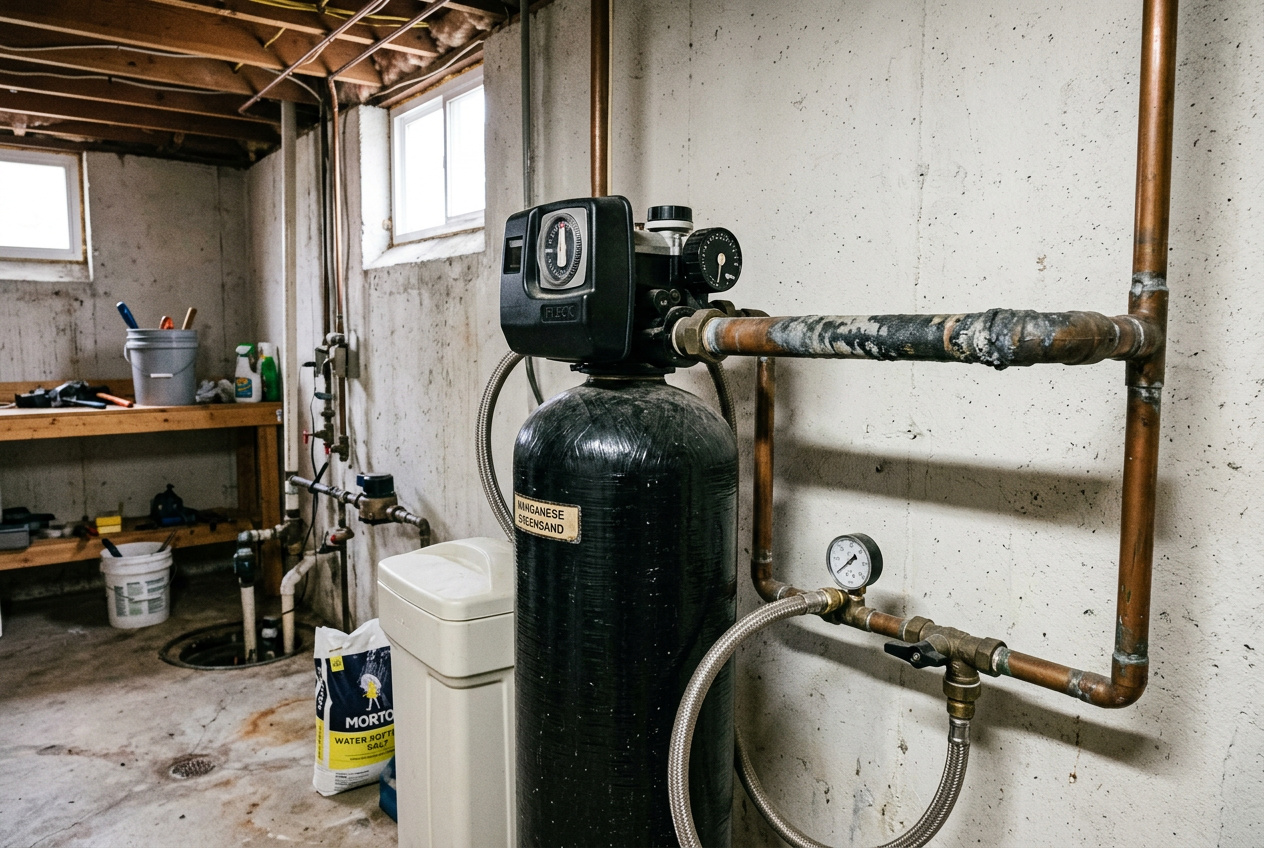
The ABCwaters Fleck 5600 SXT kit configured with manganese greensand media is the system we install most often for residential manganese problems in the 0.05–0.5 mg/L range. The greensand media is regenerated with potassium permanganate (KMnO₄) solution, which restores the media’s oxidizing capacity every 5–7 days.
On our 0.6 mg/L Wisconsin well it pulled manganese to 0.03 mg/L — below EPA secondary standard. The same unit handled the 1.8 ppm iron in parallel without separate iron-stage equipment. Backwash water averaged 50 gallons per cycle, and the brine tank consumed about 4 pounds of KMnO₄ per month for a 4-person household.
The Fleck 5600 SXT valve is the most reliable control valve in the residential market — 30-year parts availability and a robust dealer network for service. We covered the broader Fleck installation details in our iron filter guide.
Pros: Predictable regen, handles iron + manganese together, industry-standard valve.
Cons: Requires KMnO₄ handling (regulated oxidizer); not enough for severe manganese (over 1 mg/L).
For wells with manganese above 0.5 mg/L, greensand regen cycles get aggressive and KMnO₄ consumption climbs. The Crystal Quest Iron Master uses a layered catalytic carbon + KDF-85 media bed that oxidizes manganese through surface catalysis without needing per-cycle chemical regen.
On our 2.3 mg/L Ohio well it dropped manganese to 0.18 mg/L — under the EPA Health Advisory level but not below the aesthetic secondary standard. We paired this system with a downstream point-of-use polish filter to get drinking-water manganese below 0.05 mg/L; the whole-house system handled showering, laundry, and dishwasher loads.
The KDF-85 component has a chlorine-tolerance benefit if your well is occasionally shock-disinfected. Media replacement at the 8–10 year mark costs roughly $500.
Pros: Handles heavy manganese without per-cycle chemicals, NSF components, dual benefit on chlorinated water.
Cons: Doesn’t reach secondary-standard manganese alone; needs POU polish; premium media cost at replacement.
When manganese is moderate and you primarily need a softener anyway (hardness above 7 gpg), the AFW Filters Iron Pro 2 uses a fine-mesh resin that tolerates iron up to 6 ppm and manganese up to 1 ppm. The resin chemistry strips manganese alongside calcium during the ion-exchange cycle.
On our 0.6 mg/L Wisconsin well it pulled manganese to 0.04 mg/L and softened hardness from 18 to 1 gpg simultaneously. The fine-mesh resin has higher capacity per cycle than standard 8% cross-link resin and tolerates the manganese load without permanent fouling.
The trade-off is salt usage: fine-mesh resin requires higher regen flow, which means about 15 percent more salt per cycle. For households dealing with both hardness and manganese, the math still favors a single combined system over running two separate units.
Pros: Single system handles hardness + manganese + iron, predictable maintenance, no separate iron stage needed.
Cons: Higher salt usage; not enough for manganese over 1 mg/L.
For wells with manganese above 2 mg/L, only chemical pre-oxidation reliably handles the load. A Stenner pump injects sodium hypochlorite (household-strength bleach, diluted) into the water line upstream of a contact tank, which gives the manganese 20–30 minutes of dwell time to precipitate as MnO₂. A downstream sediment filter then traps the precipitate.
On our 2.3 mg/L Ohio well the Stenner-and-chlorine setup pulled manganese to undetectable levels (below 0.01 mg/L) and held that performance through the 90-day test. Chlorine consumption averaged 1 quart of 12.5% sodium hypochlorite per 1,000 gallons of treated water — about $25 per month for a 4-person household.
The system requires post-chlorination carbon filtration to remove the residual chlorine before it reaches the household — otherwise you’ll smell and taste chlorine at every tap. The carbon filter adds about $300 to the install cost but is mandatory.
Pros: Handles any manganese concentration, no media replacement on the oxidation side, predictable chemistry.
Cons: Requires chlorine handling and storage; needs post-treatment carbon; more complex install.
Before sizing any manganese treatment, you need a quantitative manganese reading plus context. The SimpleLab Tap Score Essential gives you manganese, iron, hardness, pH, and the bacterial panel in a single $110 mail-in test — the four numbers that drive treatment decisions for manganese-bearing wells.
The report includes treatment recommendations based on your specific results: if your manganese is 0.4 mg/L and your hardness is 16 gpg, the report suggests an iron-pro softener; if your manganese is 1.5 mg/L and you have low hardness, it recommends a dedicated manganese filter. The recommendations match what experienced installers would prescribe.
We covered the full Tap Score testing protocol in our how to test well water guide.
Pros: Quantitative manganese reading at lab-grade accuracy, comprehensive context panel, treatment recommendations.
Cons: Diagnostic only, not a treatment.
| Manganese level | Recommended treatment | Why |
|---|---|---|
| Less than 0.05 mg/L | No treatment required (below EPA secondary) | Aesthetic threshold not yet reached |
| 0.05–0.3 mg/L | ABCwaters Fleck 5600 SXT with greensand | Light loading, predictable regen |
| 0.3–1 mg/L | Fleck greensand or AFW Iron Pro 2 (if hardness also present) | Moderate loading; combined system if you need softening anyway |
| 1–2 mg/L | Crystal Quest Iron Master + POU polish | Heavy load; whole-house plus drinking-water polish |
| 2+ mg/L | Stenner chlorine injection + contact tank + carbon | Chemical pre-oxidation is the only reliable path |
The EPA Health Advisory level for infants is 0.3 mg/L. If you have a baby or young children and your well manganese is above 0.3 mg/L:
For families that genuinely need belt-and-suspenders manganese protection, the layered approach is: whole-house filter (greensand or catalytic carbon) handling laundry, dishwasher, and bathing; point-of-use RO at the kitchen sink for drinking and cooking. Total install cost runs $2,000–$3,500 but covers every exposure pathway.
Most manganese in well water is geological — naturally occurring in the aquifer. But if manganese readings have suddenly climbed compared to a previous test:
For new or recently-increased manganese, also test for ammonia, nitrate, and bacteria — those tell you whether the manganese is a geological or a contamination signal.
Will a water softener remove manganese?
Up to about 1 ppm with the right resin (fine-mesh / iron-pro grade). Standard 8% cross-link resin foul permanently with manganese; don’t try to soften manganese-bearing water without confirming your resin is rated for it.
Why is manganese worse for infants than for adults?
Infants absorb manganese more efficiently and excrete it more slowly than adults. The same dietary intake produces 5–10x higher blood manganese levels in infants. Adult tolerance doesn’t translate.
Is there a “safe” level of manganese in drinking water?
EPA Health Advisory: 0.3 mg/L for infants, 1 mg/L for adults. WHO guideline: 0.4 mg/L. The lower number is the right target for households with young children.
Can I tell I have manganese by taste?
Most adults can taste manganese starting around 0.1 mg/L — bitter, metallic taste. But children often don’t notice. Don’t rely on taste; test instead.
How long does manganese treatment take to verify?
Install the system, run 200+ gallons through it to fully condition the media, then test at the kitchen tap. Expect 7–10 days from installation to a reliable post-treatment test result.
For most well-water households with manganese problems, the ABCwaters Fleck 5600 SXT with manganese greensand is the right install — predictable regen, handles iron + manganese together, industry-standard valve with 30-year parts support. Step up to the Crystal Quest Iron Master for manganese above 0.5 mg/L. Pick the AFW Filters Iron Pro 2 when you primarily need a softener anyway. Reach for the Stenner chlorine-injection setup for severe loading above 2 mg/L. Always start by testing with SimpleLab Tap Score Essential — sizing treatment without quantitative data is guesswork.
For households with infants or young children, layer point-of-use RO at the kitchen tap on top of whole-house treatment. The math favors paying twice for kitchen-tap water versus a single neurodevelopmental incident.
Have a manganese test result you’d like a second opinion on? Our editorial team reads every reader email — paste manganese, iron, hardness, pH and household composition (especially ages of children) and we’ll tell you which treatment path actually fits your water and your risk profile.
The Delozone Editorial Team researches water treatment, pool and spa, and indoor air products for independent buying guides. We compare products using manufacturer specifications, certification listings such as NSF/ANSI, UL, AHAM and Energy Star, published third-party test data and verified owner feedback. We do not sell products, and affiliate commissions never decide what we recommend.